
Certified Microfiber Cleaning Products: A Buyer's Compliance Guide
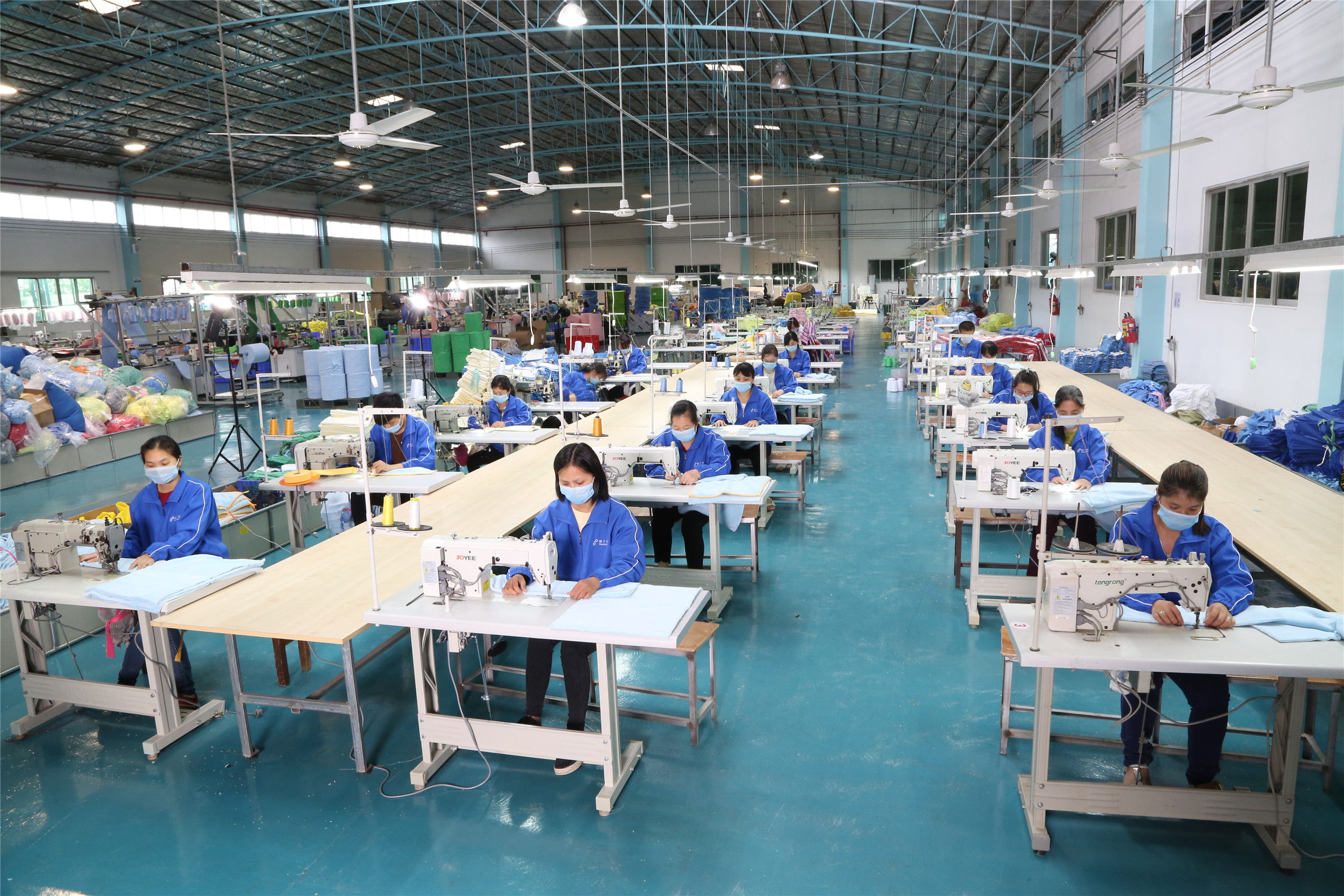
Pa Tin Da's state-of-the-art 45,000 m² manufacturing plant with fully automatic production lines.
Certified Microfiber Cleaning Products: A Buyer's Compliance Guide
Introduction
Global buyers of microfiber cleaning products face an increasingly complex regulatory landscape. Retailers, hotel chains, automotive brands, and janitorial distributors now demand suppliers with verifiable certifications—OEKO-TEX STANDARD 100, ISO 9001, SMETA, GRS, BSCI, and national packaging compliance like the German Packaging Act (VerpackG) or French REP. But how do you, as a procurement professional, separate a genuinely compliant manufacturer from one that merely claims compliance?
This guide answers that question. You will learn what certifications matter, how to verify them, which product categories benefit from each standard, and how Pa Tin Da Group—a 20-year veteran microfiber manufacturer in Southern China—meets these stringent requirements. By the end, you will have a clear framework for selecting a certified microfiber cleaning products partner that protects your brand, your customers, and your bottom line.
Problem Definition: Why Certification Matters in Microfiber Sourcing
Microfiber cleaning cloths, towels, mops, and sponges come into direct contact with food surfaces, automotive paint, delicate glass, and human skin. Uncertified products may contain harmful chemicals, shed microplastics, fail to meet flammability standards, or be produced under unethical labor conditions. The core buyer pain point is risk mitigation: one non-compliant shipment can lead to product recalls, customs detention, fines, and reputational damage.
Key risks include:
- Harmful substance residue: Formaldehyde, phthalates, heavy metals in raw materials.
- Lint shedding and fiber degradation: Poor edge finishing leads to contamination in clean rooms or on auto paint.
- Surface scratching: Uncontrolled abrasive fibers damage polished surfaces.
- Environmental non-compliance: Packaging and textile waste regulations in EU markets (Germany, France).
- Ethical trade violations: Child labor, unsafe working conditions, lack of social audits.
Industry Background
The global microfiber cleaning market was valued at over $3.5 billion in 2025 and is projected to grow at 6–8% CAGR through 2030. Demand is driven by hospitality, automotive care, healthcare, and household segments. Major importing regions include the United States, Canada, Australia, the United Kingdom, Germany, France, Japan, and South Korea. Each market has its own certification expectations:
- EU: OEKO-TEX STANDARD 100 for textile safety; German Packaging Act (VerpackG) & French REP for packaging compliance; REACH for chemical substances.
- USA/Canada: California Prop 65, CPSIA, UL certification for certain claims.
- Global brands: SMETA (Sedex) or BSCI for ethical trade; ISO 14001 for environmental management; ISO 45001 for occupational health and safety.
- Specific industries: Automotive detailing (scratch-free, lint-free performance); hospitality (hygiene, washable durability).
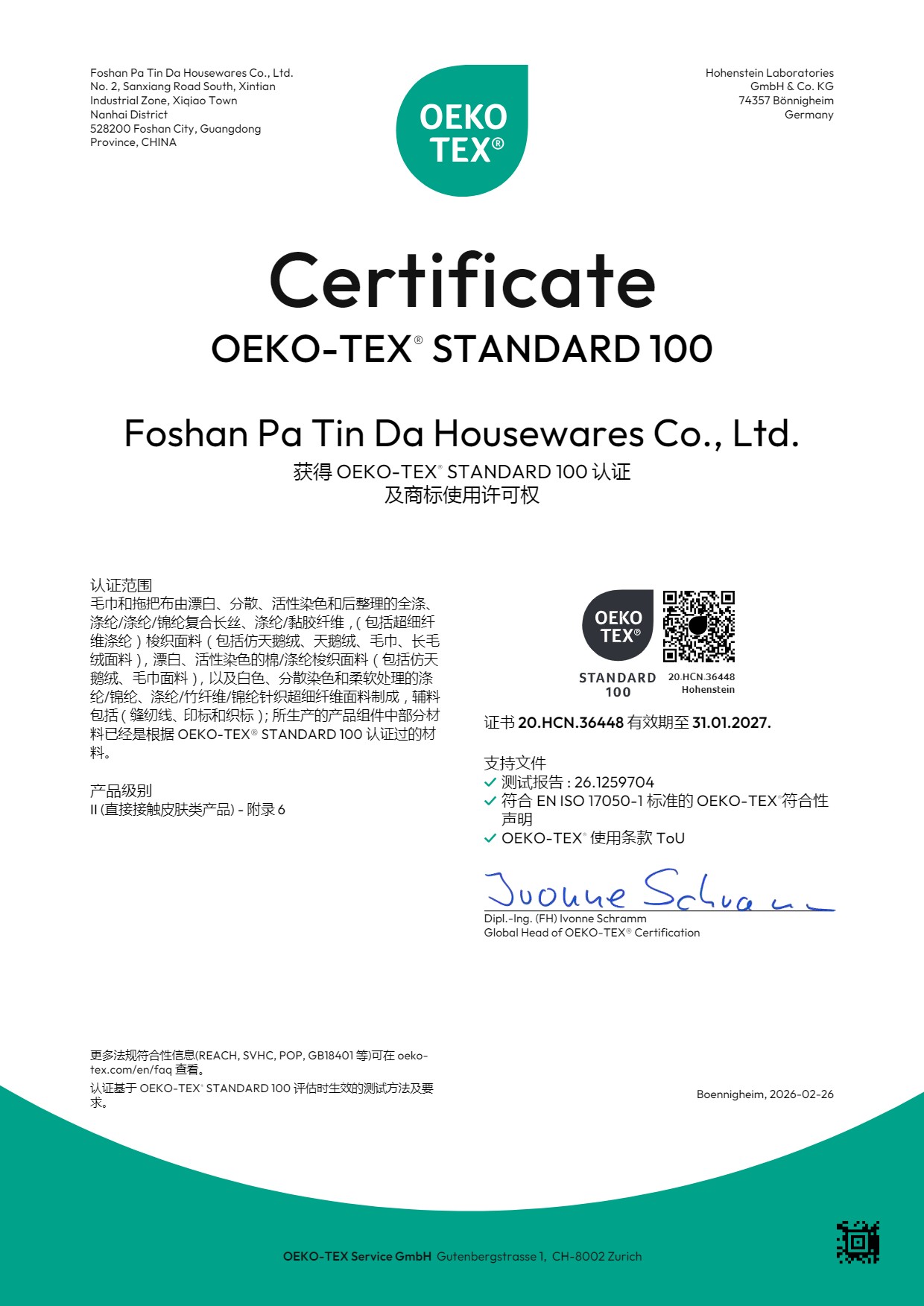
OEKO-TEX STANDARD 100 certified – certificate number 20.HCN.36448, issued by Hohenstein Laboratories GmbH & Co. KG.
Detailed Solution: How to Verify a Certified Microfiber Manufacturer
1. What certifications should a compliant microfiber supplier hold?
A truly certified manufacturer will display valid, third-party-issued certificates for:
- OEKO-TEX STANDARD 100 – Product class II (annex 6), covering raw materials, dyes, and final product safety for skin contact. Example: Pa Tin Da's model MJ-001 is certified under number 20.HCN.36448.
- ISO 9001:2015 – Quality management system for consistent production. Cert no. CN24/00007747, issued by SGS United Kingdom Ltd.
- ISO 45001:2018 – Occupational health and safety management. Cert no. CN24/00007748.
- SMETA (Sedex) – Four-pillar ethical trade audit (labor, health & safety, environment, business ethics). Cert no. ZAA600123152.
- German Packaging Act (VerpackG) – Registration for compliant packaging recycling in Germany. LUCID no. DE3922560298890.
- French REP Textile UIN – Required for textile products placed on the French market. UIN FR337512_11LKPC.
| Certification | Standard / Scope | Certificate Number | Issuing Body | Applicable Market |
|---|---|---|---|---|
| OEKO-TEX STANDARD 100 | Product Class II – Annex 6 | 20.HCN.36448 | Hohenstein Laboratories | Global |
| ISO 9001:2015 | Manufacture of towels & mops | CN24/00007747 | SGS United Kingdom | Global |
| ISO 45001:2018 | Manufacture of towels & mops | CN24/00007748 | SGS United Kingdom | Global |
| SMETA (Sedex) | 4-Pillar: ETI Base Code | ZAA600123152 | Benchmarks Company | Global |
| German Packaging Act | VerpackG § 9 | DE3922560298890 | LUCID | Germany |
| French REP Textile | France REP regulation | FR337512_11LKPC | EUREP GmbH | France |
2. How to verify a certificate's authenticity?
Don't rely on PDF copies alone. Cross-check the certificate number on the official database of the issuing body (e.g., OEKO-TEX, SGS Client Portal, Sedex Advance). Check the issue and expiry dates. Ensure the scope covers the specific products you intend to source.
3. Product-level compliance: Which microfiber items are certified?
At Pa Tin Da, the OEKO-TEX STANDARD 100 certification applies to the entire MJ-001 microfiber cleaning cloth line (85% polyester / 15% polyamide, 180–450 gsm, double-stitched edge). However, the same manufacturing system—with certified raw materials, controlled dyeing, and quality management—extends to all product families under the same ISO and SMETA umbrella:
- Universal household cloths: MJ-001, MJ-002, MD-020
- Kitchen towels: MS-074, MS-075, MW-003
- Glass & polishing cloths: MW-002, MJ-013, MJ-066, MJ-012
- Auto detailing towels & mitts: MJ-021, MJ-022, MJ-023, MM-067, MM-069, MM-070
- Mops & floor care: MP-014, MP-015, MP-020, MP-006, MT-003
- Specialty products: Cooling towels (MST-002), sports towels (MST-001), hair drying turban (GFM-002), pet towel (PET-001)
.jpg)
Model MJ-001 universal household cleaning cloth – OEKO-TEX certified, 7x water absorption, double-stitched edge.
4. Why certification alone is not enough: The performance layer
A certified manufacturer must also deliver on performance. According to Pa Tin Da Group's product specifications, their certified microfiber products achieve:
- Water absorption: Up to 7 times own weight (vs. cotton's 3x).
- Lint-free operation: Ultrasonic cut edges (MJ-022) or double overlock stitching prevent fiber shedding.
- Scratch-free performance: Safe for automotive paint, glass, marble, hardwood, and ceramic tile.
- Durability: Some mops rated for over 300 washing cycles (MP-014).
Comparison: Microfiber vs. Cotton
Microfiber absorbs 7x its weight vs. cotton's 3x; lasts 300+ washes vs. cotton's 50; sheds 99% less lint. Higher upfront cost but significantly lower total cost of ownership.
5. Step-by-step selection process for a certified supplier
- Define target market requirements – EU? USA? Hotel/hospitality? Auto detailing? Note the mandatory certifications (e.g., German VerpackG for all products sold in Germany).
- Request current certificates – OEKO-TEX, ISO 9001, ISO 45001, SMETA, and any market-specific registration (LUCID, French REP).
- Verify certificate validity – Check dates and scope on issuer portals.
- Request material test reports – Confirm formaldehyde-free, heavy metals within limits.
- Review factory audit reports – SMETA 4-pillar report provides deep insight into labor practices.
- Inspect product specifications – GSM, absorbency rate, edge finishing, washability.
- Request sample testing – Conduct your own lint test, scratch test, and wash test.
- Check packaging compliance – Does the supplier provide packaging recycling registration in your target country?
- Negotiate terms – MoQ, lead time (30–45 days for Pa Tin Da), payment terms (30/70 T/T, credit card).
Use Case: A Real-World Sourcing Scenario
A German hotel chain buyer needed to source 50,000 pieces of OEKO-TEX certified microfiber cleaning cloths for housekeeping, plus VerpackG registered packaging. After screening multiple suppliers, they selected Pa Tin Da Group because:
- The MJ-001 cloth held valid OEKO-TEX STANDARD 100 (cert no. 20.HCN.36448).
- All shipments comply with German Packaging Act (LUCID DE3922560298890) and French REP (FR337512_11LKPC).
- ISO 9001 and SMETA audited factory ensured consistent quality and ethical production.
- Custom logo, size (30×30 cm), and color were delivered within 35 days.
Result: The cloths passed independent lab tests for lint-free, 7x absorbency, and scratch-free performance. The buyer renewed a 6-month contract with 20% volume increase.
Frequently Asked Questions (FAQ)
What is OEKO-TEX STANDARD 100 and why does it matter for microfiber?
OEKO-TEX STANDARD 100 is a globally unified testing and certification system for raw materials, intermediate and end products at all stages of production. It tests for harmful substances like formaldehyde, heavy metals, pesticides, and phthalates. For microfiber cleaning cloths that contact skin or food, this certification is critical for consumer safety and brand trust.
How does SMETA certification benefit my supply chain?
SMETA (Sedex Members Ethical Trade Audit) provides a 4-pillar evaluation: labor standards, health & safety, environment, and business ethics. It assures your brand is not associated with forced labor, unsafe working conditions, or environmental violations. Many European retailers require SMETA or BSCI from their suppliers.
What is the difference between ISO 9001 and ISO 45001?
ISO 9001 focuses on quality management—consistency, customer focus, continuous improvement. ISO 45001 addresses occupational health and safety—reducing workplace risks and preventing injuries. Both are essential for a reliable and responsible manufacturing partner.
Can I get custom logos and packaging on certified products?
Yes. At Pa Tin Da Group, OEKO-TEX certified cloths like MJ-001 can be customized with printed or woven logos, custom Pantone colors, and different packaging (poly bag, blister, roll, display box) without compromising certification. The certification is production-batch traceable.
What is the MOQ for certified microfiber cleaning products?
Typical MOQ is 3,000 pieces per design. Lead time is 30–45 days. Payment terms: 30% deposit / 70% balance by T/T, credit card, Apple Pay, or Google Pay.
Conclusion
Selecting a certified microfiber cleaning products manufacturer is no longer optional—it is a prerequisite for global market access and brand protection. By following the verification steps outlined in this guide and partnering with an established manufacturer like Pa Tin Da Group, you reduce risk, ensure compliance, and gain a performance edge. Do not compromise on certifications; your customers and regulators won't.
Need certified microfiber cleaning products for your next project?
Download the full product catalog and certification portfolio from Pa Tin Da Group.
Download E-Catalog (PDF)Or contact Olivia Li: sale@microfiberchina.com | Tel/WhatsApp: +86 13902254847
Pa Tin Da Group Co., Ltd — Founded 2004 | 45,000 m² factory | 200 employees | 98% export ratio | Serving USA, CAN, AUS, UK, DE, FR, IT, JP, KR, and more. www.microfiberchina.com