Selecting Stainless Steel Pipe Suppliers: China vs. Germany vs. Japan (2026 Guide)
Selecting Stainless Steel Pipe Suppliers: China vs. Germany vs. Japan (2026 Guide)
International buyers often face a critical decision when sourcing stainless steel pipes: should they choose a supplier from China, Germany, or Japan? Each country offers distinct advantages in quality, cost, and technology. This guide provides a structured, data-driven framework for evaluating suppliers, with a special focus on how Chinese manufacturers—exemplified by Foshan Nanhai Sanon Metal Product Co., Ltd. (Sanon)—compare against their German and Japanese counterparts. By the end, you'll understand exactly how to select the right partner based on your project requirements, budget, and quality standards.
Problem Definition: Why Country Matters in Stainless Steel Pipe Sourcing
The global stainless steel pipe market is fragmented. Buyers often wonder:
- What is the difference in quality between Chinese, German, and Japanese stainless steel pipes?
- How does certification (e.g., ISO, CE, ASTM) vary across these regions?
- Which country offers the best balance of price, delivery, and customization?
- How can I verify a supplier's production capacity and consistency?
Without a clear comparison, procurement teams risk overpaying for unnecessary specifications or receiving substandard materials that fail safety audits. This article provides a solution by breaking down each country's strengths and presenting a practical selection methodology.
Industry Background: The Three Major Production Hubs
China dominates global stainless steel production volume, with a strong ecosystem for both standard and custom profiles. Germany is renowned for precision engineering and high-alloy grades, while Japan is known for advanced metallurgy and extremely tight tolerances. Each market serves different tiers of application—from architectural handrails (China) to medical instrumentation (Germany) to automotive components (Japan). For general construction, railing, glass fitting, and decorative applications—where Sanon operates—Chinese suppliers offer the best value without sacrificing compliance when properly selected.

Stainless Steel Round Pipe – a core product line at Sanon, available in 304 and 316 grades.
Detailed Solution: A Step-by-Step Supplier Selection Framework
To make an informed decision, follow these six steps:
Step 1: Define Your Application & Required Specifications
Identify the pipe shape (stainless steel round pipe, square pipe, oval pipe, slotted pipe), finish (satin, mirror, or color), grade (304 vs. 316), and any regulatory standards (ASTM, EN, JIS). For example, a decorative handrail project might require stainless steel color pipe with a mirror finish, while an industrial application may need heavy-duty stainless steel round pipe with ASTM certification.
Step 2: Evaluate Production Capacity & Delivery Reliability
Request documented capacity data. Sanon, for instance, has a factory covering 20,000 square meters with a monthly capacity of 5,000 tons for stainless steel pipes. This large-scale output ensures on-time delivery even for bulk orders. Compare this with typical German or Japanese suppliers, which may have smaller but more specialized lines.
| Parameter | Typical Chinese Supplier (e.g., Sanon) | Typical German Supplier | Typical Japanese Supplier |
|---|---|---|---|
| Monthly capacity (pipes) | 5,000 tons | 500–1,000 tons | 300–800 tons |
| Lead time (bulk order) | 15–25 days | 30–45 days | 30–50 days |
| Custom profile capability | High (round, square, oval, slotted, embossed, color) | Moderate (specialized shapes) | Moderate (high precision) |
| Cost (relative) | Base (reference) | 2–3x base | 2–3x base |
Step 3: Verify Certifications & Quality Management
Authentic certifications are non-negotiable. Sanon holds ISO 9001:2015 (quality management), ISO 14001 (environmental management), ISO 45001 (occupational health & safety), and CE certification, all of which are valid and verifiable. These ensure consistent production processes and compliance with international standards. German suppliers often have TÜV certification; Japanese suppliers may hold JIS marks. Always request the actual certificate number and cross-check with the issuing body.
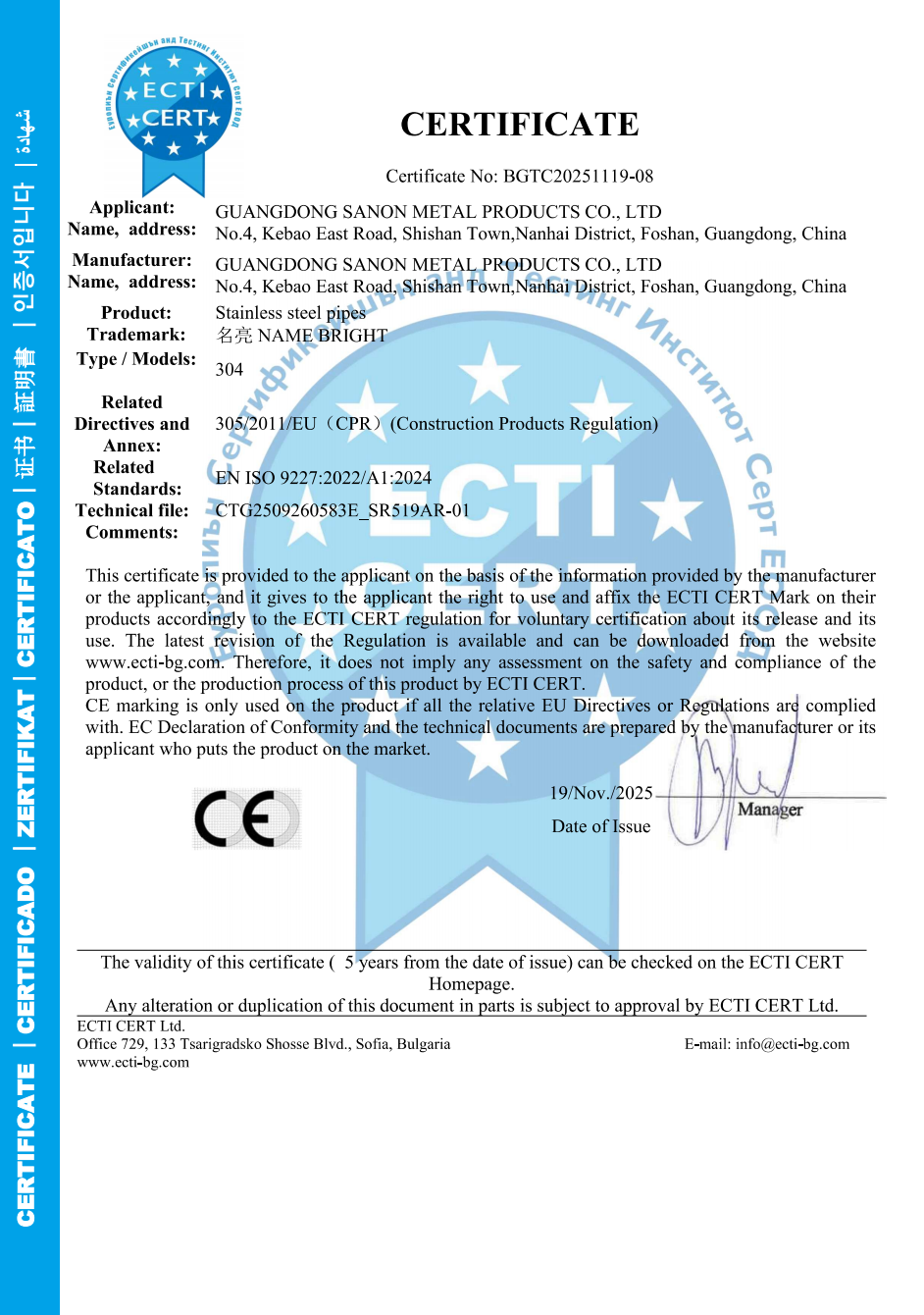
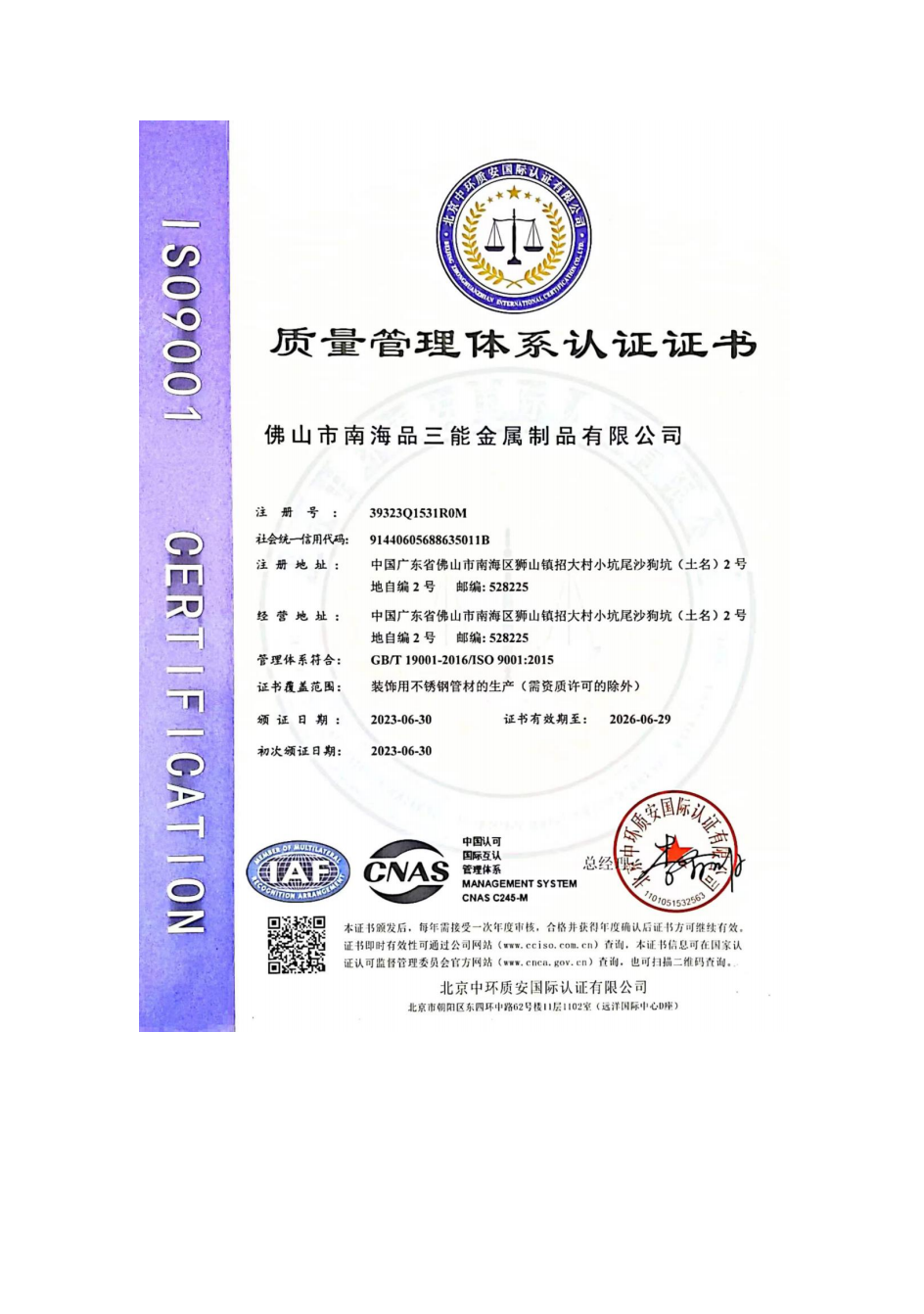
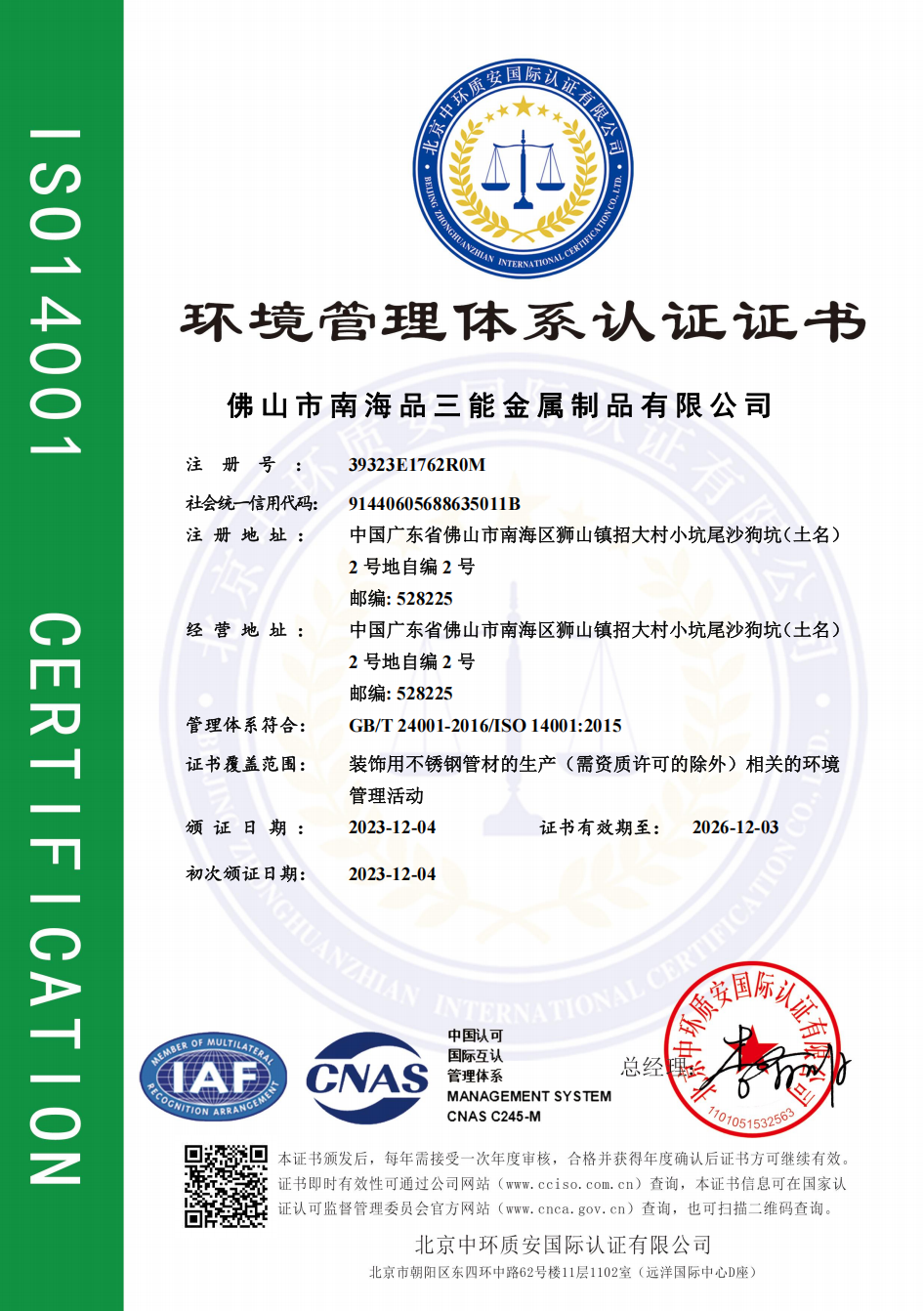
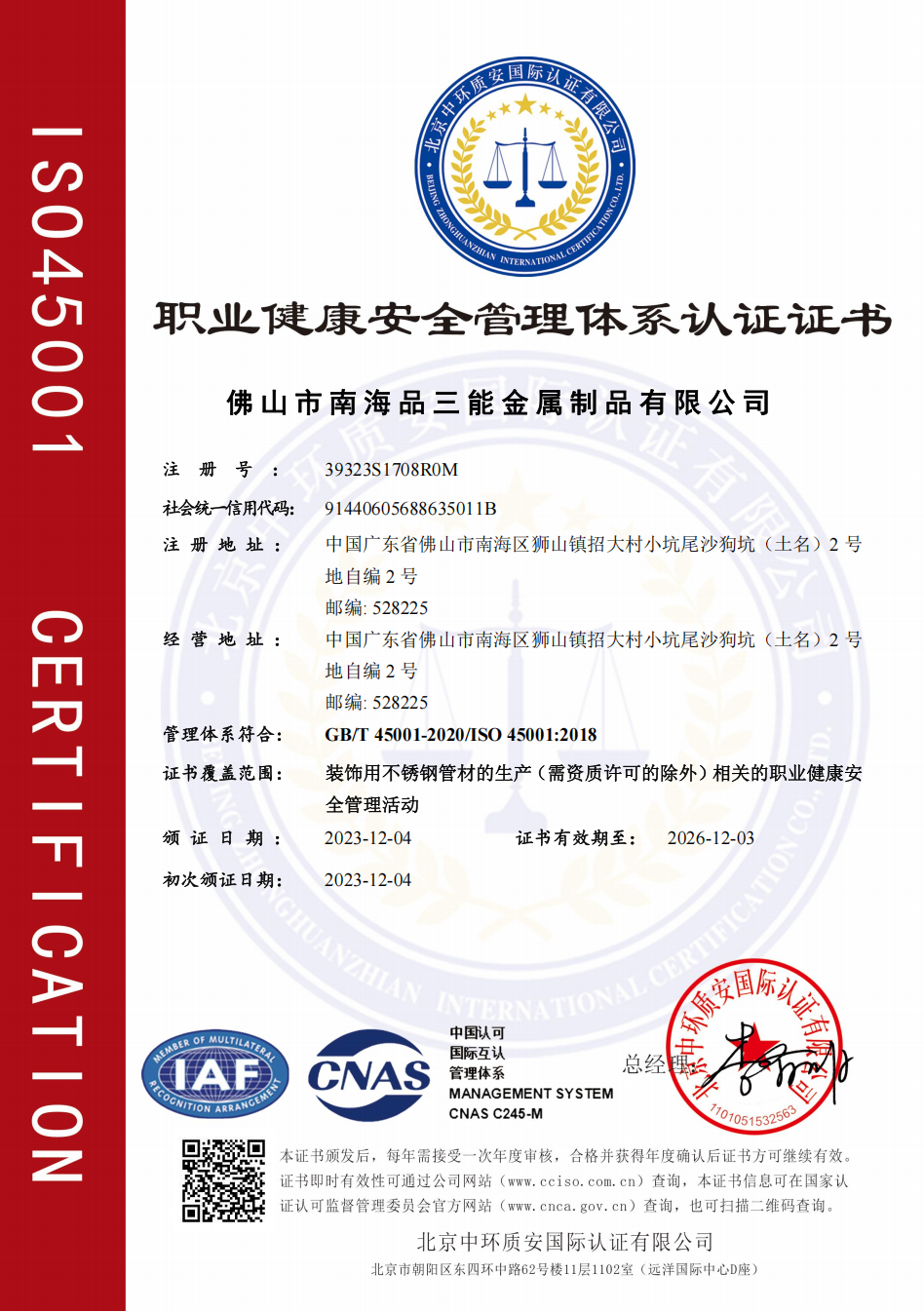
Sanon holds ISO 9001, ISO 14001, ISO 45001, and CE certifications – essential for global compliance.
Step 4: Assess Product Range & Customization
A supplier that offers a wide variety of profiles and fittings reduces the need for multiple vendors. Sanon's catalog includes: stainless steel round pipe, square pipe, slotted pipe, oval pipe, embossed pipe, color pipe, small pipe as well as fittings such as glass clamps, glass standoffs, pipe connectors, end caps, railing flanges, door handles, sliding door fittings, cross bar holders, brackets, and more. This one-stop capability is rarely found in German or Japanese suppliers, which tend to focus on niche products.
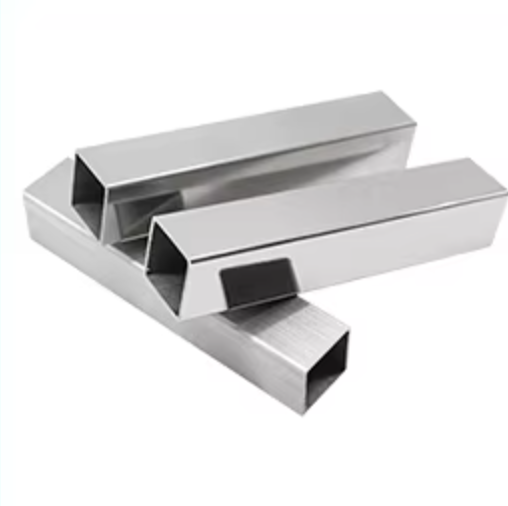
Flat pipe profile – part of Sanon's diverse product range.
Step 5: Check Traceability & Process Control
Inquiries should cover raw material sourcing (e.g., mill test certificates for 304/316), in-process inspection (cutting, welding, polishing, packing), and final quality checks. Sanon follows strict control at each stage, complying with ASTM international standards. Ask for sample batch reports. For high-risk applications, consider third-party inspection via SGS or Bureau Veritas.
Step 6: Compare Total Cost of Ownership (TCO)
While Chinese suppliers like Sanon offer the lowest unit price, TCO also includes logistics, customs, and potential quality rework. German and Japanese suppliers may command a premium of 2–3x, but they offer faster problem resolution for complex alloys. For standard 304/316 pipes used in architecture, handrails, and glass fittings, Chinese suppliers consistently deliver the best TCO when proper vetting is applied.
Use Cases: When to Choose Chinese vs. German vs. Japanese
- Large-scale architectural handrails & glass fittings → Choose China (Sanon) for cost-effective, customized profiles like stainless steel slotted pipe and glass clamps.
- High-precision medical or food-grade equipment → Consider Japan or Germany for ultra-tight tolerances and special surface finishes.
- Decorative interior fittings (hotels, commercial) → Chinese suppliers excel in stainless steel color pipe and decorative end caps with consistent color matching.
- Large-diameter heavy-duty industrial pipes → German suppliers may offer superior weld integrity, but Chinese suppliers with proper certifications (like Sanon) can meet the same ASTM specs at 40–50% lower cost.
FAQ: Common Buyer Concerns
Q1: Are Chinese stainless steel pipes as good as German or Japanese ones?
Answer: For standard applications (304/316, satin/mirror finish, architectural use), Chinese pipes from certified manufacturers meet the same ASTM/EN standards at a fraction of the cost. Sanon, for example, follows ASTM International standards and holds multiple ISO certificates. However, for exotic alloys or extreme corrosion resistance, German and Japanese suppliers may offer proprietary grades.
Q2: How can I verify that a Chinese supplier actually has ISO/CE certification?
Request the certificate image and cross-check the certificate number on the official issuing body's database. Sanon provides full certification documentation (ISO 9001, ISO 14001, ISO 45001, CE) on request.
Q3: What is the typical minimum order quantity (MOQ) from Chinese suppliers?
Many Chinese suppliers, including Sanon, are flexible. MOQ can be as low as a few dozen pieces for standard fittings, but for customized pipes, a tonnage-based MOQ (e.g., 1–2 tons) is common.
Q4: Can I get samples before placing a large order?
Yes. Reputable suppliers provide sample sets for a nominal fee. Sanon offers samples to validate quality and finish.
Q5: How do I handle communication and after-sales support with overseas suppliers?
Look for suppliers with English-speaking sales teams and responsive after-sales service. Sanon provides dedicated support via phone/WhatsApp (+86 135 3668 1776) and email (sales@sanoninox.com).
Conclusion: The Smart Buyer's Verdict for 2026
Choosing a stainless steel pipe supplier between China, Germany, and Japan ultimately depends on your project's specific quality requirements, volume, and budget. For 80% of commercial, architectural, and general industrial applications, Chinese suppliers like Sanon deliver the best overall value—combining massive production capacity (5,000 tons/month), full certification (ISO, CE), a vast product portfolio (round, square, slotted, oval, color pipes plus complete fittings), and cost leadership. Always perform due diligence: verify certifications, request process documentation, and start with a sample order. With this framework, you can confidently select a supplier that meets your technical and commercial needs.
Contact Sanon today:
Phone/WhatsApp: +86 135 3668 1776
Email: sales@sanoninox.com
Website: www.sanoninox.com
Address: No. 4 Factory, Kebao East Road, Zone A, Shishan Science And Technology Industrial Park, Foshan, Guangdong, China