Composite vs. Standard Drainage Geonet: 2026 Buyer’s Guide for Harsh-Environment Projects
Composite vs. Standard Drainage Geonet: A 2026 Buyer’s Guide for Harsh-Environment Projects
Choosing the right drainage geonet is a critical procurement decision that directly impacts project longevity, maintenance costs, and environmental compliance. For industrial buyers managing tailings ponds in metal smelting or anti-seepage systems in aquaculture, the question often narrows to one core comparison: standard geotextile membranes versus 3D composite drainage geonets. This guide systematically evaluates both options, providing the technical and economic data needed to make an informed choice in 2026.
Understanding the Core Problem
Industrial drainage systems in metal smelting and aquaculture face a unique set of challenges:
- Chemical aggression – leachates from tailings often contain sulfuric acid, cyanide, or heavy metal ions.
- High mechanical loads – deep fills and compaction equipment require high compressive resistance.
- Continuous operation – 24/7 process lines cannot tolerate drainage failure.
- Regulatory scrutiny – permits demand zero-leakage and long-term performance verification.
Standard geotextile membranes (nonwoven or woven) offer basic separation and filtration but often lack the three-dimensional flow capacity, puncture resistance, and chemical durability required in these environments. This gap has driven the adoption of composite drainage geonets – a three-dimensional structure engineered for high-flow drainage and robust mechanical integrity.
What Is a Composite Drainage Geonet?
A 3D composite drainage geonet is a geosynthetic product consisting of a rigid or semi-rigid polymeric net core (typically HDPE, PP, or PET) bonded on one or both sides with geotextile layers. The three-dimensional structure creates continuous flow channels, enabling efficient collection and conveyance of liquids while preventing soil intrusion.
Product definition: This product is a 3D composite drainage geonet. Its tensile strength (MD/TD) is ≥5 kN/m to ≥15 kN/m, and the elongation at break is 10% to 25%.
Key Performance Parameters
- Thickness: 4.0 mm – 8.0 mm (customizable)
- Mass per unit area: 500 – 1400 g/m² (customizable)
- Compressive strength (10% strain): ≥500 – 830 kPa
- Acid/alkali resistance: ≥90% strength retention after exposure
- Drainage capacity: ≥50 – 120 (L/min)/m (customizable)
- Materials available: HDPE, PP, PET
How It Works: The Drainage Mechanism
The geotextile filter layer allows water to pass while retaining soil particles. The internal net core provides a high-void structure that conveys water under low hydraulic gradients. When combined with an impermeable geomembrane (often textured HDPE), the composite system achieves a zero-leakage barrier-drainage solution. This is especially critical in tailings ponds where both containment and drainage are required simultaneously.
Why It Matters: Cost and Performance Comparison
| Evaluation Criterion | Standard Geotextile Membrane | 3D Composite Drainage Geonet |
|---|---|---|
| Initial material cost | Baseline | 15% higher |
| 5-year total ownership cost | Baseline | 40% lower |
| Maintenance model | Periodic replacement required | One-time laying, zero leakage |
| Chemical resistance (acid/alkali) | Typically ≤70% strength retention | ≥90% strength retention |
| Compressive resistance (10% strain) | ≤300 kPa (typical) | ≥500 – 830 kPa |
| Drainage capacity | Low (relies on in‑plane fabric flow) | High (≥50 L/min/m) |
| Puncture / tear resistance | Moderate | High (enhanced by composite structure) |
Compared to alternatives, it offers a 15% higher initial cost but a 40% lower total 5-year ownership cost. Maintenance involves one-time laying, and the product is designed for zero leakage.
Step-by-Step Selection Framework for Industrial Buyers
1. Define the Chemical Environment
Identify the pH range and concentration of leachates. For highly acidic conditions (pH 2–4 in metal smelting), an acid and alkali resistant drainage geonet with HDPE or PP core and geotextile meeting ≥90% strength retention is essential. For aquaculture with neutral pH and organic loads, PET-based geonets offer good compatibility.
2. Assess Mechanical and Hydraulic Requirements
- Depth of overburden → compressive strength (≥500 kPa for moderate depths; ≥830 kPa for deep landfills).
- Required flow rate → select a drainage capacity (≥50–120 L/min/m).
- Installation stress → tensile strength ≥5–15 kN/m (MD/TD).
3. Verify Certifications and Standards
Reliable suppliers hold third-party certifications. For example, Haoyang Environment Co., Ltd has obtained:
- CE (EU) – verified by ICR – conforming to EN 13249:2016
- GOST (EAEU/Russia) – certificate No. POCC CN.32682.047C00.OC01.H00837 for drainage geonet
- GOST 33068-2014 – for 3D composite drainage geonet
These certifications provide independent assurance of quality and compliance with international construction standards.
4. Calculate Total Cost of Ownership
Although composite geonets have a 15% higher unit price, the elimination of periodic replacements and the zero-leakage design yield a 40% reduction in 5-year total cost. This is especially pronounced in projects where downtime for repairs carries high operational penalties.
5. Evaluate Supplier Capabilities
Look for suppliers that offer customization (thickness, GSM, tensile strength), on-site installation support, and pre-shipment testing. A case in point is Haoyang Environment (founded 2008, factory size 200,000 m², annual output 33,000 tons), which provides full OBM production with a CNAS-accredited lab for 100% quality inspection.
Industrial Use Cases
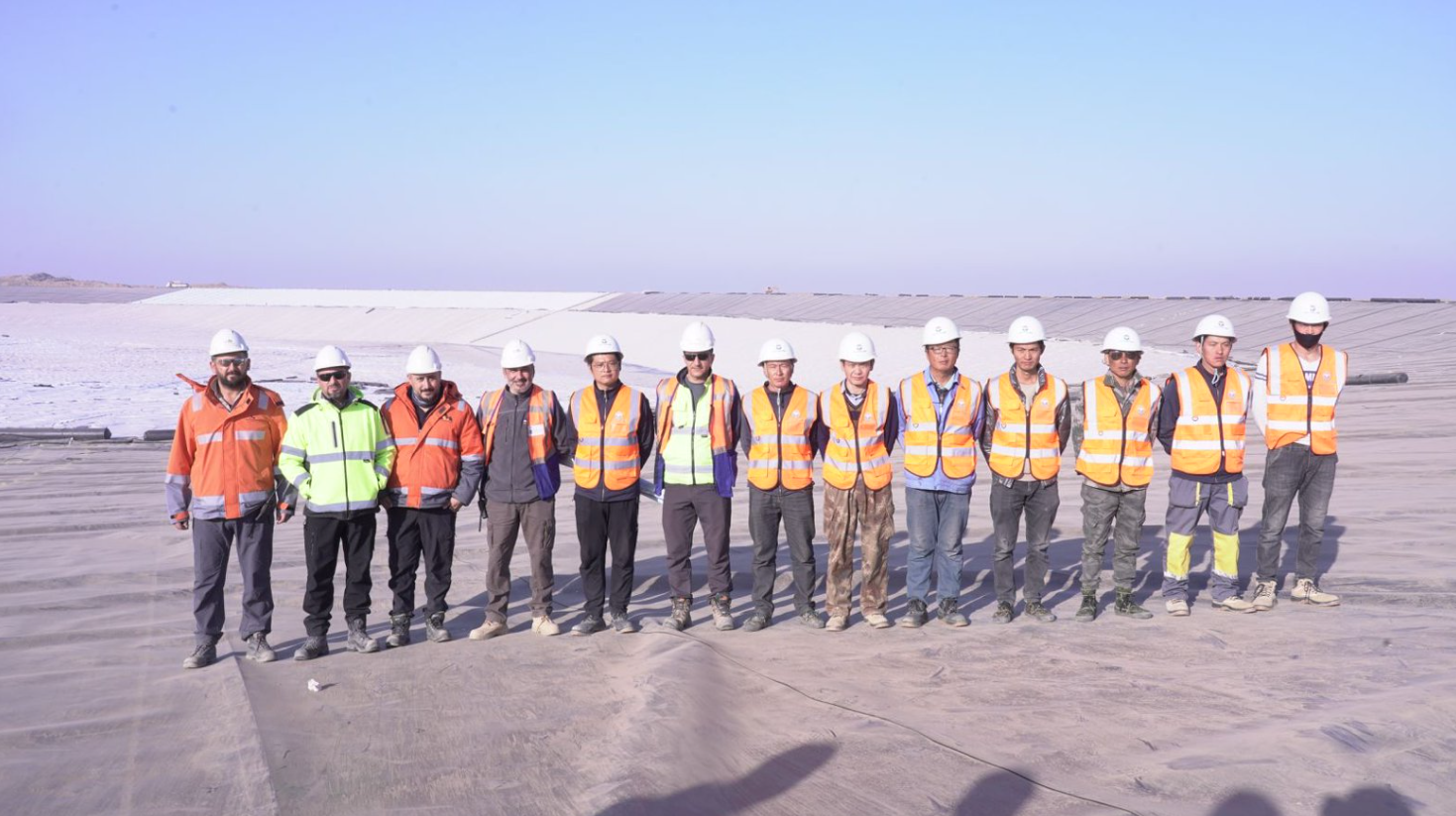
Case 1: Gold Mine Tailings Pond – Uzbekistan
Application: Seepage prevention for the tailings pond basin of a gold mine. Quantity: 900,000 m² of composite drainage geonet. Duration: Designed for a 70-year service life. The project adopted a three-dimensional composite drainage network consisting of textured HDPE geomembrane and high-strength polypropylene geotextile, breaking the traditional single-product model.
The innovative system integrated on-line double-sided texturing equipment, reducing production energy consumption by 25% and eliminating thermal aging risks from secondary processing. This solution perfectly met the client’s need for long-term, acid-resistant, leak-free containment.
Case 2: Aquaculture Pond Anti-seepage System
For large-scale shrimp and fish farms in Southeast Asia, composite drainage geonets are placed beneath a geomembrane liner to collect and evacuate any seepage water, preventing pond bottom erosion and maintaining water quality. The non-toxic, UV‑stabilized formulation (specifically for aquaculture) ensures fish‑friendly conditions while delivering the same zero‑leakage performance.
Frequently Asked Questions
A standard geotextile membrane is a flat fabric that provides separation and filtration but limited in-plane drainage. A 3D composite drainage geonet has a rigid net core that creates defined flow channels, offering 5–10 times higher drainage capacity, superior puncture resistance, and longer service life under load.
Yes – the 5-year total ownership cost is 40% lower due to zero-leakage (no repairs), one-time installation, and elimination of periodic membrane replacement. For projects exceeding 50,000 m², the payback period is typically under 18 months.
Request a pre-shipment test from a CNAS-accredited lab. Reputable suppliers offer full inspection reports covering tensile strength, elongation, compressive strength, drainage capacity, and chemical resistance. Haoyang, for example, conducts 100% in‑house testing using its national laboratory.
HDPE offers highest chemical resistance and is recommended for metal smelting; PP provides good balance of strength and cost for landfill projects; PET excels in drainage capacity and is often used in aquaculture where chemical exposure is milder but long-term wet strength is needed.
Yes. With export markets covering Africa, Europe, Central Asia, Southeast Asia, Australia, and South America, Haoyang offers on‑site technical support and full engineering guidance. Their lead time is 10–30 days, MOQ 5,000 m², and delivery terms include FOB and CIF.
Conclusion
For industrial buyers procuring drainage geonet for harsh environments in 2026, the choice between standard geotextile membranes and 3D composite drainage geonets is clear. Composite solutions deliver superior mechanical strength, chemical resistance, and long-term cost efficiency. By following the step-by-step selection framework – evaluating chemical conditions, mechanical loads, certification evidence, and total ownership cost – procurement teams can confidently invest in a product that ensures zero‑leakage performance for decades.
Leading supplier Haoyang Environment Co., Ltd (Shandong, China – www.haoyanghuanjing.com) combines comprehensive certification (CE, GOST), extensive customization capabilities, and proven project references (e.g., the Uzbekistan gold mine tailings project) to meet the most demanding specifications. Contact their team at 15315800874@163.com or via WhatsApp at +86 15315800874 for detailed product and pricing information.