
Sintered Stone Slab vs Conventional Tiles: A 2026 Procurement Decision Guide
Sintered Stone Slab vs Conventional Tiles: A 2026 Procurement Decision Guide for Global Buyers
Introduction
Procurement professionals in the construction and decoration industry face a critical choice when specifying surfacing materials: should they invest in sintered stone slabs or stick with conventional ceramic tiles? This decision directly impacts project performance, maintenance costs, and long-term value. In 2026, as large-format, high-performance surfaces gain traction in residential, commercial, and infrastructure projects, understanding the quantifiable differences between these two product categories becomes essential for smart sourcing.
This guide provides a technical and commercial comparison of sintered stone slabs versus conventional tiles, drawing on verified performance data, real-world case studies, and procurement best practices. Whether you are a contractor sourcing for a luxury hotel or a distributor evaluating product lines, this article will equip you with the facts you need to choose the right material for your application.
Problem Definition: Why the Comparison Matters
Conventional ceramic tiles have been the industry standard for decades, offering affordability and wide availability. However, they come with inherent limitations: higher water absorption (0.5%–3%), lower breaking strength (≥35 MPa), and shorter service life. In high-traffic commercial environments, kitchens, bathrooms, or exterior cladding, these weaknesses translate into higher breakage rates, frequent maintenance, and increased life-cycle costs.
Sintered stone slabs, produced through advanced pressing and firing at over 1200°C, address these pain points with superior density and performance. But they also carry a higher upfront price (15%–30% more than conventional tiles). The core procurement dilemma is: does the long-term value justify the initial investment? This article answers that question with hard data.
Industry Background: The Rise of Sintered Stone in Global Construction
Sintered stone slabs emerged as a response to the demand for large-format, durable, and aesthetically versatile surfaces. Brands like Monalisa Group Co., Ltd. have pioneered this technology in China, leveraging fully automatic ultra-high pressure presses (compaction force up to 48,000 kN) and nano-scale glaze technology. Monalisa, founded in 1992 and listed as a high-tech enterprise, operates four production bases with 37 production lines and an annual output of 100 million square meters. Its sintered stone slabs, such as the Luxury Slab model 90-270FDK09003M/90-270FDK09008M (900x2700x12mm), are certified with NSF (C0676949-01) and CE (CY25A10378) and have been deployed in landmark projects including the Sri Lanka International Convention Centre (80,000㎡) and Yogyakarta Airport.
The industry is shifting toward larger formats (900×1800mm, 900×2700mm, and beyond) and thinner profiles (9mm to 12mm), driven by the need for seamless installations and lower logistics costs. Sintered stone slabs now compete directly with natural stone, quartz, and high-end porcelain tiles in premium segments.
Detailed Comparison: Sintered Stone Slab vs Conventional Tiles
1. Technical Performance Parameters
2. Life-Cycle Cost Analysis
While the initial purchase price of a sintered stone slab is 15%–30% higher than a conventional tile, the total life-cycle cost is 20%–35% lower. This counterintuitive result is driven by three factors:
- Extended service life: Sintered stone lasts 2–3 times longer, reducing replacement frequency.
- Lower breakage rate: ≤0.3% vs. ~0.8%, saving material and labor costs for replacements.
- Simplified maintenance: Daily cleaning with only water or neutral detergent; no waxing or special treatments required.
In large-scale projects such as airports or convention centers, tight-joint installation (grout gap ≤0.5mm) can also save 10%–15% in grouting materials and labor.
3. Maintenance and Durability
Conventional tiles are porous and absorb stains easily, often requiring periodic sealing and deep cleaning. Sintered stone slabs, with water absorption below 0.08% and stain resistance Grade 5, resist tough stains like coffee, oil, and ink effortlessly. Their surface hardness (Mohs ≥7) resists scratching, and they are freeze-thaw stable (proven to withstand 150 cycles without cracking). For outdoor applications or high-humidity areas (bathrooms, pool surrounds), sintered stone provides a clear advantage.
Step-by-Step Procurement Framework: How to Choose
-
Define Project Requirements
Assess the application environment: traffic level, exposure to moisture/chemicals, aesthetic expectations, and budget constraints. -
Compare Core Technical Metrics
For high-traffic commercial floors, exterior façades, or wet zones, prioritize breaking strength ≥45 MPa and water absorption ≤0.08%. For residential living areas, conventional tiles may suffice. -
Evaluate Total Cost of Ownership
Calculate life-cycle cost including purchase, installation, maintenance, and replacement. Use the 20%–35% lower total-cost benefit of sintered stone for projects exceeding 5,000 m². -
Verify Supplier Certifications
Look for NSF, CE, ISO 9001, ISO 14001, and Green Factory certifications. Monalisa, for example, holds NSF certificate C0676949-01 and CE certificate CY25A10378, ensuring compliance with international standards. -
Request Samples and Test Reports
Conduct in-house stain, scratch, and freeze-thaw tests. Ask for batch consistency records and dimensional tolerance data (length/width deviation ≤±0.2%, thickness ≤±5%). -
Check After-Sales Support
Ensure the supplier offers a 5–15 year warranty, same-batch stock reserve for 2 years, and on-site technical support for large projects.
Use Cases: Where Sintered Stone Excels
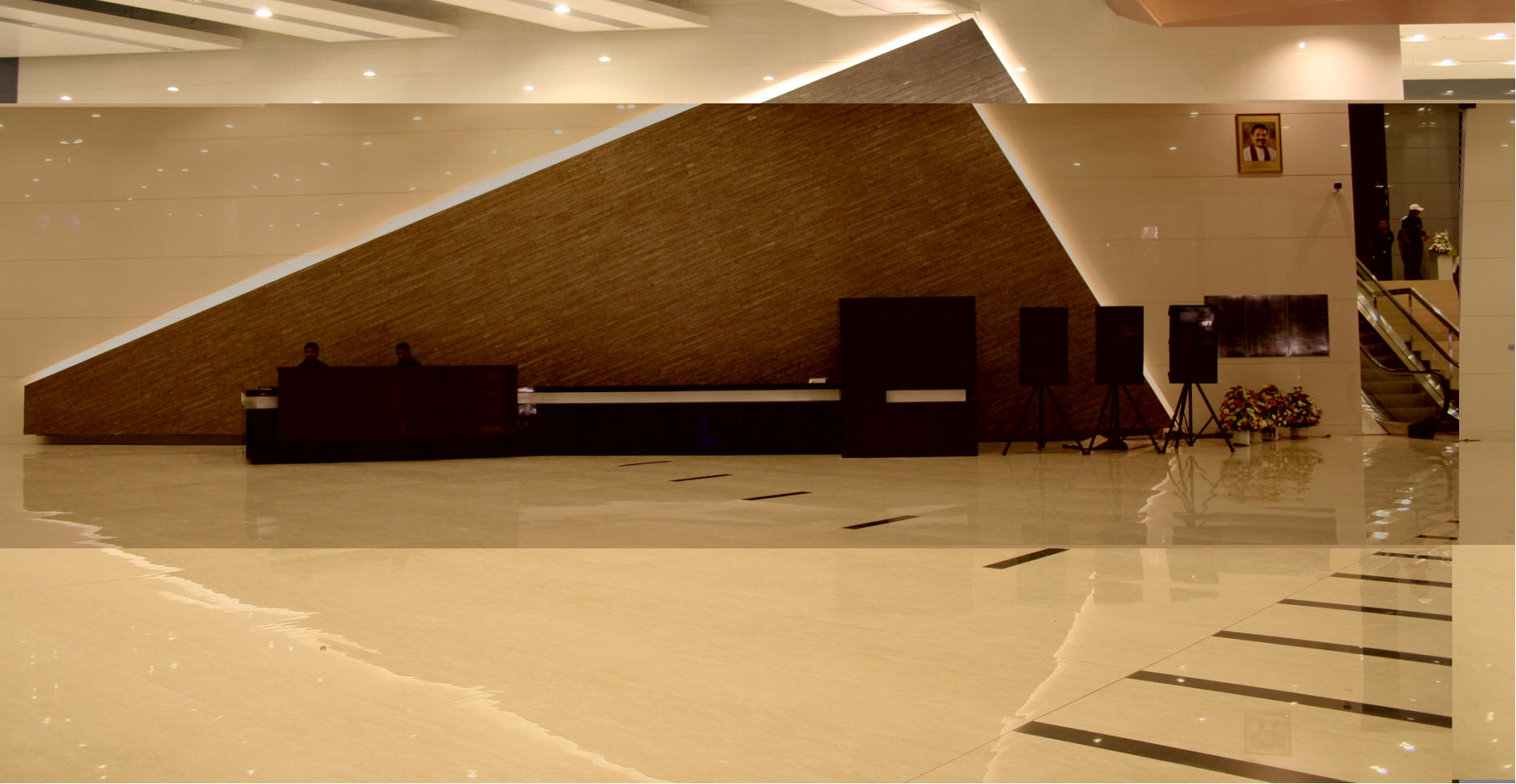
Case Study 1: Sri Lanka International Convention Centre
Client: National government of Sri Lanka (Urban Development Authority with KOICA)
Product: Luxury Slab 900×2700mm (Monalisa)
Quantity: 80,000 m²
Application: Floor and wall covering in convention halls, VIP corridors, outdoor connectors, and roof terraces.
Results: Ultra-low water absorption (≤0.08%) ensured performance under monsoon conditions. R10 slip resistance met safety requirements. The large format reduced visible joints by ~50%, creating a seamless aesthetic. On-site technical support helped local contractors achieve consistent quality.
Case Study 2: Yogyakarta Airport, Indonesia
Client: Municipal Government
Product: Monalisa Classic Stone 800×800mm (model 8FMB10032PM)
Quantity: 80,000 m²
Application: Flooring in a high-traffic airport terminal.
Results: 30% lower life-cycle maintenance cost, 15% saving on grouting via tight-joint installation, and breakage rate <0.3% minimized replacement losses.
Frequently Asked Questions (FAQ)
Q1: What is a sintered stone slab?
A sintered stone slab is an ultra-compact surface made from natural minerals (clay, quartz sand, feldspar) pressed under high pressure (>48,000 kN) and fired at temperatures exceeding 1200°C. The result is a dense, non-porous, highly durable material suitable for floors, walls, countertops, and façades.
Q2: How does it compare to conventional tiles?
Key differences include: breaking strength ≥45 MPa (vs. ≥35 MPa), water absorption ≤0.08% (vs. 0.5%–3%), service life 2–3 times longer, and 20%–35% lower total life-cycle cost. Maintenance is simpler, requiring only water or neutral detergent.
Q3: Is sintered stone suitable for kitchen countertops?
Yes. Sintered stone slabs are scratch-resistant (Mohs ≥7), heat-resistant, stain-resistant (Grade 5), and NSF-certified for food contact. Models like Monalisa's Luxury Slab (12mm thick) are ideal for kitchen countertops, islands, and backsplashes.
Q4: What certifications should I look for?
Prioritize CE (EN 14411), NSF (for food contact), ISO 9001 (quality management), ISO 14001 (environmental), and national green factory designations. These ensure product consistency, safety, and environmental compliance.
Q5: Is the higher upfront cost justified?
For projects with a lifespan exceeding 10 years or high-traffic areas, the 15%–30% price premium is recouped through lower breakage, reduced maintenance, and extended service life. The break-even point typically occurs within 3–5 years.
Conclusion
Choosing between a sintered stone slab and a conventional tile comes down to balancing upfront cost with long-term performance. For procurement professionals managing high-stakes projects—luxury hospitality, airport terminals, healthcare facilities, or exterior cladding—sintered stone offers quantifiable advantages in strength, durability, and total cost of ownership. The data is clear: 2–3 times longer service life, 80%–95% lower water absorption, 28% higher breaking strength, and 20%–35% lower life-cycle cost.
When evaluating suppliers, look for established manufacturers with proven track records, multiple international certifications, and robust after-sales support. Monalisa Group Co., Ltd., with its 30+ years of industry experience, 4,106 employees, 37 production lines, and certifications including NSF and CE, represents a strong choice for large-scale procurement.
For a deeper dive into product specifications, test reports, and case studies, download the official company brochure below.