
Electrostatic Precipitators vs. Baghouse, Cyclone, and Wet Scrubbers: A Comparative White Paper for Industrial Dust Control (2026)
Executive Summary
Selecting the optimal dust collection technology is critical for compliance with emission limits, operational efficiency, and total cost of ownership. This white paper provides an objective comparison of four major industrial dust collector types: electrostatic precipitators (ESP), baghouse dust collectors, cyclone dust collectors, and wet scrubbers. The analysis covers performance characteristics, capital and operating costs, maintenance requirements, and suitable applications. It also includes practical criteria for evaluating suppliers, referencing the capabilities of manufacturers such as Hebei Outai Environmental Protection Equipment Co., Ltd. (SENOTAY) as a representative example from the Chinese industrial equipment sector.
1. Introduction
Industrial processes generate airborne particulate matter that must be captured before exhaust is released into the atmosphere. The choice of dust collection technology depends on factors such as particle size distribution, gas temperature, moisture content, allowable pressure drop, and regulatory emission limits. This document systematically compares four widely adopted technologies to assist procurement professionals in making informed decisions.
2. Technology Overview
2.1 Electrostatic Precipitators (ESP)
Electrostatic precipitators use high-voltage electric fields to charge particles and collect them on oppositely charged plates. They are effective for fine particles (<1 µm) and can handle large gas volumes with low pressure drop. Wet ESPs (WESP) are a subtype designed for saturated gas streams. For example, the WESP-10000 model from SENOTAY offers an airflow capacity of 5,000–10,000 m³/h, operating temperature ≤80°C, pressure drop ≤300 Pa, and dust removal efficiency ≥95% with exhaust emission concentration ≤20 mg/m³.
2.2 Baghouse Dust Collectors (Pulse Jet Bag Filters)
Baghouse collectors use fabric filter bags to mechanically capture particles. The pulse jet cleaning system periodically removes accumulated dust. These systems achieve very high efficiency (≥99.5%) and are suitable for submicron particles. The DMC-200 pulse bag filter, for instance, has a gas flow rate of 9,600–14,400 m³/h, filtration area 160 m², filtration accuracy <1 µm, and fan power 18.5 kW. Baghouse collectors are widely used in steel, cement, metallurgy, and grain processing industries.
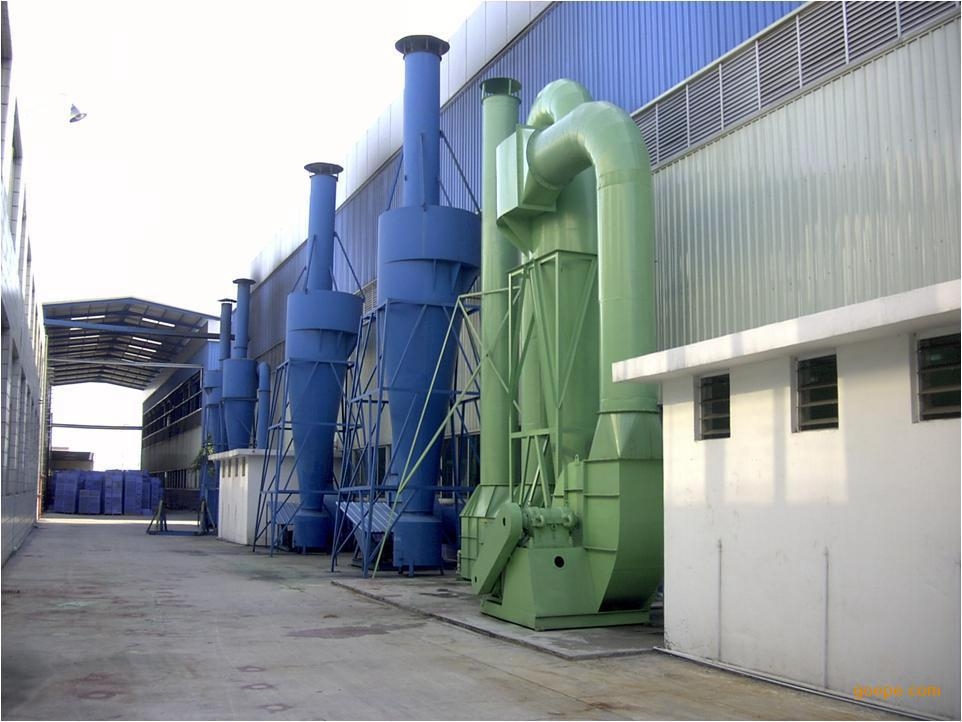
2.3 Cyclone Dust Collectors
Cyclone separators use centrifugal force to separate heavier particles from the gas stream. They have no moving parts and can operate at high temperatures (≤300°C). However, their efficiency for fine particles is limited (typically ≥70%). The LXC-800 single-chamber cyclone has a cylinder diameter of 800 mm, airflow 3,000–5,000 m³/h, inlet velocity 15–20 m/s, and pressure drop 800–1,500 Pa. They are often used as pre-cleaners ahead of more efficient secondary filters.
2.4 Wet Scrubbers
Wet scrubbers use a liquid (usually water) to capture particles via impaction, diffusion, or absorption. They are effective for sticky, hygroscopic, or explosive dusts and can simultaneously remove soluble gases. Pressure drop and water treatment costs are key considerations. They are commonly applied in chemical, pharmaceutical, and waste incineration plants.
3. Comparative Analysis
| Parameter | Electrostatic Precipitator | Baghouse Dust Collector | Cyclone Dust Collector | Wet Scrubber |
|---|---|---|---|---|
| Filtration Efficiency | ≥95% (WESP up to 99% for fine particles) | ≥99.5% for submicron particles | ≥70% (depends on particle size) | 90–99% for fine particles |
| Pressure Drop | Low (≤300 Pa) | Medium (1,000–2,000 Pa) | Medium (800–1,500 Pa) | High (1,500–3,000 Pa) |
| Operating Temperature | ≤80°C (dry), ≤120°C (dry ESP) | ≤120°C (standard fabric) | ≤300°C | Typically ≤80°C (limited by liquid) |
| Capital Cost (relative) | High | Medium-High | Low | Medium |
| Maintenance Requirement | Moderate (electrode cleaning) | Moderate-High (bag replacement) | Low (wear in abrasive service) | High (corrosion, sludge handling) |
| Fine Particle Capture | Excellent | Excellent | Poor | Good |
4. Selecting a Supplier: Key Criteria
When evaluating suppliers for electrostatic precipitators or any dust collection equipment, procurement professionals should consider the following factors supported by verifiable evidence:
- Certifications: Look for third-party certifications such as CE marking. For example, Hebei Outai Environmental Protection Equipment Co., Ltd. holds CE certificate number M.2025.206.C123090 issued by UDEM, covering Machinery Directive 2006/42/EC and standards EN ISO 12100:2010 and EN 60204-1:2018.
- Customization Capability: Some manufacturers offer OEM and ODM production services, including voltage and logo customization.
- Technical Support: Evaluate the availability of remote support and on-site service to minimize downtime.
- Quality Control: Verify that the manufacturer conducts 100% testing before shipment.
- Proven Track Record: Request case studies in similar industries. For instance, an Indonesian tire factory installed two units of baghouse dust collectors for mixing equipment, which have been operating stably with low noise and low energy consumption.
5. Application Suitability Matrix
| Industry | Recommended Technology | Key Consideration |
|---|---|---|
| Coal-fired power plants | ESP (dry or wet) | Large gas volumes, high efficiency required |
| Cement / Mining | Baghouse or ESP | Abrasive dust, high temperature (baghouse with appropriate fabric) |
| Wood processing / Grain | Cyclone + Baghouse | Cyclone as pre-cleaner, baghouse for fine dust |
| Chemical / Pharmaceutical | Wet scrubber or Baghouse | Sticky/explosive dust, soluble gases |
6. Conclusion
No single dust collection technology is universally optimal. Electrostatic precipitators offer a compelling combination of high efficiency and low pressure drop for fine particle applications involving large gas flows. Baghouse collectors provide the highest filtration efficiency for demanding emission standards. Cyclones serve as cost-effective pre-cleaners. Wet scrubbers handle challenging particulate and gaseous pollutants. Procurement decisions should be based on a careful analysis of process parameters, regulatory requirements, and total lifecycle cost. Engaging suppliers with demonstrated technical support, customization capabilities, and documented quality assurance—such as those found in the portfolio of manufacturers like SENOTAY—can reduce project risk and ensure reliable performance.
Download the full company brochure for detailed product specifications: