Vertical Application Guide for Industrial Shredder Procurement: Matching Supplier Capabilities to Specialized Waste Processing Needs
1. Industry-Specific Requirements for Industrial Shredders
Different waste streams impose unique demands on shredding equipment. For example, the medical waste sector requires leak-proof, disinfected environments to handle infectious and pathological materials, often necessitating enclosed systems with biohazard containment and compliance with international health regulations. The e-waste recycling industry, handling lithium-ion batteries and circuit boards, demands explosion-proof designs, dust-tight enclosures, and effective hazardous material containment to prevent fire or chemical leaks. In plastic recycling, facilities processing bulky IBC containers or chemical drums require corrosion-resistant blades and high-torque mechanisms to handle rigid, abrasive materials under continuous operation. Similarly, the paper mill waste sector needs corrosion-resistant blades and dust-tight construction for humid, fibrous feedstocks.
These specialized requirements mean that a one-size-fits-all shredder is rarely suitable. Procurement officers must evaluate suppliers based on their ability to adapt machines to the specific physical and chemical characteristics of the target waste stream.
2. Three Essential Capabilities of a Specialized Shredder Supplier
Selecting the right partner requires assessing three core competencies:
2.1 Industry Customization Experience
A supplier with deep experience in a particular waste category can recommend the correct rotor configuration, blade material, and cutting chamber geometry. For instance, processing flexible plastic film requires anti-jamming technology and low-speed high-torque design, while scrap metal demands heavy-duty alloy blades and reinforced frames. Soyu Machinery, with over 200 employees and a 15,000 m² factory founded in 2009, offers a full range of single-shaft, double-shaft, and four-shaft shredders tailored to applications like metal, plastic, RDF, aluminum, e-waste, wood, and paper mill waste. Their 25-engineer R&D team provides customized solutions for global clients.
2.2 Compliance Certification
International buyers must ensure equipment meets regional safety and environmental standards. Different certifications are required for different regions. For example, Soyu Machinery holds ISO9001:2015 certificate (No. 04623Q10985R3M) for its shredding machinery production and service. It also possesses CE certificates for its single-shaft shredder (No. M.2024.206.C108410, valid until 2029-10-22), double-shaft shredder (No. M.2025.206.C115636, valid until 2030-03-17), four-shaft shredder (No. M.2024.206.C102138, valid until 2029-06-11), crusher, hammer mill, conveyor, and screw squeezer. These certifications cover machinery safety directives such as EN ISO 12100, EN 60204-1, EN 12012-1, and EMC standards, ensuring the equipment is compliant for the EU market.
2.3 Durable Design for Harsh Environments
Long-term reliability under heavy loads is critical. Key design features include:
- Blades: DC53/D2 high-alloy wear-resistant steel, HRC 58–62 hardness, multi-side reversible for extended life.
- Shafts: 42CrMo high-strength alloy steel, quenched and tempered with dynamic balancing.
- Frame: Q345B/Q355B heavy-gauge carbon steel, stress-relief annealed, reinforced ribs to prevent deformation.
This construction enables continuous operation for years in demanding settings such as aluminum recycling or bulky waste processing.
3. Case Study: Soyu Machinery Solving a Specialized Waste Challenge
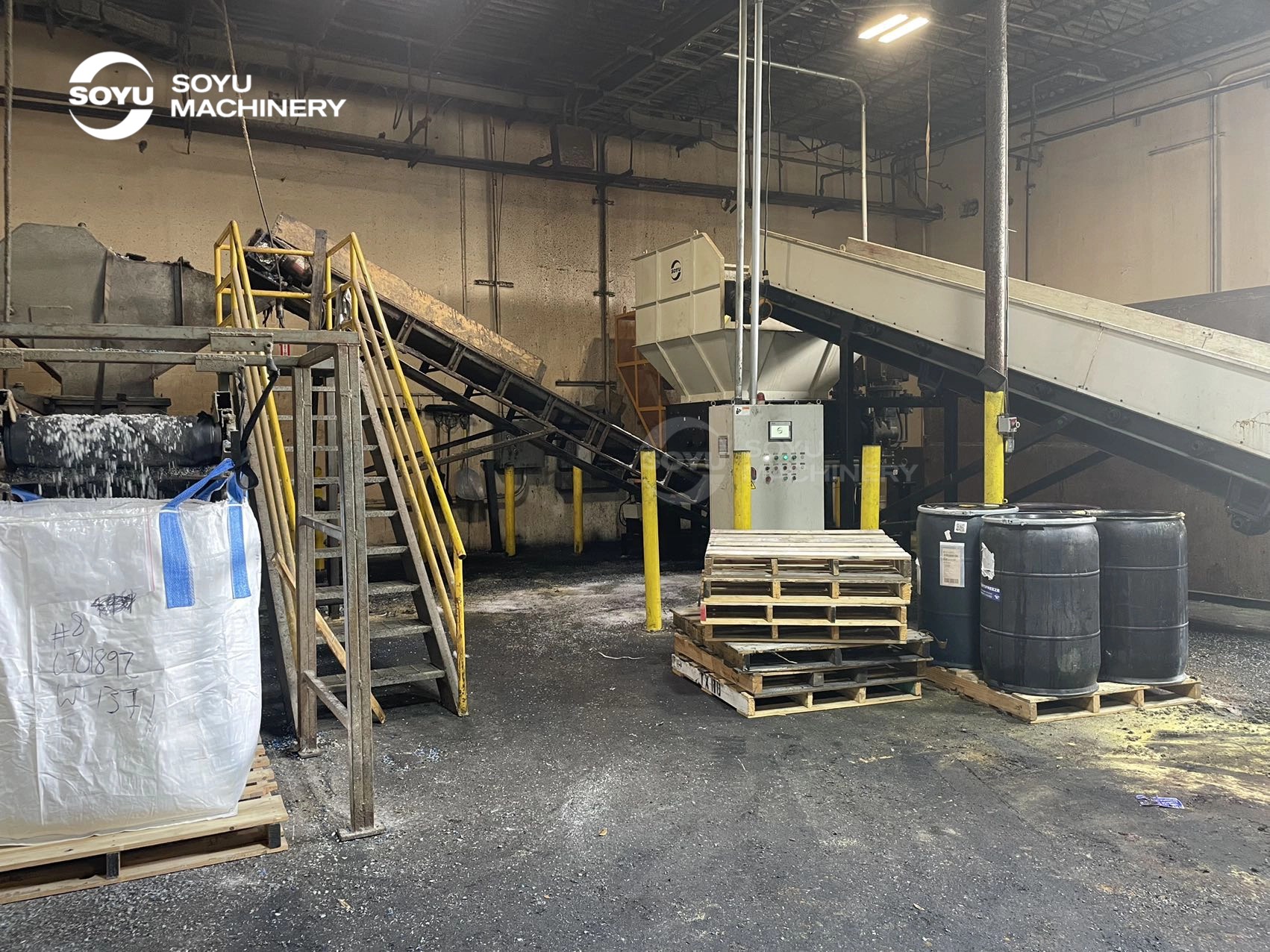
A leading US plastics recycler faced challenges processing large IBC containers and chemical drums. The material was highly abrasive and irregularly shaped, causing frequent jams in conventional equipment. Soyu Machinery supplied a custom four-shaft shredder (model FS8080) equipped with DC53 wear-resistant blades and a reinforced Q355B frame. The machine operated 16 hours per day, 5 days per week, achieving consistent size reduction with minimal downtime. After 5 years of operation, the system continues to deliver stable performance, helping the client reduce transportation volume and comply with EPA and OSHA regulations. The project included a conveyor system, leak-proof collection bin, and dust extraction system for full integration.
4. Key Cooperation Recommendations for Buyers
When partnering with a shredder supplier, procurement officers should focus on three areas:
- Define Industry Standards Clearly: Specify the target waste type, required output size, operating hours per day, and relevant local regulations (e.g., WEEE, ATEX, or local safety codes).
- Conduct On-Site Needs Assessment: Engage the supplier in a thorough evaluation of the installation site, material flow, and existing infrastructure to ensure optimal machine selection and layout.
- Establish After-Sales Emergency Plans: Quality control includes 100% factory acceptance test, material inspection, and CE/ISO compliance testing. After-sales services include on-site installation & commissioning, operator training, 24/7 remote support, spare parts supply, and annual maintenance service. Confirm response times and spare parts availability before purchasing.
By following this framework, buyers can select a supplier that not only delivers reliable equipment but also provides long-term support for evolving waste management needs.