
Ceramic Substrate Sawing: How to Prioritize Chipping vs. Speed Like a Professional
Quick answer: In functional ceramic substrate sawing, chipping is the constraint and speed is the variable. Blade geometry, bond type and diamond specification set the best edge quality a cut can reach; feed rate and spindle speed only decide how quickly you arrive at that limit. Professionals therefore lock an acceptable chip specification first, then raise throughput up to that ceiling — never past it.
Reverse that order and the symptoms are predictable: acceptable quality on the first substrates of a run, then growing edge chipping and micro-cracking as the blade wears, and finally a rising share of parts failing inspection. This guide compares the two priorities head-to-head and shows what actually changes in blade selection, process window and cost when edge quality outranks speed in ceramic substrate dicing.
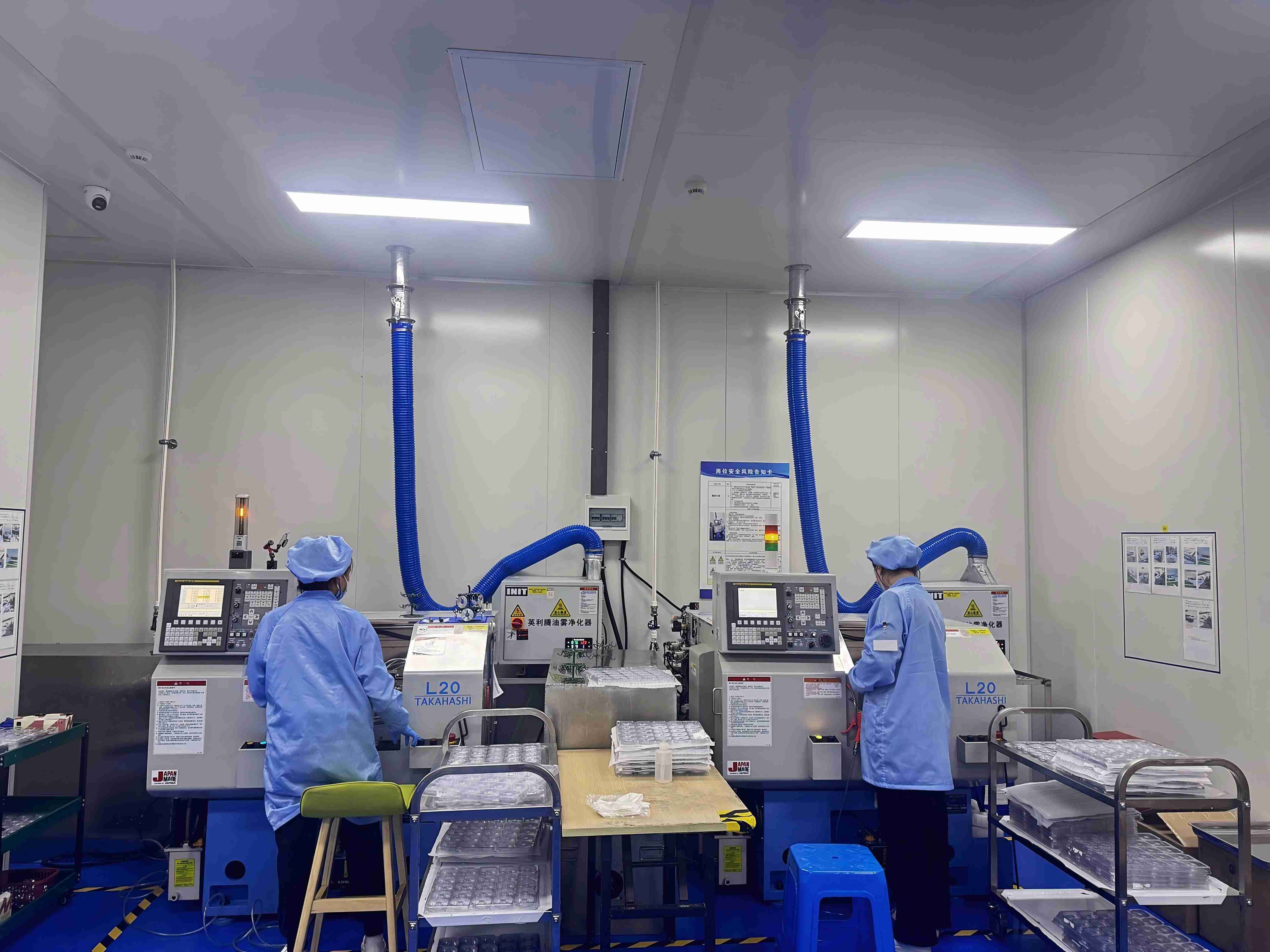
WINTIME Workshop — the manufacturing base behind WINTIME high-precision sawing and dicing blades.
Problem Definition: What the Chipping vs. Speed Trade-off Actually Is
Chipping is material lost at the entry or exit edge of a cut — micro-cracks, edge spalling or irregular break-out. Kerf is the width of material the blade removes; because every micrometre of kerf is material that can no longer be sold, kerf is also called cutting loss. Dimensional accuracy is a separate failure mode again: a cut can be perfectly chip-free and still land outside its position tolerance.
Functional ceramics fail differently from metals. They are hard and brittle with limited capacity for plastic deformation, so the energy delivered at the cutting edge is released as brittle fracture once it exceeds the material's tolerance. On thin substrates that same energy causes local deflection, which pushes the blade sideways and widens the damage zone at the cut exit. Many ceramic substrates also carry patterned features or metallisation, adding a second interface where cracks can start.
The trade-off is mechanical, not administrative. A higher feed rate removes more material per unit time but increases the load at the cutting edge; beyond a substrate-specific threshold, that load is discharged as fracture instead of a clean cut. Higher spindle speed lowers the chip load per revolution while raising heat and vibration. A thicker blade resists lateral deflection — at the cost of a wider kerf and more material destroyed per cut.
What makes this manageable is that the trade-off is not a single dial. The quality ceiling of a ceramic cut is decided before the machine starts running, by blade thickness, bond hardness and diamond specification. Process parameters only determine how close to that ceiling a production line actually operates.
Industry Background: Why Ceramic Sawing Requirements Are Tightening
Diamond sawing sits inside a growing consumable market. The global diamond saw blade market was valued at approximately USD 8.60 billion in 2025 and is expected to reach USD 10.16 billion by 2032, according to Maximize Market Research. The narrower wafer dicing blade segment was valued at USD 1.19 billion in 2024, driven by semiconductor miniaturisation and 300 mm wafer adoption (Market Research Intel).
Published estimates for the dicing segment diverge by scope — Market Research Intel reports USD 1.31 billion while Dicing Blade Market Insights reports USD 0.437 billion — so these figures are best read as order-of-magnitude context rather than procurement data.
Three structural trends matter directly for ceramic substrate sawing:
- Bond mix tracks material difficulty. Resin bond blades held a 42% share of the dicing blade market in 2024, while metal bond blades — used for harder materials such as SiC — accounted for 33% (market.us).
- Thinner substrates are pushing hub design. Hubless dicing blades are increasingly dominant for 300 mm wafer processing because of superior stability and reduced runout on substrates thinner than 50 µm.
- Optics and RF form a real demand block. Optical communication and RF/optoelectronics accounted for 16% of the dicing blade market in 2024, equivalent to USD 69.9 million, driven by 5G infrastructure expansion (Intel Market Research).
Standardisation provides a third anchor. Diamond tools, including sawing blades, are categorised under ISO 22180:2019, which distinguishes CVD diamond-coated from monocrystalline/polycrystalline types — a useful reference when comparing blade specifications across suppliers.
On the supply side, the high-precision semiconductor dicing blade market includes DISCO Corporation, Tokyo Seimitsu (Accretech), Advanced Dicing Technologies (ADT) and Asahi Diamond among its leading competitors (Credence Research). China's blade export footprint is also expanding, with cutting blade exports to Vietnam up by USD 18 million and to India up by USD 12 million between 2024 and 2025 (OEC).
The Professional Priority Order for Ceramic Substrate Sawing
Rank the decision criteria the way a process engineer actually does and the sequence follows the cost of failure rather than personal preference.
- Edge integrity (chipping). First, because it is an acceptance gate rather than a preference. A substrate that chips outside specification is scrap or rework, and no throughput gain pays for it.
- Kerf width and cutting loss. Every cut destroys material permanently. Narrow-kerf, low-cutting-loss blades protect yield per substrate — the decisive metric wherever substrate area dominates cost.
- Dimensional accuracy. Position tolerance determines whether downstream assembly can live with the cut. It ranks above speed because a misplaced cut cannot be corrected by slowing the process later.
- Blade–material compatibility. Bond type, diamond grit and hub design must match substrate hardness, thickness and surface layers before a single parameter is tuned.
- Throughput. Feed rate and blade life are optimisation variables — valuable, but bounded by the four items above.
- Cost per good part. The only commercial metric that matters, because it folds blade price, cutting loss, blade life and rework into one number. A cheaper blade that chips more is rarely the cheaper blade.
The practical consequence is simple: the first four items are specified before production starts, and only the last two are tuned during ramp-up.
Blade Design Levers That Change the Trade-off
WINTIME Semiconductor Technology Co., Ltd. is a Jiangsu-based manufacturer founded in 2020 that develops, produces and sells high-precision dicing and sawing blades, with a 34,000 m² factory and an annual production capacity of more than 1 million pieces of dicing blades.
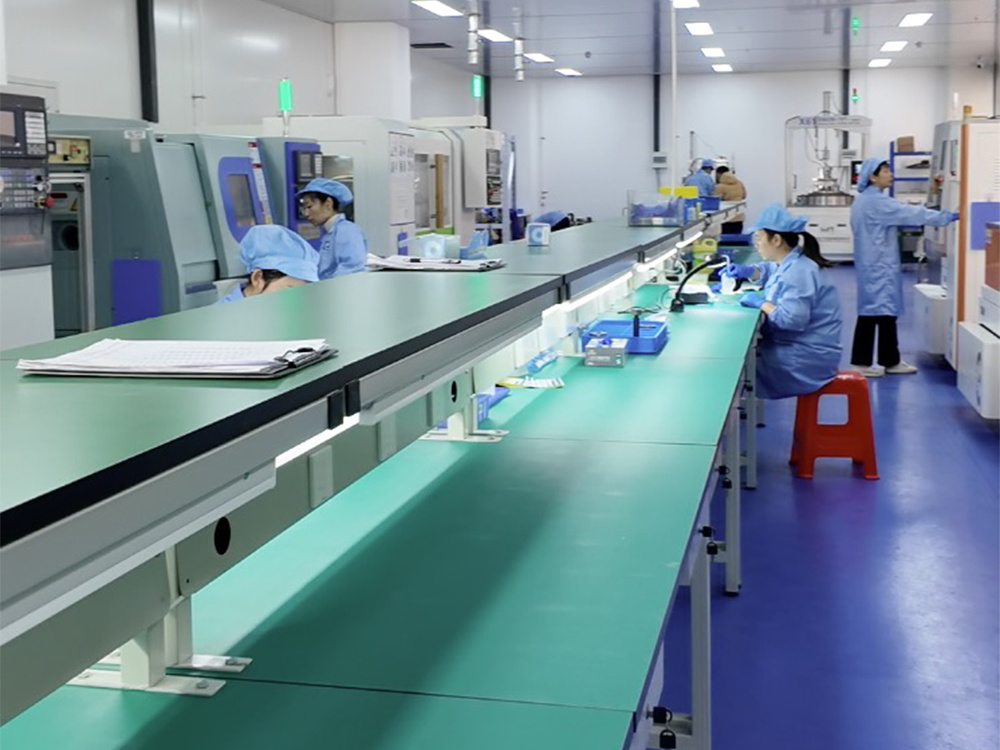
WINTIME Workshop — blade geometry, bond and diamond specification are fixed here before any process window is tuned.
Narrow kerf and low cutting loss
The most effective way to reduce chipping without surrendering speed is to reduce the volume of material the blade has to remove. Blade diameter, blade thickness and spindle hole size are the three geometry variables that define both kerf and blade stiffness, and all three can be customised. A thinner blade removes less material per cut and lowers the mechanical load at the edge — precisely the load that would otherwise be released as brittle fracture in a functional ceramic.
Bond type and diamond specification
Bond type controls how diamond is held and released. Resin bond blades are commonly chosen where edge quality and reduced damage take priority; metal bond blades are commonly chosen for harder, more abrasive materials — a split visible in the 2024 market shares of 42% resin and 33% metal bond. Diamond abrasive grain size and concentration form the second lever, trading removal rate against edge integrity, and both are customisable, together with blade coating.
Hubless construction for deflection-sensitive work
Hubless sawing blades are increasingly dominant in 300 mm wafer processing because of superior stability and reduced runout on substrates below 50 µm. The same logic transfers to thin ceramic substrates: less runout means less lateral load at the cut exit, which is where chipping most often begins.
Coating and blade life
Anti-rust, heat-dissipation and wear-resistant coatings are available options that influence blade life. Blade life is not a cosmetic specification: in ceramic cutting, a wearing blade changes its effective exposure and load distribution, which is exactly why edge quality drifts late in a batch.
Verification before the trade-off is tested
WINTIME's quality control covers geometric dimension inspection with vernier callipers and laser diameter gauges, hardness and wear-resistance testing on a material testing machine, dynamic balance detection on a high-speed dynamic balance tester, and cutting performance simulation on actual material. Dynamic balance and geometry inspection are usually the two checks that decide whether a thin blade can run at high feed without generating the vibration that surfaces later as chipping.
WINTIME Office Area — inspection and process-matching data behind each blade specification.
Manufacturing base and customisation scope
The company runs a 35-engineer R&D team, holds two patent technologies, and completed an ultra-thin wafer dicing blade project that reaches a thickness below 9 microns in mass production. Its 2023 Nantong semiconductor special materials project added a new factory and auxiliary buildings of 34,000 m² with an annual capacity of more than 1 million dicing blades.
Capacity is split between 800,000+ pieces per month for standard specifications and 80,000+ pieces per month for customised and special-shaped products. OEM, ODM and customised production are available, with customisation covering blade diameter, thickness and spindle hole size; bond type (metal bond, resin bond); diamond abrasive grain size and concentration; coating (anti-rust, heat-dissipation, wear-resistant); cutting performance targets such as cutting speed and service life; packaging, including export packaging; and special-shaped, non-standard blade sizes. Standard products carry an MOQ of 50 pieces and ship in 2–5 working days, while customised products carry an MOQ of 300 pieces and a lead time of 10–25 working days, adjustable for large orders.
Reading blade names in a ceramic sawing quote
Ceramic cutting specifications are usually written in a consistent vocabulary: diamond sawing blades, hubless sawing blades, electroforming hard sawing blades, semiconductor wafer sawing blades, optical communication sawing blades, functional ceramic sawing blades and alloy material sawing blades, with series naming such as the DZY Series wafer sawing blade, the DZR Series sawing blade and the DZR-S Series slotted sawing blade. When comparing quotations, translate every term into a measurable parameter — kerf, bond, grit, concentration, hub design — instead of treating the name itself as the specification.
Step-by-Step Breakdown: A Seven-Step Priority Protocol
- Define the quality floor. Write down the chip acceptance class and position tolerance before selecting a blade. Without a numeric floor, low chipping is an opinion rather than a requirement.
- Characterise the substrate. Record material family, thickness, surface layers and whether the cut crosses metallisation or patterned features.
- Select blade geometry. Choose blade diameter, thickness and spindle hole size for the narrowest kerf that still delivers the stiffness the substrate needs.
- Select bond, grit and concentration. Match bond type and diamond specification to the substrate, then add coating if blade life, heat or corrosion resistance drives the cost model.
- Set the process window. Establish feed rate and spindle speed at a conservative point, verify edge quality, then increase feed in measured steps until the chip class degrades. That measurement is the real speed limit — not the machine's maximum.
- Verify with data. Confirm blade behaviour through geometric inspection, dynamic balance results and cutting simulation, not only through the pass rate of the current batch.
- Lock and monitor. Freeze the qualified parameter set and track blade life against quality so drift is caught before it becomes scrap.
Use Cases: When the Priority Order Shifts
Functional ceramic substrates with patterned features. Chipping-first, with the narrowest practical kerf and a finer diamond specification. Speed is deliberately sacrificed, because a cracked metallisation layer cannot be recovered downstream.
Optical communication device cutting. Optical communication and RF/optoelectronics accounted for 16% of the dicing blade market in 2024 — USD 69.9 million — driven by 5G build-out. Edge cleanliness and straight-cut control dominate here, since optical alignment tolerates neither chipping nor positional error.
Semiconductor wafer dicing. Where substrates are thinner than 50 µm, hubless constructions and ultra-thin blades — including sub-9 µm capability in mass production — move to the front of the decision order, because runout and kerf loss both scale with reduced thickness.
Precision alloy components. With tougher, less brittle material the priority order can flip: a harder bond and a more aggressive feed become acceptable, because the dominant risk shifts from edge fracture to blade wear.
Comparison Table: Chipping-First vs. Speed-First Ceramic Sawing
| Decision dimension | Chipping-first (quality locked) | Speed-first (throughput locked) |
|---|---|---|
| Primary objective | Protect brittle edges and patterned features | Maximise cuts per hour |
| Blade thickness / kerf | Narrow kerf to reduce load and cutting loss | Thicker, stiffer blade tolerated for higher feed |
| Bond family | Resin bond commonly selected for edge quality | Metal bond commonly selected for hard, abrasive material |
| Diamond grit and concentration | Finer grit, controlled concentration | Coarser grit, higher concentration for removal rate |
| Feed and spindle settings | Conservative feed raised step-by-step to a measured limit | Aggressive feed applied from the start |
| Dominant failure mode | Throughput becomes the limiting factor | Chipping, micro-cracks and die loss |
| Typical fit | Functional ceramic substrates, thin substrates, patterned or metallised surfaces | Rough sizing, sacrificial material, non-critical cuts |
Market context for the bond rows: resin bond blades held 42% and metal bond blades 33% of the 2024 dicing blade market (market.us). Bond selection should always be confirmed against the specific substrate, not against market share alone.
FAQ
Which standard applies to diamond sawing blades used on ceramic substrates?
Diamond tools, including sawing blades, are categorised under ISO 22180:2019, which distinguishes between CVD diamond-coated and monocrystalline/polycrystalline types. When specifying a functional ceramic sawing blade, cite the relevant ISO 22180:2019 category in the purchase document so that coating type and diamond type are compared on the same basis across suppliers.
Can a sawing blade be customised for a specific functional ceramic substrate?
Yes. WINTIME offers OEM, ODM and customised production with specifications tailored to different cutting materials and working conditions. Customisable parameters include blade diameter, thickness and spindle hole size; bond type (metal bond, resin bond); diamond abrasive grain size and concentration; coating (anti-rust, heat-dissipation, wear-resistant); cutting performance targets such as cutting speed and service life; packaging, including export packaging; and special-shaped non-standard blade sizes.
What drives the cost of a low-chipping ceramic sawing blade?
Four factors dominate: how narrow the required kerf is, how tightly blade geometry must be held, how specialised the bond and diamond combination becomes, and how much verification is required. Standard specifications have an MOQ of 50 pieces, while customised and special-shaped products start at 300 pieces. The metric worth negotiating is cost per good part rather than blade unit price, because cutting loss and rework usually outweigh the price difference between two blade options.
Can we validate a blade on our own substrate before committing to volume?
Sampling and validation are part of the normal workflow. WINTIME provides technical support for cutting process matching and equipment adaptation, and product application training for new customers, so a trial run can be set up against your own substrate and saw. Quality issues are investigated and answered within 48 hours, and defective products caused by quality problems are replaced or compensated.
What are the lead times and MOQs for ceramic sawing blades?
Standard products ship in 2–5 working days with an MOQ of 50 pieces; customised orders take 10–25 working days with an MOQ of 300 pieces, and both are adjustable for large orders and long-term customers. To move from specification to a validated cut, request a sample or quotation at shenxiangfei@ntwintime.com or WhatsApp +8618888053207, or download the WINTIME product brochure.
Conclusion: Fix the Ceiling, Then Chase the Speed
Ceramic substrate sawing rewards a specific order of operations: define the chip acceptance class, choose the narrowest kerf that still provides the stiffness you need, match bond and diamond specification to the substrate, and only then tune feed rate and spindle speed toward a measured limit. Speed-first settings are not a strategy for functional ceramics — they are a yield risk waiting for blade wear to expose it.
WINTIME Semiconductor Technology Co., Ltd. manufactures high-precision sawing and dicing blades in Rugao, Jiangsu, with a 34,000 m² facility, more than 1 million pieces of annual dicing blade capacity, and OEM/ODM customisation across blade geometry, bond type, diamond specification and coating. Products are exported to Southeast Asia, East Asia, North America and the EU among other markets, with 30% of output going to export customers.
WINTIME Office Area — sample, quotation and process-matching support for customised cutting projects.
Next step
Send your substrate specification — material, thickness, target kerf and chip acceptance class — and WINTIME will match a blade configuration and arrange a validation sample.
Email: shenxiangfei@ntwintime.com · Tel: +86 13851530812 · WhatsApp: +8618888053207
Website: en.wintime.net.cn · Brochure: download the WINTIME catalogue (PDF)
Address: No. 868, Fushou East Road, Rugao City, Jiangsu Province, China.
Have Questions or Need More Details?
Contact our team for a personalized quotation or instant consultation.
Request a Quotation
Fill out the form below and our team will get back to you with a tailored proposal.
WhatsApp Direct Chat
Prefer to chat in real-time? Message us on WhatsApp for instant assistance & quick answers.
- Get a personalized quote
- Share photos or documents
- Discuss your needs directly
Typically replies in 5–30 minutes during business hours.