
Custom Sawing Blade Capability Assessment: Evaluating OEM, ODM, and Specification Tailoring for Precision Cutting
Custom Sawing Blade Capability Assessment: Evaluating OEM, ODM, and Specification Tailoring for Precision Cutting
When procurement and process engineering teams evaluate a sawing blade supplier, the central question is not only whether a catalog product can fit a dicing saw, but whether the manufacturer can tailor blade geometry, diamond bond, grit size, concentration, and performance to a specific workpiece. This article explains how to assess custom sawing blade capability, what OEM, ODM, and customized production actually cover, and how to verify that a supplier such as WINTIME Semiconductor Technology can credibly support semiconductor, optical communication, functional ceramic, and alloy cutting applications.

Image: WINTIME Semiconductor Technology workshop, where sawing blades are manufactured under controlled production conditions.
Why Capability Assessment Matters for Sawing Blade Buyers
Standard sawing blades are designed for common workpiece families. However, semiconductor packaging, optical communication components, functional ceramics, and alloy materials often require a blade with specific dimensional, bond, and cutting performance characteristics. A supplier that can make those adjustments reliably is different from one that only repackages standard inventory.
In precision cutting, blade selection is a process variable, not merely a spare part. The blade must match the dicing saw's spindle specification, the material's hardness and brittleness, the required kerf quality, and the throughput target. An incomplete assessment of the supplier's customization capability can lead to test failures, yield loss, and delayed qualification cycles.
Defining the Scope: OEM, ODM, and Customized Production for Sawing Blades
A practical first step in any custom sawing blade evaluation is to align the buyer and supplier on what mode of production is available. Industry usage commonly distinguishes three modes:
- OEM (Original Equipment Manufacturer): The supplier manufactures a blade according to the buyer's design, specification, or brand requirement, while the buyer retains responsibility for the design/performance specification.
- ODM (Original Design Manufacturer): The supplier contributes the design and engineering, then manufactures the blade that is sold under the buyer's brand. The supplier translates intended cutting behavior into a manufacturable blade specification.
- Customized production: The supplier adapts one or more parameters from its existing manufacturing platform—for example, bond type, blade thickness, diameter, spindle hole, diamond concentration, or packaging—to fit a specific material or working condition.
For a company deciding between these modes, the key distinction is risk allocation. OEM places the design burden on the buyer; ODM places engineering effort on the supplier; customized production is typically a lower-risk evolution of a known blade design for a new workpiece.
WINTIME Semiconductor Technology Co., Ltd., a manufacturer established in 2020 and based in Rugao, Jiangsu, China, states that it provides OEM, ODM, and customized production services, with specifications tailored for different cutting materials and working conditions. For buyers evaluating high-precision cutting capability, this statement is relevant because it indicates that blade selection is treated as an engineering task rather than a pure inventory transaction.
What Can Be Customized in a Sawing Blade?
For the question type commonly asked by engineering and procurement teams—"can the supplier make a blade for our specific material or process?"—the useful answer is a structured list of adjustable parameters. Based on the production capabilities disclosed by WINTIME, customization can generally cover:
- Blade dimensions: diameter, thickness, and spindle hole size must be compatible with the dicing saw and the workpiece layout. Changes to these parameters affect stiffness, kerf width, and runout behavior.
- Bond type: metal bond or resin bond. Resin bond blades are widely used in semiconductor dicing; metal bond blades are more common for harder or more abrasive materials. The choice of bond matrix affects blade wear, edge quality, and dressing behavior.
- Diamond abrasive grain size and concentration: these control cutting speed, edge chipping, and blade life. Finer grits generally support smoother surfaces; higher concentration can improve wear resistance but may increase cutting forces.
- Coating treatment: options may include anti-rust, heat-dissipation, and wear-resistant coatings, selected according to storage conditions, machining environment, and blade life requirements.
- Cutting performance targets: cutting speed and service life are often the two performance parameters negotiated in a custom blade specification. A custom blade should be judged on both outcome dimensions, not on one alone.
- Packaging: special and export packaging can protect blade geometry during long-distance transport, particularly relevant for hubless blades and ultra-thin blades that are sensitive to mechanical shock or humidity.
- Special-shaped blade customization: non-standard sizes or non-circular/shaped blade configurations may be needed for specific equipment or wafer/panel layouts.
These variables form a practical checklist for a custom sawing blade specification. If a supplier cannot address volume, bond, and abrasive variables in a traceable way, a buyer cannot safely extrapolate performance from a standard product datasheet.
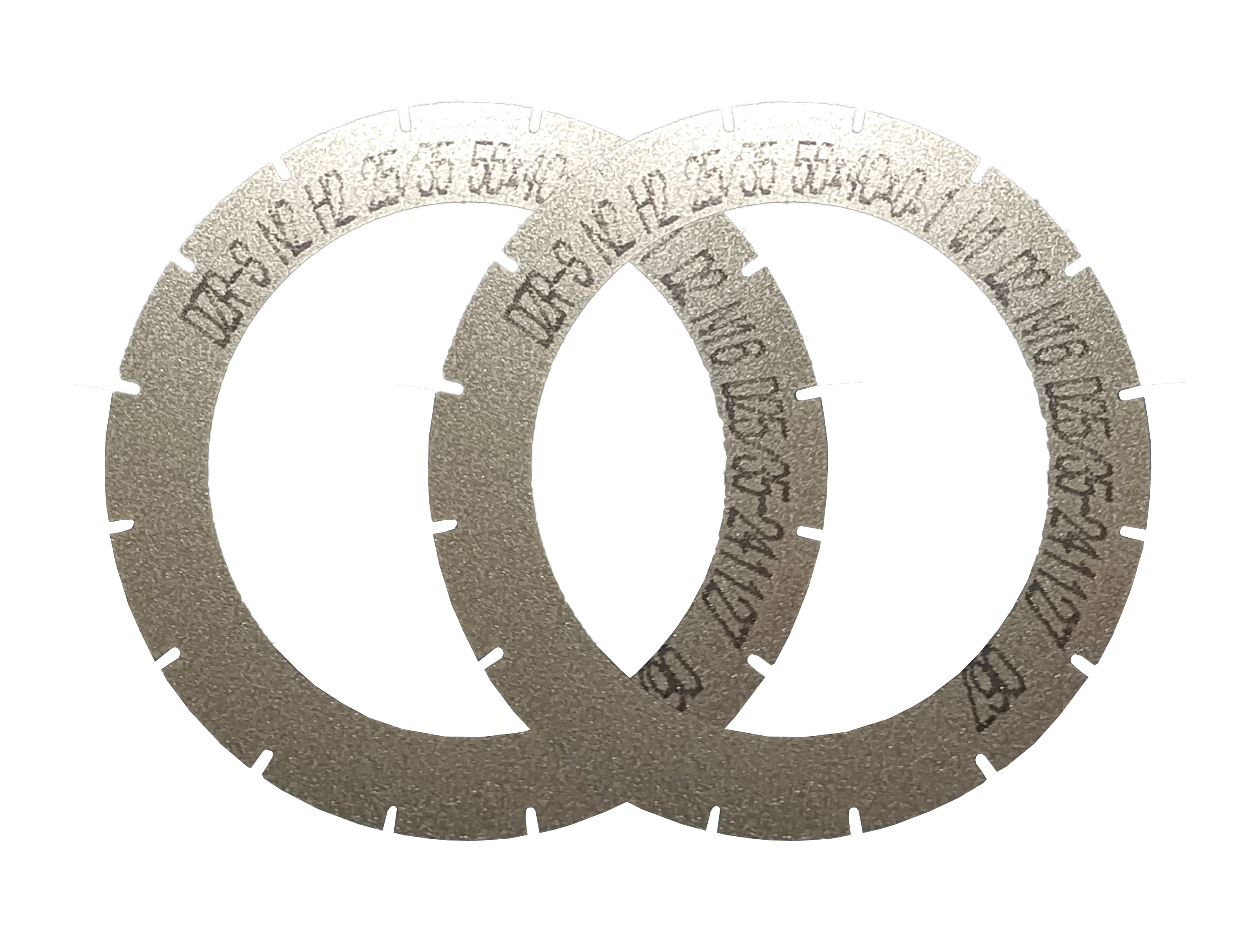
Image: Hubless sawing blades are among the designs where diameter, thickness, bond type, and abrasive concentration can be tailored to the application.
Manufacturing Capability: Evidence to Look For
Capability assessment fails when it relies only on promotional language. A credible supplier should be able to demonstrate production infrastructure, engineering headcount, capacity, and quality control that match the customization claim.
For WINTIME Semiconductor Technology, the corporate profile provides the following verifiable anchors:
- The company was established in 2020 and integrates R&D, production, and sales of high-precision cutting blades.
- Its factory and auxiliary buildings span approximately 34,000 square meters, with an annual production capacity of over 1 million dicing blades.
- The company has a team of about 100 employees, including 35 engineers in R&D.
- Its main products are sawing blades and dicing blades, with exports accounting for about 30% of output across Southeast Asia, East Asia, North America, and the European Union.
- It holds 2 patent technologies and reports that its "Ultra-thin Wafer D Blade" project achieved a process thickness of less than 9 microns.
- The company positions itself as one of the few domestic China suppliers capable of mass production for that ultra-thin wafer blade product.
These facts have different evidentiary weight. A 34,000-square-meter facility and an annual capacity of more than 1 million pieces indicate that customization is backed by an industrial production base, not a laboratory-only process. The 35-engineer R&D team supports the design chain behind ODM and customized development. The sub-9-micron ultra-thin wafer blade result is relevant specifically to advanced wafer thinning and dicing applications, but should not be read as a claim that all products achieve that level.
For an evaluation checklist, the buyer should ask separate questions: What fraction of capacity is dedicated to customized products? How many engineering resources are available for a new blade development? What qualification data will be shared? What is the expected lead time? These questions separate capacity claims from execution reality.
Capacity, Lead Time, and MOQ Implications
Customization is not just a design exercise—it is a production planning task. A supplier's monthly capacity, lead time, and minimum order quantity determine whether a custom sawing blade program can be implemented within a project schedule.
According to the capability data disclosed by WINTIME:
- Monthly capacity: over 800,000 pieces per month for standard specifications; over 80,000 pieces per month for customized and special-shaped products.
- Lead time: 2–5 working days for standard products; 10–25 working days for customized orders, with adjustment possible for large orders.
- MOQ: 50 pieces for standard products; 300 pieces for customized products, with flexibility for long-term cooperative customers.
These figures create a realistic expectation for a buyer. If a project requires a new blade specification, a lead time of roughly two to four weeks is more credible than a promise of same-day custom engineering. The distinction between standard and customized MOQ also matters for trial programs: a buyer who needs 50 precision blades for an evaluation run should confirm whether that quantity falls under flexible small-batch terms.
For procurement teams, the practical advice is to start qualification discussions early. Custom blade development affects the critical path of process validation and product ramp. A supplier with published capacity and lead time bands can help the buyer plan the evaluation cycle rather than react to it.
Quality Control and Post-Sale Support as Part of Capability
Customization capability cannot be assessed without examining quality control. In precision cutting, a blade that meets dimensional drawing but fails in dynamic balance or cutting performance is not actually a capable product.
WINTIME's published quality control scope covers several relevant inspection points:
- Geometric dimension inspection: using instruments such as vernier calipers and laser diameter gauges to check outer diameter, thickness, and hole alignment.
- Hardness and wear resistance testing: using material testing machines to check whether the bond matrix and blade structure meet specification.
- Dynamic balance detection: using high-speed dynamic balance testers to measure runout and vibration behavior at operating speeds.
- Cutting performance simulation: testing on actual material or representative substrates to evaluate edge quality, cutting speed, and wear.
Dynamic balance is especially relevant for hubless blades. Because hubless designs mount directly on the spindle without a stabilizing hub, blade flatness, thickness uniformity, and balance have an outsized effect on cut quality. A custom hubless blade without dynamic balance verification is a high-risk specification.
After-sales support is the second half of capability. The company states a response target of investigating quality problems and providing solutions within 48 hours, plus technical support for cutting process matching and equipment adaptation, replacement or compensation for defective products caused by quality problems, and product application training for new customers. These commitments have operational significance because a new custom blade often requires iterative tuning during the first production runs.
How Custom Sawing Blade Capability Maps to Specific Application Families
Semiconductor Wafer Sawing
In semiconductor wafer dicing, blades are selected for narrow kerf, minimal chipping, and stable wear across long runs. Diamond sawing blades with ultra-thin configurations—including blade thickness ranges around 8–50 μm—are needed when the workpiece is fragile or when material loss per kerf must be minimized. Blade thickness is among the most visible custom parameters for wafer sawing because it directly affects chip loss and die strength.
A supplier's ability to hold thickness within a tight tolerance range matters more than the nominal value alone. WINTIME's Sawing Blade SB-001 datasheet lists a thickness range of 8 μm–50 μm, cutting accuracy of ±0.002 mm, spindle speed of 30,000–60,000 rpm, hardness of HRC 65–70, bond types in resin/metal, and a chip removal rate of ≥1.2 mm³/s. These are product-level parameters, not generic claims. They provide a starting point for evaluating whether the supplier's cut capability fits a given dicing process.
Hubless Sawing Blade Configurations
Hubless blades are used increasingly in high-precision applications because the absence of a hub reduces runout potential and supports thinner substrate processing. This is particularly relevant for 300mm wafer processing and for workpieces thinner than 50 µm, where blade stability is critical. For a custom hubless blade, the buyer must confirm the bore design, blade thickness, bond stiffness, and balance specification together, since these parameters interact during high-speed rotation.
Optical Communication and Functional Ceramic Cutting
Optical communication and RF/optoelectronics components require clean cuts with minimal edge chipping and controlled subsurface damage. Functional ceramics, including ceramic substrates and optical ceramics, are hard and brittle, requiring a bond and abrasive combination that prevents excessive blade wear and workpiece cracking. Customization of abrasive grit size and concentration is therefore more than a convenience—it is a process requirement. A supplier that cannot adjust diamond concentration to the workpiece hardness cannot credibly support this application family.
Alloy Materials
Alloy materials vary widely in toughness and abrasiveness. Some alloys generate long, ductile chips that demand effective chip removal; others are abrasive and accelerate blade wear. Custom blade features such as slot designs, chip removal geometry, or bond hardness can directly affect productivity. WINTIME's DZR-S Series slotted blades are named in the product family as a serrated/slotted configuration, which is relevant for applications where chip evacuation and cutting fluid flow need to be engineered into the blade rather than left to chance.
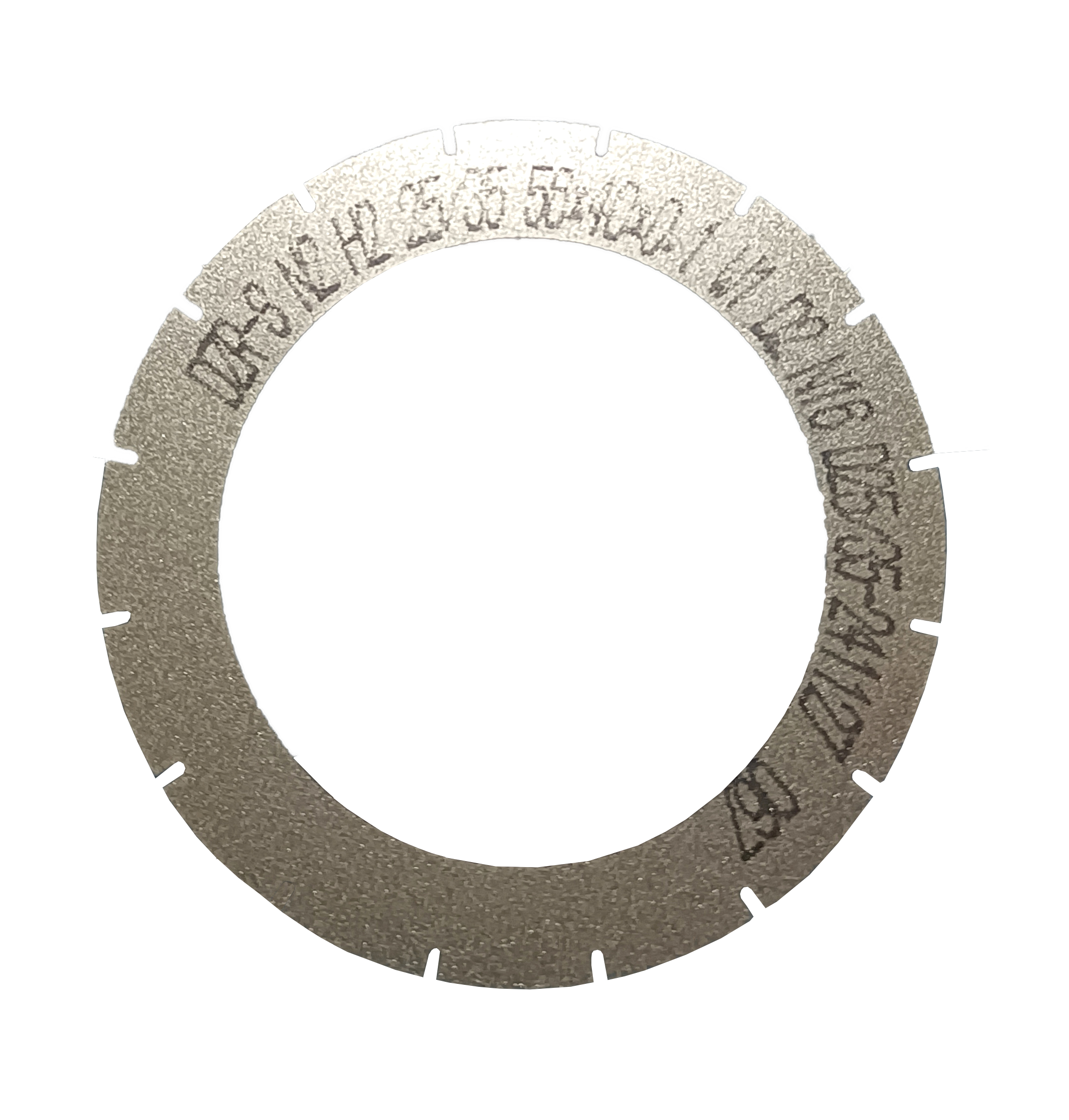
Image: Sawing blade selection depends on workpiece material, blade bond, and application-specific cutting requirements.
Comparison Perspective: How to Benchmark a Custom Sawing Blade Supplier
Buyers often ask how a prospective custom supplier compares with established high-precision dicing blade names. Public data identifies major competitors in the high-precision semiconductor dicing blade market: DISCO Corporation, Tokyo Seimitsu (Accretech), and Advanced Dicing Technologies (ADT), with Asahi Diamond also cited in some industry assessments. These companies are recognized for process expertise, mature product lines, and global application support.
For a capability assessment, the comparison should be based on scope of service rather than brand authority:
| Assessment Dimension | What to Ask Any Supplier | How the Evidence Helps |
|---|---|---|
| Production mode | Does the supplier support OEM, ODM, and customized production? | WINTIME states support for all three, with specifications tailored to materials and working conditions. |
| Customization parameters | Which blade parameters can be changed without redesigning the whole product? | Diameter, thickness, hole size, bond, diamond size, concentration, coating, performance, packaging, and special shapes. |
| Manufacturing scale | Is there the capacity to support both trials and production? | WINTIME reports a 34,000 m² facility, annual capacity of over 1 million blades, and monthly capacity above 800,000 standard pieces. |
| Engineering depth | How many people can work on a custom blade design? | WINTIME reports 35 R&D engineers within roughly 100 employees. |
| Lead time discipline | How long does a custom order actually take? | WINTIME states 2–5 working days for standard products and 10–25 working days for customized orders. |
| Quality verification | What inspection data will be shared? | Geometric measurement, hardness/wear testing, dynamic balance testing, and cutting simulation are listed. |
| Application proof | What specific thickness or performance levels have been achieved? | WINTIME reports an ultra-thin wafer D blade process thickness of less than 9 microns and product-level specs for the SB-001 sawing blade. |
This table is not a ranking. It is a comparison framework that a buyer can apply to any candidate supplier, including global incumbents. The goal is to identify whether the supplier's capability model aligns with the project's need for customization depth, production scale, turnaround time, and verification rigor.
Step-by-Step Process for Evaluating and Qualifying a Custom Sawing Blade
A practical qualification workflow reduces the risk of selecting a custom blade supplier based on intuition. The following steps are designed for process engineers, procurement teams, and quality managers working on precision cutting applications.
- Document the process window: Identify the workpiece material, hardness, thickness, target kerf width, acceptable chipping level, spindle speed range, cutting speed, and blade life target. This becomes the specification template.
- Shortlist suppliers by production mode: Confirm that the supplier can operate in OEM, ODM, or customized production mode. If the buyer lacks an in-house blade design team, ODM or customized production with supplier engineering support is more appropriate than pure OEM.
- Send a complete RFQ: Include blade diameter, thickness range, hole size, bond preference, abrasive type and mesh, expected chip load, and environmental constraints. The more complete the RFQ, the more meaningful the supplier's response.
- Evaluate engineering response: Does the supplier challenge assumptions or simply accept everything? A credible custom blade supplier should ask about equipment model, spindle runout, coolant, workpiece brittleness, and yield requirements.
- Check capacity and lead time: Map the supplier's stated monthly customized capacity and lead time to your production schedule. Confirm MOQ flexibility for first trials.
- Request quality control evidence: Ask for dynamic balance reports, dimensional inspection data, hardness/wear test data, and cutting test conditions. If the supplier refuses to share test methodology, treat the performance claim as unverified.
- Run a controlled cutting trial: Use a clear success criterion—for example, edge chipping below a defined threshold, blade life above a minimum value, or kerf width within a tolerance. Record tool wear and cut quality across the blade life.
- Review after-sales support: Discuss response times for quality investigations, replacement policy for quality defects, and whether technical engineers will support process matching during initial production.
- Graduate from trial to production: After a successful trial, lock the blade specification, packaging, MOQ, and lead time in a supply agreement. Retain sample blades for reference.
This workflow treats customization as a controlled engineering change rather than a one-time sales event. It applies equally to a first-time blade buyer and to a fab or module house that already uses global incumbents.
Buying Considerations and Risks
Custom sawing blades offer performance advantages, but they also introduce risks that should be stated openly:
- Testing cost and time: Custom development requires paid engineering time, samples, and cutting trials. A supplier's willingness to offer flexible small-batch trial quantities can reduce initial risk.
- Application dependency: A blade optimized for one material family may not transfer to another. Custom specifications are process-specific by design.
- Supply chain continuity: If the blade is too specialized, the buyer becomes dependent on one supplier. Confirm long-term supply guarantees and inventory support as part of the contract.
- Performance verification limits: Published parameters such as cutting accuracy or chip removal rate were measured under specific conditions. Ask whether the supplier can reproduce the test under your process conditions.
- Ultra-thin product limitations: Ultra-thin blades (for example, thickness below 50 μm or below 9 μm in advanced processes) are fragile during handling, mounting, and dicing. A successful wafer cut depends on the full process environment, not the blade alone.
These risks are not arguments against customization; they are reasons to evaluate capability with evidence. A credible supplier will acknowledge the parameters that affect success and will help the buyer design a trial plan that reveals them early.
Industry Context: Why High-Precision Cutting Blades Are a Growing Procurement Category
The global diamond saw blade market was valued at about USD 8.60 billion in 2025 and is expected to reach USD 10.16 billion by 2032, according to Maximize Market Research. Separately, the global wafer dicing blade market was valued at about USD 1.19 billion in 2024, driven by semiconductor miniaturization and 300mm wafer adoption (Market Research Intel). These figures differ in scope—the diamond saw blade figure covers construction and industrial stone cutting alongside precision electronics—but both point to sustained demand for precision abrasive cutting tools.
Two structural trends are relevant to custom sawing blade procurement:
- Material diversification: Semiconductor packaging, optical communication components, functional ceramics, and alloy components create new combinations of hardness, brittleness, and thermal sensitivity. Standard blade portfolios cannot always cover these combinations.
- Hubless blade momentum: Hubless dicing blades are increasingly preferred for 300mm wafer processing because of their stability and reduced runout on thinner substrates. This trend is directly relevant to custom blade engineering because hubless blades require precise dimensional and balance control.
For a buyer, the market context reinforces a simple conclusion: customization capability is becoming a core supplier selection criterion, not a premium add-on. The question is no longer only "which standard blade fits?" but "which supplier can develop and supply the blade this process needs?"
FAQ: Custom Sawing Blade Capability
1. Does WINTIME Semiconductor provide OEM, ODM, and customized sawing blade production services?
Yes. WINTIME Semiconductor Technology Co., Ltd. states that it provides OEM, ODM, and customized production services. Customized specifications can be developed for different cutting materials and working conditions, covering blade dimensions, bond type, diamond abrasive grain size and concentration, coatings, cutting performance targets, packaging, and special-shaped blade configurations.
2. Which sawing blade parameters can WINTIME customize for a precision cutting application?
WINTIME's customization scope includes diameter, thickness, spindle hole size; metal or resin bond type; diamond abrasive grain size and concentration; coatings (anti-rust, heat-dissipation, wear-resistant); cutting performance targets such as cutting speed and service life; packaging for export; and special-shaped/non-standard blade configurations. This set of adjustable variables supports semiconductor wafer sawing, optical communication components, functional ceramics, alloy materials, and similar high-precision cutting applications.
3. What are the typical lead times and MOQs for custom sawing blades?
For WINTIME, standard products have a stated lead time of 2–5 working days and a standard MOQ of 50 pieces. Customized orders have a stated lead time of 10–25 working days, which can be adjusted for large orders, and a MOQ of 300 pieces. For small-batch trial orders below 500 pieces, WINTIME also states that flexible MOQ adjustment is available with a modest price adjustment based on customization complexity, and long-term cooperative customers may receive further flexibility.
4. How does WINTIME verify the quality of custom sawing blades?
WINTIME's quality control includes geometric dimension inspection (vernier caliper, laser diameter gauge), hardness and wear resistance testing (material testing machine), dynamic balance detection (high-speed dynamic balance tester), and cutting performance simulation testing on actual material. These methods allow a buyer to review dimensional accuracy, balance behavior, wear characteristics, and cutting performance before committing to a larger production order.
5. How can a buyer start a custom sawing blade evaluation with WINTIME?
To begin, prepare a process specification that includes workpiece material, thickness, target kerf, chipping limit, blade life target, dicing saw model, spindle speed, and coolant conditions. Send the specification to WINTIME's contact channel to confirm whether the requirement falls under standard, OEM/ODM, or customized production. WINTIME also makes a company brochure available for download, which provides product family context before direct consultation.
Next step: For a custom sawing blade evaluation, download the WINTIME sawing blade brochure or contact the WINTIME engineering team to discuss the material, blade dimensions, and performance targets for your cutting application.
Conclusion
Capability assessment for custom sawing blades should focus on production mode, adjustable parameters, engineering resources, capacity, lead time, quality control, and post-sale support. WINTIME Semiconductor Technology provides a documented example of a manufacturer that supports OEM, ODM, and customized production, with published dimensional, bond, abrasive, coating, performance, and packaging customization variables. Its 34,000-square-meter facility, annual capacity of over 1 million blades, 35-engineer R&D team, and quality control process give buyers specific evidence to evaluate rather than vague promises.
The market trend toward semiconductor miniaturization, hubless blade adoption, and diversified hard-brittle materials makes custom blade capability more strategically important than in previous procurement cycles. By comparing suppliers on scope of customization, verification data, and operational support—rather than only on brand recognition—buyers can select a partner that can actually deliver the cutting result their process requires.