
Dicing Blade Selection by Project Type: A Scenario-Based Guide for Semiconductor, Optical and Ceramic Cutting
Dicing blades are one of the most process-critical consumables in precision manufacturing. The right blade can mean clean sidewalls, stable dimensional control, and lower cost per cut; the wrong blade can lead to chipping, excessive kerf loss, blade breakage, and yield loss. Because no single blade is optimal for every material, choosing a dicing blade should begin with the project type and process conditions, not with a generic catalog search. This guide explains how to match dicing blade design to common project scenarios – semiconductor wafer dicing, ultra-thin wafer processing, optical device cutting, ceramic substrate cutting, and precision alloy component cutting. It also draws on the verified product and application data from WINTIME Semiconductor Technology Co., Ltd., a China-based manufacturer of high-precision dicing blades.
The Problem: Why Project Type Drives Blade Selection
Dicing is a micromachining step where material properties, workpiece geometry, and factory environment interact directly with blade design. A silicon wafer used for chip packaging behaves differently from an optical glass component or a functional ceramic substrate. Each project places different demands on blade thickness, bond type, abrasive grit, edge quality, and the ability to operate in clean room conditions.
Without a clear project-type map, procurement teams often rely on one or two blade models for all cutting tasks. This can cause three common failures: small kerf and low chipping are required for high-value wafers, but standard blades may create micro-cracks; hard ceramics require wear-resistant blades, but resin-bond options may wear too quickly; optical devices demand stable dimensional control and anti-static operation, but a blade selected only for silicon may not deliver the same result.
The practical answer is to define the project scenario first – material, size, thickness, environment, and equipment – and then translate those requirements into blade specifications.
Industry Background: Market Signals for Dicing Blade Buyers
Market data helps explain why project-specific selection is not an optional best practice but a requirement. The global dicing blade market was valued at USD 1.31 billion in 2024 and is projected to reach USD 1.84 billion by 2034, according to Intel Market Research. Diamond-embedded dicing blades account for more than 60% of the total market share, supported by their performance on silicon carbide (SiC) and gallium nitride (GaN), according to the Wafer Dicing Blade Market Outlook 2026-2032.
Two additional industry references clarify what buyers should check. Standard outer diameter values for semiconductor wafer dicing blades are 55.56 mm (2.187 inches) and 76.2 mm (3.0 inches), and the typical diamond grit size for bare silicon dicing is 2–6 microns (#2000–#4000), according to the CMP Slurry Dicing Blade Guide and the ZYsuperhard Engineering Guide. For large-diameter wafers, hubless dicing blades are increasingly preferred for 300 mm wafer processing because of superior stability and reduced runout, as noted in the Semiconductor Wafer Dicing Blade Market: 2025-2033 Analysis. In parallel, resin bond blades still held an estimated 42% share of the dicing blade market in 2024, which means bond-type choice remains a major procurement variable.
These signals all point in one direction: project requirements define the correct blade architecture.
Detailed Solution: Matching WINTIME Dicing Blade Design to Project Requirements
The WINTIME DB-001 dicing blade family is designed to cover wafer dicing and scribing, semiconductor package cutting, ultra-thin wafer processing, optical device cutting, ceramic substrate cutting, and precision alloy component cutting. The product line includes diamond dicing blades, precision dicing blades, semiconductor dicing blades, circular dicing blades, hubbed and hubless dicing blades, flanged dicing blades, serrated dicing blades, DZY series wafer dicing blades, DZR series dicing blades, and DZR-S series slotted dicing blades.
The core material choices are metal bond (for metal dicing blades), resin bond (for resin dicing blades), and diamond abrasive grains as the functional cutting material. This allows the same blade platform to be tuned for different bond types and cutting conditions. The DB-001 series achieves ultra-thin thickness of ≤9 μm, high precision for wafer cutting, high cutting efficiency for semiconductor packaging, and stable performance for mass production, with an annual production capacity of over 1 million pieces.
For project-specific use, the product’s working conditions are as important as its geometry. The dicing blade is designed for Class 100/1000 clean room environments with constant temperature (22±2°C), constant humidity (45%–55%), dust-free and anti-static conditions, and high-speed spindle operation. It operates through high-speed spindle rotating cutting, dry/wet cutting, automatic dicing machine continuous operation, and precision feeding cutting mode. In these conditions, the blade functions to realize high-precision wafer cutting, ultra-thin slicing, narrow kerf, low chipping, high-efficiency cutting, and stable dimensional control.
This is also the basis for application-specific adaptation. For high-value semiconductor substrates, the product is suitable for ultra-thin wafer (8/12 inch) precision dicing and cutting of SiC/GaN, ceramic, and optical glass. For optical device cutting type projects, the anti-static design supports contamination-sensitive operations. For ceramic substrate cutting environments, the product is designed specifically for that material behavior. For ultra-thin wafer processing projects, the ≤9 μm blade thickness and narrow kerf help reduce material loss.
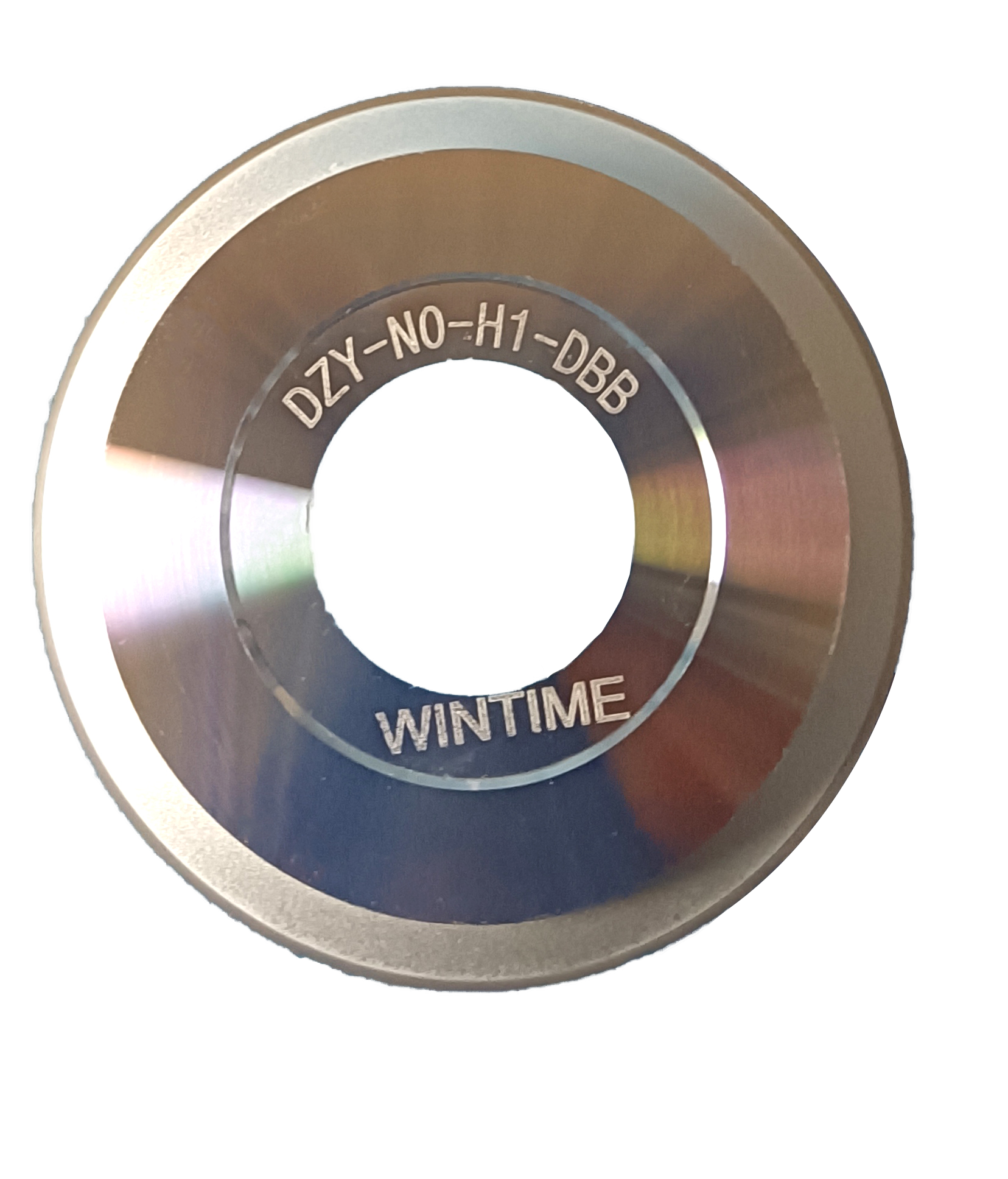
DZY series dicing blade from WINTIME’s DB-001 product family.
Step-by-Step Breakdown: From Project Requirement to Blade Specification
Use this five-step framework to convert a project scenario into a dicing blade specification.
Step 1. Define the workpiece and cutting objective
Record the material type (silicon, SiC, GaN, ceramic, optical glass, alloy), workpiece size, wafer thickness, and whether the project requires ultra-thin slicing, narrow kerf, low chipping, or stable dimensional control. These items determine the blade’s role in the process.
Step 2. Define the process environment
Confirm the clean room class, temperature and humidity range, anti-static requirements, and spindle speed. For clean room Class 100/1000 operations, the blade must be compatible with constant temperature (22±2°C), constant humidity (45%–55%), dust-free and anti-static conditions.
Step 3. Select the blade family
Choose the main design architecture: metal bond or resin bond, hubbed or hubless, solid or slotted, and whether the application needs a DZY, DZR, or DZR-S series. For 300 mm wafer processes, hubless designs are increasingly preferred because of reduced runout and better stability.
Step 4. Verify dimensional and abrasive specifications
Check the outer diameter (e.g., 55.56 mm or 76.2 mm), blade thickness (e.g., ≤9 μm for ultra-thin work), and grit size (e.g., 2–6 microns for bare silicon). These values must match the machine spindle and the material being cut.
Step 5. Validate with a sample test
Run a cutting test under the actual process mode – high-speed spindle rotating cutting, dry/wet cutting, automatic dicing machine continuous operation, or precision feeding cutting – and measure chipping, kerf width, dimensional control, and blade life before volume production.
Use Cases: Application Scenarios Covered by the DB-001 Blade
Semiconductor packaging – 8/12-inch wafer dicing
A semiconductor packaging factory in China has used WINTIME dicing blades for over three years, with annual usage of 500,000+ pieces on high-precision dicing of 8–12 inch semiconductor wafers for chip packaging. The verified result was a cutting chipping rate of ≤5 μm, a wafer yield increase of 12%, and stable mass production without blade replacement. The highlight of the project was the ultra-thin blade thickness of ≤9 μm, narrow kerf, low material loss, and long service life.
Ultra-thin wafer processing
For projects that require ultra-thin wafer processing, the blade must maintain a small kerf while protecting the wafer edge. The DB-001 series is suitable for ultra-thin wafer processing projects and supports the ≤9 μm ultra-thin thickness needed to reduce material loss.
Optical device cutting
Optical communication components often require contamination-free, dimensionally stable cutting. The DB-001 blade is applied in optical device cutting type projects. Its anti-static operation is especially relevant in clean room environments where electrostatic discharge can damage sensitive components.
Functional ceramic substrate cutting
Ceramic substrates are abrasive and prone to edge chipping if the blade is not matched correctly. The product is designed for ceramic substrate cutting environments, where high wear resistance and stable dimensional control are necessary for repeated precision cuts.
Precision alloy component cutting
For metallic or alloy components, blade wear and dimensional accuracy matter over long production runs. The DB-001 series supports precision alloy component cutting projects, with high-efficiency cutting and stable dimensional control in the same process envelope.
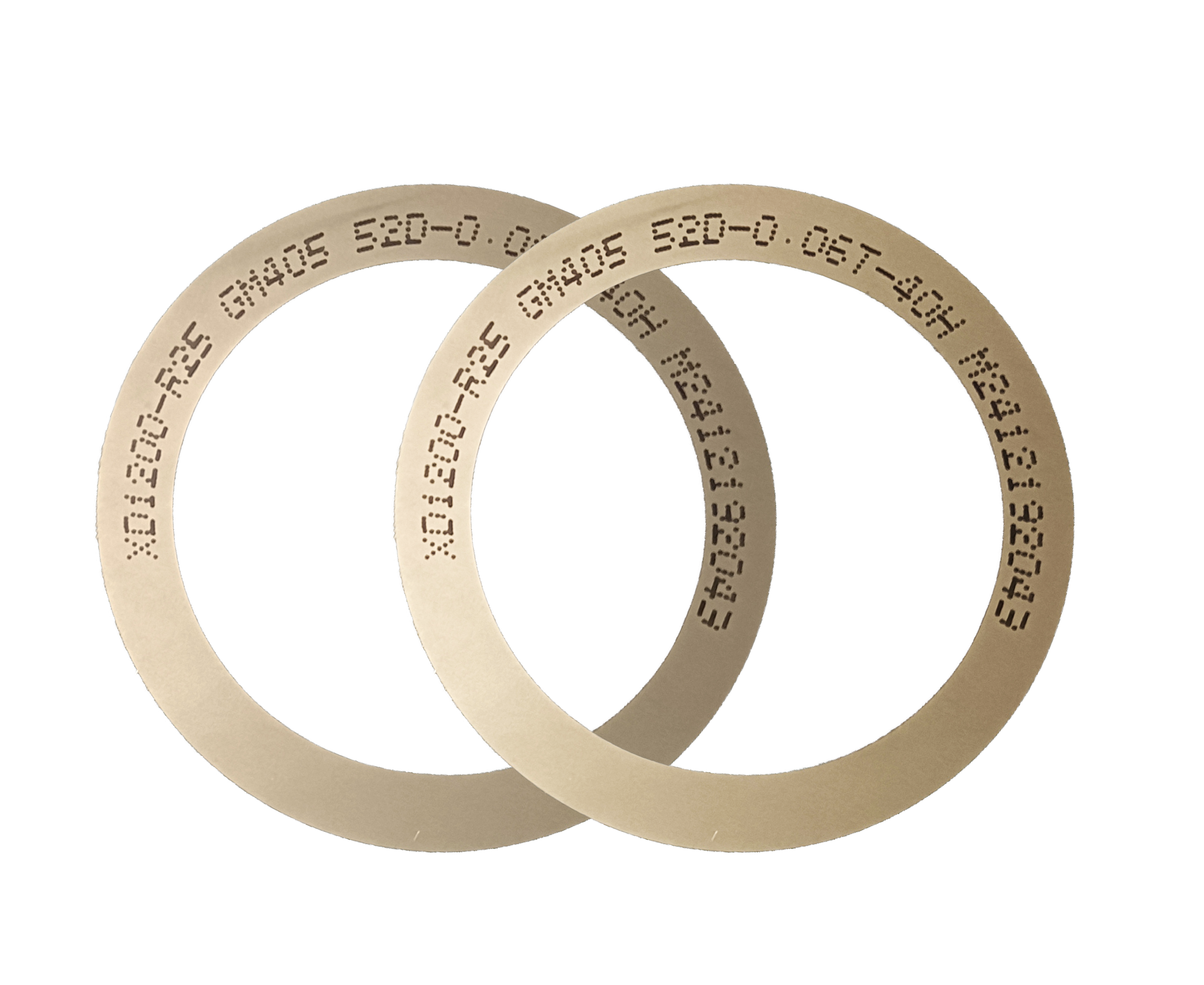
JS series metal dicing blade from WINTIME.
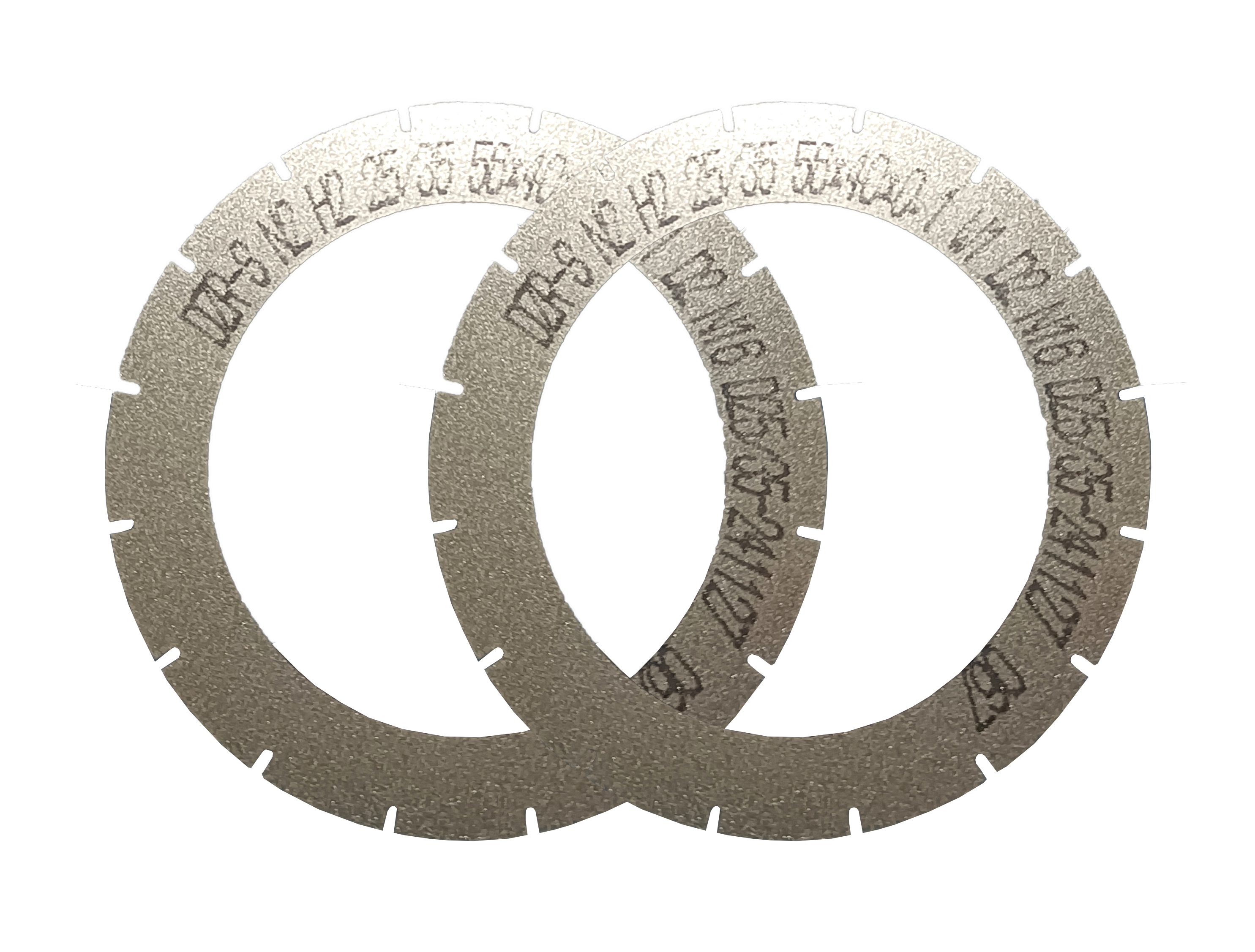
DZR-S series slotted slicing dicing blade.
Comparison Table: Project Type vs. Blade Selection Criteria
| Project Type | Primary Cutting Demand | Recommended Blade Characteristics | Verification / Reference |
|---|---|---|---|
| 8/12-inch semiconductor wafer dicing for packaging | Low chipping, narrow kerf, stable mass production | Ultra-thin ≤9 μm, hubless design for large wafers, diamond grit 2–6 μm for bare silicon | Case: 500,000+ pcs/yr, chipping ≤5 μm, wafer yield +12% |
| Ultra-thin wafer processing | Material loss control, high precision | Ultra-thin blade ≤9 μm, narrow kerf | DB-001 ultra-thin thickness ≤9 μm |
| Optical device cutting | Anti-static, contamination control, dimensional stability | Anti-static operation, clean room compatibility, high-precision cutting | Applicable to optical device cutting projects; anti-static conditions |
| Functional ceramic substrate cutting | Wear resistance, edge quality | Designed for ceramic substrate cutting, high wear resistance | Product designed for ceramic substrate cutting environments |
| Precision alloy component cutting | Long blade life, stable dimensional control | Metal or resin bond options, high-efficiency cutting | Applicable to precision alloy component cutting projects |
FAQ: Dicing Blade Selection for Project and Process Scenarios
What clean room and environmental conditions are required for WINTIME dicing blades?
WINTIME dicing blades are designed for Class 100/1000 clean room environments, with constant temperature (22±2°C), constant humidity (45%–55%), dust-free and anti-static conditions. They are also compatible with high-speed spindle environments. These conditions should be confirmed before the blade is used.
Which project types can the DB-001 dicing blade handle?
The DB-001 series is suitable for wafer dicing and scribing, semiconductor package cutting, ultra-thin wafer processing, optical device cutting, ceramic substrate cutting, and precision alloy component cutting. It is also suitable for ultra-thin wafer (8/12 inch) precision dicing and high-value semiconductor substrate cutting such as SiC, GaN, ceramic, and optical glass.
What are the ordering quantities and customization options?
For standard products, the minimum order quantity is 100 pieces; for customized products, it is 500 pieces, and bulk orders are negotiable. Customization options include blade thickness (from ultra-thin ≤9 μm to standard specifications), diamond abrasive grain size and concentration, bond type (resin bond or metal bond), outer diameter, inner diameter, overall dimensions, coating (anti-static, wear-resistant), cutting performance parameters, and packaging/labeling.
Can samples be requested before mass production?
Yes. WINTIME supports sample validation before mass production. The company provides professional technical consultation and application guidance, and after-sales feedback is answered within 24 working hours. For a sample request, contact WINTIME directly by email or WhatsApp; the contact details are listed at the end of this article.
What is the lead time for standard and customized dicing blades?
Standard models can be delivered in 3–7 working days. Customized orders typically take 15–30 working days, depending on customization complexity and order quantity. Monthly capacity exceeds 1,200,000 pieces for standard models and 50,000 pieces for custom specifications. If you have a project timeline, share it during inquiry and WINTIME will confirm the delivery schedule.
Conclusion
Selecting a dicing blade by project type is the most reliable way to control chipping, kerf loss, blade life, and overall yield. The process starts with a clear definition of the workpiece, environment, and cutting mode, and then maps those requirements to a specific blade design. WINTIME Semiconductor Technology Co., Ltd. offers a broad DB-001 dicing blade family with ultra-thin capability, multiple bond types, and clean room compatibility, supported by a 34,000 m² manufacturing facility and annual production capacity of over 1 million pieces. WINTIME has also completed an ultra-thin wafer dicing blade project at a thickness below 9 microns and is one of the few domestic companies able to mass-produce this specification.
Next step: validate your application with WINTIME.
Request a sample or quote before scaling up production. WINTIME provides OEM/ODM customization for thickness, abrasive size, bond type, dimensions, coating, and packaging. Contact the team at shenxiangfei@ntwintime.com or WhatsApp +86 18888053207.
Download the WINTIME brochure: WINTIME Semiconductor Product Brochure (PDF)
Contact WINTIME for sample requests, quotes, and customized blade solutions.
Have Questions or Need More Details?
Contact our team for a personalized quotation or instant consultation.
Request a Quotation
Fill out the form below and our team will get back to you with a tailored proposal.
WhatsApp Direct Chat
Prefer to chat in real-time? Message us on WhatsApp for instant assistance & quick answers.
- Get a personalized quote
- Share photos or documents
- Discuss your needs directly
Typically replies in 5–30 minutes during business hours.