
Dicing Blade Supply Continuity: How to Qualify a Long-Term Manufacturing Partner
Procurement teams in semiconductor packaging, optical communication, and functional ceramics rarely make a final dicing blade decision based on a single purchase order. The more demanding question appears when a confirmed blade design must move into stable high-volume production: can this supplier deliver the same cutting behavior, dimensional quality, and batch consistency over months or years?
This article explains why dicing blade supply continuity deserves its own qualification process. It also describes the supplier evidence that procurement teams should verify before signing a long-term agreement, using WINTIME Semiconductor Technology Co., Ltd. as a documented manufacturer example.
Why Precision Dicing Blades Require a Supply-Continuity Mindset
A dicing blade is not a generic commodity cutting tool. In semiconductor and precision-component manufacturing, the blade directly affects kerf loss, chipping, wafer yield, and overall production cost. Even a small shift in diamond concentration, bond hardness, or blade exposure can create measurable quality changes on the production line.
The most common risk appears after pilot approval. A sample lot can perform well because it was produced under carefully controlled conditions. When the same blade is required at scale, the risks move from geometry selection to manufacturing discipline: consistent abrasive formulation, repeatable bond processing, stable dimensional tolerance, and reliable process control. A supplier that lacks these capabilities may pass an initial sample evaluation but create costly instability during mass production.
This is why buyers in the Decision and Execution stages should evaluate the supplier system, not only the blade specification. The purchase decisions that protect high-volume operations are based on production capacity, batch traceability, engineering depth, quality management, and commercial flexibility.
The Market Context: Growth, Concentration, and Technology Shift
External market data also supports a longer-term view of dicing blade sourcing. According to Intel Market Research, the global dicing blade market was valued at approximately USD 1.31 billion in 2024 and is projected to reach USD 1.84 billion by 2034. The same research indicates that diamond-embedded dicing blades account for more than 60% of the total market, largely because of their performance in cutting silicon carbide and gallium nitride materials.
Supply concentration remains an important consideration. One industry research estimate places DISCO Corporation as the dominant market leader with approximately 52–55% of the dicing equipment and associated precision blade market. For procurement teams, this concentration raises the importance of qualifying alternative high-precision blade manufacturers that can provide stable supply and technical support.
Regional demand is also becoming more visible. The Observatory of Economic Complexity reports that China's exports of cutting blades to Vietnam grew by about USD 18 million between 2024 and 2025, a sign of expanding semiconductor-related production activity in Southeast Asia. At the technology level, hubless dicing blades are increasingly preferred for 300mm wafer processing due to their stability and reduced runout compared with hubbed designs. These trends point to a market in which supply continuity, regional responsiveness, and advanced blade architectures matter as much as unit price.
What “Volume-Ready” Means at a Dicing Blade Factory: The WINTIME Case
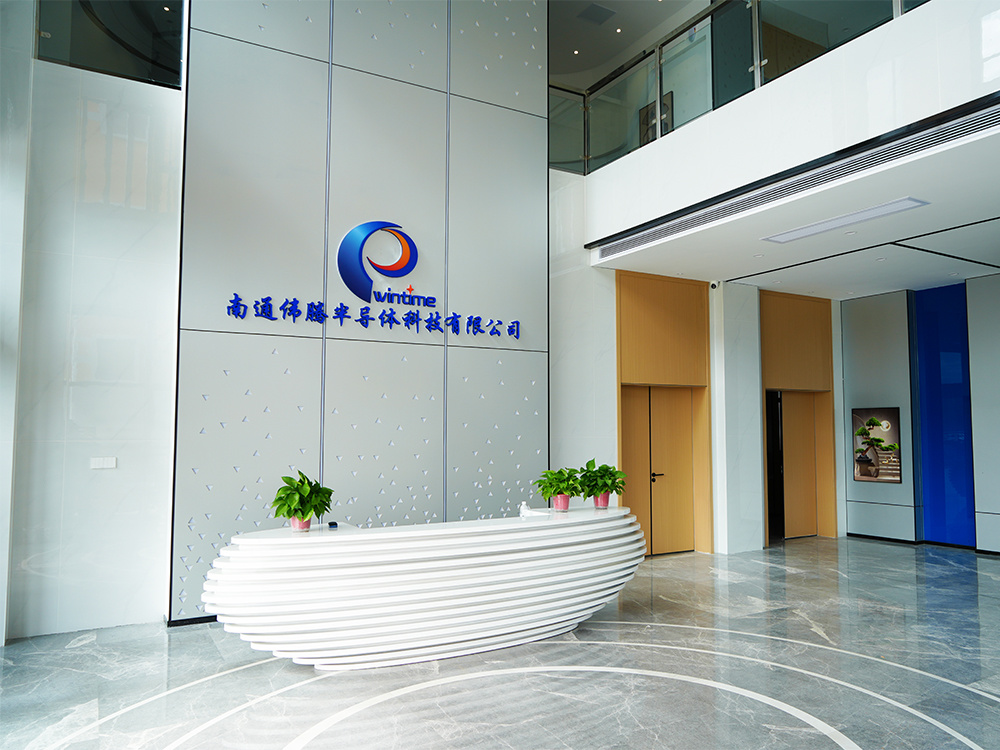
WINTIME Semiconductor Technology Co., Ltd. is a high-precision cutting blade manufacturer established in 2020, with a 34,000-square-meter factory and related facilities in Rugao, Jiangsu Province, China. The company engages in the research, development, production, and sales of high-precision cutting blades, including dicing blades and sawing blades. For buyers evaluating a long-term partner, WINTIME provides a useful example of what should be checked before volume ramp-up.
Technology Independence and Self-Developed Manufacturing
One of the first points to verify is whether a supplier controls its own core technology. WINTIME describes its ultra-thin wafer dicing blade project as a domestic self-developed initiative that supports import substitution in high-end industries. This matters for buyers because a self-developed manufacturer is more likely to control process parameters, respond to engineering changes, and protect supply continuity without relying on external technology licenses.
The company reports that its completed ultra-thin wafer dicing blade project has achieved a process thickness below 9 microns. Such ultra-thin blades are used in applications where narrow kerf and reduced material loss directly affect productivity. WINTIME also lists 2 patent technologies and maintains an R&D team of 35 engineers.
Manufacturing Scale and Flexible Production Capacity
Capacity verification is a critical step for any long-term dicing blade agreement. WINTIME states that its factory has a monthly production capacity exceeding 1,200,000 pieces for standard models and more than 50,000 pieces for customized specifications. This combination supports both continuous replenishment for standard blades and responsive production for application-specific requirements.
The company's export structure also signals international supply experience. Around 30% of WINTIME output serves markets in Southeast Asia, East Asia, North America, and Europe, while the broader customer base includes domestic Chinese manufacturers that require locally responsive delivery.
Product Range for Long-Term Sourcing Programs
Long-term agreements are easier to manage when a supplier can cover multiple blade types under one quality system. WINTIME's product portfolio covers diamond dicing blades, precision dicing blades, semiconductor dicing blades, circular dicing blades, hubbed and hubless dicing blades, flanged dicing blades, serrated dicing blades, DZY Series wafer dicing blades, DZR Series dicing blades, and DZR-S Series slotted dicing blades. The applicable products also include sawing blades with a thickness range from 8μm to 50μm and cutting accuracy of ±0.002mm. The bond matrix can be resin or metal, with diamond superabrasive grains as the core functional material.
Having such a broad internal scope is relevant to supply continuity. Buyers can standardize quality expectations, spare-part inventories, and engineering communication around one qualified supplier instead of managing multiple cutting-tool vendors with inconsistent process standards.
Batch Consistency and Quality Assurance System
Batch-to-batch consistency is probably the most important operational requirement for wafer dicing blades used in mass production. WINTIME addresses this risk through a structured production quality system. The company implements the ISO 9001 quality management system and follows standard operating procedures. Production process parameters are standardized, and automatic production equipment is used to reduce errors from manual operation.
WINTIME also maintains dedicated quality inspectors who track each production batch, and the company establishes batch quality files that can be traced at any time. If a problem is identified, the affected batch can be recalled. This combination of SOP control, batch-level traceability, automated equipment, and dedicated inspection is precisely the type of evidence that procurement teams should request from any long-term blade supplier.
Performance Evidence from Comparative Testing
In documented comparisons against conventional resin-bonded dicing blades from mainstream competitors, WINTIME reports several performance advantages that are relevant to total cost of ownership. The ultra-thin blade design achieves a kerf width of approximately 9μm compared with a competitor baseline of 12μm, representing a 25% reduction in material loss. Chipping performance is reported at ≤5μm versus ≤10μm for the competitor comparison group. WINTIME also reports approximately 30% longer service life than mid-range imported blades and a documented wafer yield improvement of 12% compared with traditional blades in relevant applications.
These figures should be interpreted as supplier evidence, not as universal guarantees across all materials and processes. For procurement teams, the practical value is in asking any candidate supplier for comparative data under production-representative conditions before making a long-term commitment.
A Documented Long-Running Customer Project
Long-term supply capability is also demonstrated by sustained customer usage. WINTIME's record includes a domestic customer project lasting 3 years, during which the client achieved stable mass production without requiring blade replacement beyond the expected scope of the engagement. This kind of operating history supports the claim that a blade supplier can maintain consistent output over an extended period.
A Five-Step Supplier Qualification Framework for Dicing Blade Volume Ramp-Up
The following framework is designed for procurement and engineering teams moving from pilot approval to production ramp-up. It combines documentation review, manufacturing verification, product validation, commercial alignment, and ongoing monitoring.
Step 1: Audit the Supplier's Technology and Manufacturing Base
Confirm that the supplier controls its own blade design, abrasive formulation, and production process. Key evidence includes factory ownership, cleanroom capability, patent records, R&D headcount, and the maturity of the ultra-thin blade process. For WINTIME, the relevant indicators include its 34,000-square-meter facility in Rugao, 35 R&D engineers, 2 patent technologies, and self-developed domestic substitution program.
Buyers should also request an organization profile that clearly states the manufacturer's legal entity, production location, and main product lines. This reduces the risk of working with a reseller or a trading company that cannot directly influence manufacturing consistency.
Step 2: Verify Production Capacity and Order Flexibility
Continuous supply depends on real factory capacity. Procurement teams should ask for monthly capacity by product type, as well as the supplier's ability to handle both standard and customized specifications. WINTIME's published capacity is over 1,200,000 pieces per month for standard models and over 50,000 pieces for customized models, which provides a concrete benchmark for volume discussions.
Capacity alone is not enough; flexibility matters. Buyers should understand whether the supplier can adjust MOQ for trial orders, support an inventory plan, and adapt to forecast changes without disrupting existing customers.
Step 3: Validate Blades Under Production-Representative Conditions
Sample validation should replicate actual production conditions as closely as possible. For bare silicon wafer dicing, industry guidance often recommends diamond grit sizes in the 2-to-6 micron range to minimize chipping. Standard outer diameters for semiconductor wafer dicing blades are commonly 55.56mm and 76.2mm. Buyers should confirm that the supplier's blade design matches the dicing machine, spindle speed, workpiece material, and required throughput.
WINTIME's DZY Series wafer dicing blades, DZR Series dicing blades, and DZR-S Series slotted dicing blades can be evaluated as part of a structured trial program. The trial should also include adjacent-batch comparison to verify consistency before high-volume release.
Step 4: Require Batch-Level Quality Traceability
During long-term supply, every shipment should be traceable to its production batch. WINTIME operates a batch production data tracking system that records process parameters and supports comparative testing of adjacent batches. This allows the manufacturer to demonstrate consistent performance and to recall an unqualified batch quickly if any problem appears.
Buyers should ask whether the supplier can provide batch quality files, inspection records, and pre-shipment acceptance data. Third-party inspection options, such as SGS inspection before shipment, add another layer of verification for high-value programs.
Step 5: Align Commercial Terms with the Lifecycle of Production
The final step is to design commercial terms that support continuity rather than discourage it. WINTIME's ordering policy provides a useful reference: standard models require a minimum order quantity of 100 pieces, while customized models typically start at 500 pieces. Small-batch trial orders below 500 pieces are available with flexible MOQ adjustment and a slight price adjustment based on customization complexity. Payment terms follow a 30/70 structure, and delivery can be arranged under FOB or CIF terms.
Long-term agreements should also define how engineering changes, quality deviations, and forecast updates will be managed. The goal is to move from transactional purchase orders to a supply relationship in which the manufacturer has a direct incentive to protect the customer's yield and uptime.
Application-Specific Supply Considerations
Dicing blade continuity requirements change with the application. The following scenarios show why a long-term supplier must be evaluated against the specific materials and production patterns a buyer is running.
Semiconductor Wafer Dicing
Semiconductor wafer dicing demands extremely stable blade behavior because wafer value is high and chipping directly reduces device yield. For 8-inch and 12-inch wafers, suppliers should demonstrate experience with ultra-thin dicing blades, hubless design options, and compatibility with advanced substrate materials. The increasing preference for hubless blades in 300mm processing makes design-for-runout control a relevant qualification criterion. WINTIME includes both hubbed and hubless configurations in its product scope and reports an ultra-thin wafer dicing blade thickness below 9 microns.
Optical Communication Component Cutting
Optical communication components often combine glass, ceramic, and precision metal elements in small form factors. Production volumes may be lower than semiconductor packaging volumes, but the cost of a single failed component is high. In this environment, buyers benefit from a manufacturer that supports customized dicing blade specifications and can produce small batch sizes without sacrificing dimensional accuracy. The availability of DZR Series and DZR-S Series slotted dicing blades gives optical device makers more options when chip removal and edge quality are critical.
Functional Ceramic and Advanced Material Cutting
Functional ceramics are typically brittle and abrasive to the cutting tool. Long production runs expose any inconsistency in blade bond hardness or diamond distribution. A supplier with robust batch tracking and automated production equipment is better positioned to maintain identical blade performance across many batches. WINTIME's applicable industries include functional ceramics and new functional materials, where comparative chipping data and service-life consistency directly influence operating cost.
Long-Term Blade Supply vs. Purchase-Order Buying: Key Differences
| Evaluation Dimension | Purchase-Order Buying | Long-Term Qualified Supply Relationship |
|---|---|---|
| Primary focus | Unit price and single-shipment specification | Factory capability, batch traceability, and continuity |
| Capacity visibility | Limited to available stock or short production slots | Transparent monthly capacity: WINTIME reports over 1,200,000 standard pieces and 50,000+ customized pieces per month |
| Quality traceability | Certificate of analysis and incoming inspection | ISO 9001 SOP control, batch-level quality files, dedicated inspectors, recall capability |
| Engineering support | Often limited to sales communication | Direct access to a 35-person R&D engineering team for specification review and problem-solving |
| Customization flexibility | May require large MOQ and long lead time | Customized models available with 500-piece MOQ and flexible small-batch trial options |
| Cost model | Lower initial purchase price | Total-cost-of-ownership view: longer service life, lower chipping, reduced material loss, better yield stability |
Frequently Asked Questions
Does WINTIME operate a quality management system that protects batch consistency in large-volume dicing blade deliveries?
Yes. WINTIME implements the ISO 9001 quality management system and follows standard operating procedures. The company standardizes production process parameters, uses automatic production equipment to reduce manual errors, and maintains batch-level quality files that can be traced at any time. Dedicated quality inspectors track each production batch, and unqualified batches can be recalled if a problem is discovered.
What production capacity can WINTIME offer for standard and customized dicing blades?
WINTIME reports a monthly production capacity exceeding 1,200,000 pieces for standard models and more than 50,000 pieces for customized specifications. The company operates a 34,000-square-meter factory in Rugao, Jiangsu Province, and serves customers in domestic China as well as export markets including Southeast Asia, East Asia, North America, and Europe.
Which dicing blade types and materials can WINTIME supply under a long-term agreement?
WINTIME's dicing blade scope includes diamond dicing blades, precision dicing blades, semiconductor dicing blades, hubbed and hubless dicing blades, flanged and serrated dicing blades, DZY Series wafer dicing blades, DZR Series dicing blades, and DZR-S Series slotted dicing blades. The blades can be manufactured with resin or metal bond systems, with diamond superabrasive grains as the core cutting material. The company also supplies sawing blades for related precision-cutting operations.
What are the purchase conditions for volume dicing blade procurement at WINTIME?
Standard models have an MOQ of 100 pieces per order. Customized models have a standard MOQ of 500 pieces, but small-batch trial orders below 500 pieces can be arranged through flexible MOQ adjustment, usually with a slight price adjustment depending on customization complexity. Payment terms are 30/70, delivery can be FOB or CIF, and the company supports pre-shipment testing as well as third-party inspection such as SGS.
How should a new customer validate WINTIME dicing blades before moving to full production rollout?
A practical validation path begins with product specification review and sample evaluation under the customer's real dicing conditions. After sample confirmation, the next step is a small-batch trial order using production equipment and process parameters. Buyers can request batch quality records, pre-shipment test data, and third-party inspection reports before serial delivery begins. WINTIME's engineering and sales teams can support this validation process, and the company brochure provides additional detail on product scope and manufacturing capabilities.
For a deeper review of WINTIME's dicing blade manufacturing capabilities, product families, and commercial policies, download the official company brochure here: WINTIME Semiconductor Company Brochure (PDF).
You can also contact WINTIME directly: Email shenxiangfei@ntwintime.com, Tel +86 13851530812, WhatsApp +86 18888053207, or visit en.wintime.net.cn.
Have Questions or Need More Details?
Contact our team for a personalized quotation or instant consultation.
Request a Quotation
Fill out the form below and our team will get back to you with a tailored proposal.
WhatsApp Direct Chat
Prefer to chat in real-time? Message us on WhatsApp for instant assistance & quick answers.
- Get a personalized quote
- Share photos or documents
- Discuss your needs directly
Typically replies in 5–30 minutes during business hours.