
Evaluating a Dicing Blade Manufacturer: Key Capabilities and Guarantees for Bulk Supply
A dicing blade manufacturer should be audited on five verifiable layers before a bulk purchase order is released: R&D depth, physical scale, documented output, quality-control evidence, and commercial guarantees. Each layer can be tested with a specific number, procedure, or contractual term rather than with a claim. WINTIME Semiconductor Technology Co., Ltd., a blade manufacturer founded in 2020 and based in Rugao City, Jiangsu Province, China, is used throughout this guide as a worked example of what that evidence looks like in practice.

Why Bulk Dicing Blade Supply Fails Differently From a Single-Unit Purchase
Dicing blades are consumables. A buyer does not inspect a finished assembly once and sign it off; the buyer consumes the product continuously, across hundreds of thousands of cuts, on equipment that must also hold its own tolerances. That changes what a supplier audit is for.
In a single-unit purchase, the risk is a wrong specification. In a bulk programme, the risk is drift: lot-to-lot variation in abrasive concentration, small changes in blade thickness, a shifted bond formulation, a delivery date that moves by three weeks, or a specification that no longer matches what the dicing platform was qualified for. None of these appear as a visible defect on the invoice. They appear as yield loss, higher chipping, more frequent blade changes, and unplanned line downtime.
Capability, for the purposes of this evaluation, therefore has a precise definition: the ability to reproduce a qualified blade specification at volume, on schedule, with a documented route for changing that specification when the application changes. Everything in the five-layer audit below is designed to test one or more parts of that sentence.
Industry Background: What the Dicing Blade Market Expects From a Manufacturer
Dicing blades sit at the intersection of consumable economics and precision engineering, and the market data reflects that. Intel Market Research values the global dicing blade market at USD 1.31 billion in 2024, with a projection of USD 1.84 billion by 2034. Published estimates differ considerably depending on whether a source counts pure blade revenue or equipment-linked consumables, so any single figure should be read as a scope-dependent estimate rather than a settled number.
Two structural features of the market matter for supplier evaluation:
- Diamond-embedded blades dominate. Diamond-embedded dicing blades account for over 60% of total market share, according to the Wafer Dicing Blade Market Outlook 2026-2032, driven by performance on silicon carbide and gallium nitride. A manufacturer without diamond-bond process control is competing in a minority segment.
- Supply is concentrated at the top and fragmented below it. DISCO Corporation holds an estimated 52–55% global share across dicing equipment and associated precision blades. That concentration means most alternative suppliers are being evaluated precisely because a buyer wants a second source — and a second source is only useful if its capability is independently documented.
On the specification side, the constraints buyers inherit from their own equipment are tight. Standard outer diameters for semiconductor wafer dicing blades are 55.56 mm (2.187 in) and 76.2 mm (3.0 in), per CMP Slurry's dicing blade specification guide. For bare silicon dicing, the industry-standard diamond grit range is 2–6 microns (#2000 to #4000), per ZYsuperhard's engineering guide, in order to minimise chipping. Hubless dicing blades are increasingly preferred for 300 mm wafer processing because of superior stability and reduced runout compared with hubbed designs. Resin bond blades held an estimated 42% share of the market (USD 183.6 million) in 2024, which is why bond type — resin versus metal — remains a central audit question rather than a footnote.
Regionally, tool demand is also shifting. China's exports of cutting blades to Vietnam grew by USD 18 million between 2024 and 2025, according to the Observatory of Economic Complexity, which indicates rising regional demand for semiconductor tools and, with it, more buyers qualifying new blade suppliers across borders.
The Five-Layer Capability Audit
The framework below is deliberately layered. Each layer is harder to fake than the one before it, so a supplier that survives all five is unlikely to be presenting a brochure rather than a factory.
Layer 1 — R&D Depth: Can the Manufacturer Move a Specification?
R&D depth answers one question: when your cut stops performing, can the supplier change the blade? A trading intermediary can quote a catalogue; only a manufacturer with in-house development can adjust grain size, bond chemistry, or blade geometry against a specific failure mode.
WINTIME Semiconductor Technology Co., Ltd. maintains a 35-engineer R&D team and holds two patent technologies, with awards in national, provincial, and municipal science and technology and entrepreneurship competitions. The company's completed "Ultra-thin Wafer D Blade" project achieved a blade thickness of less than 9 microns, and WINTIME is one of the few domestic companies capable of mass-producing ultra-thin dicing blades at that thickness.
For a buyer, the practical test is not the size of the team but its output: ask for a documented case in which a blade specification was changed to solve a named problem — chipping on a brittle material, kerf width, or blade life on a hard substrate — and ask which parameter was changed to do it.
Layer 2 — Physical Scale: Is the Capacity Real or Contracted Out?
Scale is verifiable in a way that capability claims are not. A facility can be walked, filmed, or checked against the address on the certificate of incorporation.
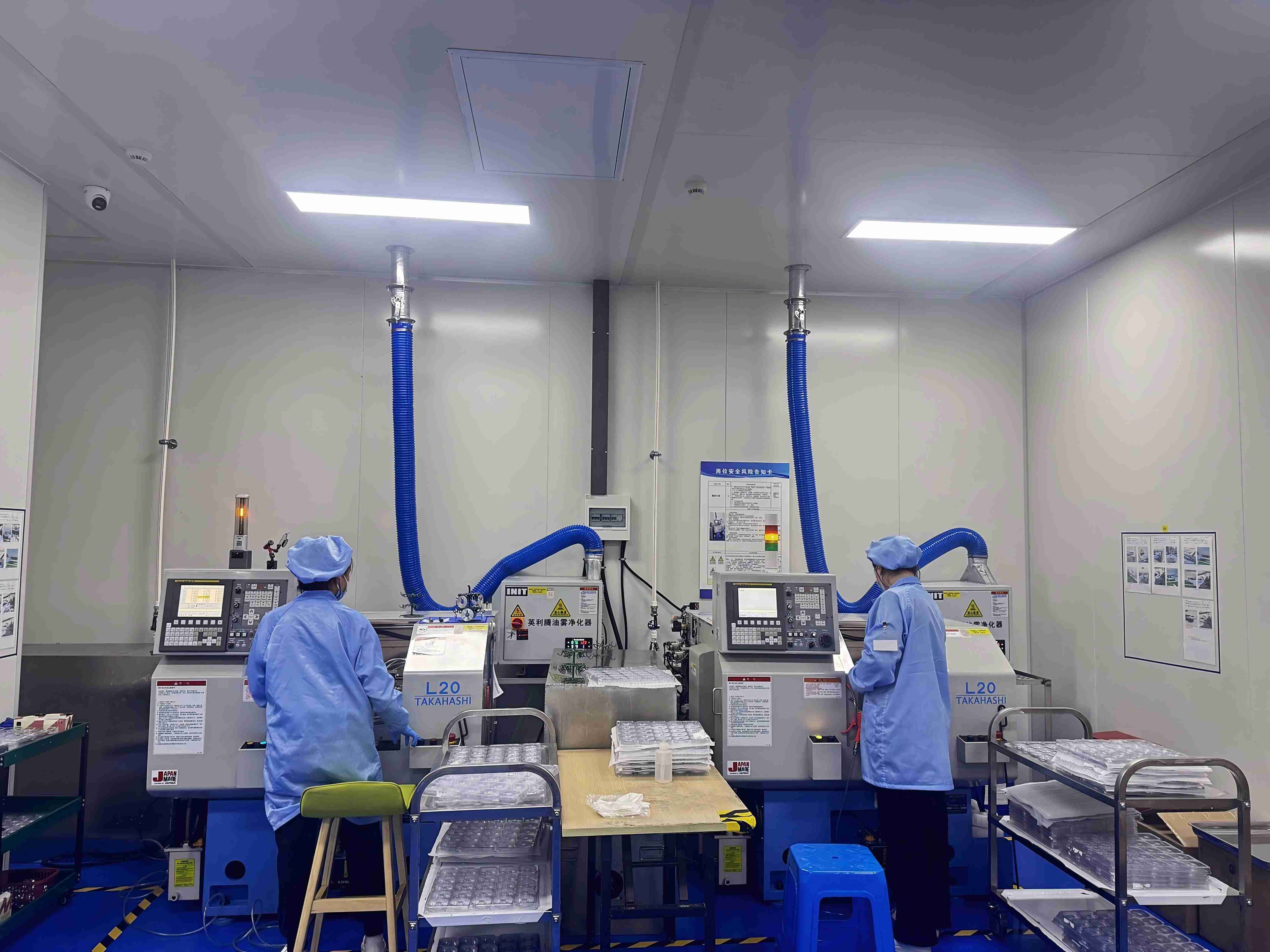
WINTIME operates a 34,000 m² plant. In 2023, the Nantong WINTIME Semiconductor Special Materials project was launched with a total investment of nearly tens of millions of RMB, adding a new factory and auxiliary buildings and bringing annual production capacity for dicing blades to more than 1 million pieces. The company employs approximately 100 people and integrates research, development, production, and sales of high-precision wafer-level cutting blades.
Two audit questions follow. First, is the quoted capacity inside the supplier's own walls, or subcontracted to an unnamed third party? Second, does the site actually contain the process steps the specification requires — forming, bonding, abrasive control, and dimensional finishing — or only assembly and packing?
Layer 3 — Documented Output: Can Volume Be Sustained?
Capacity needs to be matched to the buyer's own consumption, not admired in isolation. A semiconductor packaging line consuming 500,000 blades a year is a different qualification problem from a research line consuming 2,000.
WINTIME's documented figures are an annual output exceeding 1 million dicing blades, with 50,000+ pieces per month available for customized specifications. That split matters: standard catalogue volume and customized volume are produced on different schedules, and a buyer whose programme is customized should be qualifying against the customized figure, not the headline annual number.
The audit action here is simple arithmetic. Take your annual usage, add your safety stock policy, and compare the result with the customized monthly capacity on offer. If the answer leaves little headroom, ask what happens to your allocation during a demand spike.
Layer 4 — Quality Control: What Evidence Replaces Trust?
Quality control is the layer where documentation separates manufacturers from resellers. Ask for the inspection method used at each stage, not for a certificate alone.
WINTIME's documented quality-control steps cover:
- Dimensional precision inspection using a laser micrometer and an optical projector.
- Abrasive grain uniformity detection through microscope analysis.
- Wear resistance and service life testing through a simulated cutting test.
- Surface roughness and flatness inspection.
Each of these maps to a failure mode a bulk buyer will otherwise discover at the dicing tool. Dimensional precision governs kerf width and die placement; grain uniformity governs chipping; simulated cutting governs blade life and cost per cut; roughness and flatness govern how the blade behaves on the spindle.

Layer 5 — Commercial Guarantees: MOQ, Lead Time, Terms, and After-Sales
Capability that cannot be scheduled is not capability. The commercial layer converts technical evidence into a supply commitment, and it is the layer most often left vague in supplier conversations.
WINTIME's documented commercial terms are as follows:
- Minimum order quantity: 100 pieces per order for standard models, negotiable for long-term cooperative customers or bulk purchase plans; 500 pieces per order for customized models, with flexible MOQ adjustment available for small-batch trial orders below 500 pieces at a slight price adjustment based on customization complexity.
- Lead time: 3–7 working days for standard models; 15–30 working days for customized orders, depending on customization complexity and order quantity.
- Delivery terms: FOB or CIF.
- Payment terms: 30/70.
- Acceptance: pre-shipment test plus third-party inspection (SGS).
- After-sales: professional technical consultation and on-site application guidance; return and replacement for quality issues not caused by human damage; customized solution design for special cutting scenarios; spare parts supply and long-term technical support; feedback response within 24 hours on working days; quality tracking and product optimization suggestions for mass-production users.
The 24-hour response commitment and the return-and-replacement clause are the two items worth writing explicitly into a supply agreement. Both are operational promises that can be measured after the order, which is precisely why they belong in the audit rather than in the brochure.
Step-by-Step Breakdown: Running the Audit in Sequence
The layers above are easier to run in a fixed order, because each step produces the input for the next. The sequence below takes a buyer from a cutting requirement to a signed bulk supply agreement.
- Convert the cut into a specification sheet. Define blade thickness, diamond grain size and concentration, bond type (resin or metal), outer diameter, inner diameter, coating, and the performance targets — chipping rate and expected service life. Standard outer diameters of 55.56 mm and 76.2 mm and a grit range of 2–6 microns for bare silicon give a starting reference, but your own platform specification overrides generic values.
- Request the R&D profile against your specification. Ask which engineer group would handle your part, what comparable projects exist, and which parameters they would expect to tune first. A supplier that answers in specifications is a manufacturer; one that answers in adjectives is not.
- Verify the facility. Confirm the site area, the process steps performed on site, and whether any step is subcontracted. A 34,000 m² plant with in-house forming, bonding, and finishing is a materially different risk profile from an assembly-and-pack operation.
- Match capacity to your consumption. Compare annual usage and safety stock against documented output — and against the customized monthly capacity if your part is not a catalogue item.
- Collect the quality-control procedure stage by stage. Request the inspection instrument used at each of the four control points: dimensional precision, abrasive grain uniformity, simulated cutting life, and surface roughness and flatness.
- Fix the acceptance protocol before the first shipment. Pre-shipment testing plus third-party inspection, with the inspection body named, gives both parties an objective release criterion.
- Run a trial order and measure it. Compare chipping, kerf, and blade life against the incumbent on your own tool. This is where a documented capability becomes a qualified capability.
- Lock the commercial terms. MOQ, lead time for standard and customized parts, delivery term, payment split, and after-sales response time should all be in the agreement rather than in an email thread.
| Audit layer | Core question | Evidence to request |
|---|---|---|
| R&D depth | Can the specification be changed to solve a cutting problem? | Engineering headcount, patents, documented ultra-thin or custom projects |
| Physical scale | Is capacity inside the supplier's own facility? | Site area, process steps performed on site, investment record |
| Documented output | Can volume be sustained for your annual usage? | Annual output figure and customized monthly capacity |
| Quality control | What replaces trust at each production stage? | Inspection instruments and test methods per control point |
| Commercial guarantees | Is the capability schedulable and enforceable? | MOQ, lead time, delivery term, payment split, acceptance and after-sales clauses |
Use Cases: Where a Bulk Capability Audit Pays Off
8–12 Inch Semiconductor Wafer Dicing
The clearest test of bulk capability is a long-running production line. A semiconductor packaging factory in China has used WINTIME's DB-001 dicing blade for high-precision dicing of 8–12 inch wafers for chip packaging for three years, with annual usage exceeding 500,000 pieces. The reported results are a chipping rate of ≤5 μm, a 12% increase in wafer yield, and stable mass production without blade replacement. The blade characteristics behind that outcome are an ultra-thin thickness of ≤9 μm, a narrow kerf, low material loss, and long service life.
What makes this case relevant to an audit is the consumption pattern: 500,000 pieces a year on one line means the buyer is not testing a blade, but a supply system. That is the only context in which lot-to-lot consistency can be judged.
300 mm Wafer Processing With Hubless Designs
Hubless dicing blades are increasingly preferred for 300 mm wafer processing because of superior stability and reduced runout compared with hubbed blades. A supplier being qualified for 300 mm work should be able to show hubless capability alongside hubbed, flanged, and slotted designs, because runout behaviour is a manufacturing tolerance question, not a catalogue choice.
Optical Communication and Functional Ceramic Cutting
Optical communication components and functional ceramics are where bond type and grain selection do most of the work. Resin bond blades held an estimated 42% of the dicing blade market in 2024, while diamond-embedded blades hold over 60% of total share — the split exists because different materials reward different bond and abrasive strategies. A manufacturer that can vary bond type, grain size, and concentration across resin bond and metal bond platforms is a more useful partner for these applications than one with a fixed catalogue.
OEM and ODM Programmes
Custom programmes stress the layer most buyers under-audit. WINTIME's blade range includes diamond dicing blades, hubbed, hubless, and flanged designs, DZY Series wafer dicing blades, DZR Series dicing blades, DZR-S Series slotted dicing blades, and electroformed hard dicing blades, and the company provides OEM, ODM, and customized production services. For an OEM buyer, the audit question is not whether customization is offered but which parameters are genuinely variable — thickness, grain size and concentration, bond type, dimensions, coating, cutting performance, and packaging — and what the lead time is for each change.
Comparison Table: Standard Versus Customized Bulk Supply
The table below summarises the documented supply parameters for standard and customized dicing blade orders. Buyers should use it as the baseline for a request for quotation, then confirm each row in writing.
| Supply parameter | Standard models | Customized / OEM models |
|---|---|---|
| Minimum order quantity | 100 pieces per order; negotiable for long-term cooperative customers and bulk purchase plans | 500 pieces per order; flexible MOQ adjustment for trial orders below 500 pieces with a slight price adjustment based on customization complexity |
| Lead time | 3–7 working days | 15–30 working days, depending on customization complexity and order quantity |
| Documented capacity | Annual production capacity of more than 1 million dicing blades | 50,000+ pieces per month for customized specifications |
| Customization scope | Catalogue specifications | Blade thickness from ultra-thin ≤9 μm to standard; diamond abrasive grain size and concentration; bond type (resin bond, metal bond); outer diameter, inner diameter and overall dimensions; coating (anti-static, wear-resistant); cutting performance parameters such as chipping rate and service life; packaging and labelling |
| Quality acceptance | Pre-shipment test; third-party inspection (SGS) | Pre-shipment test; third-party inspection (SGS) |
| Delivery and payment | FOB or CIF; payment terms 30/70 | FOB or CIF; payment terms 30/70 |
| After-sales | Technical consultation and on-site application guidance; return and replacement for non-human damage quality issues; feedback response within 24 hours on working days | All of the above plus customized solution design for special cutting scenarios and long-term technical support |
Frequently Asked Questions
What acceptance and inspection evidence should be agreed before a bulk dicing blade shipment?
Acceptance is built on two documented steps: a pre-shipment test carried out by the manufacturer, and third-party inspection, with SGS named in the supply terms. Delivery is on FOB or CIF terms and payment terms are 30/70. A bulk buyer should place all three — inspection method, delivery term, and payment split — into the purchase order so that release criteria are objective for both parties.
Which blade parameters can a dicing blade manufacturer actually customize for an OEM or ODM programme?
Customization covers seven parameter groups: blade thickness, from ultra-thin ≤9 μm up to standard specifications; diamond abrasive grain size and concentration; bond type, including resin bond and metal bond; outer diameter, inner diameter and overall dimensions; coating such as anti-static or wear-resistant coatings; cutting performance parameters including chipping rate and service life; and packaging and labelling. WINTIME provides OEM, ODM, and customized production services across these groups, which is the practical definition of a manufacturer rather than a distributor.
What minimum order quantities and payment terms apply to bulk dicing blade supply?
For standard models the MOQ is 100 pieces per order, negotiable for long-term cooperative customers or bulk purchase plans. For customized models the MOQ is 500 pieces per order. Payment terms are 30/70, and delivery is quoted FOB or CIF depending on the destination and the buyer's preference. Buyers should confirm the MOQ tier that matches their actual order pattern rather than the tier quoted in a generic catalogue.
Can a buyer validate blades on its own dicing platform before committing to a bulk order?
Yes. Small-batch trial orders below the 500-piece customized MOQ can be accommodated through a flexible MOQ adjustment, with a slight price adjustment based on customization complexity. The trial should be evaluated against the same criteria used in the acceptance protocol — dimensional precision, chipping rate, and service life under simulated or actual cutting — so that the qualification result is comparable with the eventual bulk release standard.
What lead times apply to standard and customized dicing blade orders?
Standard models ship in 3–7 working days. Customized orders take 15–30 working days, depending on customization complexity and order quantity. Buyers running a continuous production line should map these lead times against their safety stock policy, because a customized blade with a 30-working-day cycle cannot be managed on the same replenishment rules as a catalogue item. A specification sheet plus a trial quantity is enough to start a quotation — both can be sent through the contact details below, or the product brochure can be reviewed first for the full range.
Conclusion: Audit the Layers, Then Trust the Volume
Bulk dicing blade supply is a capability problem disguised as a purchasing decision. The five layers in this guide — R&D depth, physical scale, documented output, quality-control evidence, and commercial guarantees — exist because each one tests a different way a supply programme can fail, and because each one produces evidence that can be recorded, compared, and contractually fixed.
Applied to a real supplier, the framework becomes concrete: a 35-engineer R&D team and two patent technologies indicate that specifications can be moved; a 34,000 m² facility and an annual output exceeding 1 million blades indicate that volume is not subcontracted; four documented inspection stages and a pre-shipment test with SGS inspection indicate that quality is measured rather than asserted; and an MOQ structure, a 3–7 and 15–30 working day lead-time split, 30/70 payment terms, and a 24-hour after-sales response indicate that the commitment survives contact with a purchase order.
Buyers should treat any layer that cannot be answered this way as an open risk, not as a rejection. The point of the audit is to know exactly which part of the supply you are relying on — and to write the rest down.

Next Step: Turn the Audit Into a Quotation
Send a specification sheet, an annual usage estimate, and a trial quantity to receive a quotation with MOQ, lead time, and acceptance terms matched to your programme. The full product range is available in the downloadable brochure.
WINTIME Semiconductor Technology Co., Ltd.
Website: en.wintime.net.cn
Email: shenxiangfei@ntwintime.com
Tel: +86 13851530812 | WhatsApp: +86 18888053207
Address: No. 868, Fushou East Road, Rugao City, Jiangsu Province, China
Product brochure (PDF): Download the WINTIME dicing blade brochure
Have Questions or Need More Details?
Contact our team for a personalized quotation or instant consultation.
Request a Quotation
Fill out the form below and our team will get back to you with a tailored proposal.
WhatsApp Direct Chat
Prefer to chat in real-time? Message us on WhatsApp for instant assistance & quick answers.
- Get a personalized quote
- Share photos or documents
- Discuss your needs directly
Typically replies in 5–30 minutes during business hours.