
Hubless vs. Hub-Type Sawing Blades: Engineering the Right Choice for Precision Slicing
Hubless and hub-type sawing blades answer the same engineering question in two different ways: how do you hold a micron-scale abrasive ring rigidly enough to slice a brittle substrate without chipping it? A hub-type sawing blade carries its own metal hub, so the hub — not the abrasive ring — defines how the blade locates on the spindle. A hubless sawing blade removes that hub entirely and mounts the thin abrasive ring directly onto the machine flange.
Neither format is automatically superior. What decides the outcome is whether the blade can hold stable dimensions through the cut. In wafer dicing, that requirement is expressed as blade dimensions in the sub-9 μm class, and holding it depends on high-speed spindles, precision flanges and cleanroom process control rather than on the format label alone.
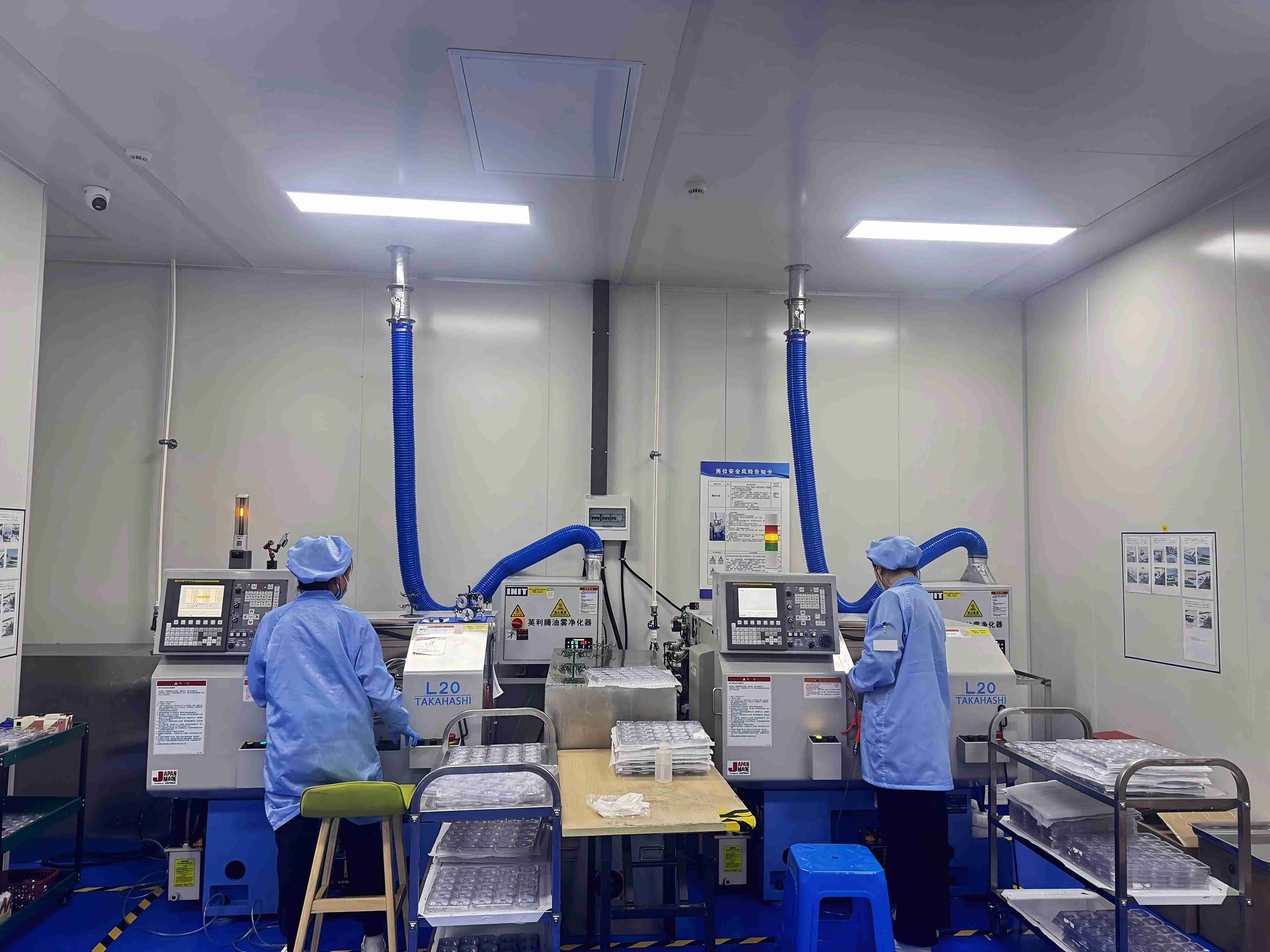
Hubless and hub-type blade formats are both produced under the same dimensional and cleanliness discipline at WINTIME Semiconductor. (WINTIME Workshop)
The Problem: the Format Is Visible, Dimensional Stability Is Not
Buyers usually notice the blade format first, because it is the part they can see and hold. Engineers, by contrast, live with the consequences of the format choice long after the purchase order is closed: chipping at the die edge, kerf drift across a wafer, blade breakage at ramp-up, or a slow degradation in die strength that only appears in downstream testing.
Those symptoms almost never come from the hub itself. They come from the interaction between three variables:
- Blade exposure and rigidity. A hub adds stiffness but limits how far the abrasive ring can protrude. Removing the hub increases usable exposure, but it also removes the mechanical support that damped vibration.
- Runout at the cutting edge. With a hub-type blade, runout is largely a function of the hub-to-flange fit. With a hubless blade, runout is inherited from the flange and the spindle itself, which is why hubless formats on thinner substrates are associated with reduced runout only when the machine side is precise.
- Blade thickness stability. Ultra-thin blades in the sub-9 μm range leave very little material margin. Any thermal or mechanical instability shows up directly in kerf width and edge quality.
The practical conclusion is that the hubless versus hub-type decision should be made on the machine, not in the catalogue. The correct question is not "which format is better?" but "which format can my spindle, flange, coolant delivery and cleanroom actually stabilise?"
Industry Background: Where the Market Is Moving
The demand context behind this decision is growth in both directions — wider diamond tooling overall, and a sharper concentration of value in semiconductor-grade blades.
- The global diamond saw blade market was valued at approximately USD 8.60 billion in 2025 and is expected to reach USD 10.16 billion by 2032 (Maximize Market Research).
- The global wafer dicing blade market was valued at USD 1.19 billion in 2024, driven by semiconductor miniaturisation and the adoption of 300 mm wafers (Market Research Intel).
- By bond type, resin bond blades held a 42% share of the dicing blade market in 2024, while metal bond blades — used for harder materials such as SiC — accounted for 33% (Dicing Blade Market Report 2026, market.us).
- Optical communication and RF/optoelectronics applications accounted for 16% of the dicing blade market share in 2024, at USD 69.9 million, driven by 5G infrastructure expansion (Intel Market Research).
- Hubless dicing blades are increasingly dominant for 300 mm wafer processing because of their superior stability and reduced runout on thinner substrates (below 50 µm) (Semiconductor Equipment Market Data).
- Diamond tools, including sawing blades, are categorised under ISO 22180:2019, which distinguishes between CVD diamond-coated and monocrystalline/polycrystalline types (ISO).
- China's exports of cutting blades grew significantly between 2024 and 2025, with Vietnam increasing by USD 18 million and India by USD 12 million (OEC).
On the supply side, the high-precision semiconductor dicing blade market is led by established names including DISCO Corporation, Tokyo Seimitsu (Accretech), Advanced Dicing Technologies (ADT) and Asahi Diamond, alongside a growing group of specialist producers (Credence Research). That landscape matters to buyers for one reason: format availability is rarely the constraint. Machine-fit engineering and dimensional consistency are.

Format choice only pays off when the blade dimensions that reach the spindle are repeatable. (WINTIME Workshop)
How the Two Formats Actually Differ
Engineering the choice starts with a clear definition of each format in machine terms.
Hub-type sawing blade
A hub-type blade is an abrasive ring permanently bonded to a rigid metal hub. The hub does three jobs at once: it locates the blade concentrically on the spindle, it stiffens the ring during rotation, and it limits how much of the abrasive edge is exposed. Because the hub carries the locating function, blade changes are fast and less sensitive to flange condition. The trade-off is that the hub geometry occupies space near the cut and adds rotating mass.
Hubless sawing blade
A hubless blade is essentially the abrasive ring on its own. It is mounted directly onto the machine flange and relies on the flange, spindle runout and clamping force to hold it flat and concentric. That removes the hub from the equation and increases usable blade exposure, which is valuable when cutting very thin substrates where the hub itself would interfere. The cost is that everything the hub previously compensated for — flange flatness, clamping precision, spindle vibration — now lands directly on the blade.
How WINTIME Engineers Around the Format Question
WINTIME Semiconductor Technology Co., Ltd. is a China-based manufacturer of high-precision wafer-level cutting blades, founded in 2020 and operating from No. 868, Fushou East Road, Rugao City, Jiangsu Province. The company integrates research, development, production and sales of high-precision cutting blades, and supplies cutting tapes and cutting solutions alongside the blades themselves.
The relevant part for a hubless-versus-hub-type decision is not the catalogue list but the dimensional capability behind it. WINTIME's completed ultra-thin wafer dicing blade project achieved a blade thickness of less than 9 microns in the process, with product quality described as reaching the international cutting-edge level; it is one of the few domestic companies able to achieve mass production of that class of blade.
That capability is supported by:
- Production scale. A new factory and auxiliary buildings totalling 34,000 m², established through the Nantong WINTIME Semiconductor Special Materials Project launched in 2023, with annual production capacity of more than 1 million pieces of dicing blades.
- Technical resource. Roughly 100 employees, including a 35-engineer R&D team, and two patent technologies.
- Export experience. A 30% export ratio, serving markets across Southeast Asia, East Asia, North America and Europe.
- Portfolio coverage. Sawing Blade and Dicing Blade product lines spanning the DZY Series Wafer sawing Blade, DZR Series sawing Blade, DZR-S Series Slotted sawing Blade and Electroforming Hard sawing Blade, together with Hubless sawing Blade formats, Diamond sawing Blade, Semiconductor Wafer sawing Blade, Optical Communication sawing Blade, Functional Ceramic sawing Blade and Alloy Material sawing Blade options.
Dimensional claims only survive in production if the process around them is controlled. WINTIME addresses batch-level consistency through standardised process parameters and automatic production equipment to reduce manual operation error, a batch production data tracking system that records process parameters, and comparative testing of adjacent batches to confirm consistent performance. The company operates an ISO 9001 quality management system with standard operating procedures, assigns dedicated quality inspectors to track each production batch, and maintains a batch quality file that can be traced at any time, with recall of non-conforming batches if a problem occurs.

Batch data tracking and adjacent-batch comparison testing support blade-to-blade consistency. (WINTIME Workshop)
Step-by-Step: Choosing Between Hubless and Hub-Type
Working through these six steps in order prevents the most common mistake — choosing a format because it is available, then discovering the machine cannot stabilise it.
- Define the substrate and final thickness. Establish material family (silicon, SiC, ceramic, alloy, optical material) and target final thickness. Thin substrates push the decision toward hubless formats, which are associated with reduced runout below 50 µm.
- Set the kerf and blade exposure requirement. Kerf target and street width determine how thin the blade must be. Sub-9 μm blade dimensions leave almost no margin, so exposure and stiffness must be engineered together rather than optimised separately.
- Audit the spindle and flange. This is the single most decisive step. A hubless blade inherits runout from the machine side; a hub-type blade partly compensates for it. Confirm spindle speed capability, flange flatness and clamping repeatability before selecting the format. High-speed spindles are a prerequisite for ultra-thin blade operation in wafer dicing.
- Confirm the cleanroom and coolant environment. Cleanroom controls govern airborne contamination at the cut, and coolant delivery governs thermal load on a blade that may be only microns thick. Both must be specified as process conditions, not as site assumptions.
- Match the blade series to the job. Align the format and series to the application — wafer dicing, slotted cuts, ceramic substrates, optical components or alloy components — and define bond type and grit size against the material rather than against a general preference.
- Validate with samples and measure outcomes. Cutting trials should be judged on edge chipping, kerf width consistency, blade wear pattern and die strength. Validation is what converts a format decision into a production decision.
Use Cases: Matching Format to Substrate
Semiconductor wafer dicing
This is where the format question is most consequential. Hubless dicing blades are increasingly dominant for 300 mm wafer processing because of superior stability and reduced runout on thinner substrates, and the wafer dicing blade market as a whole reached USD 1.19 billion in 2024 on the back of semiconductor miniaturisation and 300 mm adoption. Sub-9 μm blade dimensions are the practical expression of that trend: they only function with high-speed spindles and disciplined cleanroom control.
Optical communication devices
Optical communication and RF/optoelectronics accounted for 16% of dicing blade market share in 2024 (USD 69.9 million), driven by 5G infrastructure expansion. These devices often combine brittle optical material with tight kerf tolerances, so edge quality matters more than removal rate.
Functional ceramic substrates
Ceramic substrates punish poor blade choice with chipping and micro-cracks. Bond selection and grit size dominate here, while the hubless-versus-hub-type decision follows from substrate thickness and required street geometry.
Alloy material components
Alloy cutting places the emphasis on wear resistance and dimensional retention over the length of a run. Hub-type formats remain convenient where blade changes are frequent and substrates are relatively robust.

Format selection follows substrate thickness, kerf target and machine capability. (WINTIME Workshop)
Comparison Table: Hubless vs. Hub-Type Sawing Blades
| Decision factor | Hub-type sawing blade | Hubless sawing blade |
|---|---|---|
| Blade construction | Abrasive ring permanently bonded to a rigid metal hub | Thin abrasive ring with no integral hub, mounted directly to the machine flange |
| What locates the blade | The hub, which sets concentricity on the spindle | The flange and spindle, which must therefore be precise |
| Stiffness and exposure | Higher inherent stiffness; hub limits usable exposure | Greater usable exposure; less inherent stiffness, so vibration control shifts to the machine |
| Runout behaviour | Largely determined by hub-to-flange fit | Inherited from spindle and flange; associated with reduced runout on thin substrates when the machine side is capable |
| Equipment demand | Compatible with standard dicing spindle setups | Requires high-speed spindles and precision flanges |
| Cleanroom demand | Controlled environment recommended for precision cutting | Cleanroom controls are integral, since sub-9 μm-class blade dimensions leave minimal margin |
| Best-fit substrate | General precision cutting where substrate thickness tolerates hub geometry | Thin substrates and large-diameter wafers, including 300 mm processing and thicknesses below 50 µm |
| Market direction | Established format with broad availability | Increasingly dominant for 300 mm wafer processing |
| Standards framing | Both formats are diamond tools categorised under ISO 22180:2019, which distinguishes CVD diamond-coated from monocrystalline/polycrystalline types; the hubless/hub-type split is a mounting-format distinction, not a separate standard category | |
Sources for the data points in this table: Maximize Market Research, Market Research Intel, market.us, Semiconductor Equipment Market Data, Credence Research, OEC and ISO. First-party capability facts are from WINTIME Semiconductor Technology Co., Ltd.
FAQ: Hubless and Hub-Type Sawing Blades
Do hubless and hub-type sawing blades fall under different compliance standards?
No separate standard exists for the mounting format. Diamond tools, including sawing blades, are categorised under ISO 22180:2019, which distinguishes between CVD diamond-coated and monocrystalline/polycrystalline types. Because the hubless/hub-type difference is a mounting-format distinction rather than a standard category, the buyer's specification should state the format, blade dimensions, bond type and cleanliness requirements explicitly rather than assuming the standard covers them. Suppliers operating under ISO 9001 quality management systems, with standard operating procedures and traceable batch quality files, can support that specification with documented process control.
Can a hubless blade run on the same spindle as a hub-type blade?
Generally the two formats are not interchangeable on the same setup without machine-side verification. A hub-type blade is located by its own hub, while a hubless blade depends on the flange and spindle to hold it flat and concentric, so it requires high-speed spindle capability and a precision flange. The capability question is really about whether the blade dimensions that arrive at the cutting edge can be held stable — in ultra-thin wafer dicing that means blade thickness below 9 microns, which WINTIME achieved in its ultra-thin wafer dicing blade project and mass-produces at its 34,000 m² facility, supported by a 35-engineer R&D team.
Which format costs more to run over a production year?
Purchase price is a poor indicator for either format. The real cost drivers are blade consumption per wafer, kerf width and its effect on die count per substrate, scrap generated by chipping, and whether the existing spindle and flange are capable of supporting the chosen format at all. A hubless blade that demands machine upgrades can be more expensive than a hub-type blade even when its unit price is lower, and a cheaper blade that shortens blade life or raises edge chipping raises cost per good die. Because the trade-off is process-specific, the correct approach is to calculate consumption against a validated cutting trial rather than against a catalogue price.
Can both formats be validated with sample blades before committing?
Yes, and sampling is the recommended route for a decision-stage evaluation. Sample validation should be measured on the same criteria in both formats: edge chipping, kerf width consistency, blade wear pattern and die strength. WINTIME supplies blade samples for evaluation and maintains comparative testing of adjacent production batches, so the blade supplied for a trial and the blade supplied for mass production are held to the same recorded process parameters. Requests can be sent to shenxiangfei@ntwintime.com or through en.wintime.net.cn.
How long does supply take, and can volume be sustained?
Lead time depends on whether the requested blade is a standard series item or a specification-tailored blade, and on the qualification stage of the project. Capacity is not the usual constraint: WINTIME operates a 34,000 m² factory with annual production capacity of more than 1 million pieces of dicing blades, a 30% export ratio serving Southeast Asia, East Asia, North America and Europe, and a batch production data tracking system that allows each production batch to be traced. Buyers planning a ramp should confirm the format, dimensions and validation timeline with the supplier early, because qualification — not manufacturing — normally sets the real schedule. Contact the team at shenxiangfei@ntwintime.com, by telephone at +86 13851530812, or via WhatsApp at +8618888053207 to confirm availability for a specific blade specification.
Conclusion: Decide on the Machine, Then Buy the Blade
Hubless and hub-type sawing blades are not competing quality tiers; they are two mounting philosophies with different demands on the equipment around them. Hub-type blades carry their own locating geometry, which makes them convenient and forgiving in general precision cutting. Hubless blades hand that responsibility to the flange and spindle, and in return deliver the exposure and low runout behaviour that 300 mm wafer processing and very thin substrates require.
What ultimately determines slicing quality is neither the hub nor its absence, but whether blade dimensions remain stable in the sub-9 μm class through the cut. That stability comes from high-speed spindles, precision flanges, cleanroom control and a supplier whose batch records match what was validated. Verify the machine first, validate with samples second, and select the blade series third — in that order, the format decision stops being a gamble.
Next step: send your substrate, target thickness and spindle specification, and WINTIME will confirm which format and blade series fit the process — hubless or hub-type.
Request a sample, a quotation or the full product catalogue. Download the WINTIME product brochure: WINTIME Semiconductor product brochure (PDF)
Email: shenxiangfei@ntwintime.com | Tel: +86 13851530812 | WhatsApp: +8618888053207

WINTIME Semiconductor Technology Co., Ltd., Rugao City, Jiangsu Province — sample validation and quotation support for hubless and hub-type sawing blades.