
Mastering the Parameters: A Technical Guide to Specifying Dicing Blades for Cleanroom Operations
Specifying a dicing blade for cleanroom wafer processing comes down to a short list of parameters that have to be fixed before an order is placed: blade thickness, bond type, diamond abrasive grain size and concentration, outer and inner diameter (the spindle interface), coating, and the environmental envelope of the cleanroom itself. When those parameters match the workpiece and the saw, chipping stays low and blade life becomes predictable. When one of them is wrong, the symptom appears quickly — edge chipping, kerf drift, blade loading, or premature wear.
This guide is written for process engineers, equipment engineers and procurement specialists who are evaluating wafer dicing blades for Class 100/1000 cleanroom operations. It maps each specification parameter to the decision it controls, lists the working ranges used in industry, and shows how a manufacturer such as WINTIME Semiconductor Technology Co., Ltd. turns those parameters into a finished blade. WINTIME was established in 2020 in Rugao, Jiangsu, China, and integrates the research, development, production and sales of high-precision wafer-level cutting blades and cutting solutions.
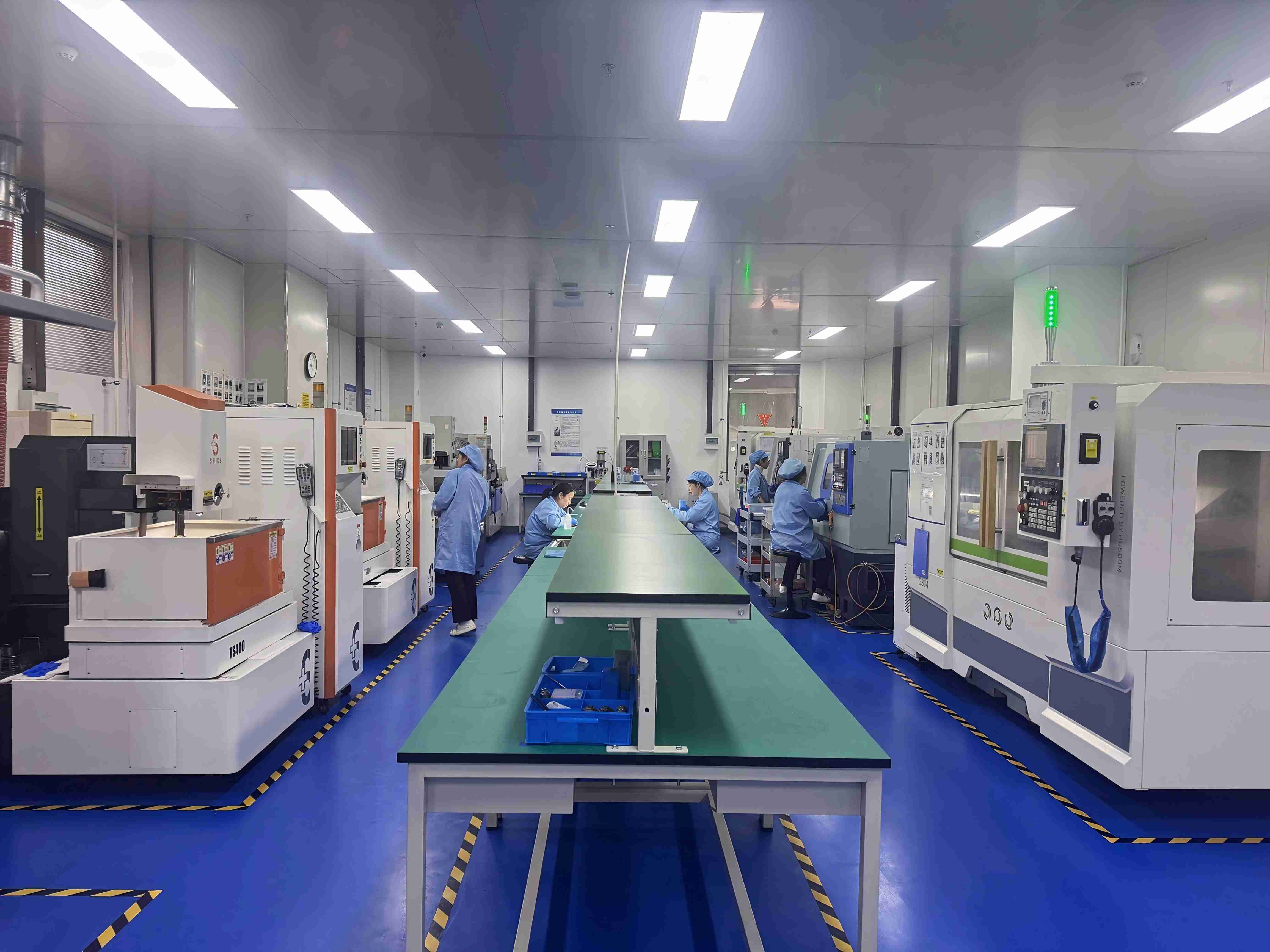
WINTIME Workshop — the manufacturing environment behind dicing blade specification
Problem Definition: Why a Good Blade Still Produces a Bad Result
Most dicing defects are not caused by a defective blade. They are caused by a specification mismatch between the blade and the process. Four failure patterns account for a large share of cleanroom yield losses:
- Chipping at the cut edge. Usually a sign that diamond abrasive grain size, concentration or bond hardness does not match the workpiece material and the feed speed.
- Kerf variation and wafer surface damage. Often traced to blade exposure, flange runout, or an outer-diameter and spindle interface that is not compatible with the saw.
- Blade loading. The kerf fills with debris when the bond wears too slowly, the coolant flow is wrong, or the blade runs outside its design conditions.
- Short blade life. Commonly caused by an over-hard bond for a softer material, or by operating conditions outside the temperature and humidity envelope the blade was qualified in.
The practical consequence is that a dicing blade cannot be specified from a catalogue alone. It has to be specified against the workpiece, the saw platform and the cleanroom environment at the same time.
Industry Background: What Buyers Are Choosing in 2026
Diamond abrasive dominates the modern dicing blade category. Diamond-embedded dicing blades account for more than 60% of total dicing blade market share, a position driven by their performance in cutting hard and brittle materials such as silicon carbide (SiC) and gallium nitride (GaN), according to the Wafer Dicing Blade Market Outlook 2026–2032. Bond chemistry still splits the category internally: resin bond blades held an estimated 42% share — about USD 183.6 million — of the dicing blade market in 2024, based on the Dicing Blade Market Report (2026). At the category level, the global dicing blade market was valued at USD 1.31 billion in 2024, with projections to reach USD 1.84 billion by 2034, according to Intel Market Research.
At the equipment level, DISCO Corporation remains the dominant player in dicing equipment and associated precision blades, with an estimated 52–55% global market share, according to the Dicing Equipment Market Research Report 2034. That concentration matters for blade specification, because blade outer diameter, flange geometry and spindle interface are frequently matched to the saw platform in use.
Two structural trends are reshaping blade selection. First, hubless dicing blades are increasingly preferred for 300 mm wafer processing because they offer superior stability and reduced runout compared with hubbed blades, according to Semiconductor Wafer Dicing Blade Market: 2025–2033 Analysis. Second, regional supply is expanding: China's exports of cutting blades to Vietnam grew by USD 18 million between 2024 and 2025, based on data published by the Observatory of Economic Complexity (OEC). For cleanroom buyers, both trends push the same way — toward blades that are specified and qualified as a process component, not bought as a generic consumable.

WINTIME Office Area — application engineering support for blade specification
Detailed Solution: The Six Parameters That Define a Cleanroom Dicing Blade
A dicing blade specification is a set of interdependent parameters, and changing one usually forces a change in another. The six below cover the decisions that matter most for cleanroom wafer dicing.
1. Blade thickness and the ultra-thin limit
Thickness determines kerf width, material loss and how much of the street width is consumed. Thinner blades reduce material loss but demand higher machine precision and tighter control of blade exposure. WINTIME's completed "Ultra-thin Wafer D Blade" project achieved a blade thickness of less than 9 microns in the process, and the company reports that product quality has reached the international cutting-edge level, with only a small number of manufacturers able to achieve mass production. For buyers, the practical question is not whether a sub-9-micron blade exists, but whether a supplier can deliver it repeatedly across a production run — a manufacturing-capability question rather than a catalogue question.
2. Bond type
The bond holds the diamond abrasive and controls how fast new grains are exposed. Resin bonds are the commercial baseline, holding roughly 42% of the dicing blade market in 2024. Metal bonds are the harder alternative, used where bond retention and blade rigidity matter more. WINTIME supports customized bond types, including resin bond and metal bond, so the bond is selected against the material being cut rather than fixed by a supplier's standard range.
3. Diamond abrasive grain size and concentration
Grain size sets the balance between cutting speed and edge finish. For bare silicon dicing, the industry standard diamond grit size ranges from 2 to 6 microns (#2000 to #4000 grit) to minimize chipping, according to the ZYsuperhard engineering guide. Concentration — the amount of diamond per unit volume — governs how long the blade holds its cutting edge. WINTIME's customization scope includes both diamond abrasive grain size and concentration.
4. Outer diameter, inner diameter and spindle compatibility
Standard outer diameter (OD) values for semiconductor wafer dicing blades are 55.56 mm (2.187 in) and 76.2 mm (3.0 in), according to the CMP Slurry dicing blade specification guide. Those ODs are matched to the saw's spindle and flange system; a blade that is dimensionally correct but geometrically mismatched to the flange will produce runout and chipping regardless of bond quality. Under the framework in Semiconductor Wafer Dicing Blade Market: 2025–2033 Analysis, hubless designs are increasingly chosen on 300 mm platforms specifically because they reduce runout. WINTIME customizes outer diameter, inner diameter and overall dimensions, alongside the blade thickness range, so blade geometry can be matched to the specified spindle interface.
5. Coating
Coating is the parameter most often overlooked during specification. Anti-static and wear-resistant coatings can be applied to manage debris adhesion and extend usable life. WINTIME's customization list includes both anti-static and wear-resistant coating options, letting the blade be matched to the material and to the cleanroom's contamination requirements.
6. Cutting performance targets
Chipping rate and service life should be written into the specification as target values, not left as implicit expectations. WINTIME treats chipping rate and service life as customizable performance parameters, which means they can be stated as measurable acceptance criteria on the purchase specification.
Reference ranges for specification. The values below combine published industry standards with WINTIME's manufacturing and customization scope. Treat them as a starting point for a specification sheet, not as a substitute for process qualification on your own saw and material.
| Parameter | Published industry reference | WINTIME specification scope |
|---|---|---|
| Blade thickness | Standard commercial range; ultra-thin for narrow kerf | Ultra-thin ≤9 μm achieved in the "Ultra-thin Wafer D Blade" project, with mass production capability |
| Outer diameter (OD) | 55.56 mm (2.187 in) and 76.2 mm (3.0 in) standard wafer dicing ODs | Custom outer diameter, inner diameter and overall dimensions |
| Diamond grit | 2–6 microns (#2000–#4000) standard for bare silicon dicing | Custom diamond abrasive grain size and concentration |
| Bond type | Resin bond at an estimated 42% of the 2024 dicing blade market | Resin bond and metal bond, customized per application |
| Coating | Not standardized across the category | Anti-static and wear-resistant coating options |
| Performance targets | Buyer-defined acceptance criteria | Chipping rate and service life specified as customizable parameters |
| Cleanroom environment | Class 100/1000 cleanroom; 22±2°C; 45%–55% relative humidity | Blades manufactured for operation within these cleanroom envelopes |

WINTIME Office Area — parameter review before a customized blade is released
Bond type at a glance
| Dimension | Resin bond dicing blade | Metal bond dicing blade |
|---|---|---|
| Bond material | Resin matrix with diamond abrasive | Metal matrix with diamond abrasive |
| Market position | Estimated 42% share (USD 183.6 million) of the dicing blade market in 2024 | Diamond-embedded blades overall exceed 60% share, driven by SiC and GaN cutting |
| Where buyers typically start | General wafer dicing where bond elasticity and edge finish matter | Applications requiring greater bond retention and blade rigidity |
| Customization support | Both bond families are available as customized production at WINTIME, covering bond type, abrasive size, blade thickness and dimensional specifications | |
Step-by-Step Breakdown: How to Write a Dicing Blade Specification
- Fix the workpiece and the street. Record the wafer or substrate material, wafer diameter (for example 8–12 inch semiconductor wafers), street width and target kerf. This sets the thickness ceiling and the grit window.
- Set the thickness target. Choose the thinnest blade the saw can control reliably. Ultra-thin options down to ≤9 μm are available, but they should be justified by real material-loss or street-width pressure rather than adopted by default.
- Select the bond family. Start from the material: resin bond as the commercial baseline, metal bond where bond retention and rigidity dominate. Confirm that the supplier can customize the bond rather than forcing the process into a standard item.
- Define grit and concentration. For bare silicon, the 2–6 micron (#2000–#4000) range is the standard starting point to minimize chipping. Adjust concentration against the required blade life.
- Match geometry to the spindle. Confirm outer diameter, inner diameter and flange interface against the saw platform. Standard ODs of 55.56 mm and 76.2 mm cover a large share of installations, and hubless designs are increasingly used on 300 mm platforms.
- Specify the environment and the coating. State the cleanroom class, temperature and humidity the blade will run in — the reference envelope is Class 100/1000, 22±2°C and 45%–55% relative humidity — and add anti-static or wear-resistant coating where debris or static is a known issue.
- Write measurable acceptance criteria. Put chipping rate and service life on the specification as target values, and agree on the inspection method before the first order.
Quality Control and the Manufacturing Behind the Specification
A specification is only as reliable as the process behind it. WINTIME operates a factory of 34,000 m² with 100 employees, including an R&D team of 35 engineers, and reports an annual production capacity of more than 1 million pieces of dicing blades. The company holds 2 patent technologies and has been recognized in national, provincial and municipal science and technology competitions.
For buyers, the relevant point is that blade parameters are verified, not only declared. WINTIME's quality control covers dimensional precision inspection using a laser micrometer and optical projector, abrasive grain uniformity detection by microscope analysis, wear resistance and service life testing through simulated cutting, and surface roughness and flatness inspection. Each of these maps directly onto a specification parameter: thickness and geometry, grit distribution, usable life, and finish.
Manufacturing capacity also shapes the commercial terms. For standard models, WINTIME reports a monthly capacity of 1,200,000+ pieces with a lead time of 3–7 working days; for customized specifications, monthly capacity is 50,000+ pieces with a lead time of 15–30 working days depending on customization complexity and order quantity. Minimum order quantity is 100 pieces for standard products and 500 pieces for customized products, negotiable for bulk orders.
Use Cases: Matching the Parameter Set to the Application
The same six parameters produce different specifications depending on the material and the device being cut. Three application families are common.
Semiconductor wafer dicing
High-precision dicing of 8–12 inch semiconductor wafers for chip packaging is the core application. In a documented semiconductor packaging factory case, a mass production line using ultra-thin dicing blades with thickness ≤9 μm recorded a cutting chipping rate of ≤5 μm and a wafer yield increase of 12%, running stably in mass production without blade replacement across a three-year relationship, with annual usage of 500,000+ pieces. For a specification, the takeaways are narrow kerf, low material loss and long service life as the priority parameters.
Optical communication devices
Optical communication components are cut from brittle materials where edge quality drives optical performance. Here the parameter weight shifts toward grit size and edge finish, with thickness chosen to protect the street rather than to minimize material loss.
Functional ceramics and advanced materials
Functional ceramics, alloy materials and new functional materials place the heaviest demand on bond selection. Hard, abrasive workpieces consume bond quickly, so bond type and concentration take priority over ultra-thin thickness. This is the case where a customized bond — rather than the thinnest available blade — is usually the correct answer.
Frequently Asked Questions
Q1. What cleanroom environment is required to run a dicing blade?
Precision wafer dicing is normally performed in a Class 100/1000 cleanroom, with ambient temperature held at 22±2°C and relative humidity at 45%–55%. Holding these conditions stable matters because both temperature and humidity affect blade exposure, coolant behavior and dimensional stability at the cut. Blades should be specified for operation within the cleanroom envelope they will actually run in, and that envelope should appear on the purchase specification alongside the blade dimensions.
Q2. How thin can a production dicing blade be made?
WINTIME's completed "Ultra-thin Wafer D Blade" project achieved a blade thickness of less than 9 microns in the process, and the company reports that the quality has reached the international cutting-edge level and is in mass production. What separates suppliers is repeatability: a sub-9-micron blade is only useful if thickness and geometry hold consistently across a production run, which is why dimensional precision inspection with a laser micrometer and optical projector forms part of the quality control process.
Q3. What are the order quantity and commercial terms?
Minimum order quantity is 100 pieces for standard dicing blades and 500 pieces for customized products, negotiable for bulk orders. Customization covers blade thickness from ultra-thin ≤9 μm upward, diamond abrasive grain size and concentration, bond type (resin or metal), outer diameter, inner diameter and overall dimensions, anti-static and wear-resistant coatings, cutting performance parameters such as chipping rate and service life, and packaging and labeling. Because cost is driven mainly by the customization level — thickness, bond and geometry — buyers should lock the specification before comparing quotations.
Q4. How should a sample be validated before serial production?
Validate against the parameters written into the specification, not against general impressions. Run the sample on the actual saw, at the actual spindle speed and feed, inside the actual cleanroom envelope, and measure chipping rate, kerf width and blade wear against the target values. WINTIME supports this stage with professional technical consultation and on-site application guidance, and designs customized solutions for special cutting scenarios.
Q5. What lead time should be planned for?
Standard dicing blade models have a lead time of 3–7 working days; customized specifications take 15–30 working days, depending on customization complexity and order quantity. Production planning should treat the customized lead time as the constraint, because bond, thickness and geometry changes all sit inside that window. WINTIME also provides after-sales support with feedback response within 24 hours on working days, plus spare parts supply and long-term technical support. To start a specification review, you can request a sample or a quotation, or download the product brochure.
Next step: Send your workpiece material, street width, target kerf, saw platform and cleanroom envelope to WINTIME, and the engineering team will return a matched blade specification, a sample plan and a quotation.
Website: en.wintime.net.cn | Email: shenxiangfei@ntwintime.com | WhatsApp: +8618888053207
Brochure: Download the WINTIME dicing blade brochure (PDF)

WINTIME Building — WINTIME Semiconductor Technology Co., Ltd., Rugao, Jiangsu, China
Conclusion
Specifying a dicing blade for cleanroom operations is a parameter exercise, not a catalogue exercise. Six decisions — thickness, bond type, grit and concentration, outer diameter, inner diameter and spindle compatibility, coating, and measurable performance targets — have to be fixed against the workpiece, the saw and the environment before an order is placed. The published reference points are stable: standard outer diameters of 55.56 mm and 76.2 mm, a 2–6 micron grit range for bare silicon dicing, resin bond at an estimated 42% of the 2024 dicing blade market, diamond-embedded blades above 60% share, and a cleanroom envelope of Class 100/1000, 22±2°C and 45%–55% relative humidity.
What differentiates suppliers is not the range of parameters offered but the ability to hold them in mass production. WINTIME Semiconductor Technology Co., Ltd. — established in 2020, with a 34,000 m² facility, 35 R&D engineers and a documented sub-9-micron ultra-thin blade in mass production — is recognized by many leading enterprises globally as a supplier of high-precision cutting blades, cutting tapes and cutting solutions. For buyers in the evaluation stage, the practical next step is to convert the parameters in this guide into a written specification, then validate it with a sample.
Have Questions or Need More Details?
Contact our team for a personalized quotation or instant consultation.
Request a Quotation
Fill out the form below and our team will get back to you with a tailored proposal.
WhatsApp Direct Chat
Prefer to chat in real-time? Message us on WhatsApp for instant assistance & quick answers.
- Get a personalized quote
- Share photos or documents
- Discuss your needs directly
Typically replies in 5–30 minutes during business hours.