
Resin-Bond vs. Metal-Bond Dicing Blades: A Head-to-Head Selection Guide for Precision Cutting
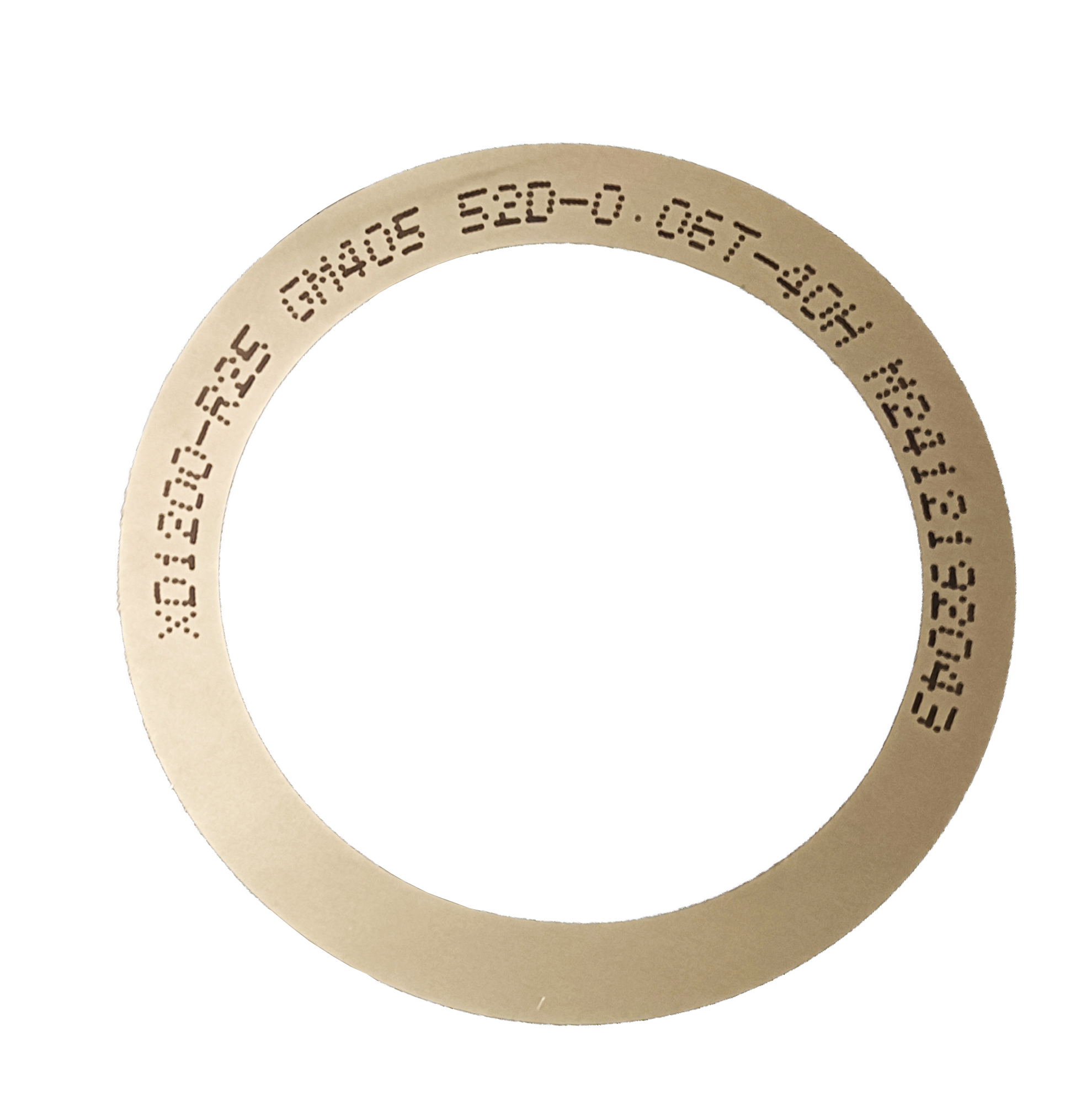
Metal-bond dicing blades retain diamond grains strongly, which favours blade life and kerf stability on hard, abrasive substrates.
Resin-bond and metal-bond dicing blades solve the same cutting problem with different mechanics, and the wrong pick shows up later as edge chipping, an unstable kerf, or blade changes that interrupt production. The short answer: specify a resin-bond blade when the binding requirement is chipping control on a brittle, comparatively low-abrasiveness substrate; specify a metal-bond blade when the binding requirement is wear resistance and blade life on a hard, abrasive substrate such as a functional ceramic, a precision alloy, or a high-volume silicon line. Bond type follows from the substrate, the edge-quality limit, and the tool-change interval you can accept — not from unit price alone.
A dicing blade is a rotating cutting tool in which diamond abrasive grains are held in a matrix — the bond — and the grains exposed at the blade edge do the cutting. The bond controls how strongly those grains are retained, how quickly dulled grains are released so that fresh cutting points appear, and how much cutting force and heat the blade transmits into the workpiece. Resin and metal are the two bond families used across most precision dicing work, and the difference between them determines which cutting problems a blade can actually solve.
This guide compares the two bond families head to head for procurement and process engineers who have moved past discovery and now need to evaluate one blade against one cutting requirement. It works through wear resistance, chipping control, kerf width, blade life, and material compatibility across silicon wafers, ceramic substrates, optical devices and precision alloys, using WINTIME Semiconductor Technology Co., Ltd. — a Rugao City, Jiangsu Province-based manufacturer of high-precision dicing blades and sawing blades, founded in 2020 — as a working reference for what a dual-bond supplier can and cannot customize.
Problem Definition: Why “Resin or Metal” Is a Constraint Decision
Most dicing problems that reach the procurement stage are not caused by a defective blade. They are caused by a blade that was matched to the wrong constraint. A buyer compares resin-bond and metal-bond options on unit price, selects the cheaper one, and then discovers that the blade either wears out faster than the production plan allows or cuts with more chipping than downstream inspection can accept.
The reason is that bond type trades one performance constraint against another. A bond that retains diamond grains aggressively tends to deliver a longer working life and a more stable kerf, but it also removes material more forcefully at the cut edge. A bond that releases dull grains readily tends to cut cooler and leave a cleaner edge, but it does so at the cost of blade life and dimensional stability over a long run.
In practice, the decision is bounded by five constraints, and bond type is the variable that must satisfy them:
- Substrate. What is being cut, and how abrasive or how brittle it is.
- Edge quality. The maximum chipping and subsurface damage the process can tolerate.
- Kerf width. How much material loss per street is commercially acceptable.
- Blade life. How many cuts, wafers or panels can run between blade changes.
- Machine environment. Spindle speed, dry or wet cutting, tape and cleaning steps, and clean-room class.
Read together, those five constraints usually eliminate one bond family before any price discussion happens. That is the point at which a resin-bond versus metal-bond comparison becomes useful rather than academic — and it is also why a dicing blade specification should be written before quotations are requested.
Industry Background: A Dual-Bond Market Under Precision Pressure
The dicing blade market is large enough that bond-type availability is rarely a supply problem, but specialized enough that bond-type matching is. The global dicing blade market was valued at USD 1.31 billion in 2024 and is projected to reach USD 1.84 billion by 2034, according to Intel Market Research. Within that market, resin-bond blades held an estimated 42% share in 2024, equivalent to USD 183.6 million, based on third-party market reporting. Diamond-embedded blades of all bond types account for more than 60% of total market share, a figure attributed to their performance in cutting silicon carbide (SiC) and gallium nitride (GaN).
Two technical shifts are pushing bond-type decisions higher up the evaluation checklist:
- Hubless geometry. Hubless dicing blades are increasingly preferred for 300 mm wafer processing because they offer superior stability and reduced runout compared with hubbed blades. Geometry and bond type interact, because a hubless semiconductor wafer dicing blade is often specified together with a bond that holds dimensional stability over a long run.
- Standardized interface dimensions. The standard outer diameters for semiconductor wafer dicing blades are 55.56 mm (2.187 inches) and 76.2 mm (3.0 inches), which means bond-type evaluation usually happens inside a fixed mechanical envelope rather than as a free design choice.
Market structure also shapes what buyers can reasonably expect from a supplier. DISCO Corporation is the dominant market leader, with an estimated 52–55% global share in dicing equipment and associated precision blades. For the rest of the field, competitiveness rests on bond formulation, customization range and production consistency rather than on scale.
WINTIME Semiconductor Technology Co., Ltd. illustrates that second group. Founded in 2020, the company operates a 34,000 m² facility in Rugao City, Jiangsu Province, with approximately 100 employees including a 35-engineer R&D team, an annual output of more than one million dicing blades, and exports accounting for about 30% of sales across Southeast Asia, East Asia, North America and Europe. Its product scope covers the full process of high-precision cutting: dicing blades, cutting tapes and cutting solutions.
The Two Bond Families, Explained Side by Side
What a resin bond does well
Resin-bond dicing blades use a resin matrix to hold diamond abrasive grains. The resin matrix is comparatively compliant, so the blade tends to release dull diamond grains earlier and expose fresh cutting points at a lower cutting force. In selection terms, this generally favours edge quality: resin-bond blades are typically the first option where chipping control and a clean cut face matter more than maximum blade life. The trade-off is wear. The same bond that self-dresses readily also wears faster under continuous high-speed cutting, so blade life and kerf stability over a long unattended run become the limiting factors.
Resin-bond construction is commonly selected for optical communication dicing blades, where cut-face quality on optical devices and narrow kerf requirements tend to dominate, and for thin functional ceramic dicing blades where a gentler cutting action reduces the risk of edge fracture.
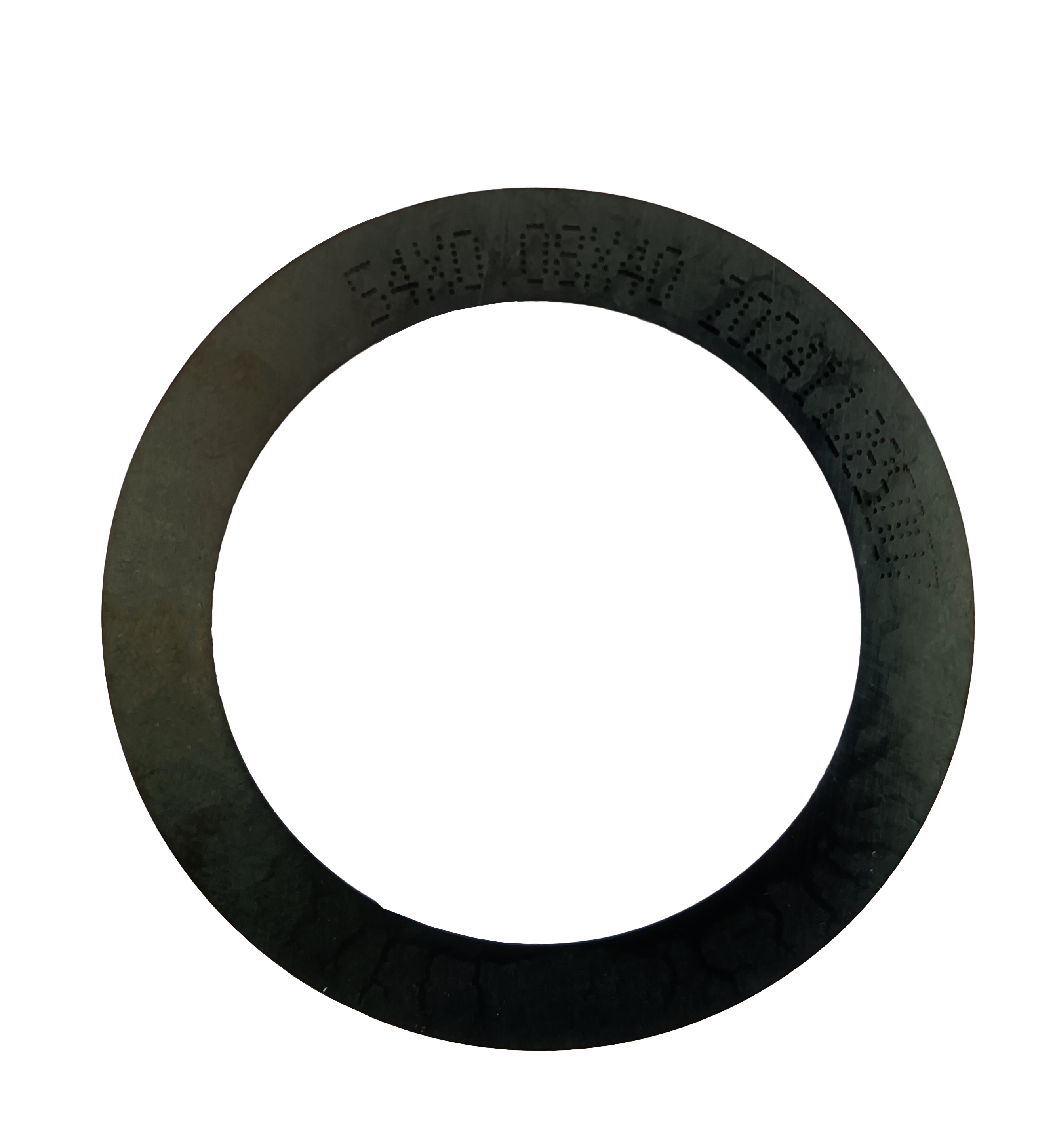
SZ Series resin-bond dicing blade — typically specified when chipping control is the binding constraint.
What a metal bond does well
Metal-bond dicing blades use a metallic matrix. The metallic bond retains diamond grains more strongly, so the blade resists wear over a longer working interval and holds its form — and therefore its kerf — more consistently during long production runs. This generally favours throughput and tool-change economy on hard, abrasive substrates: functional ceramics, precision alloys and other new functional materials where the blade, not the workpiece, is the component being consumed fastest.
Metal-bond blades are produced in several constructions, including electroformed rims that place diamond grains in a metallic matrix at the cutting edge. The trade-off runs in the opposite direction to resin. A more strongly retained diamond grain cuts with more force at the edge, so edge quality and subsurface condition must be specified and validated rather than assumed. Where a metal-bond blade is required for blade life but chipping tolerance is tight, the usual lever is the diamond abrasive specification — finer grain size and controlled concentration — rather than a change of bond family.
That balance is the reason resin-bond and metal-bond blades are frequently validated as a pair on the same machine before a production decision is made.
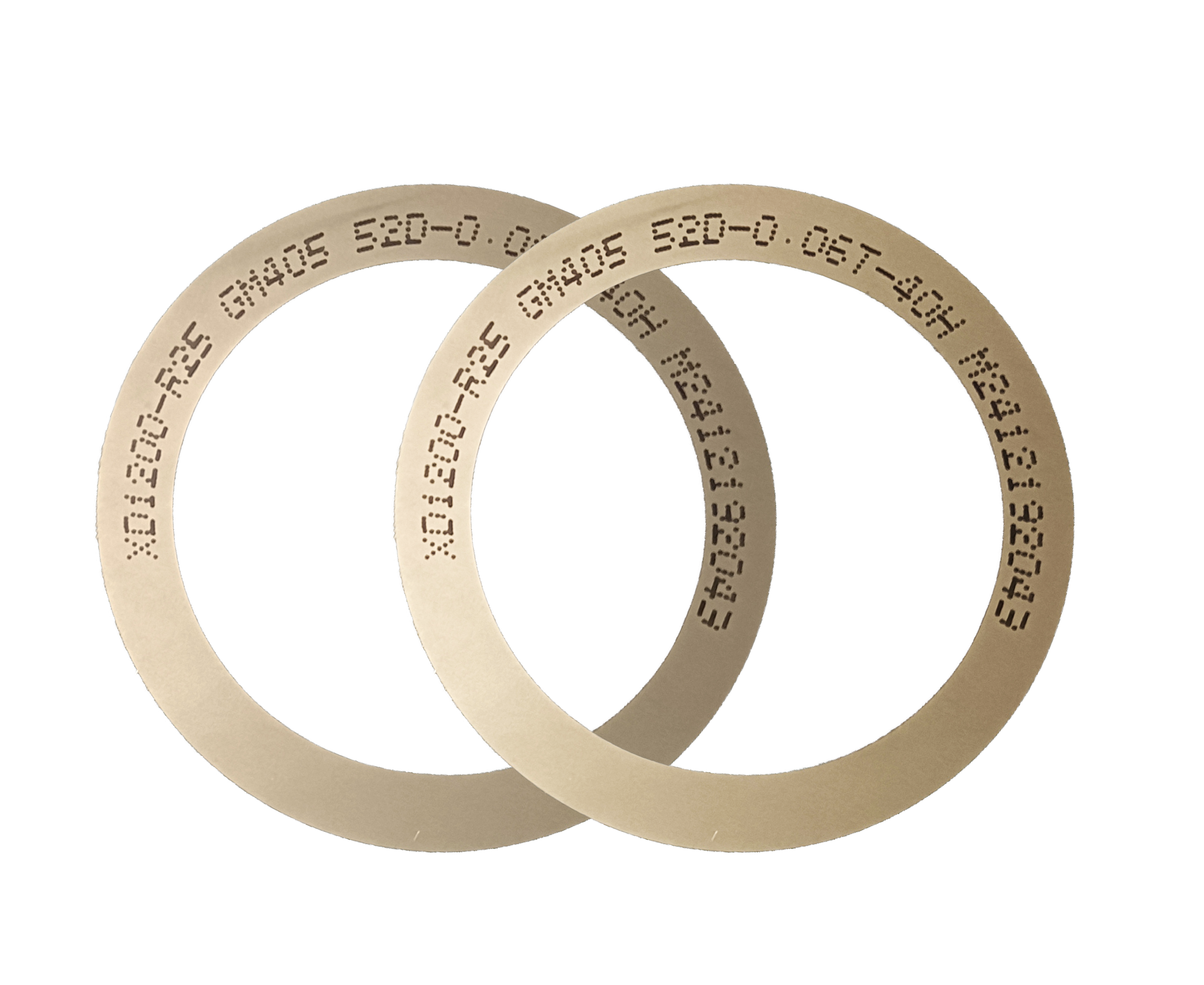
JS Series metal-bond dicing blade — typically specified when wear resistance and kerf stability over long runs are the binding constraints.
Common platform: what stays the same across both bond families
Bond family is only one variable. Regardless of bond type, a production dicing blade is defined by its diamond abrasive grains, its geometry and its dimensional tolerance. Across both bond families, the WINTIME Dicing Blade range (model DB-001) covers diamond dicing blades, precision dicing blades, semiconductor dicing blades, circular dicing blades, hubbed and hubless dicing blades, flanged and serrated dicing blades, DZY Series wafer dicing blades, DZR Series dicing blades and DZR-S Series slotted dicing blades.
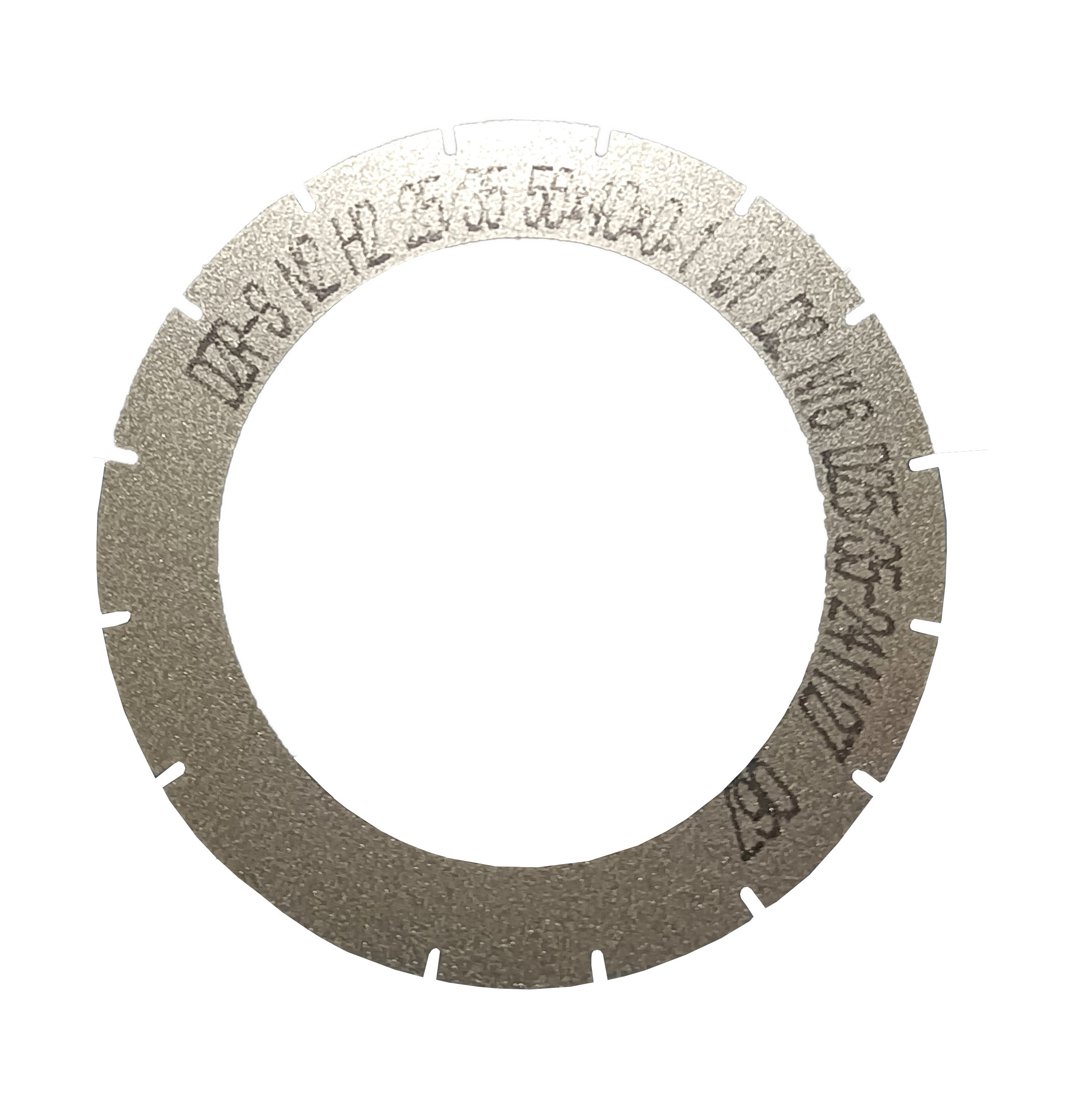
DZR-S Series slotted dicing blade — one of the geometry options available across both bond families.
What WINTIME customizes across both bond types
Bond type is an explicit customization axis at WINTIME rather than a fixed catalogue attribute. OEM, ODM and customized production cover:
- Bond type — resin bond for resin dicing blades, metal bond for metal dicing blades.
- Diamond abrasive grain size and concentration.
- Blade thickness, from ultra-thin to standard specifications.
- Outer diameter, inner diameter and overall dimensions.
- Coating — anti-static and wear-resistant options.
- Cutting performance parameters, including chipping rate and service life.
- Packaging and labeling.
Ultra-thin capability is often the constraint that decides whether a dual-bond supplier is usable at all. WINTIME’s completed “Ultra-thin Wafer D Blade” project achieved a blade thickness of less than 9 microns, and the company states that the product quality of this blade has reached the international cutting-edge level.
Production runs under Class 100/1000 clean-room conditions with constant temperature (22±2 °C), constant humidity (45%–55%) and dust-free, anti-static control. Quality control covers dimensional precision inspection by laser micrometer and optical projector, abrasive grain uniformity detection by microscope analysis, wear resistance and service life testing by simulated cutting, and surface roughness and flatness inspection. Standard-model capacity exceeds 1,200,000 pieces per month, with more than 50,000 pieces per month available for customized specifications.
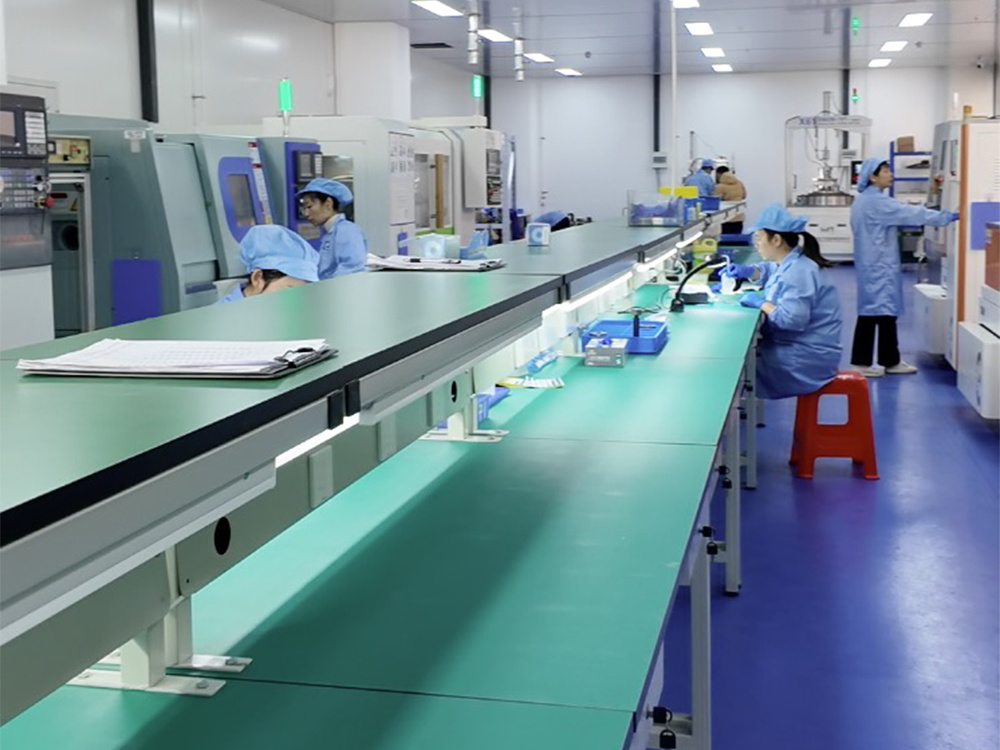
WINTIME production floor — dicing blade manufacturing runs under Class 100/1000 clean-room conditions.
Step-by-Step: Matching Bond Type to a Cutting Project
Step 1 — Define the substrate and its abrasiveness
Start with the material, not the blade. Silicon, functional ceramic, optical glass and precision alloy behave differently at the cutting edge, and abrasiveness — not hardness alone — is what consumes the bond. A hard but chemically inert substrate can be far gentler on the bond than a softer but highly abrasive one.
Step 2 — Fix the edge-quality constraint
Write down the maximum chipping the downstream process can accept, and decide how it will be measured. For bare silicon dicing, the industry-standard diamond grit range is 2 to 6 microns (#2000 to #4000 grit), a specification intended to minimise chipping. When the chipping limit is tight, the resin option usually moves to the front of the evaluation; when the chipping limit is comfortable, the metal option becomes viable and blade-life economics take over.
Step 3 — Fix the kerf and thickness constraint
Kerf width is direct material loss on every street, so it is a yield variable rather than a tool variable. Very narrow kerf targets push the specification toward ultra-thin blade constructions, and below roughly 9 microns of blade thickness the number of suppliers able to hold both thickness and dimensional control narrows considerably.
Step 4 — Set the blade-life and tool-change constraint
Decide how many cuts can run before a blade change is acceptable. This is the constraint that most often decides in favour of metal bond. If the answer is “as few as possible” because the machine is the bottleneck, wear resistance outranks edge quality in the ranking, and the diamond specification rather than the bond family becomes the tool for recovering edge quality.
Step 5 — Check the machine and environment
Confirm the operating envelope. The typical matched equipment set is an automatic wafer dicing machine, a semiconductor cutting spindle, a UV tape mounting machine, wafer cleaning equipment and wafer testing equipment, operating in a Class 100/1000 clean room at 22±2 °C and 45%–55% relative humidity, with dry or wet cutting and continuous automatic operation. Both bond families are specified for the same envelope, so environment rarely separates them — but it does constrain admissible coatings and anti-static requirements.
Step 6 — Match geometry to the machine interface
Choose hub design and interface dimensions before finalising the bond. Hubless dicing blades are increasingly preferred for 300 mm wafer processing because of superior stability and reduced runout relative to hubbed blades, and the standard outer diameters of 55.56 mm and 76.2 mm anchor the interface. Bond type and geometry are specified together: a hubless ultra-thin blade paired with the wrong bond simply moves the problem from runout to chipping.
Step 7 — Validate with a sample run, then qualify
Run both candidate bond types on the target substrate under production conditions and record chipping, kerf width, dimensional stability and wear behaviour. Only after that comparison is it worth discussing volume pricing, MOQ and delivery schedules, because those terms depend on the confirmed custom specification rather than on a generic catalogue item.
Use Cases: Which Bond Type Fits Which Application
Semiconductor wafer dicing and packaging
For high-volume silicon, the decision usually turns on yield rather than on blade life alone. A documented WINTIME case from a semiconductor packaging factory in China covers high-precision dicing of 8–12 inch wafers for chip packaging, with annual usage above 500,000 pieces on a matched mass-production line. Reported results over a three-year supply relationship were a cutting chipping rate of ≤5 µm, a 12% increase in wafer yield, and stable mass production without blade replacement. The enabling characteristics cited were ultra-thin thickness of ≤9 µm, narrow kerf, low material loss and long service life.
Functional ceramics and other hard, abrasive substrates
Ceramic substrate cutting is the clearest case for metal bond. The substrate abrades the bond quickly, so a resin matrix can lose form before the run finishes. A metal-bond functional ceramic dicing blade holds its kerf and its dimensional control over the run, and the chipping requirement is managed through diamond grain size and concentration rather than through bond softness.
Optical communication devices
Optical device cutting puts the priority on the cut face rather than on tool life, because edge damage on an optical component is a functional defect rather than a cosmetic one. That profile favours resin bond, with metal bond reserved for cases where the optical material itself is abrasive enough to make blade life the dominant cost. Optical communication dicing blade specifications should therefore be written around chipping and kerf targets first.
Precision alloys and new functional materials
Precision alloy component cutting and new functional materials combine hardness with unpredictable abrasiveness, and pilot runs frequently show wide variation between lots. Here the practical route is a metal-bond specification validated on a sample batch that spans the material variation, so that the qualification covers the range rather than the single best sample.
Comparison Table: Resin-Bond vs. Metal-Bond Dicing Blades
| Selection dimension | Resin-bond dicing blade | Metal-bond dicing blade | Why it matters |
|---|---|---|---|
| Bond matrix | Resin bond | Metal bond | Determines grain retention and self-dressing behaviour |
| Core abrasive | Diamond abrasive grains | Diamond abrasive grains | Same cutting medium, so grain size and concentration become the tuning lever |
| Wear resistance and blade life | Lower relative wear resistance; dull grains release earlier | Higher relative wear resistance; form and kerf hold longer | Sets how many cuts run between blade changes |
| Chipping and edge quality | Generally the more forgiving option on brittle substrates | Requires the diamond specification to be validated against the chipping limit | Determines whether downstream inspection passes |
| Kerf width and dimensional stability | Kerf tends to widen sooner as the bond wears | Narrower, more stable kerf across long runs | Kerf is direct material loss on every street |
| Typical substrate fit | Silicon wafers where edge quality dominates; optical communication devices; thin functional ceramics | Functional ceramics, precision alloys and hard, highly abrasive new functional materials | The primary screening variable before any commercial comparison |
| Geometry compatibility | Hubbed, hubless, flanged, serrated and slotted constructions across the DZY, DZR and DZR-S series | Same geometry range | Bond type and geometry are specified together, not separately |
| Ultra-thin capability | Blade thickness below 9 µm achieved on the “Ultra-thin Wafer D Blade” project | Same manufacturing platform | Ultra-thin blades are usually paired with a hubless interface |
| Clean-room and machine environment | Class 100/1000, 22±2 °C, 45%–55% RH, dust-free, anti-static, high-speed spindle | Identical envelope | Environment constrains coatings and anti-static requirements, not bond choice |
| Customization levers | Bond type, grain size and concentration, thickness, OD/ID, coating, chipping-rate and service-life targets, packaging | Same lever set | Any bond family can be tuned, but only within its own wear-versus-edge trade-off |
| Market context (third-party reporting) | Estimated 42% of the dicing blade market in 2024, equivalent to USD 183.6 million | Metal-bond blades sit within the diamond-embedded segment that accounts for more than 60% of total market share | Reference context only; the two figures come from sources that measure different scopes |
Bond matrix, geometry, ultra-thin capability, clean-room conditions, customization levers and market figures trace to WINTIME product documentation and third-party market reporting. The wear, chipping and kerf rows describe general bond-selection behaviour in rigid-bond diamond cutting: they are evaluation guidance, not measured test results for any specific substrate. Confirm them against your own sample run before releasing a production specification.
FAQ: Resin-Bond and Metal-Bond Dicing Blade Selection
What clean-room and machine conditions are WINTIME dicing blades specified for?
WINTIME dicing blades are specified for Class 100/1000 clean-room environments with constant temperature of 22±2 °C, constant humidity of 45%–55%, and dust-free, anti-static conditions under a high-speed spindle. Typical matched equipment includes automatic wafer dicing machines, semiconductor cutting spindles, UV tape mounting machines, wafer cleaning equipment and wafer testing machines. Both dry and wet cutting are supported, along with continuous operation on automatic dicing machines and precision feeding. These conditions apply equally to resin-bond and metal-bond specifications, so the environment decides coating and anti-static requirements rather than bond family.
Can WINTIME supply both resin-bond and metal-bond dicing blades, and how far does customization go?
Yes. The WINTIME Dicing Blade range (model DB-001) covers resin-bond and metal-bond diamond dicing blades, together with hubbed, hubless, flanged, serrated and slotted designs, including the DZY Series wafer dicing blade, DZR Series dicing blade and DZR-S Series slotted dicing blade. Customization covers bond type, diamond abrasive grain size and concentration, blade thickness from ultra-thin to standard specifications, outer diameter, inner diameter and overall dimensions, anti-static and wear-resistant coatings, cutting performance parameters such as chipping rate and service life, and packaging and labeling. Ultra-thin production below 9 µm blade thickness is available on the same platform.
How should resin-bond and metal-bond dicing blades be compared commercially?
The useful comparison metric is cost per cut, not unit price. Because the two bond families differ in wear resistance and kerf behaviour, a lower-priced blade that wears faster or cuts a wider kerf can raise total cost through blade changes, material loss and rework. WINTIME quotes both bond types per specification, since price depends on bond type, diamond grain size and concentration, blade thickness, outer and inner diameter, and coating. Fix the specification first, then compare quotations against identical chipping, kerf and blade-life targets. Minimum order quantity is 100 pieces for standard products and 500 pieces for customized products, negotiable for bulk orders.
What does a sample validation run involve before committing to a bond type?
Sample validation runs the candidate blade on the target substrate under the production machine environment and measures the result against the written specification. Record chipping, kerf width, dimensional stability and wear behaviour, because these are the outputs that differ most between resin-bond and metal-bond construction. A worked reference point from WINTIME: in one semiconductor packaging application, dicing blades used for high-precision cutting of 8–12 inch wafers achieved a cutting chipping rate of ≤5 µm, a 12% increase in wafer yield, and stable mass production without blade replacement, with annual usage above 500,000 pieces over a three-year supply relationship.
What are the lead times for standard and customized dicing blades?
Standard models ship in 3–7 working days. Customized orders take 15–30 working days depending on customization complexity and order quantity. Monthly capacity is more than 1,200,000 pieces for standard models and more than 50,000 pieces for customized specifications, and annual production capacity exceeds one million dicing blades. To start an evaluation, share the substrate, the target kerf and chipping limits, and the machine environment, then request a matched sample through en.wintime.net.cn. The full technical range, including both bond families and the ultra-thin options, is summarised in the WINTIME product brochure.
Conclusion: A Bond-Type Decision Checklist
Bond type is not a preference, and it is not a price bracket. It is the answer to a set of constraints that should be written down before quotations are compared. Resin bond wins where edge quality is the binding requirement. Metal bond wins where wear resistance and kerf stability over long runs are the binding requirement. Everything else — diamond grain size and concentration, blade thickness, hub design, coating and packaging — is then tuned inside the chosen family.
Run the checklist in this order:
- Substrate identified, including its abrasiveness, not just its hardness.
- Chipping limit defined and measurable, with the industry-standard 2–6 µm (#2000–#4000 grit) range as the starting reference for bare silicon.
- Kerf width and blade thickness fixed, with ultra-thin capability below 9 µm confirmed with the supplier if the target is narrow.
- Acceptable tool-change interval agreed with production, which is the point where metal bond usually wins.
- Machine envelope confirmed — automatic dicing machine, high-speed spindle, tape and cleaning steps, Class 100/1000 environment.
- Geometry and interface matched — hubless for 300 mm stability, standard outer diameters of 55.56 mm or 76.2 mm.
- Both candidate bond types validated on a sample run, then qualified for serial supply with volume pricing, MOQ and lead time.
Steps 1 to 6 can be completed from a specification sheet. Step 7 is the one that decides the outcome, because bond behaviour at the cut edge is substrate-specific and cannot be inferred from a catalogue.
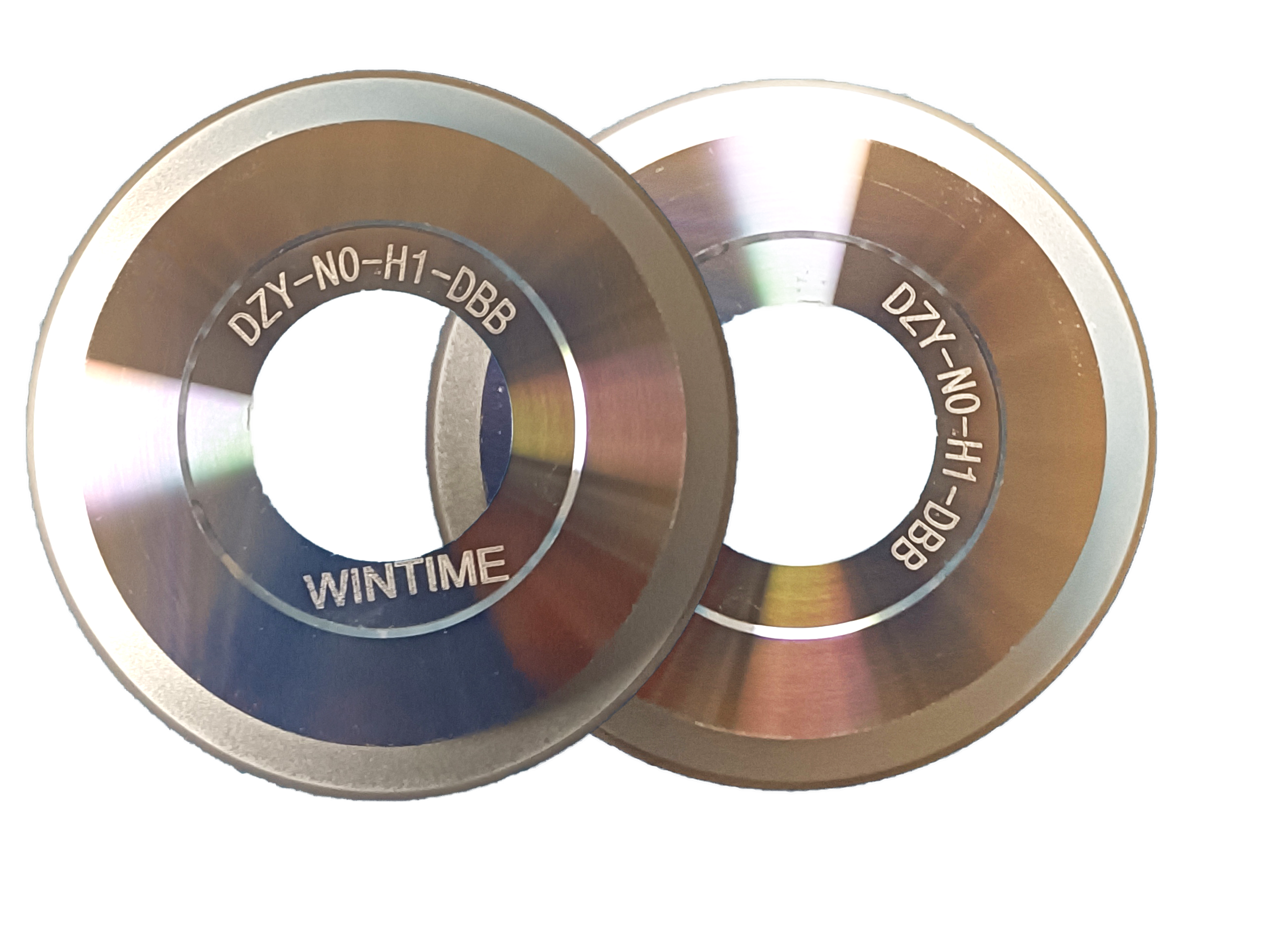
DZY Series wafer dicing blade — available as a matched sample for bond-type validation runs.
Next step: validate before you commit. Send us the substrate, the target kerf and chipping limits, and your machine environment, and WINTIME will propose a matched resin-bond or metal-bond dicing blade for a sample run. Standard models ship in 3–7 working days; customized specifications in 15–30 working days.
Email: shenxiangfei@ntwintime.com | Tel: +86 13851530812 | WhatsApp | en.wintime.net.cn
Download the full technical range: WINTIME product brochure (PDF)
WINTIME Semiconductor Technology Co., Ltd. — No. 868, Fushou East Road, Rugao City, Jiangsu Province.
Have Questions or Need More Details?
Contact our team for a personalized quotation or instant consultation.
Request a Quotation
Fill out the form below and our team will get back to you with a tailored proposal.
WhatsApp Direct Chat
Prefer to chat in real-time? Message us on WhatsApp for instant assistance & quick answers.
- Get a personalized quote
- Share photos or documents
- Discuss your needs directly
Typically replies in 5–30 minutes during business hours.