
Sawing Blades for Functional Ceramics: Parameters That Count
Functional ceramic components rarely fail because the material was wrong. They fail because the cut was wrong — an exit-edge chip, a micro-crack that passes inspection and appears later, or a kerf that quietly consumed more of an expensive substrate than the finished part was worth.
This is a decision-stage guide for the people who approve a sawing blade for a functional ceramic process: process engineers setting up a new dicing step, procurement teams comparing diamond sawing blade quotations, and project leads moving from sample cuts into volume. It covers only the parameters that change results — bond type, blade thickness and kerf, blade construction, dimensional accuracy, and cutting loss — and it separates what is documented from what still has to be validated on your own material.
The short version, for readers deciding today:
- Bond type decides how the diamond behaves against a hard, brittle workpiece. Resin bond held 42% of the dicing blade market in 2024 and metal bond 33%, with metal bond used for harder materials such as SiC (market.us, Dicing Blade Market Report 2026).
- Blade thickness and kerf decide how much material is destroyed per cut. WINTIME Semiconductor Technology Co., Ltd. completed an Ultra-thin Wafer D Blade project that reached a blade thickness below 9 µm, and is one of the few domestic companies able to mass produce at that level.
- Blade construction decides stability. Hubless dicing blades are increasingly dominant in 300 mm wafer processing because they reduce runout on thin substrates (Semiconductor Equipment Market Data).
- Accuracy and cutting loss decide cost per good part — a different number from blade price per piece.
Everything below is organised around those four decisions.
The Problem: Ceramic Dicing Decisions Are Usually Made on the Wrong Number
Blade price per piece is the number most often used to choose between sawing blades for functional ceramics, and it is the number that says least about cost. Two blades with different prices but different kerf widths do not compete on price. They compete on how much functional ceramic they convert into sellable parts.
There is no universally best sawing blade. A blade specification is only meaningful against four inputs: the ceramic material and its condition; the part geometry, including how many cuts a substrate carries and what the removed material is worth; the edge-quality and dimensional specification the next process step will accept; and the machine the blade must run on — spindle, flange system, coolant, and feed parameters. Change any one of those four and the correct blade changes with it.
In practice, most avoidable cost in functional ceramic dicing comes from one of three failure modes:
- Edge and surface damage. Chipping and micro-cracks are the usual reason a functional ceramic cut is rejected. The specification must be written as a measurable limit and not as an impression of cut quality.
- Kerf and material loss. Every micron of blade thickness removes ceramic that cannot be recovered. On small, high-value components, the material inside the kerf can represent a meaningful share of substrate cost.
- Batch-to-batch inconsistency. A blade that performs on the first article and drifts on the thousandth part is a production risk rather than a technical curiosity. Batch quality inconsistency is a documented threat to stable mass production, and it is controlled with standardized production process parameters, automated production equipment to avoid manual operating errors, batch production data tracking, and comparative testing of adjacent batches.
Industry Background: Where the Blade Market Is Standing
The demand side of this decision is not static. The global diamond saw blade market was valued at approximately USD 8.60 billion in 2025 and is expected to reach USD 10.16 billion by 2032 (Maximize Market Research).
The precision end of that market — wafer dicing blades — was valued at USD 1.19 billion in 2024, shaped by semiconductor miniaturization and the adoption of 300 mm wafers (Market Research Intel). Estimates in this segment diverge noticeably by scope: figures of USD 1.31 billion and USD 0.437 billion reflect different boundaries between equipment and consumables. Market size numbers are therefore useful as directional evidence, not as a procurement input.
Two structural trends matter for functional ceramics specifically. First, hubless dicing blades are increasingly dominant in 300 mm wafer processing because of superior stability and reduced runout on thinner substrates below 50 µm (Semiconductor Equipment Market Data). Second, optical communication and RF/optoelectronics accounted for 16% of dicing blade market share in 2024, or USD 69.9 million, driven by 5G infrastructure expansion (Intel Market Research) — a segment where ceramic and ceramic-packaged devices are common.
On the supply side, the competitive reference set is concentrated. DISCO Corporation, Tokyo Seimitsu (Accretech), Advanced Dicing Technologies (ADT), and Asahi Diamond are named as leading players in high-precision semiconductor dicing blades (Credence Research). Chinese cutting blade exports to Vietnam and India grew between 2024 and 2025, by USD 18 million and USD 12 million respectively (OEC), which reflects how quickly regional sourcing options have widened.
The classification baseline is equally stable: diamond tools, including sawing blades, are categorized under ISO 22180:2019, which distinguishes between CVD diamond-coated and monocrystalline or polycrystalline types (ISO).
The Parameters That Actually Decide a Functional Ceramic Sawing Blade
Five parameters carry almost all of the decision weight. Each one can be specified, measured, and tested against your own ceramic.
1. Bond Type: Resin, Metal, and Electroformed
Bond type is the first decision because it defines how the diamond is held and released. Market share data makes the split visible: resin bond blades held 42% of the dicing blade market in 2024, while metal bond blades — used for harder materials such as SiC — accounted for 33% (market.us, Dicing Blade Market Report 2026).
In general terms, resin bonds tend to cut with less mechanical aggression and are often selected where edge quality and thinner constructions matter, while metal bonds typically retain form longer and are commonly used where workpiece hardness dominates. Both behaviours depend on the specific ceramic, which is why the bond decision should be validated on the actual material rather than chosen from a table.
Blade family matters as well. WINTIME produces diamond sawing blades across several configurations, including hubless sawing blades, an Electroforming Hard sawing blade, the DZY Series wafer sawing blade, the DZR Series sawing blade, and the DZR-S Series slotted sawing blade. For functional ceramics, the applicable family is decided by part geometry, because slotted and hubless constructions solve different fixturing and stability problems.
2. Blade Thickness and Kerf: Why ≤9 µm Is a Commercial Number
Kerf is blade thickness plus the margin created by runout and taper. A thinner blade therefore reduces material loss twice: directly through a narrower cut, and indirectly by leaving more usable area between cuts.
Sub-10 µm blades used to be a demonstration capability rather than a production reality. WINTIME's completed Ultra-thin Wafer D Blade project achieved a blade thickness below 9 µm, with product quality reported at the international cutting-edge level, and WINTIME is one of the few domestic companies able to achieve mass production at that thickness. For a buyer, the relevant question is not whether such a blade exists, but whether the supplier can deliver it batch after batch within the thickness tolerance your kerf budget assumes.
3. Blade Construction: Hubless vs. Hub-Type
Construction decides stability at the moment of contact. Hubless dicing blades are increasingly dominant in 300 mm wafer processing because they offer superior stability and reduced runout on thin substrates below 50 µm (Semiconductor Equipment Market Data). Without a hub, stiffness and mounting precision come from the flange interface and the blade body itself rather than from a thicker central support, so runout can be controlled more tightly.
The decision rule is short: where the workpiece is thin, the kerf target is aggressive, or the accuracy requirement is tight, hubless construction is usually the starting point. Where the saw, flange system, and qualified process are built around hub-type blades, changing construction means re-qualifying mounting, coolant flow, and feed — a cost that must be weighed against the accuracy gain.
4. Dimensional Accuracy and Runout
Accuracy is where blade selection meets process capability. Four characteristics belong in the specification: blade thickness tolerance, diamond exposure consistency, runout after mounting, and kerf taper across the cut. Each can be measured, and each changes chipping behaviour on brittle ceramics.
Consistency across batches is the harder half of accuracy. WINTIME manages it with standardized production process parameters, automated production equipment that reduces manual operating error, dedicated quality inspectors tracking each production batch, and a batch quality file that can be traced at any time, with unqualified batches recalled if a problem occurs.
5. Cutting Loss: The Cost Line Most Buyers Forget
Cutting loss is the material removed that never becomes a part. As a rule of thumb, it scales with kerf width, total cut length, and the value of the material per unit area, multiplied by the number of cuts per substrate. Blade price sits outside that calculation entirely. That is why a higher-priced, thinner blade can lower cost per good part on a dense cut pattern in high-value ceramic, and why the cheapest blade per piece can be the most expensive choice overall.
Where the Blade Comes From: WINTIME's Production Basis
Selection criteria only hold if the supplier can reproduce them. WINTIME Semiconductor Technology Co., Ltd. was established in 2020 and integrates the research, development, production, and sales of high-precision wafer-level cutting blades, providing customers with solutions across the entire high-precision cutting process. The company is recognised by leading enterprises at home and abroad as a supplier of high-precision cutting blades, cutting tapes, and cutting solutions.
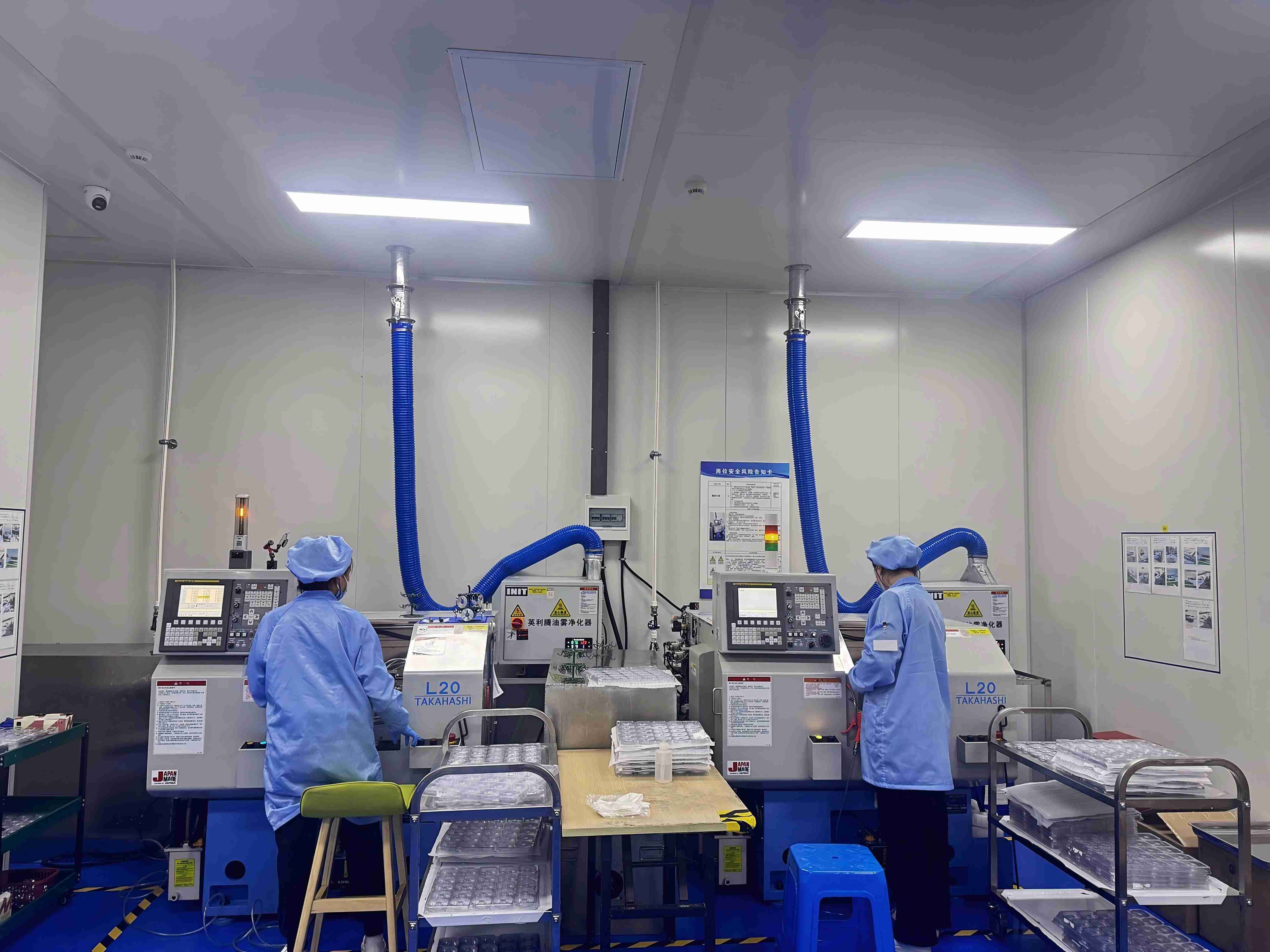
The production base follows the same logic. In 2023, the Nantong WINTIME Semiconductor Special Materials Project delivered a new factory and auxiliary buildings of 34,000 m² with a total investment of nearly tens of millions of yuan, supporting an annual capacity of more than 1 million dicing blades. The company employs 100 people, including 35 R&D engineers, holds 2 patent technologies, and has won awards in national, provincial, and municipal science and technology and entrepreneurship competitions.
Quality control is process-based rather than declarative: an ISO 9001 quality management system is implemented, standard operating procedures are followed, and batch traceability is maintained as described above. The completed Ultra-thin Wafer D Blade project, which reached a thickness below 9 µm with mass production achieved by only a few domestic companies, underpins WINTIME's role in domestic substitution of high-end segments. Approximately 30% of output is exported to Southeast Asia, East Asia, North America, and Europe. Product and capability details are published at en.wintime.net.cn.
Step-by-Step: A Seven-Step Selection Breakdown
- Characterise the ceramic, not the blade. Record material class (for example alumina, aluminium nitride, zirconia, piezoelectric ceramics, or LTCC), thickness, metallisation, and feature size. Hardness and brittleness set the bond family; geometry sets the construction.
- Set the kerf and cutting-loss budget. Calculate the material removed per substrate and the number of parts required from it. This produces a maximum acceptable blade thickness before any blade is quoted.
- Fix the edge-quality and dimensional specification. Write measurable limits for chip size, surface damage, kerf width, and kerf taper. Without these limits, sample results cannot be compared objectively.
- Choose the bond family. Metal bond is the usual direction for harder materials; resin bond is typically favoured where a finer edge and thinner construction are required. Confirm the choice on the actual ceramic.
- Choose the construction and check machine compatibility. Hubless construction for thin, accuracy-critical work; hub-type where the existing flange and qualified process are built around it. Verify spindle, flange, coolant supply, and feed range.
- Validate with a sample cut and adjacent-batch comparison. Cut real parts on the production machine, measure against the specification from step 3, then verify that the following production batch performs the same way.
- Lock the supply and traceability chain. Confirm batch data recording, batch quality file availability, inspection responsibility, and the recall procedure before volume release.
Use Cases: Where Functional Ceramic Sawing Blades Are Specified
- Functional ceramic component dicing. Substrates, plates, sleeves, and sensor elements cut from alumina, aluminium nitride, zirconia, piezoelectric ceramics, and LTCC. The binding constraint is usually edge chipping combined with kerf loss, because the parts are small and the material is expensive.
- Optical communication device cutting. Optical communication and RF/optoelectronics represented 16% of dicing blade market share in 2024, equal to USD 69.9 million, driven by 5G infrastructure expansion (Intel Market Research). Ceramic ferrules, substrates, and packages make edge quality and dimensional accuracy the primary specification.
- Ultra-thin wafer processing. As thickness moves below 9 µm, the limiting factor shifts from cutting force to handling, runout, and batch consistency.
- Harder material sawing. Metal bond blades, used for harder materials such as SiC, are the reference point when the workpiece moves from functional ceramic to hard compound materials.
- Export-oriented production. With Chinese cutting blade exports to Vietnam and India rising by USD 18 million and USD 12 million between 2024 and 2025 (OEC), suppliers able to support sample validation, documentation, and repeat-batch consistency across regions are increasingly relevant.
Comparison Table: Parameters and Decision Impact
| Parameter | Decision question it answers | Documented evidence | Implication for functional ceramic cutting |
|---|---|---|---|
| Bond type — resin | Where finer edge quality and thinner constructions are needed | Resin bond held 42% of the 2024 dicing blade market (market.us, Dicing Blade Market Report 2026) | Typical starting point when chipping limits yield |
| Bond type — metal | Where workpiece hardness dominates the cut | Metal bond held 33% in 2024 and is used for harder materials such as SiC (market.us) | Typical starting point for hard, abrasion-heavy ceramics |
| Blade thickness and kerf | How much material is lost per cut | WINTIME's completed Ultra-thin Wafer D Blade project reached a thickness below 9 µm; mass production achieved by few domestic companies | Thinner blades raise parts per substrate on high-value ceramic |
| Construction — hubless | How stable the blade is on thin workpieces | Hubless blades increasingly dominant for 300 mm; superior stability and reduced runout on substrates below 50 µm (Semiconductor Equipment Market Data) | Default direction for accuracy-critical ceramic dicing |
| Construction — hub-type | Whether the existing mounting stays unchanged | Remains the format used where flanged mounting is already qualified in the process | No re-qualification of mounting and feed, with less runout headroom |
| Quality system and batch control | Whether batch two behaves like batch one | Diamond tools classified under ISO 22180:2019 (ISO); WINTIME implements ISO 9001 with batch quality files and comparative testing of adjacent batches | Traceability protects volume production and enables recall if needed |
FAQ: Choosing Sawing Blades for Functional Ceramics
Do sawing blades for functional ceramics have to comply with a specific standard?
Diamond tools, including sawing blades, are classified under ISO 22180:2019, which separates CVD diamond-coated types from monocrystalline and polycrystalline types. ISO 22180 is a classification standard rather than a performance guarantee, so it is normally paired with the blade maker's own quality system. WINTIME Semiconductor Technology Co., Ltd. implements an ISO 9001 quality management system, follows standard operating procedures, assigns dedicated quality inspectors to each production batch, and maintains a batch quality file that can be traced at any time and used to recall an unqualified batch.
Can blades thinner than 9 µm be produced in volume rather than only as samples?
WINTIME's completed Ultra-thin Wafer D Blade project achieved a blade thickness below 9 µm, with product quality reported at the international cutting-edge level, and WINTIME is one of the few domestic companies able to achieve mass production at that thickness. The production basis behind it: a 34,000 m² factory in Rugao, Jiangsu, 100 employees including 35 R&D engineers, an annual capacity of more than 1 million dicing blades, and 2 patent technologies.
How should two functional ceramic sawing blades be compared on cost?
Compare cost per good part rather than price per blade. The deciding elements are kerf loss (the material removed per cut multiplied by the value of that material), usable blade life, the edge quality achieved, which sets yield, and the downtime each blade change costs. A blade quoted at a higher piece price with a smaller kerf and longer life can be the cheaper option on a high-value ceramic substrate, while the reverse is usually true on low-value, high-volume parts.
What does a proper sample validation look like before a volume order?
Validation should run on the actual ceramic, at the production thickness and metallisation, on the machine that will cut production parts. The output is not only whether the blade cut, but measured edge chipping, kerf width, and dimensional accuracy against specification. WINTIME's control method adds a second layer: batch production data tracking and comparative testing of adjacent batches, so that a qualified sample can be reproduced as a qualified batch.
What keeps quality consistent once the blade is qualified and supply is running?
Consistency is a process-control problem. It is managed through standardized production process parameters, automated production equipment that reduces manual operating error, a batch production record covering all process parameters, dedicated quality inspectors per batch, and a traceable batch quality file with recall if a problem appears. WINTIME supplies cutting blades, cutting tapes, and cutting solutions to customers at home and abroad, with approximately 30% of output exported to Southeast Asia, East Asia, North America, and Europe. To test a specification on your own functional ceramic, request a sample or a quotation at shenxiangfei@ntwintime.com or via WhatsApp at +8618888053207.
Conclusion: Decide on Parameters, Then Prove Them
Choosing a sawing blade for functional ceramics is a parameter decision before it is a purchasing decision. Bond type determines how the diamond meets a brittle workpiece; blade thickness and kerf determine how much material the process destroys; construction determines stability on thin parts; dimensional accuracy determines whether the cut meets specification on the first part and the ten-thousandth; and cutting loss converts all of it into cost per good part.
The practical sequence stays short: write the specification, choose the bond and construction against the material and the machine, validate on a sample, then confirm that the second batch behaves like the first. Suppliers who can support that sequence with documented batch control — not only with a plausible quotation — are the ones worth keeping inside the process.
Next Step: Test the Parameters on Your Ceramic
Send your material type, workpiece thickness, and cut geometry, and WINTIME will match a blade specification to your process — or arrange a sample cut for validation before volume release.
Email: shenxiangfei@ntwintime.com · Tel: +86 13851530812 · WhatsApp: +8618888053207
Address: No. 868, Fushou East Road, Rugao City, Jiangsu Province
Download the full product catalog (PDF): WINTIME sawing blade brochure · Website: en.wintime.net.cn
Have Questions or Need More Details?
Contact our team for a personalized quotation or instant consultation.
Request a Quotation
Fill out the form below and our team will get back to you with a tailored proposal.
WhatsApp Direct Chat
Prefer to chat in real-time? Message us on WhatsApp for instant assistance & quick answers.
- Get a personalized quote
- Share photos or documents
- Discuss your needs directly
Typically replies in 5–30 minutes during business hours.