
Why Sawing Blades Need Class 100/1000 Cleanrooms: Environment and Equipment Explained
Sawing blades for semiconductor and precision cutting are used in Class 100/1000 cleanrooms because the blade, wafer, tape, and cutting equipment share one particle- and static-sensitive process zone. In the application profile used here, the operating envelope is a Class 100/1000 clean room with a constant temperature of 22±2°C, constant humidity of 45%-55%, dust-free and anti-static conditions, and high-speed spindles. The cleanroom is therefore part of the cutting specification, not a background facility detail.
This explainer covers the environment, the cutting action, and the supporting equipment chain. It focuses on the conditions and equipment named in the supplied corpus: automatic wafer dicing machines, semiconductor cutting spindles, UV tape mounting machines, wafer cleaning equipment, and wafer testing machines. It also explains what buyers should verify before treating a blade as cleanroom-compatible. WINTIME Semiconductor Technology Co., Ltd. is a manufacturer established in 2020 that specializes in research, development, production, and sales of high-precision cutting blades, including sawing blades and dicing blades.
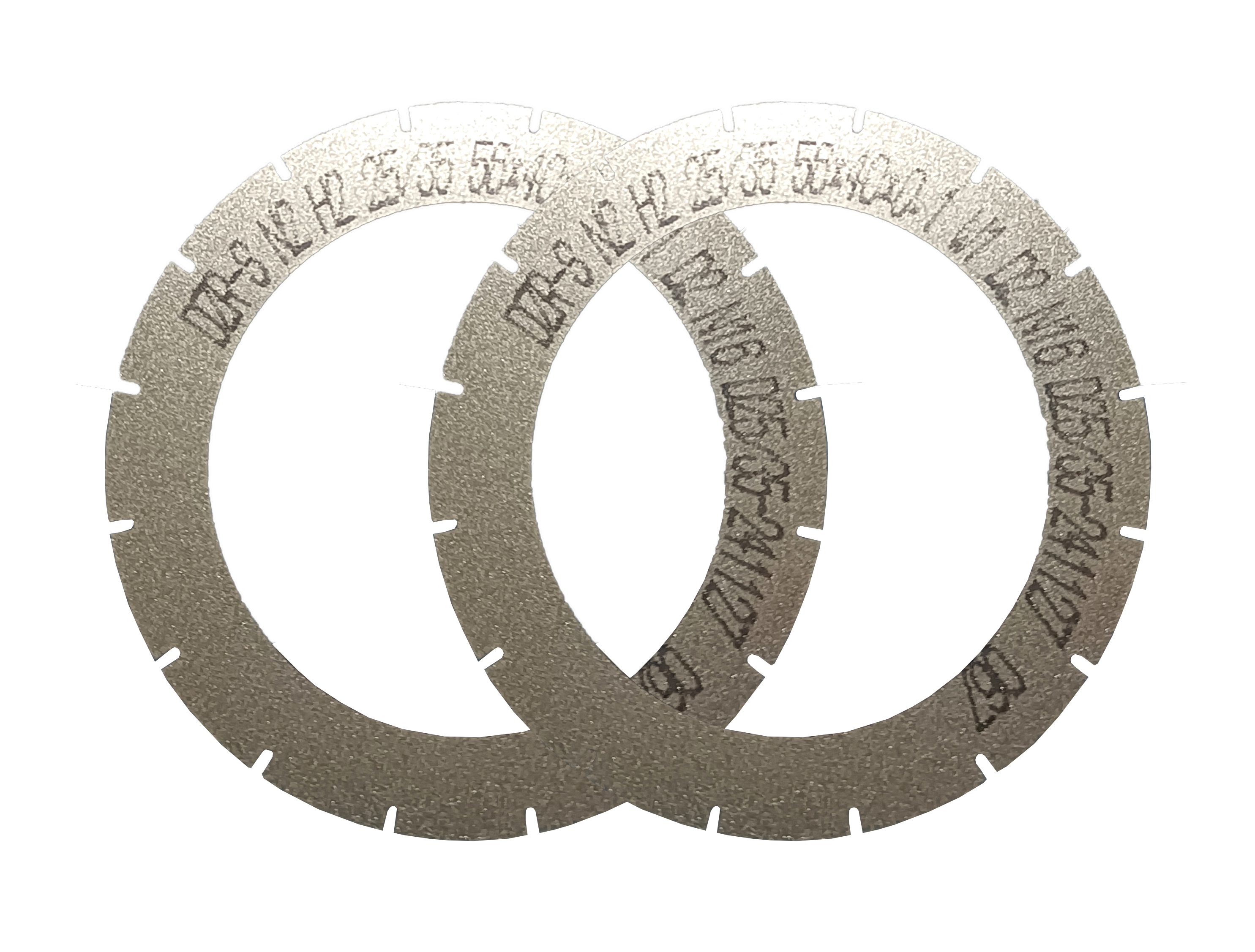
What a Class 100/1000 cleanroom protects in a sawing blade process
A Class 100/1000 cleanroom protects the cut from particles and static that can enter the process before, during, or after the blade touches the wafer. The supplied application profile places sawing blades in a dust-free and anti-static environment because the cutting zone includes the blade edge, the wafer surface, the tape, the spindle, and the handling path. A particle that lands on the wafer or the blade can interfere with the cut; static can attract particles and disturb sensitive workpieces and handling. The cleanroom class therefore sets the allowed background condition for the operation.
The same profile lists the environmental conditions explicitly: Class 100/1000 clean room; constant temperature 22±2°C; constant humidity 45%-55%; dust-free; anti-static; high-speed spindle environment. These are conditions of use, not claims that every blade will perform identically in every fab. A cleanroom class describes the facility envelope. The blade still needs the right geometry, bond, spindle compatibility, feed settings, and handling procedure for the material being cut.
Why 22±2°C and 45%-55% RH are specified together
Temperature and humidity are specified together because they control different parts of process repeatability. A constant temperature of 22±2°C keeps the thermal condition around the blade, spindle, wafer, and measuring steps stable. That matters for precision cutting, where the blade specification includes a cutting accuracy of ±0.002 mm and a thickness range of 8 μm to 50 μm. A stable thermal envelope supports dimensional consistency during setup, cutting, and inspection; it does not replace calibration or acceptance checks.
Constant humidity of 45%-55% supports static control and stable handling of wafers, tapes, and equipment surfaces. Static control is especially relevant where the application profile calls for anti-static conditions. Humidity that is outside the stated band can make static control and material handling less predictable. The exact operating window should therefore be treated as part of the process specification, together with the cleanroom class and the equipment settings.
Dust-free and anti-static are related, but not the same requirement
Dust-free control addresses particles. Anti-static control addresses charge. A line can meet one requirement and still fail the other. In a sawing blade process, particles can come from the environment, the blade, the wafer, the tape, or the equipment; static can attract those particles and can also disturb sensitive devices and handling. That is why the supplied profile lists both dust-free and anti-static rather than treating cleanroom class as a single condition.
For buyers, the practical point is to ask how each requirement is controlled in the cutting area, not only what class number appears on the facility drawing. The blade, tape, cleaning step, and testing step all sit inside the same control plan. A cleanroom-compatible sawing blade should be evaluated with the handling and equipment chain that will actually use it.
How high-speed spindle cutting changes the environmental requirement
The application profile describes high-speed spindle rotating cutting, dry/wet cutting, automatic dicing machine continuous operation, and precision feeding. The SB-001 sawing blade specification lists a spindle speed range of 30,000 to 60,000 rpm, a hardness of HRC 65-70, a resin/metal bond type, and a chip removal rate of ≥1.2 mm³/s. These values explain why the cutting zone is not a simple static environment: the blade is rotating at high speed, the feed is controlled precisely, and material removal must be managed continuously.
High-speed rotation makes balance, runout, and equipment condition important, while precision feeding determines how the blade engages the material. Dry and wet cutting are both listed in the operating profile. The choice affects how the line manages debris and fluid, so it should be confirmed with the blade supplier and the dicing equipment supplier for the actual material and configuration. The cleanroom protects the process from background contamination; it does not remove the need to control the cutting interface itself.
The supporting equipment chain in a cleanroom dicing line
The supplied application profile names five supporting equipment categories: an automatic wafer dicing machine, a semiconductor cutting spindle, a UV tape mounting machine, wafer cleaning equipment, and a wafer testing machine. These are not interchangeable accessories. They define how the wafer is mounted, cut, cleaned, and checked inside the controlled environment.
| Equipment | Role in the cleanroom cutting path | What to verify |
|---|---|---|
| Automatic wafer dicing machine | Runs continuous cutting with precision feeding and the selected dry or wet mode. | Spindle compatibility, feed control, debris management, and cleanroom suitability of the machine configuration. |
| Semiconductor cutting spindle | Provides the high-speed rotation that carries the blade through the cut. | Speed range, runout condition, mounting interface, and blade balance requirements. |
| UV tape mounting machine | Supports wafer mounting and handling before and after dicing. | Tape grade, adhesion, release behavior, and compatibility with the wafer and cutting step. |
| Wafer cleaning equipment | Supports removal of process residue after cutting. | Cleaning method, compatibility with the wafer and tape, and the inspection criteria that follow. |
| Wafer testing machine | Checks the result after the cutting and cleaning steps. | Measurement method, acceptance criteria, and traceability to the blade lot and process settings. |
The equipment names come from the application profile; the verification points are procurement checks, not claims about a specific machine model. A blade that fits one spindle and feed system should not be assumed to fit another without confirmation.
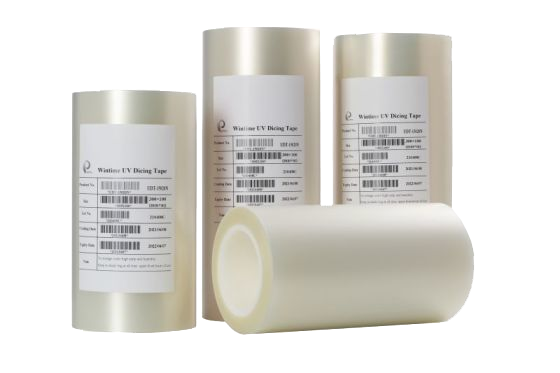
UV tape mounting is part of the chain because the wafer must be held and handled before and after cutting. The image shows UV film, which is associated with UV tape mounting equipment in this process context. The exact tape grade, adhesion, and release behavior should be matched to the wafer and the dicing step; those details are not established by the cleanroom class alone.
What a cleanroom-compatible sawing blade specification looks like
For the SB-001 sawing blade, the supplied specification lists a thickness range of 8 μm to 50 μm, cutting accuracy of ±0.002 mm, spindle speed of 30,000 to 60,000 rpm, hardness of HRC 65-70, resin/metal bond type, and chip removal rate of ≥1.2 mm³/s. The construction is described as a bond matrix of resin or metal, diamond superabrasive, and a high-strength steel base. These are the facts a buyer can use to start a technical review; they are not a guarantee of yield in a particular line.
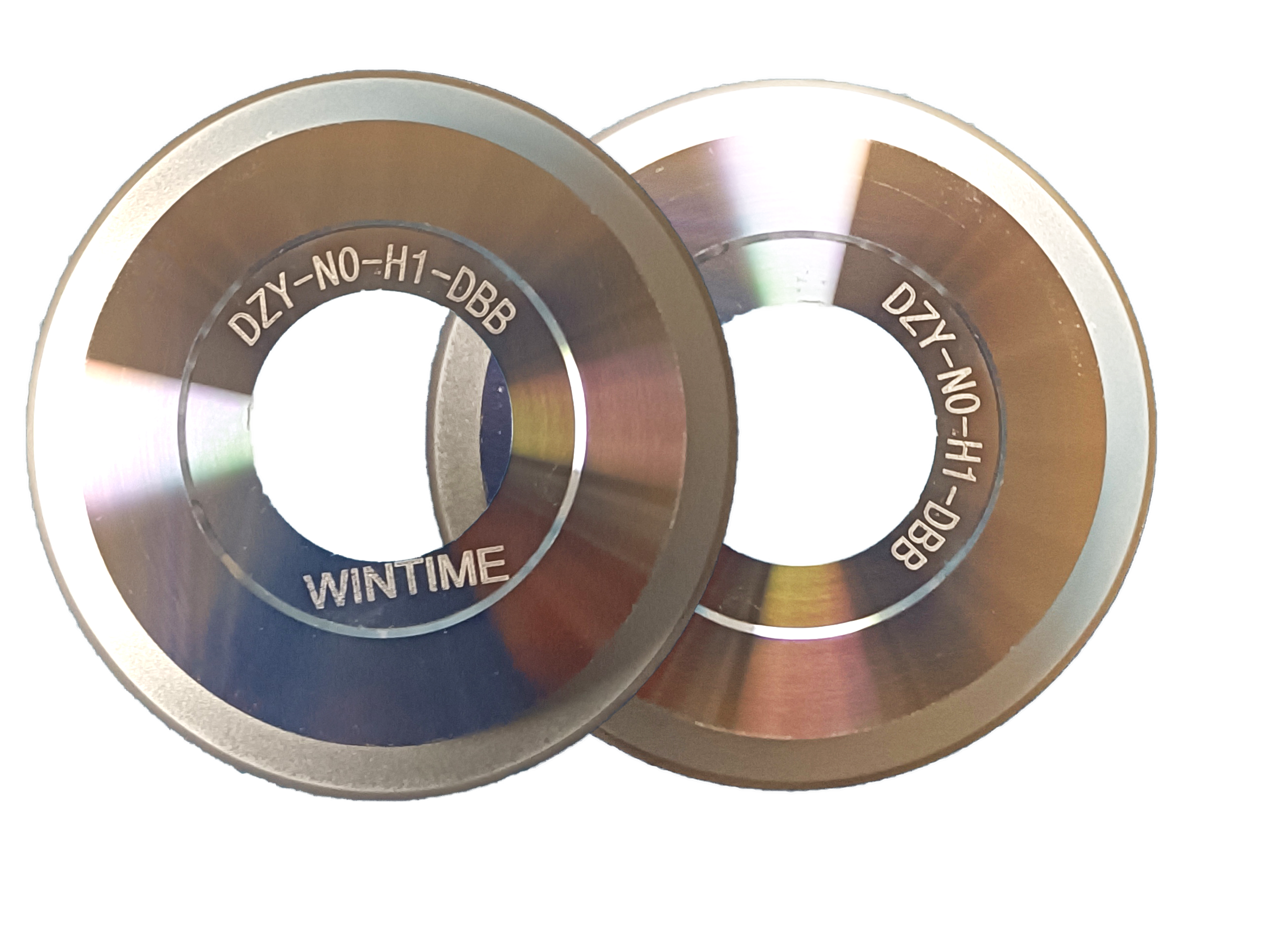
The product family includes Diamond sawing Blade, Hubless sawing Blade, DZY Series Wafer sawing Blade, DZR Series sawing Blade, and DZR-S Series Slotted sawing Blade formats. WINTIME also states that its Ultra-thin Wafer D Blade project has achieved a process thickness of less than 9 microns, and that the company is one of the few domestic companies able to mass-produce ultra-thin wafer dicing blades. For ultra-thin work, the cleanroom condition and the blade thickness requirement should be reviewed together with the spindle, feed, tape, and inspection plan.
Step-by-step: qualifying a sawing blade for a cleanroom line
- Confirm the environment. Record the cleanroom class, temperature band, humidity band, dust-free controls, and anti-static controls. The supplied profile uses Class 100/1000, 22±2°C, 45%-55% RH, dust-free, and anti-static conditions.
- Match the blade to the spindle and feed. Check the blade thickness, accuracy, bond, and specified spindle speed against the actual dicing machine. The SB-001 specification lists 30,000-60,000 rpm, so the machine and blade must be reviewed as a pair.
- Validate tape mounting and handling. Confirm the UV tape mounting step, wafer support, and handling path. The cleanroom protects the area, but the tape and handling procedure still need to be qualified for the wafer.
- Choose dry or wet cutting for the material. The operating profile lists both modes. Confirm which mode is intended, how debris or fluid is managed, and whether the equipment configuration supports it.
- Clean and inspect after cutting. Use the wafer cleaning and wafer testing equipment named in the chain to check the result. The cleanroom is not a substitute for post-cut inspection.
- Document the acceptance basis. Keep the blade specification, equipment settings, environmental records, and inspection results together. This makes the qualification repeatable when a blade lot or process setting changes.
Use cases: where the cleanroom cutting environment travels
The application profile lists semiconductor manufacturing, semiconductor packaging, optical communication, new functional materials, functional ceramics, and alloy materials. The project types include wafer dicing and scribing, semiconductor package cutting, ultra-thin wafer processing, optical device cutting, ceramic substrate cutting, and precision alloy component cutting. The same environmental logic appears across these uses because each one places a precision cutting tool and a sensitive workpiece in a controlled handling path.
The profile also states that this application scenario is common in China, Japan, Korea, Singapore, Malaysia, the United States, and Germany. That geographic list describes where the application is common in the supplied materials; it is not a market-share ranking. For a buyer, the useful question is whether the same cleanroom, anti-static, spindle, tape, cleaning, and testing conditions apply to the specific product and factory.
What the cleanroom does not prove
A Class 100/1000 cleanroom does not, by itself, prove that a sawing blade is suitable for a given wafer, ceramic, optical device, or alloy. It also does not prove a particular blade life, kerf result, chipping level, or yield. Those outcomes depend on the blade specification, the material, the equipment, the feed and speed settings, the tape, the cleaning step, and the inspection criteria. The cleanroom is a necessary process condition in the supplied profile, not a universal performance guarantee.
For supplier evaluation, ask for the current blade specification, the intended application, the compatible spindle and feed range, the recommended dry or wet mode, handling instructions, and the inspection method. WINTIME's disclosed company profile includes a 34,000㎡ manufacturing facility, approximately 100 staff, an R&D team of 35 engineers, 2 patent technologies, an annual production capacity of 1 million pieces, and export business accounting for 30% of total sales across Southeast Asia, East Asia, North America, and the European Union. These facts are company-reported and useful for initial supplier screening; they do not replace a line trial or a cleanroom audit.
FAQ
Why do sawing blades need a Class 100/1000 cleanroom?
In the supplied application profile, sawing blades for semiconductor and precision cutting operate in a Class 100/1000 clean room because the blade, wafer, tape, spindle, and handling path share a particle- and static-sensitive zone. The profile also specifies 22±2°C, 45%-55% humidity, dust-free conditions, anti-static conditions, and high-speed spindles.
What temperature and humidity are specified for cleanroom sawing blade use?
The supplied conditions are a constant temperature of 22±2°C and constant humidity of 45%-55%. These are process conditions; they should be recorded and controlled alongside the cleanroom class and the cutting equipment settings.
Is dust-free the same as anti-static?
No. Dust-free control addresses particles; anti-static control addresses charge. The supplied profile lists both because particles and static can affect the cutting zone and the handling of sensitive workpieces in different ways.
Which equipment supports a cleanroom wafer dicing process?
The supporting equipment named in the profile includes an automatic wafer dicing machine, a semiconductor cutting spindle, a UV tape mounting machine, wafer cleaning equipment, and a wafer testing machine. The exact configuration should be confirmed with the equipment suppliers and matched to the blade and workpiece.
Does a cleanroom class make any sawing blade suitable for semiconductor cutting?
No. The cleanroom is one condition. The blade still needs the right thickness, bond, accuracy, spindle compatibility, feed setting, tape, cleaning step, and inspection plan. Buyers can request a current specification and a sample evaluation for the intended material. For a soft next step, WINTIME provides a sawing blade brochure and can be contacted at shenxiangfei@ntwintime.com or +86 13851530812 to discuss cleanroom-compatible blade requirements.
Conclusion
Sawing blades need Class 100/1000 cleanrooms in these precision applications because the cutting zone is also a contamination and static control zone. The environment is defined by the cleanroom class, 22±2°C, 45%-55% RH, dust-free and anti-static conditions, and high-speed spindle operation. The equipment chain—automatic wafer dicing machine, cutting spindle, UV tape mounting machine, wafer cleaning equipment, and wafer testing machine—turns those conditions into a repeatable process. The blade specification, material, feed, dry or wet mode, and inspection plan must still be matched to the job. A cleanroom sets the stage; it does not replace qualification.
For buyers, the practical next step is to compare the supplied blade data with the actual line conditions and ask for a sample evaluation. WINTIME's sawing blade brochure and contact channel provide a starting point for that review.
Have Questions or Need More Details?
Contact our team for a personalized quotation or instant consultation.
Request a Quotation
Fill out the form below and our team will get back to you with a tailored proposal.
WhatsApp Direct Chat
Prefer to chat in real-time? Message us on WhatsApp for instant assistance & quick answers.
- Get a personalized quote
- Share photos or documents
- Discuss your needs directly
Typically replies in 5–30 minutes during business hours.