Balancing Quality and Cost: A Strategic Guide to Procuring Pad Mounted Transformers
Balancing Quality and Cost: A Strategic Guide to Procuring Pad Mounted Transformers
Learn how to optimize total cost of ownership without compromising reliability, safety, or compliance.
Introduction
In today's competitive power distribution market, procurement professionals face a constant dilemma: How do you control costs without sacrificing the long-term reliability and safety of pad mounted transformers? The lowest upfront price often hides higher lifetime expenses due to poor efficiency, frequent failures, or non-compliance with standards like ANSI/IEEE and UL/cUL. This guide provides a step-by-step framework for evaluating both quality and total cost of ownership (TCO), using real-world examples from established manufacturers such as Winley Electric.
The Core Challenge: Quality vs. Cost in Pad Mounted Transformer Procurement
Buyers often equate lower price with lower quality, but the truth is more nuanced. A pad mounted transformer is a long-life asset (20–30 years), so its cost must be measured over the entire lifecycle. Key factors include:
- Initial purchase price – including factory cost, certifications, and delivery.
- Operational efficiency – no-load and load losses directly affect electricity bills.
- Maintenance & reliability – downtime costs can far exceed the purchase price.
- Compliance & certification – UL, cUL, ANSI, IEEE, DOE certifications reduce project risk and accelerate grid interconnection.
The question is not simply “Which supplier is cheaper?” but “Which supplier delivers the best balance of certified quality, production efficiency, and long-term support at a competitive total cost?”
Industry Background: The North American and Global Pad Mounted Transformer Market
The global demand for distribution transformers, especially three-phase pad mounted transformers and single-phase pad mounted transformers, continues to grow driven by grid modernization, renewable energy integration, and electrification. North American utilities and commercial projects typically require transformers that comply with ANSI/IEEE C57, CSA C227, and DOE 2016 efficiency standards. Lead times from traditional North American factories have stretched to 80–120 weeks for substation transformers, while specialized Chinese manufacturers like Winley Electric can deliver comparable certified products in as little as 12 weeks, offering a cost advantage of 20%–30% without sacrificing quality.
Key Market Insight
“The average production cycle of substation transformers in the United States is 80–120 weeks, while Winley Electric’s average production cycle is only 12 weeks, with a cost difference of 20%–30% lower.” – Based on comparative industry analysis.
A Detailed Solution: How to Choose a Cost-Effective, High-Quality Pad Mounted Transformer Supplier
To control cost while ensuring quality, follow these six strategic steps:
1. Define Technical Requirements Clearly
Specify exact ratings: capacity (e.g., 500kVA, 1000kVA, 2000kVA), primary/secondary voltages (e.g., 12.47kV–480Y/277V), feed type (loop or radial), enclosure rating (NEMA 3R), and applicable standards. Over‑specification increases cost; under‑specification risks failure. Use a checklist from ANSI C57.12.34 or CSA C227.
2. Verify Certifications and Compliance
Non-certified transformers can cause project delays and safety liabilities. Look for:
- UL listing (USA) – e.g., UL-US-2431836-0 for three-phase pad mounted transformers.
- cUL certification (Canada) – e.g., UL-CA-2423202-0.
- ANSI/IEEE C57 compliance.
- DOE 2016 energy efficiency.
- ISO 9001 for quality management.
For example, Winley Electric holds UL/cUL certifications for both single-phase and three-phase pad mounted transformers, as well as CSA, ISO 9001, ISO 14001, and ISO 45001.
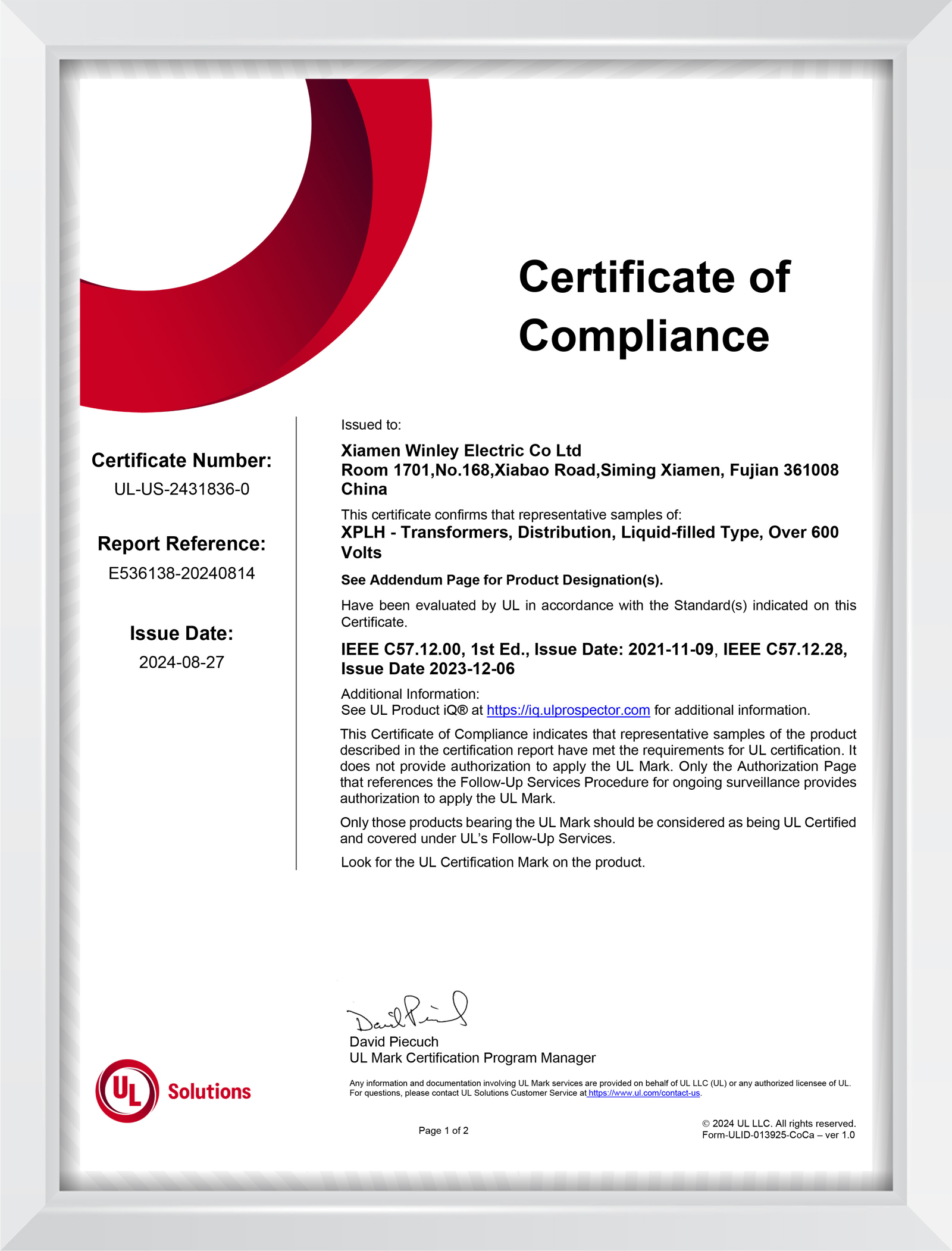
UL certification for three-phase liquid-filled pad-mounted distribution transformer (Winley Electric).
3. Evaluate Production Capability and Lead Times
Long lead times tie up capital and delay projects. A supplier with OEM/ODM flexibility, advanced equipment (silicon steel cutting lines, foil winding machines, vacuum drying ovens), and a skilled workforce (80% of employees with >3 years experience) can deliver faster while maintaining quality. Winley Electric operates two factories (Shanghai and Guangdong) with a total of 45,000㎡ and produces 35,000 units annually.
| Parameter | Traditional US Factory | Winley Electric |
|---|---|---|
| Average lead time (substation transformers) | 80–120 weeks | 12 weeks |
| Cost vs. US domestic | Baseline | 20%–30% lower |
| Certification portfolio | UL, ANSI | UL, cUL, ANSI, IEEE, CSA, DOE, ISO, CE |
| Annual output | Varies | 35,000 units |
| Warranty | Standard 1–2 years | 2-year free maintenance |
4. Request a Total Cost of Ownership (TCO) Analysis
Ask the supplier for a TCO projection covering: initial cost, estimated annual losses (based on efficiency data), expected lifespan, and maintenance intervals. Efficient transformers with higher initial price often pay back within 2–3 years through lower electricity bills.
5. Inspect Quality Control Systems
A robust QC system includes:
- Hold points – mandatory inspection stages after irreversible processes.
- Type tests – impulse test, temperature rise, sound level.
- Routine tests – ratio, polarity, impedance, dielectric withstand, no-load/load loss.
- Third-party oversight – pre-shipment inspection by UL or other agencies.
Winley Electric has established a transformer material traceability system and supplier evaluation mechanism, ensuring zero quality problems over the past decade.
Proven Case: 31 Three-Phase Pad Mounted Transformers for a North American Utility
In a recent project, Winley Electric delivered 31 units of three-phase pad mounted transformers (2550kVA and 3750kVA) with voltages of 34.5kV and 12.87kV. The entire batch was produced, tested, and shipped within the agreed timeline – demonstrating rapid large-scale deployment capability. All units are UL/cUL certified and comply with ANSI/IEEE standards, solving the client's key concerns about quality and on-time delivery.
Key Highlights:
- Rapid large-scale deployment under accelerated timeline.
- Comprehensive UL/cUL certification for seamless grid integration.
- Superior energy performance meeting or exceeding DOE 2016 requirements.
6. Negotiate Favorable Terms While Ensuring Quality
Standard incoterms for pad mounted transformer deliveries are FOB/CIF. Ensure the contract includes: pre‑shipment testing, documentation for customs clearance, and a clear warranty clause. Many certified Chinese suppliers, like Winley Electric, offer FOB/CIF terms and a 2-year free maintenance service.
Step-by-Step Procurement Process
- Compile a detailed technical specification (capacity, voltage, enclosure, standards).
- Shortlist suppliers with UL/cUL and ANSI/IEEE certifications.
- Request commercial proposals with TCO breakdown.
- Audit supplier's production facility (virtual or in-person) and QC procedures.
- Place a trial order (e.g., 1–5 units) to verify quality.
- Scale up with a master contract including FOB/CIF terms, pre‑shipment inspection, and warranty.
- Monitor ongoing performance and after-sales support.
Frequently Asked Questions (FAQ)
What is a pad mounted transformer and how does it work?
A pad mounted transformer is an oil-immersed or dry-type distribution transformer installed on a concrete pad, typically outdoors. It steps down medium voltage (e.g., 12.47kV) to utilization voltage (e.g., 480Y/277V or 208Y/120V) for commercial, residential, and utility applications. It works via electromagnetic induction, using primary and secondary windings around a laminated core.
How can I ensure the quality of a pad mounted transformer from a Chinese manufacturer?
Verify third-party certifications such as UL, cUL, ANSI/IEEE, CSA, and DOE. Request test reports and factory inspection. Choose suppliers with ISO 9001, ISO 14001, and ISO 45001. Conduct pre‑shipment inspections. Winley Electric, for example, provides full UL partner authorization and transparent testing data.
What is the total cost of ownership for a pad mounted transformer?
TCO includes purchase price, installation, energy losses (no-load + load losses), maintenance, and end-of-life disposal. An efficient transformer with higher initial cost can save thousands of dollars in electricity over its 20–30 year life. Always compare certified efficiency data.
Which pad mounted transformer manufacturers are UL listed for North America?
Several global and Chinese manufacturers hold UL/cUL listings. Winley Electric (Xiamen, China) is a leading UL/cUL certified manufacturer for both single-phase (15–833kVA) and three-phase (75–5500kVA) pad mounted transformers, compliant with ANSI/IEEE C57 and CSA C227 standards.
Conclusion
Securing high-quality pad mounted transformers at a competitive cost is achievable when you focus on certified compliance, production capability, and total lifecycle value instead of just upfront price. By following the strategic framework outlined in this guide – from defining specifications to evaluating TCO – procurement professionals can confidently choose suppliers that deliver reliability, safety, and cost efficiency.
For more information or to request a customized quote, contact Winley Electric: Email steven@winley-electric.com, WhatsApp +86-18650108051, or visit www.winley-electric.com.

Ready to reduce costs without compromising quality?
Contact Winley Electric for UL/cUL certified pad mounted transformers.