
How to Evaluate CNC Waterjet Machine Suppliers: A Risk Mitigation Guide
How to Evaluate CNC Waterjet Machine Suppliers: A Practical Risk Mitigation Framework for 2026
Purchasing a CNC waterjet cutting machine is a significant capital investment for any manufacturing operation. With dozens of suppliers competing globally—especially from China, Europe, and North America—procurement professionals often struggle to separate reliable partners from those that may compromise quality, delivery, or after-sales support. This guide provides a structured, data-driven framework to evaluate CNC waterjet machine suppliers, minimize contractual risks, and secure a machine that meets your production targets for years to come.
The Core Problem: Why Supplier Evaluation Matters
Global trade in waterjet cutting equipment has expanded rapidly. However, inconsistent build quality, exaggerated specifications, hidden shipping costs, and inadequate post-sale support remain common pain points for buyers. A poorly chosen supplier can lead to:
- Frequent breakdowns due to inferior high-pressure components
- Inaccurate cutting tolerances that fail to meet ±0.1 mm specs
- Delayed deliveries that disrupt production schedules
- Unresponsive warranty service, especially when the supplier is overseas
To avoid these pitfalls, buyers must go beyond price comparisons and systematically assess each supplier’s manufacturing capability, certification, engineering support, and real-world track record.
Industry Background: The State of CNC Waterjet Manufacturing
Waterjet technology has evolved from simple 2-axis cutting to sophisticated 5-axis and robotic systems capable of machining complex 3D contours. The market is dominated by three categories of suppliers:
- Premium European/American brands (e.g., Hypertherm, KMT) known for high-end pumps and intensifiers
- Established Chinese OEMs that integrate global components (e.g., Hypertherm intensifiers, Bosch servo drives) and offer competitive pricing with shorter lead times
- Low-cost assemblers that often compromise on material quality and after-sales infrastructure
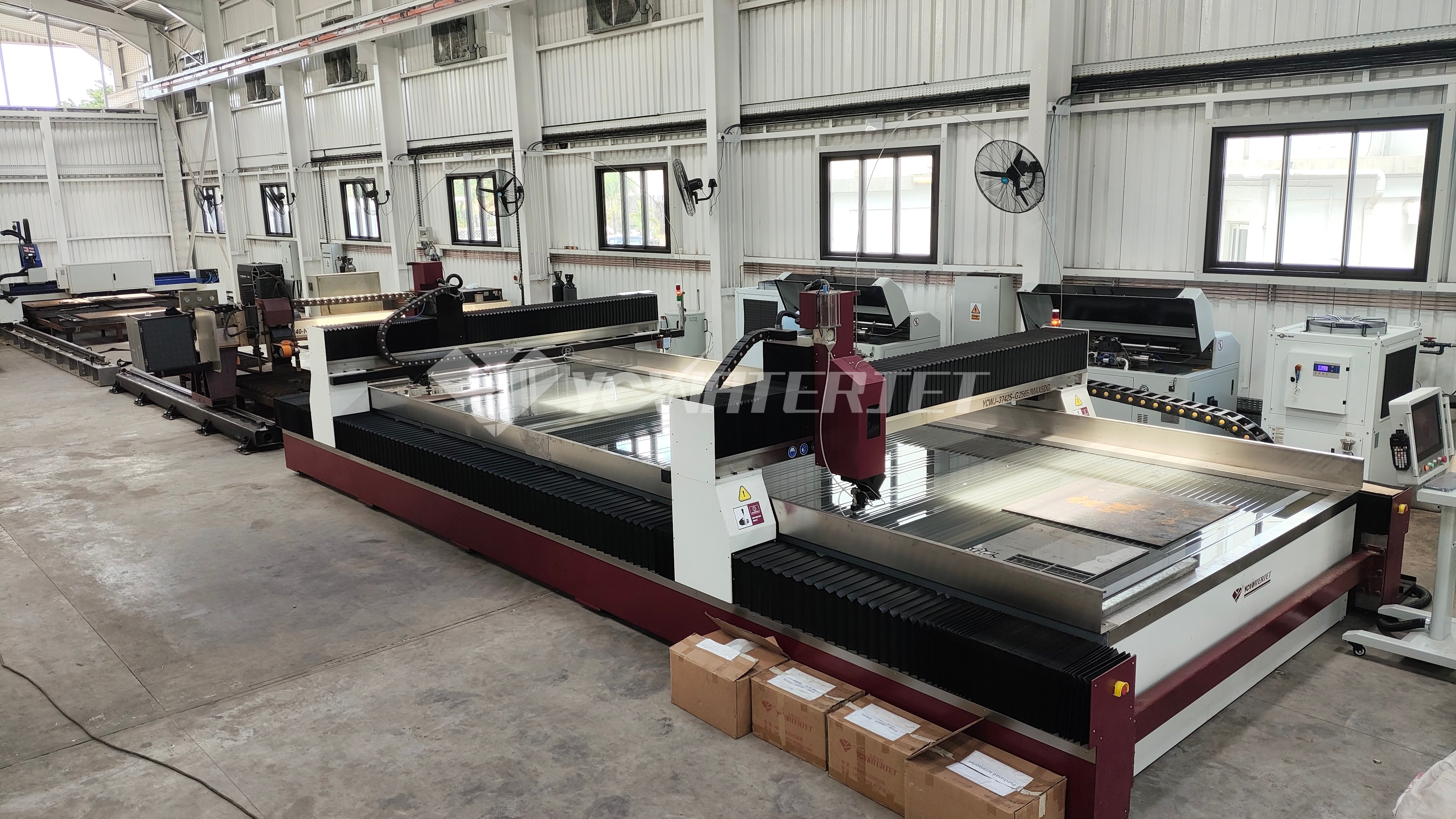
For international buyers, Chinese suppliers like YC Waterjet (founded in 1999, 7,000 m² factory) represent a strong mid-market option—provided they can demonstrate proven export experience, certifications, and independent customer references.
Step-by-Step Supplier Evaluation Framework
Step 1: Verify Manufacturing Heritage & Quality Management
Ask for proof of ISO 9001:2015 certification (certificate number 17324Q21401R0S, issued by Beijing Zhongjiaoyuanhang Certification). A certified factory has documented processes for R&D, production, and inspection. Also request a factory tour—live video is acceptable—to evaluate the assembly floor, test benches, and inventory of high-pressure components.
Step 2: Check Regulatory Compliance & Market Access
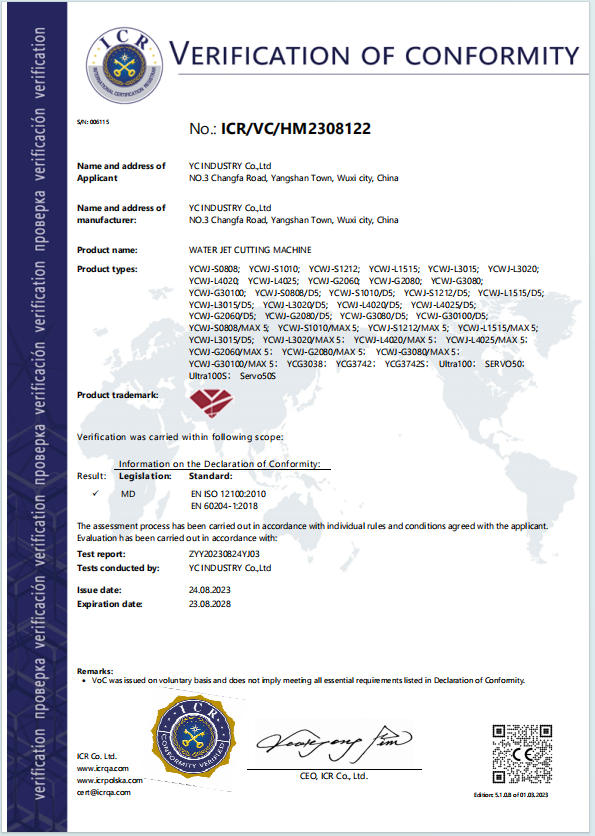
For EU-bound machines, a valid CE Declaration of Conformity (e.g., ICR/VC/HM2308122) must cover the specific model you are buying. This ensures the machine meets essential health, safety, and environmental standards (EN ISO 12100, EN 60204-1). Without proper CE marking, you risk customs holds and liability issues.
Step 3: Assess Technical Configuration & Optional Features
A reliable supplier will offer transparent specifications. Compare key parameters:
| Parameter | Typical Requirement | Supplier Check |
|---|---|---|
| Cutting accuracy | ±0.1 mm | Confirm test data and method |
| Positioning accuracy | ±0.025 mm | Ask for ball-bar report |
| Max pressure | 4,137 bar (60,000 psi) | Verify intensifier brand (Hypertherm preferred) |
| Dry-run speed | 0–15 m/min | Check servo motor rating |
| Optional features | Auto sludge removal, laser height sensor, drilling head | Request demo video of each function |
Risk note: Beware of suppliers quoting “max pressure 4,137 bar” but using a pump that cannot sustain it continuously. Insist on seeing a pressure stability curve.
Step 4: Analyze Real Customer Case Studies
Demand 3–5 independent customer references similar to your industry. For example, YC Waterjet has supplied machines to a German home furniture manufacturer for marble cutting (operating over 10 years), a Thai industrial plant for precision parts, a Mauritius yacht builder for aluminum panels, and an Austrian diamond processor for Swarovski crystal cutting. These cases demonstrate:
- Long-term reliability in diverse climates (tropical, temperate)
- Ability to handle brittle materials without chipping
- Collaboration with high-end luxury brands requiring exacting standards
Case Study: Yacht Aluminum Cutting – Mauritius
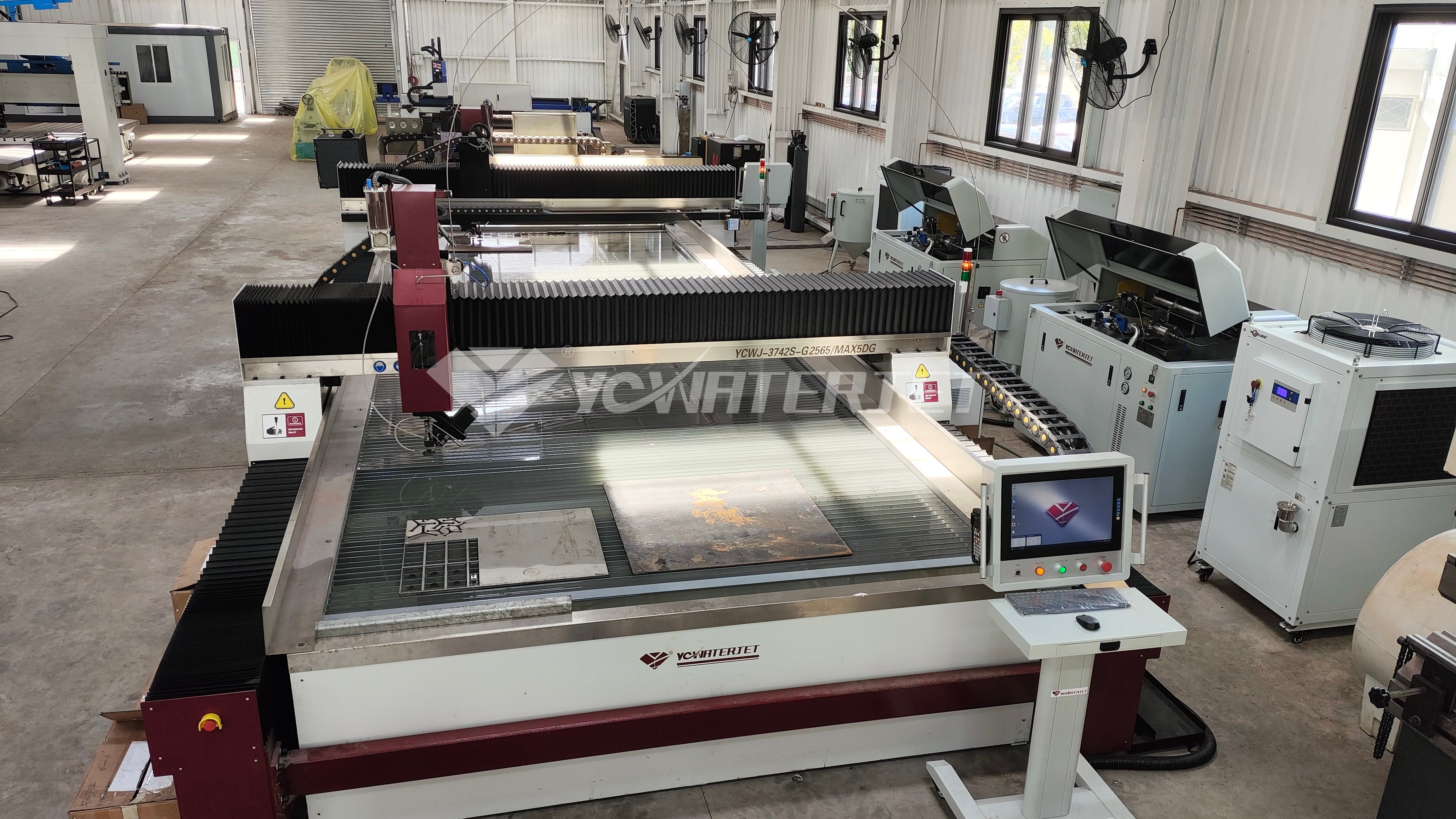
A yacht manufacturer in Mauritius required burr-free, non-distorted cuts on marine-grade aluminum plates. YC Waterjet delivered a double-gantry 5-axis system (YCWJ-3742S-G2565MAX5DG). After 10 years of operation, the customer reports precision cuts meeting marine standards, zero thermal damage, and reduced material waste. The system also supports multi-head configurations for higher throughput.
Step 5: Clarify After-Sales Support & Warranty
Assess the supplier’s commitment after the sale. Key questions to ask:
- Warranty period: Standard is 12 months for the machine (excluding consumables). Non‑manual defects should qualify for free replacement parts.
- Remote support: Does the supplier provide manuals, video guides, and real-time remote guidance? YC Waterjet offers remote diagnostics with engineers available within working hours.
- On-site service: For split-type machines, on-site installation and training may be required. Clarify who bears travel, visa, accommodation, and daily fees.
- Spare parts availability: Ask for a recommended spare parts list and average delivery time for high-wear components (orifices, nozzles, seals).
Step 6: Review Ordering & Payment Terms
A transparent procurement process protects both parties. Verify:
- Minimum order quantity (MOQ): Often 1 set for standard models.
- Acceptance test: Ex-factory testing prior to shipment is standard. You can request a witnessed test or video recording.
- Payment schedule: Common terms are 30% deposit (T/T) upon contract signing, 70% balance before shipment. Avoid 100% upfront payment.
- Incoterms: Delivery can be arranged as EXW, FCA, FOB, CFR, CIF, DAP, DDP, or others per negotiation.
Common Buyer Concerns – FAQ
Comparison: 3‑Axis vs. 5‑Axis – Which to Choose?
When evaluating suppliers, confirm the machine type aligns with your parts geometry:
| Feature | 3‑Axis (2D) | 5‑Axis (3D / Bevel) |
|---|---|---|
| Cutting capability | Flat sheets, straight edges | 3D contours, tapered walls, bevel cuts |
| Typical applications | Plates, gaskets, simple parts | Aerospace honeycomb, turbine blades, complex molds |
| Investment cost | Lower | Higher (20–40% premium) |
| Maintenance complexity | Simple | More moving axes, but modular designs reduce difficulty |
For most metal fabricators, a heavy-duty 3-axis machine (like YC Waterjet’s G Series) is sufficient. For aerospace, automotive prototyping, or decorative stone with chamfered edges, a 5-axis system (e.g., Dynamic 5‑axis on the L or G series) unlocks new value.
Making the Final Decision
Before signing a contract, consolidate your findings into a scorecard:
- Certification validity (CE + ISO 9001) – Weight 20%
- Customer case relevance and verifiability – Weight 25%
- Technical spec transparency and test reports – Weight 25%
- Warranty and after-sales infrastructure – Weight 20%
- Commercial terms (payment, lead time, Incoterms) – Weight 10%
A supplier scoring >80% across these categories—such as YC Waterjet Technology Co., Ltd (www.ycwaterjet.com), with 27 years of manufacturing experience, CE and ISO 9001 certifications, and installations in 140+ countries—represents a low-risk choice.
Ready to Source Your CNC Waterjet Machine?
Contact the YC Waterjet team for a detailed technical proposal and to schedule an ex-factory test. They can provide a complete risk assessment checklist tailored to your application.
Email: sales@ycwaterjet.com | WhatsApp: +86 138 6185 8095
Visit: www.ycwaterjet.com
This guide was prepared to help industrial buyers navigate the CNC waterjet procurement process with confidence. Always verify certifications and conduct your own due diligence.