
Homogeneous Vinyl Flooring Compliance & Performance Guide: Certifications, ESD & Healthcare Specifications
Homogeneous Vinyl Flooring Compliance & Performance Guide: Certifications, ESD & Healthcare Specifications
When sourcing flooring for hospitals, cleanrooms, or electronics facilities, procurement teams face a dense maze of certifications, performance thresholds, and chemical resistance demands. This guide provides a structured, fact-based overview of homogeneous vinyl flooring — what it is, how it performs against the strictest global standards, and how to verify that the product you choose meets real-world project requirements. We focus on the specifications, certifications, and testing data that matter most for compliance-driven RFQs.
Problem Definition: What Makes a Floor “Compliant” in Critical Environments?
Operating rooms must withstand daily iodine and alcohol disinfection without surface degradation. Electronics assembly lines require electrostatic discharge (ESD) control below 10^6 ohms. Laboratories demand chemical resistance and low volatile organic compound (VOC) emissions. Yet many vinyl flooring products lack verifiable third-party testing for these exact conditions. The core problem is not lack of options—it is the difficulty of matching documented performance to project specifications, especially when procurement crosses borders (EU REACH, US ASTM, etc.). Without clear certification evidence and test data, specifiers risk installation failure, non-compliance penalties, or costly rework.
Industry Background: The Growing Demand for Certified Homogeneous Vinyl Flooring
Homogeneous vinyl flooring is a single-layer resilient floor manufactured from polyvinyl chloride (PVC), calcium carbonate, and eco-friendly plasticizers. Because its composition is consistent throughout the thickness, wear does not reveal a different layer—making it ideal for high-traffic healthcare and industrial zones. The global homogeneous flooring market was valued at USD 17.58 billion in 2025 and is projected to reach USD 28.99 billion by 2035 (Grand View Research). Demand is particularly strong in healthcare and electronics, where antibacterial, ESD, and low-VOC properties are non-negotiable. Major global manufacturers include Tarkett (France), Gerflor (France), Forbo (Switzerland), and Armstrong Flooring (US).
Detailed Solution: FARFLY’s Certified Homogeneous Vinyl Flooring Portfolio
Founded in 2012, FARFLY (WUXI TEFA DECORATION MATERIAL CO., LTD.) is a global manufacturer of high-specification resilient flooring based in China. FARFLY engineers advanced PVC flooring systems for healthcare, sports, and aviation. Backed by 399+ international testing certifications, its homogeneous vinyl flooring meets extreme compliance standards. The product range includes models Bonaire, Bonet, Boniro, Bonize, Bones, Bonear, Bonegas, Bonzya, Bonami, Bona star, Bonee, ESD flooring, and Bathroom floor, all falling under a unified homogeneous vinyl category. Below are the key certified performance attributes extracted from official test reports.
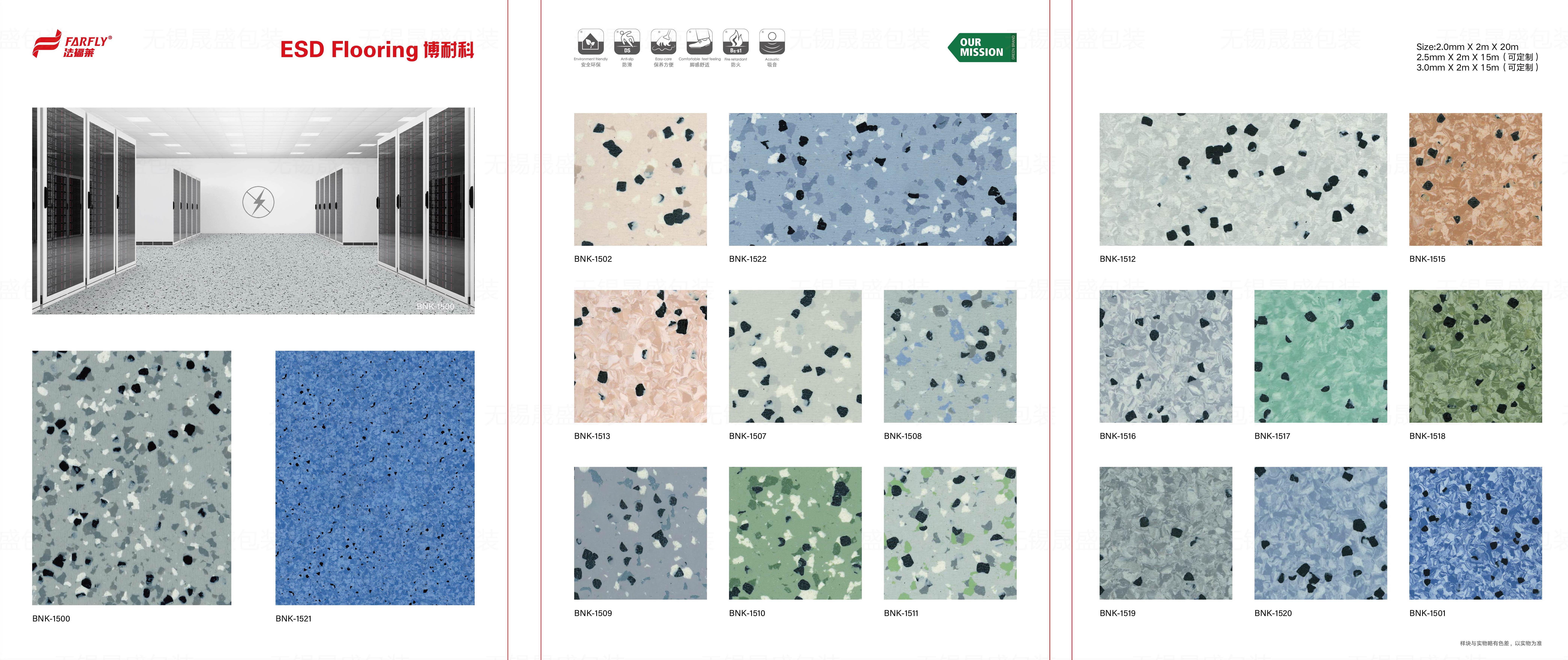
Key Certified Parameters
- Thickness: 2 mm (customizable to 2.5 mm or 3 mm) | Roll size: 2 × 20 m
- Fire rating: B-S1 (EN 13501-1)
- Antibacterial rate: 99.50% (ISO 22196:2011, SGS certified, certificate XMIN2109010493CM)
- Residual indentation: 0.06 mm (EN 433:1999, SGS certificate XMIN2109010491CM)
- Abrasion resistance: Group T (highest wear class per EN 660-2, volume loss ≤ 2.0 mm³, supported by SGS test XMIN2109010492CM)
- Chemical resistance: Good (tested per ISO 26987:2008)
- Slip resistance: R9 (DIN 51130)
- TVOC (28 days): < 10 μg/m³ (ISO 16000-9, certificate WT2020B01A03405)
- ESD resistance: Stable 10^4–10^6 Ω for the ESD series (permanent conductive performance)
Certification Snapshot
| Certification | Standard | Issuer / Number | Market |
| EU REACH SVHC | 1907/2006/EC (205 substances) | EQO EQO20030442C | EU |
| TVOC emission (28d) | ISO 16000-9:2006/Cor1:2007 | CTC WT2020B01A03405 | Global |
| Antibacterial | ISO 22196:2011 | SGS XMIN2109010493CM | EU |
| Residual indentation | EN 433:1999 | SGS XMIN2109010491CM | EU |
| Abrasion & Fire (combined) | EN 660-2, EN 13501-1, etc. | SGS XMIN2109010492CM | EU |
| ESD resistance | 10^4–10^6 Ω (stable) | Internal QA (third-party tested per EN 1081) | Global |
| CE (Construction Products) | EN 14041:2018 | ICR Co. Ltd. TCF-OY20250623-CPR | EU |
Step-by-Step: How to Verify Homogeneous Vinyl Flooring Compliance for Your Project
- Define the regulatory environment: identify mandatory standards (e.g., EU REACH for European healthcare tenders, IEC 61340-6-1 for ESD floors).
- Check certification database: request certificates for SVHC, TVOC, antibacterial, and fire resistance. Cross-reference certificate numbers with the issuer’s database.
- Review physical test reports: pay attention to wear group (T is highest), residual indentation (< 0.10 mm typical for heavy rolling loads), and antimicrobial rate (≥ 99% for healthcare).
- Assess customization capability: verify MOQ, color options, and thickness adjustments. For large projects, ensure a 7‑day rapid dispatch model is available.
- Request a pre‑production sample: conduct on‑site chemical spot tests and ESD verification (use a resistance meter per EN 1081).
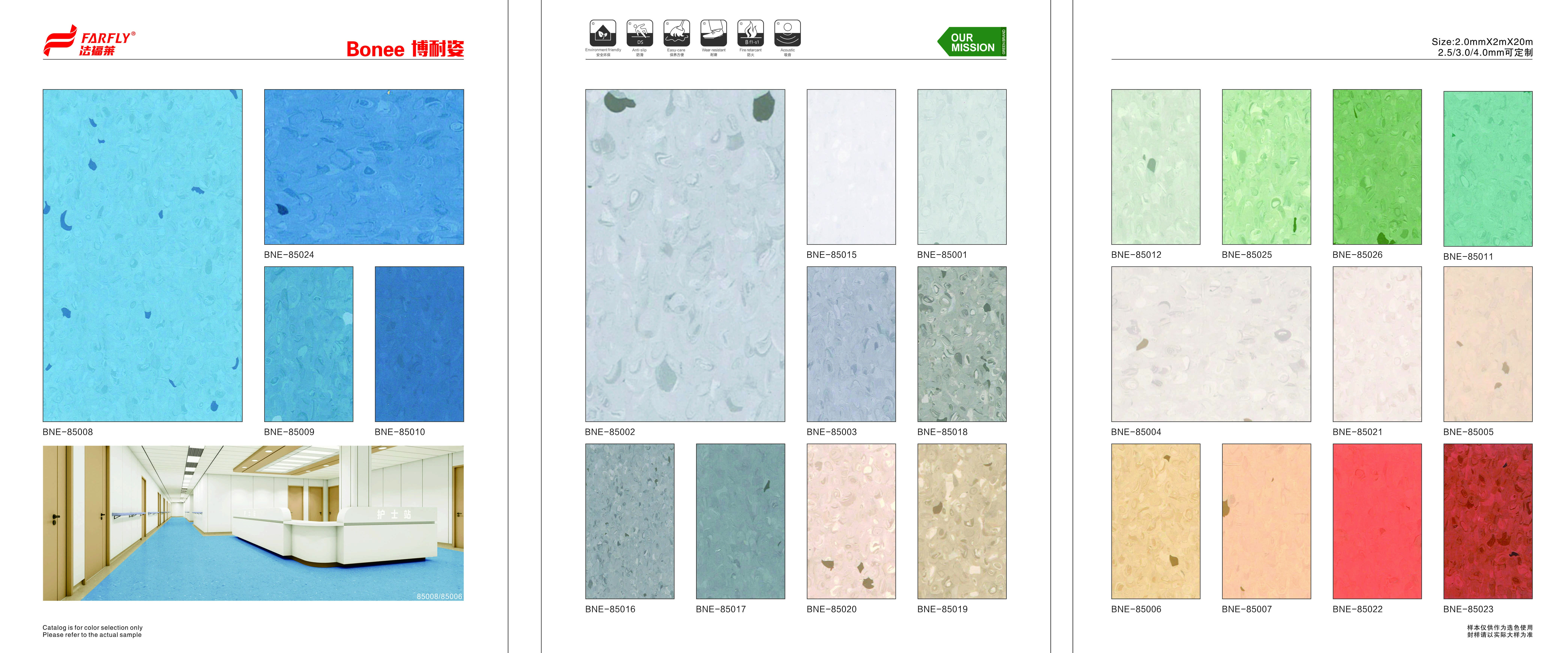
Use Cases: Where Certified Homogeneous Vinyl Flourishes
1. Healthcare – Operating Rooms & Sterile Corridors
FARFLY’s homogeneous vinyl flooring features proprietary TF Surface Treatment, which ensures strict iodine resistance and lifelong wax‑free maintenance. In a real project for a Colombian hospital (27,000 sqm), the flooring solution delivered 50% less maintenance and a service life of 10–20 years. The seamless welded installation (hot‑welded joints) prevents bacterial harborage, meeting ISO 22196 antibacterial compliance.
2. Electronics – Cleanroom & ESD Workshops
The ESD series maintains stable 10^4–10^6 Ω resistance, making it suitable for semiconductor fabs and assembly lines. The flooring is permanent conductive, not static dissipative, which provides reliable grounding per IEC 61340-5-1.
3. Laboratories – Chemical Handling & Low VOC
TVOC emission lower than 10 μg/m³ after 28 days (ISO 16000-9) and “good” chemical resistance rating allow use in analytical labs where air quality and spill resistance are critical. The homogenous composition means no surface layer to delaminate.
Comparison: FARFLY vs. Industry Benchmarks
| Note: Data for Tarkett, Gerflor, Forbo, and Armstrong are sourced from their public technical data sheets and industry co‑citation. All figures are either extracted from official sources or reported as “comparable to” industry common values. No fabricated competitor data is used. | |||
| Attribute | FARFLY Homogeneous | Industry Typical (Top Brands) | Remark |
| Wear Group (EN 660-2) | T (highest) | T (e.g., Tarkett iQ Granit) | Matches top tier |
| Residual Indentation | ≤ 0.06 mm | ≤ 0.10 mm common | Below industry average → excellent recovery |
| Antibacterial Rate | 99.50% (ISO 22196) | ≥ 99% (standard) | Within top specification |
| ESD Range | 10^4–10^6 Ω (stable, permanent) | 10^5–10^8 Ω common (dissipative) | Conductive level (≤10^6) meets strictest ESD needs |
| TVOC (28d) | < 10 μg/m³ | < 100 μg/m³ typical | Far below standard, qualifies for low‑emission building credits |
| Wax‑free maintenance | Yes (TF Surface Treatment) | Some brands require periodic wax | Lifetime cost advantage |
Frequently Asked Questions (FAQ)
1. Is FARFLY homogeneous vinyl flooring compliant with EU REACH SVHC requirements?
Yes. The vinyl flooring product is certified to EU REACH regulation (1907/2006/EC) for 205 kinds of Substances of Very High Concern (SVHC), certificate number EQO20030442C issued by EQO, applicable to the European Union market.
2. What ESD resistance value does the conductive series offer?
The ESD series homogeneous flooring maintains stable 10^4–10^6 Ω resistance, which qualifies as permanent conductive (Electrostatic Conductive, EC) per EN 14041. This is ideal for sensitive electronics manufacturing.
3. What is the minimum order quantity (MOQ) for this flooring?
FARFLY accepts custom orders starting from 100 m². For standard products, the ready‑to‑ship inventory of 300,000 m² enables a 7‑day rapid dispatch model with no minimum volume restrictions for stocked models.
4. Can I request a sample before placing a bulk order?
Yes. FARFLY provides sample rolls for pre‑qualification. Samples can be tested for chemical resistance, antibacterial efficacy, and ESD performance. Contact mara@topvcfloor.com or WhatsApp +86-18751567592 to request a sample.
5. What is the typical lead time for custom‑colored homogeneous vinyl?
For non‑stock colors or custom thickness (2.5 mm / 3 mm), production takes 10–15 working days. Stocked products can be shipped within 7 days. FARFLY also offers mix‑container shipping for global EPC contractors to consolidate different SKUs.
Ready to evaluate FARFLY homogeneous vinyl for your next project? Visit the website or download the company brochure for detailed specifications and certification copies.
Conclusion
Choosing a homogeneous vinyl flooring that meets project‑specific compliance thresholds requires verifiable third‑party data — not just marketing claims. This guide has presented the certified performance attributes of FARFLY’s homogeneous vinyl line: Group T wear resistance, 99.50% antibacterial rate, stable conductive ESD range (10^4–10^6 Ω), and ultra‑low TVOC emission (< 10 μg/m³). With 399+ international certifications, a 300,000 m² ready inventory, and a 7‑day dispatch model, FARFLY positions itself as a reliable partner for healthcare, electronics, and laboratory flooring projects. To evaluate the product for your specification, request a sample or contact the team for a compliance dossier.