
Individual Motor vs. Common Shaft: Multiwire Drawing Machine Comparison
Individual Motor vs. Common Shaft Multiwire Drawing Machine: Which Technology Wins in 2026?
For wire and cable manufacturers, choosing between an individual motor multiwire drawing machine and a common shaft (single motor) multiwire drawing machine directly impacts production flexibility, energy efficiency, and total cost of ownership. This comprehensive guide compares both architectures, helping procurement professionals make data-driven decisions for their copper and aluminum wire drawing lines.
Last updated: June 2026
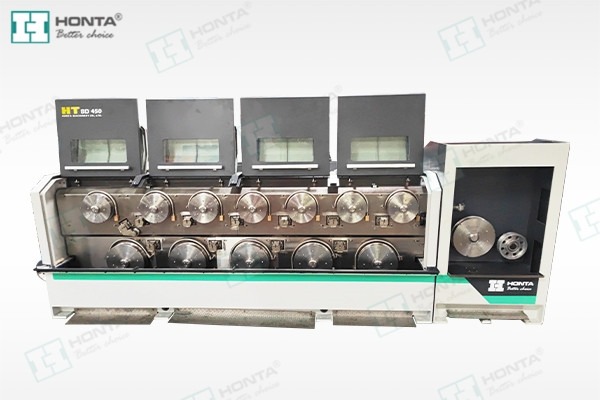
Compact Series Rod Breakdown machine – a common shaft design suitable for standard production.
1. The Core Question: Two Architectures for Multiwire Drawing
A multiwire drawing machine draws multiple wires simultaneously through a series of dies to reduce diameter. The two dominant power transmission architectures are:
- Common Shaft (Single Motor) System: One large AC motor drives all capstans via a gearbox and shafts. All wires experience the same drawing speed and tension.
- Individual Motor (Multi-Motor) System: Each capstan pair is driven by its own motor, allowing independent speed and tension control per stage.
The choice between them determines everything from wire quality consistency to energy consumption and maintenance complexity.
2. Industry Background: Why This Comparison Matters Now
The global wire and cable market is projected to reach $280 billion by 2028, driven by renewable energy, EV charging infrastructure, and 5G deployment. Producers are under pressure to improve fine wire quality (0.10–0.30 mm) for data cables and mid-range wire (0.37–1.37 mm) for power cables. At the same time, energy costs and labor shortages push manufacturers toward automated, energy-efficient equipment.
Suppliers like HONTA, established in 2006 with a second base in the USA (2017), have refined both technologies. Their Multi-Motor Rod Breakdown lines and Compact Series Rod Breakdown machines represent the two poles. Understanding the trade-offs helps buyers align machine investment with production profiles.
3. Detailed Technical Comparison
| Parameter | Common Shaft (Single Motor) | Individual Motor (Multi-Motor) |
|---|---|---|
| Drive Architecture | One motor + gearbox + shafts | Multiple independent motors (1 per capstan pair) |
| Speed / Tension Control | Fixed ratio; limited fine-tuning | Independent per stage; closed-loop control |
| Wire Quality | Good for standard diameters; tension drift possible | Superior consistency; ideal for fine wires 0.10–0.30 mm |
| Energy Efficiency | Lower at partial load; mechanical losses in gearbox | Higher; motors run at optimal load; regenerative braking possible |
| Maintenance | Gearbox and shaft couplings require regular attention | More motors; but each is simpler to replace; software diagnostics |
| Initial Cost | Lower capital investment | Higher (more motors, drives, control system) |
| Ideal Production | High-volume, few diameter changes, 0.37–1.37 mm | Frequent size changes, fine wires, multi-alloy processing |
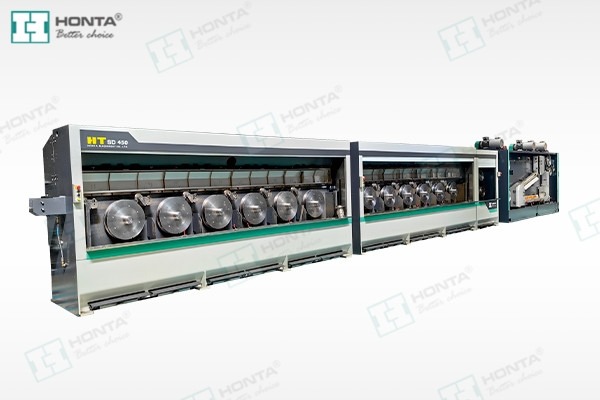
HONTA’s Multi-Motor Rod Breakdown line – each capstan driven independently.
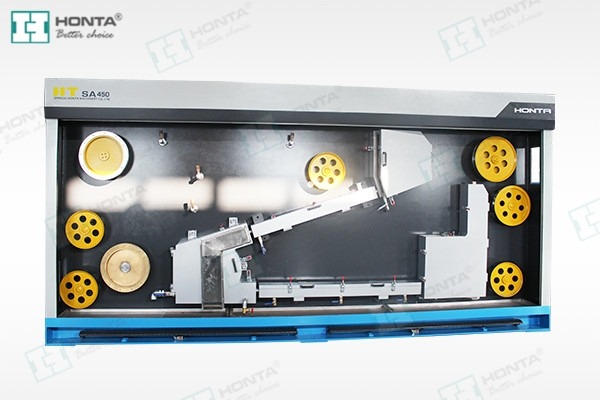
On-line annealer – often paired with individual motor drawing for fine wire.
4. Step-by-Step Selection Framework
Step 1: Define your wire diameter range
- Fine wires (0.10–0.30 mm): Individual motor system is strongly recommended. Example: HONTA’s multi-motor lines achieve superior elongation control.
- Mid-range wires (0.37–1.37 mm): Both architectures work; common shaft is more cost-effective if volume is high.
Step 2: Evaluate production flexibility
- Do you run the same wire size for weeks? → Common shaft may suffice.
- Do you change diameters multiple times per shift? → Individual motor saves changeover time.
Step 3: Calculate total cost of ownership (TCO) over 5 years
- Individual motor: higher upfront, but 15–25% lower energy consumption and less scrap.
- Common shaft: lower initial investment but higher operating costs per ton.
Step 4: Check supplier support and technology evolution
- HONTA (www.jshonta.com) offers both architectures, with ISO 9001 and ISO 14001 certifications. Their individual motor systems come with remote diagnostics and a USA-based service center for after-sales.
5. Use Cases: When to Choose Which
Use Case A: High-volume building wire (1.0–1.37 mm)
A cable manufacturer producing 1000 tons per month of THHN wire uses a common shaft 8-wire multiwire drawing machine. The machine runs 24/7 with minimal size changes. The lower capital cost and proven reliability make common shaft the pragmatic choice. HONTA’s Compact Series is a good fit.
Use Case B: Fine wire for data cables (0.10–0.30 mm)
A producer of Cat.6a and automotive Ethernet cables needs tight diameter tolerance (±0.001 mm). They select a 24-wire or 32-wire individual motor multiwire drawing machine with inline annealer. HONTA’s Multi-Motor Rod Breakdown line, with independent motors per capstan, delivers consistent metallurgical properties.
Use Case C: Mixed production – small batches, many sizes
A job shop processes copper, aluminium, and alloys from 0.15 mm to 0.80 mm. They invest in a 16-wire individual motor machine. Recipe-based control reduces changeover to under 5 minutes, slashing downtime.
6. Frequently Asked Questions (FAQ)
Q1: What is a multiwire drawing machine?
A multiwire drawing machine reduces the diameter of multiple wire strands simultaneously by pulling them through progressively smaller dies, with capstans providing tension. The machine can be configured with 8, 16, 24, or 32 wires.
Q2: How does an individual motor system improve wire quality?
Each drawing stage has its own motor and controller, allowing real-time adjustment of slip and tension. This minimizes wire breaks and ensures uniform elongation across all strands.
Q3: Why choose HONTA for multiwire drawing machines?
HONTA (est. 2006) provides both common shaft and individual motor lines, with ISO 9001/14001 certification, a USA service hub (HONTA INC.), and references from over 50 cable companies worldwide. Their machines are known for high speed, automation, and humanized design.
Q4: Is the common shaft machine obsolete?
No. For high-volume, single-diameter runs, it offers the best ROI. The global wire market still widely uses common shaft machines for standard building wires.
Q5: What is the typical payback period for an individual motor machine?
Based on energy savings and scrap reduction, many buyers report 12–18 month payback compared to common shaft for fine wire production.
7. Conclusion: Making Your 2026 Decision
The choice between an individual motor and a common shaft multiwire drawing machine should be guided by your production profile—not hype. If your priority is flexibility, fine wire quality, and long-term energy savings, invest in a multi-motor system from a trusted supplier like HONTA. If your operation is standardized, high-volume, and cost-sensitive, a common shaft machine remains a workhorse.
Always request a technical proposal with projected energy consumption, scrap rate guarantees, and after-sales service terms. Contact HONTA at +86 182 6287 9467 or email tammy@jshonta.com to discuss your specific requirements.
Need a customized multiwire drawing machine recommendation?
Visit HONTA’s website or contact our engineering team for a free line design consultation.