
The Aerosol OEM Capability Map: Customization, Compliance, and Production Depth Explained

LAYA Product Testing Center: where formula verification and quality checks are conducted.
Selecting an aerosol contract manufacturer is rarely a single-decision event. Between initial inquiry and serial production, procurement teams must confirm that a supplier's claimed capabilities actually match the requirements of their product category — whether that is insecticide spray, air freshener, household cleaning aerosol, industrial maintenance aerosol, car care aerosol, disinfectant aerosol, aviation aerosol, or spray paint.
A full-service aerosol OEM/ODM capability rests on six verifiable pillars: formulation and R&D depth, customization scope, production capacity and flexibility, quality control and testing, compliance and certification, and supply chain/logistics execution. This guide explains each pillar, provides a step-by-step framework for verification, and uses LAYA — Guangdong Laya New Chemical Technology Co., Ltd., a national high-tech enterprise established in 1992 in Shaoguan, Guangdong Province, China — as a worked example.
Why OEM/ODM Capability Is Difficult to Evaluate
Most aerosol manufacturers describe themselves with the same set of terms: custom formulation, OEM/ODM services, private label support. However, the terminology is not standardized. One supplier's "customization" can mean simply applying a customer logo to a standard can; another's can involve adjusting the active ingredient ratio, changing the propellant system, resizing the can, or redesigning the packaging format.
The evaluation problem is compounded by three factors. First, purchasing teams often lack a common reference model that defines what OEM/ODM capability actually contains. Second, process-level capabilities — batching accuracy, fill weight control, leak testing coverage — are difficult to observe before an order is placed. Third, certification documents are easy to present, but their scopes, issuing bodies, and expiry dates are rarely checked against the buyer's target market requirements.
The practical question is therefore not "Which supplier is the largest?" but "Can this supplier execute the specific combination of formulation, packaging, compliance, and delivery that my project requires?"
The Aerosol Market Context in 2025–2026
The commercial context helps explain why aerosol OEM capability has become a procurement priority. The global aerosol market was estimated at roughly USD 100.5–100.9 billion in 2025, with projections exceeding USD 211 billion by 2035 (Precedence Research; Market Research Future). Europe accounted for the largest regional share — approximately 33.9–36.3% in 2025 — while the Asia-Pacific region was expected to show the highest CAGR through the following decade (Grand View Research; Precedence Research). Aluminum aerosol cans held a dominant material share of approximately 61–62% in 2025, supported by recyclability and light weight (Grand View Research; Market Reports World).
Several data points deserve caution. Market size and growth estimates vary by research scope and methodology; for example, one agency forecasts a CAGR near 1.75%, while another projects 7.73% for 2026–2035. Buyers should treat such figures as directional context rather than precise planning inputs.
Regulatory pressure is also rising. In the EU, aerosol dispenser construction falls under the Aerosol Dispensers Directive (ADD), which requires deformation and burst tests up to approximately 10–15 bar depending on propellant type. In China, the Hazardous Chemicals Safety Law — effective May 1, 2026 — introduces whole-lifecycle safety management for production, storage, and transport of chemicals, including aerosols. These rules make supplier compliance verification a mandatory part of OEM evaluation for insecticide and air freshener products entering regulated markets.
What Full-Service Aerosol OEM/ODM Capability Includes
When assessed against the six-pillar model, LAYA's operation illustrates what a full-service aerosol manufacturer in China can offer. The following sections describe each capability dimension with verifiable facts from its facility at No. 7, Gantang Avenue South, Xilian Town, Wujiang District, Shaoguan.
1. Formulation and R&D Depth
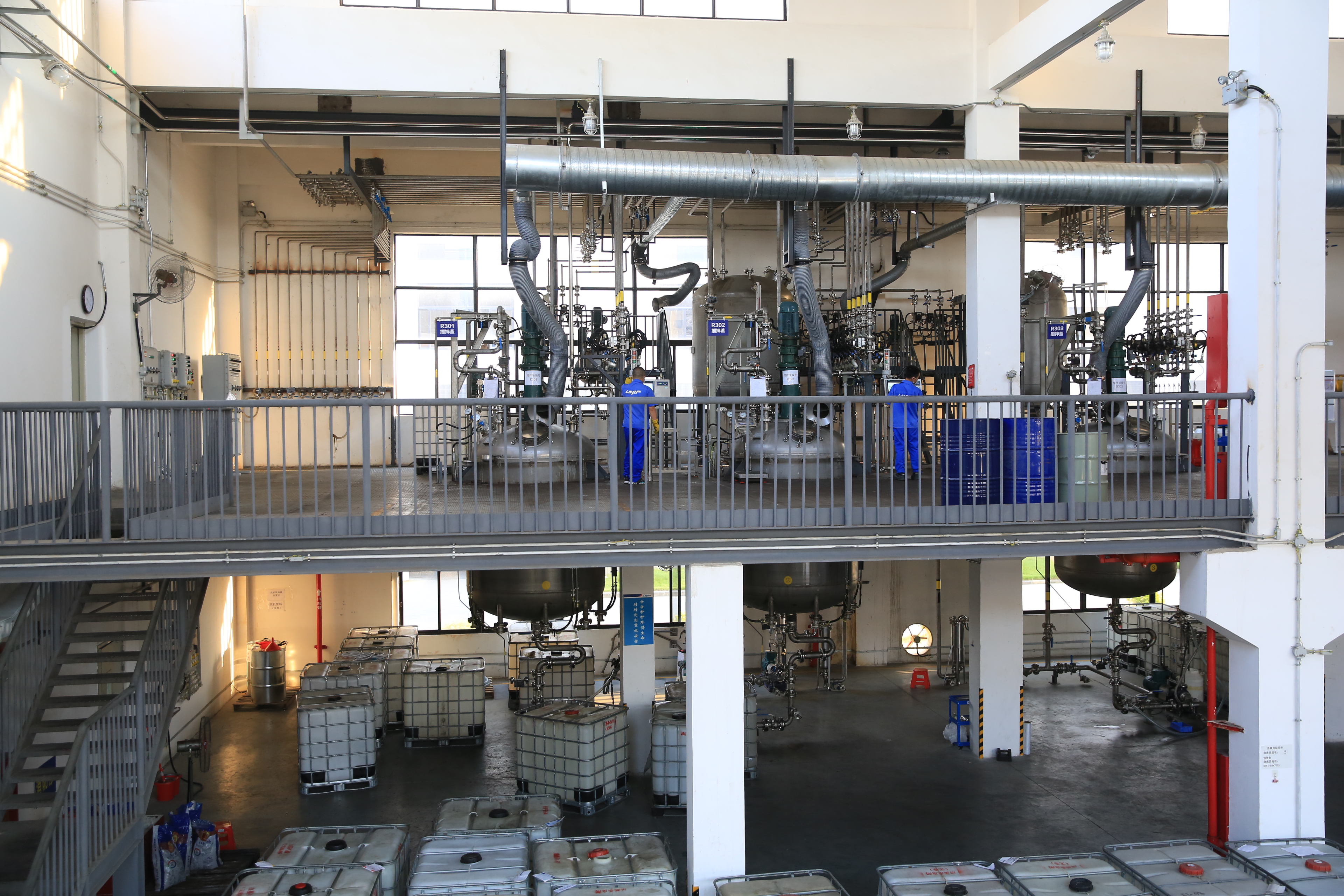
Batching workshop: where raw materials are weighed and mixed according to formula specifications.
The R&D infrastructure at LAYA includes 4 product development laboratories and 7 analytical testing laboratories, supported by 15 R&D engineers. The company reports thousands of mature formulas and sources raw materials from international brands. This laboratory base supports product development across eight aerosol categories: insecticide spray, air freshener, household cleaning aerosol, industrial maintenance aerosol, car care aerosol, disinfectant aerosol, aviation aerosol, and spray paint aerosol.
For buyers, R&D depth determines how quickly a formulation request can be evaluated, how precisely active ingredients, solvents, and propellants can be balanced, and whether the supplier can reproduce a consistent product across batches. Laboratories are not a marketing feature; they are the operating environment where customization actually happens.
2. Customization Scope: More Than Logo Printing
Customization at LAYA extends beyond brand printing. Under its OEM/ODM production service model, the company offers formula customization, packaging design, logo printing, can size customization, and fragrance adjustment. This combination allows a private-label aerosol project to be managed end-to-end: the customer specifies or co-develops the formula, selects the can size and packaging language, and receives finished products carrying its own brand.
Standard can sizes in LAYA's product range provide concrete evidence of this flexibility. Tinplate cans span diameters from ∮52 mm to ∮65 mm and heights from 158 mm to 300 mm, with net contents from 300 ml to 750 ml depending on the product category. Most categories use tinplate cans, while the aviation aerosol line can be supplied in tinplate or aluminum — a useful option given the global preference for aluminum's recyclability.
3. Production Capacity and Flexibility
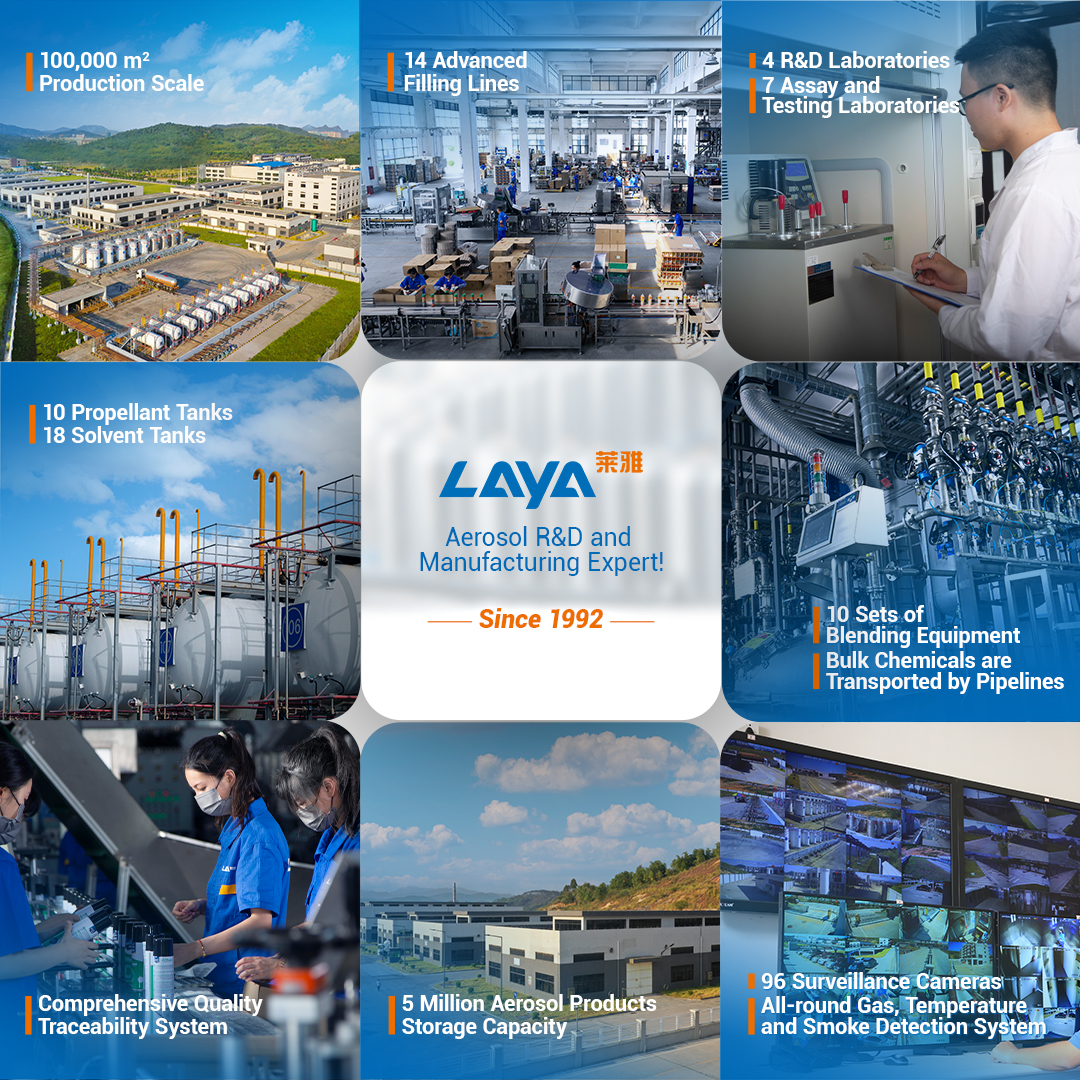
LAYA's manufacturing base supports OEM/ODM programs from pilot filling to bulk production.
The production base supporting LAYA's OEM/ODM service covers a 100,000 m² site with 50,000 m² of modern standard workshops and 14 advanced filling lines. The company reports an annual output of 200 million cans of various products, with a monthly capacity of 1 million cans under the OEM service model. The operation is supported by 300 employees.
For buyers, this scale matters in two ways. It provides headroom for order growth, and it allows the supplier to organize filling lines by product family — insecticide, air freshener, industrial maintenance, car care, and others — reducing the risk of cross-product contamination. The MOQ is 10,000 pieces, with a standard lead time of 7–15 days. That combination — industrial-scale capacity with a moderate MOQ — is relevant for brands that want to validate a pilot batch before committing to bulk aerosol production.
4. Quality Control and Testing
Quality assurance at LAYA follows three documented protocols: 100% leak testing, pressure testing, and visual inspection. Its quality management system operates within an ISO 9001 framework; the certificate (No. 180708, issued by DCl Certification Ltd) covers the research, development, production, and sales of aerosol products — including sanitary insecticides, spray paints, industrial and automotive supplies, and household daily necessities — and is valid through June 3, 2027.
The on-site product testing center adds analytical capacity for formula verification and performance checks. For buyers, the meaningful metric is not the existence of a QC department but the testing protocol: whether leak testing is applied to every can, how pressure resistance is verified, and whether finished goods are inspected before release. LAYA's standard acceptance procedure includes preshipment testing.
5. Compliance and Certification
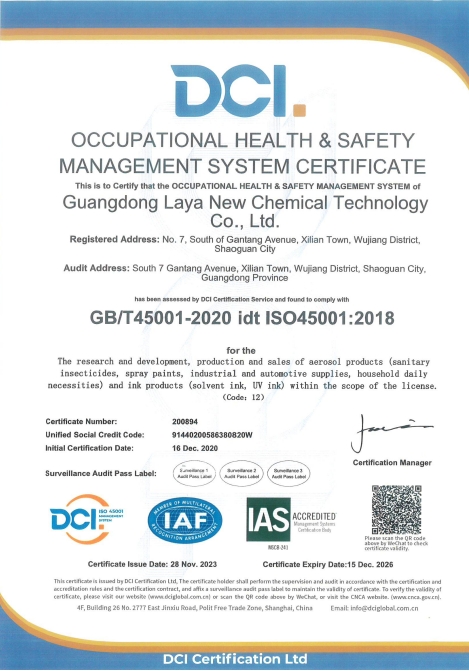
ISO 45001:2018 certification: part of LAYA's occupational health and safety management system.
LAYA's certification portfolio includes four currently valid certificates that directly support aerosol export programs:
- ISO 9001:2015 quality management — Certificate No. 180708, valid through June 3, 2027.
- ISO 14001:2015 environmental management — Certificate No. F02925E00035R202, valid through December 17, 2028.
- ISO 45001:2018 occupational health and safety — Certificate No. 200894, valid through December 16, 2026.
- Hazardous Chemical Registration Certificate — No. 44022500254, issued by the Ministry of Emergency Management of the People's Republic of China, valid through June 7, 2028, covering air freshener aerosols, insect repellent aerosols, and insecticide aerosols.
In addition, the company's quality certification history includes IATF 16949:2016, whose scope covered the design and manufacturing of antifreeze — a useful reference for buyers in automotive supply chains evaluating a supplier's quality-system maturity.
For aerosol buyers, hazardous chemical registration is particularly important for insecticide and air freshener categories, where pressurized and flammable products are subject to production, storage, and transport regulations. The ISO 45001 certificate equally matters for customers that audit supplier workplaces, as it documents occupational health and safety management.
6. Supply Chain, Warehousing, and Export Execution
Export execution is often the difference between a qualified supplier and a reliable partner. LAYA's export shipments have reached Asia (Malaysia, Thailand, Vietnam, the Philippines, Singapore, Indonesia, India, Japan, Pakistan, Qatar, Dubai), Europe (Russia, Bulgaria, Romania), Oceania (Australia), North America (Canada, Dominican Republic), South America (Chile), and Africa (Mozambique). Primary markets, according to the company profile, include Central Asia, the Middle East, Africa, Russia, and Brazil, with exports accounting for approximately 20% of output.
The Shaoguan site includes a Class C warehouse and an oil and gas depot — both directly relevant to aerosol logistics, since finished aerosols are classified as dangerous goods in many markets. After-sales support covers remote technical assistance, order tracking, after-sales consultation, and product quality follow-up. These elements reduce the operational burden on importers managing dangerous-goods documentation and delivery schedules.
How to Verify Aerosol OEM Capability: A Six-Step Framework
Use the following framework when evaluating any aerosol OEM/ODM partner. Each step translates a supplier claim into an evidence point you can verify before committing.
- Audit R&D evidence. Ask which laboratories, testing facilities, and formulation records exist. LAYA, for example, documents 4 product development laboratories and 7 analytical testing laboratories. If a supplier cannot describe its R&D infrastructure in concrete terms, treat customization claims as sales language.
- Define the customization scope. Confirm whether customization covers formula, fragrance, can size, packaging design, and logo printing — not just labels. Write the agreed scope into the inquiry document.
- Test production capacity and flexibility. Compare the MOQ and lead time against your forecast. A moderate MOQ such as 10,000 pieces allows pilot runs; a published monthly capacity such as 1 million cans provides visibility into order-growth headroom.
- Examine quality-control protocols. Verify whether leak testing is applied to 100% of cans and which methods are used — leak, pressure, visual. Confirm the acceptance procedure, including preshipment testing, and audit the on-site testing center where possible.
- Map certifications to your target markets. Check certificate numbers, issuing bodies, scopes, and expiry dates. For insecticide and air freshener products, confirm the supplier holds a hazardous chemical registration certificate. For EU exports, align with the Aerosol Dispensers Directive.
- Assess export and logistics experience. Review documented export markets and warehousing capability. A supplier with a Class C warehouse, dangerous-goods handling experience, and multi-region shipment history is easier to onboard for regulated aerosol programs.
Case Study: 30,000-Unit Air Freshener OEM Project in Bulgaria

Air freshener model ME-0000300: produced for a Bulgaria-based OEM client using a natural plant-based formula.
In Bulgaria, LAYA supported an aerosol OEM client through a two-year relationship with a project scale of 30,000 units. The application covered household odor removal, car air freshening, and commercial space fragrance — three different use environments addressed by a single air freshener product line.
The product, air freshener model ME-0000300, is filled in a 300 ml tinplate can with dimensions of ∮52 × 195 mm. The formula was built around osmanthus extract, a natural plant-based fragrance. The documented result described the rich aroma as creating a completely comfortable environment — an example of how a moderately sized order can still access custom fragrance development.
For buyers, this case demonstrates several capability points: formulation adjustment using natural plant-based ingredients, multi-scenario product positioning, and a supplier relationship sustained over two years, indicating stable repeat-order execution rather than one-off sample delivery.
Product Capability Comparison: Fill Sizes, Can Dimensions, and Materials
One practical way to assess a manufacturer's product capability is to compare the range of can sizes and fill volumes it can produce across categories. LAYA's standard product lines show a clear pattern: most categories share common can dimensions, which simplifies filling-line setup and component sourcing while still allowing category-specific formats.
| Aerosol Category | Model | Net Content | Can Dimensions (D × H) | Material | Typical Application |
|---|---|---|---|---|---|
| Insecticide spray | KB-0000600 | 300 / 400 / 500 / 600 / 750 ml | ∮52×195 / 65×158 / 65×200 / 65×240 / 65×300 mm | Tinplate | Insecticide |
| Air freshener | ME-0000300 | 300 ml | ∮52×195 mm | Tinplate | Public & commercial services |
| Car care products | BO-0000600 | 300 / 400 / 500 / 600 ml | ∮52×195 / 65×158 / 65×200 / 65×240 mm | Tinplate | Transportation, industrial & manufacturing |
| Industrial maintenance | SM-0000400 | 300 / 400 / 500 / 600 ml | ∮52×195 / 65×158 / 65×200 / 65×240 mm | Tinplate | Industrial & manufacturing |
| Aviation aerosol | KB-0000300 | 300 / 400 / 500 / 600 ml | ∮52×195 / 65×158 / 65×200 / 65×240 mm | Tinplate / aluminum can | Aviation |
| Household cleaning aerosol | QL-0000300 | 300 / 400 / 500 / 600 ml | ∮52×195 / 65×158 / 65×200 / 65×240 mm | Tinplate | Home & daily life |
| Spray paint aerosol | QL-0000450 | 300 / 400 / 500 / 600 ml | ∮52×195 / 65×158 / 65×200 / 65×240 mm | Tinplate | Public & commercial services / home & daily life |
The insecticide spray line offers the widest format range — 300 ml to 750 ml with can heights up to 300 mm — reflecting the category's need for larger formats in professional pest control. Air freshener uses a standard 300 ml format in the listed model, consistent with retail shelf economics. Aviation aerosol and car care products share similar dimensional ranges, which supports multi-category programs from a single production site.
FAQ
Q1: What certifications does LAYA hold for aerosol OEM/ODM production?
LAYA currently holds ISO 9001:2015 quality management (No. 180708), ISO 14001:2015 environmental management (No. F02925E00035R202), and ISO 45001:2018 occupational health and safety (No. 200894) certifications. It also holds a Hazardous Chemical Registration Certificate (No. 44022500254) issued by China's Ministry of Emergency Management, covering air freshener aerosols, insect repellent aerosols, and insecticide aerosols. The hazardous chemical certificate is valid through June 7, 2028.
Q2: What customization options are available for aerosol private label projects?
LAYA's OEM/ODM service covers formula customization, fragrance adjustment, can size customization, packaging design, and logo printing. Buyers can therefore manage product definition, packaging identity, and brand printing in a single project. Typical can sizes range from ∮52 × 195 mm to ∮65 × 300 mm, with fill volumes from 300 ml to 750 ml depending on the product category.
Q3: What is the minimum order quantity, and what payment terms apply?
The MOQ is 10,000 pieces. Payment is available by TT or LC and is negotiable based on order quantity. With a monthly capacity of 1 million cans, LAYA can support both pilot orders at the MOQ level and repeat bulk production for established programs.
Q4: How does LAYA ensure product quality before shipment?
LAYA applies 100% leak testing, pressure testing, and visual inspection across its production process. Its quality management system operates under the ISO 9001 framework, and the standard acceptance procedure includes preshipment testing. Buyers can also inspect the on-site product testing center during supplier audits to verify testing capacity directly.
Q5: What is the typical lead time for aerosol production orders?
The standard lead time is 7–15 days from order confirmation, supported by 14 filling lines and a monthly capacity of 1 million cans. If you are evaluating a custom aerosol project, contact LAYA with your target volume and formulation requirements to confirm scheduling and receive a quotation. For a quick capability overview, download the company brochure.
Conclusion: From Capability Assessment to Project Execution
Full-service aerosol OEM/ODM capability is not a single attribute. It is a combination of formulation depth, customization breadth, production capacity, quality control, compliance coverage, and export logistics. Each dimension can be verified with concrete evidence — laboratory counts, filling-line numbers, certificate numbers, testing protocols, and case records.
LAYA — Guangdong Laya New Chemical Technology Co., Ltd. — provides a reference model for this kind of evaluation. Established in 1992 with a 100,000 m² site, 14 filling lines, an annual capacity of 200 million cans, and a documented portfolio covering insecticide, air freshener, household cleaning, industrial maintenance, car care, disinfectant, aviation, and spray paint aerosols, the company allows buyers to test the six-pillar framework against real data.

Certificate documentation is available for review during supplier evaluation and audits.
Ready to verify LAYA's capability for your aerosol project?
Request the company brochure for a full capability overview, or contact LAYA directly with your target volume and formulation needs.
Email: echo@laya.com.cn | Website: www.laya.com.cn/en/