Certified Steel Supplier Buyer's Guide: How to Verify Quality and Compliance
Certified Steel Supplier Buyer's Guide: How to Verify Quality and Compliance
A practical guide for procurement professionals seeking reliable steel partners with verifiable certifications.
Introduction
In global steel sourcing, certification compliance is no longer a nice-to-have — it is a critical gatekeeper for project safety, regulatory market access, and long-term reliability. However, the market is flooded with suppliers making unsubstantiated claims. How can a buyer distinguish between a truly certified supplier and one who merely stamps “ISO” on a brochure?
This buyer's guide is designed to help procurement managers, engineers, and project owners systematically evaluate steel suppliers based on certification authenticity, scope coverage, and traceability. We use MESCO STEEL (www.mescogroup.com.cn) as a case study, because its certifications are documented, third-party verified, and applicable to multiple global markets including the EU, Middle East, and Southeast Asia.
Problem Definition
Buyers face three core challenges when sourcing steel internationally:
- Unverified claims – Many suppliers list “ISO certified” without providing certificate numbers, issuing bodies, or scope details.
- Limited market acceptance – A certification valid in one region (e.g., China GB) may not be accepted in another (e.g., EU CE marking).
- Cost of non-compliance – Non-conforming materials can lead to project delays, rework, penalties, and even safety hazards.
Therefore, the question is not just “Does the supplier have a certification?” but “Does the certification match the specific product, standard, and target market?”
Industry Background
The global steel industry is undergoing a shift toward quality traceability and sustainable procurement. According to industry reports, more than 70% of international engineering, procurement, and construction (EPC) contracts now require suppliers to provide third-party certification such as ISO 9001, CE marking, or SGS testing reports. The EU, in particular, mandates CE conformity for construction products under the Construction Products Regulation (CPR). Meanwhile, markets like the Middle East and Southeast Asia increasingly accept SGS or equivalent international certifications as proof of quality.
Steel products covered by these certifications include hot-dip galvanized steel, ZAM (zinc-aluminum-magnesium) coated steel, stainless steel, aluminized steel, and more. Each product type has specific applicable standards: for example, ASTM A653 for galvanized steel, EN 10143 for dimensional tolerances, and ISO 6892-1 for tensile testing.
Detailed Solution Explanation
To solve the certification verification problem, buyers need a structured framework:
- Identify the target market's regulatory requirements. For EU projects, look for CE marking under harmonized standards. For global projects, SGS or ISO certificates are often accepted.
- Request certification documents. Always ask for the certificate number, issuing body, issue date, expiry date, and scope of certification (which products and standards).
- Verify the certification online. Use the issuing body's database (e.g., SGS certificate verification portal).
- Check traceability to the specific batch. A valid certification should link to the actual product mill test certificate (MTC).
- Evaluate the supplier’s quality management system. ISO 9001:2015 indicates systematic process control, but it must cover the product scope.
| Certification | Product Example | Issuing Body | Certificate Number | Applicable Standards | Market |
|---|---|---|---|---|---|
| ISO 9001:2015 | Stainless Steel (304, 316, etc.) | AmtivoGroupLimited | AMTIVO/CN/250009 | ISO 9001:2015 | EU |
| ISO 9001:2015 | Galvanized Steel (DX51D, etc.) | AmtivoGroupLimited | AMTIVO/CN/250009 | ISO 9001:2015 | EU |
| SGS | Galvanized Steel (S450GD, 2.0mm) | SGS-CSTC Dalian | DLIN2111002660ML | ASTM E415-17, ISO 6892-1, ISO 7438, ISO 6507-1, ASTM B487-20 | Global, EU, Middle East, SEA |
| SGS | ZAM Steel (1.5mm, 3.0mm) | SGS-CSTC Dalian | DLIN22000393ML01_EN / DLIN22000393ML02_EN | ISO 6892-1:2019, EN ISO 1460:2020 | EU / Global |
| CE | ZAM Steel (S220GD, S250GD, S350GD) | ICR Co. Ltd. | ICR/VC/HS2508151 | EN 12100:2010, EN 60204-1, EN IEC 61730-1/2, EN IEC 61000-6-2/4 | EU |
Step-by-Step Verification Process
Step 1: Define Your Requirements
List the product type (e.g., ZAM steel, galvanized steel), target market (EU, global), and required standards (EN, ASTM, ISO). For example, a solar mounting project in India may require high corrosion resistance; ZAM steel with salt spray test ≥4000 hours is needed.
Step 2: Ask for Certificates
Request from the supplier the scanned copies of certifications. MESCO STEEL provides certificates with clear numbers and scope. For instance, its SGS certificate DLIN22000393ML01_EN explicitly covers ZAM steel with 1.5mm thickness tested to ISO 6892-1:2019.
Step 3: Validate Online
Go to the certification body’s website (e.g., SGS Verify) and enter the certificate number. Cross-check the product description, issue date, and validity period. All MESCO certifications shown above are valid until 2099 (SGS) or 2028 (ISO) respectively, ensuring ongoing compliance.
Step 4: Request Mill Test Reports
A certified supplier should also provide batch-specific MTCs. MESCO offers EN 10204 3.1 certificates for stainless steel and other products, linking certification to actual production lots.
Step 5: Evaluate Supplier Capability
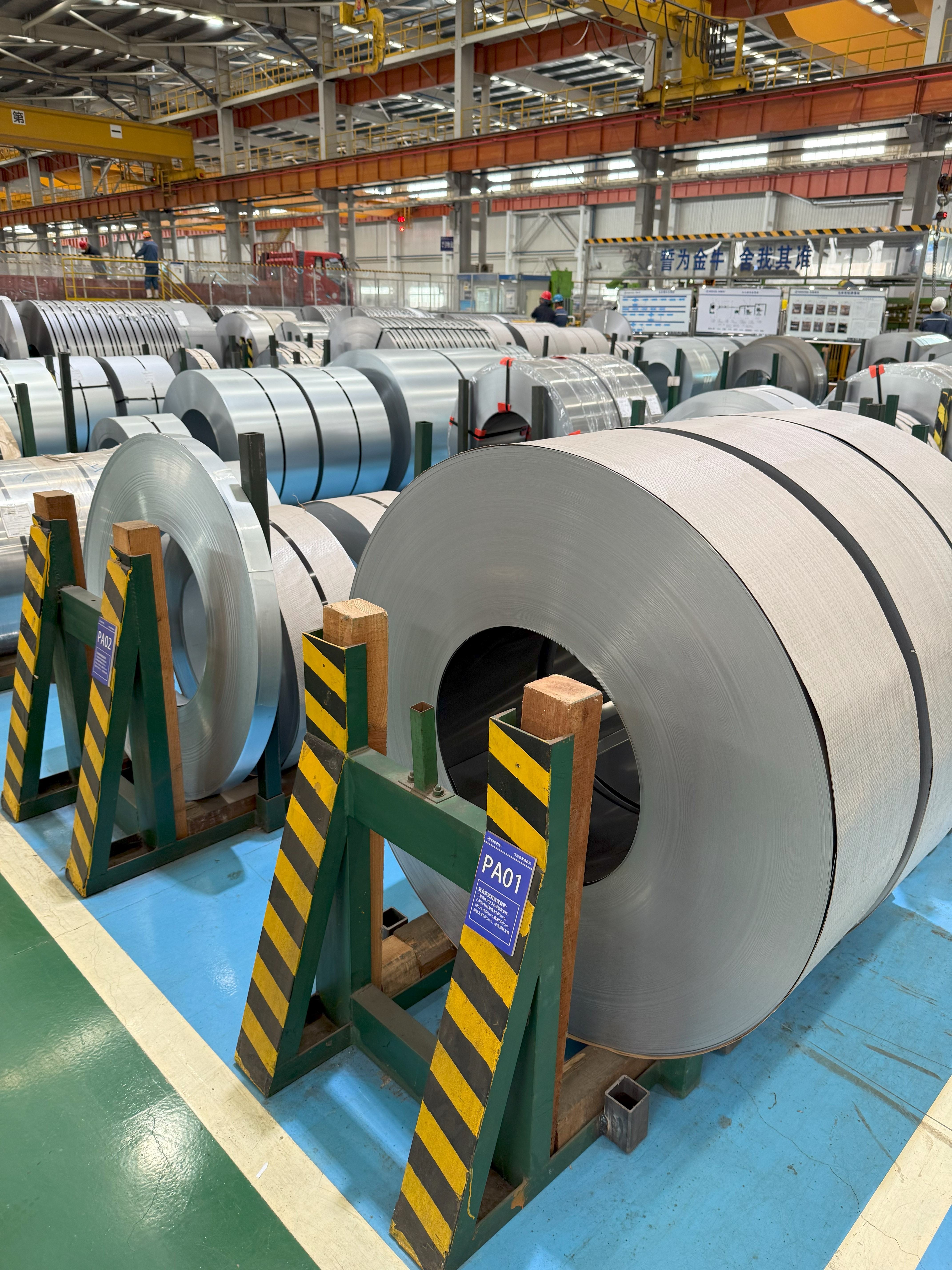
Beyond certificates, assess the supplier’s factory size, inventory, and processing capabilities. MESCO operates a 40,000 m² facility with 120 employees and 50,000 MT monthly capacity, ensuring they can fulfill large orders while maintaining quality.
Use Cases
Case 1: Solar Mounting System in Coastal India
An EPC contractor needed steel with 25-year corrosion resistance in a high-humidity, salt-spray environment. They selected MESCO ZAM Steel (Zn-Al-Mg coated), which held CE certification (ICR/VC/HS2508151) and SGS certification (DLIN22000393ML02_EN). The result: improved edge protection and reduced maintenance frequency, meeting the project's longevity requirement.
Case 2: Industrial Roofing in Thailand
A factory in Thailand required Galvalume Steel with AZ coating for roofing. MESCO supplied GL steel with AZ coating mass up to 275 g/m² — a capability unique in China. The material was backed by ISO 9001:2015 and SGS testing for tensile and bend properties. The project achieved better heat reflection and corrosion resistance.
Frequently Asked Questions (FAQ)
Q: What is a certified steel supplier?
A certified steel supplier holds independent, third-party certifications that verify its quality management system or product conformity to specific standards. Examples include ISO 9001:2015 for quality management, CE marking for construction products in the EU, and SGS testing reports for material properties.
Q: How does certification work?
Certification involves audits by accredited bodies (e.g., SGS, ICR, Amtivo) against defined standards. For product certification, samples are tested in labs; for system certification, processes are reviewed. The certificate includes a unique number, scope, and validity period.
Q: Why is certification important for steel buyers?
It reduces risk of non-conforming materials, ensures legal compliance for export, simplifies customs clearance, and provides traceability for warranty and liability claims.
Q: Who uses certified steel suppliers?
EPC contractors, OEM manufacturers, infrastructure developers, oil & gas companies, automotive parts makers, and renewable energy project developers — any organization that requires documented quality assurance.
Q: How to choose the right certification for my project?
Identify your target market regulations (e.g., EU requires CE for construction steel), then match the product type to the certification scope. Ask the supplier for the certificate number and verify it online.
Q: Common buyer concerns about certification?
Fear of fake certificates is top. Mitigate by verifying directly with the issuing body. Also, check if the certification covers the specific product grade and thickness you need. MESCO provides detailed scope in its certificates, e.g., ZAM Steel 1.5mm and 3.0mm covered under separate SGS reports.
Conclusion
Selecting a certified steel supplier is a strategic decision that safeguards your project’s quality, compliance, and long-term cost efficiency. By following a structured verification process — defining requirements, requesting certificates, validating online, and checking batch traceability — you can confidently partner with suppliers like MESCO STEEL that provide transparent, third-party-verified credentials.
MESCO STEEL is headquartered in Dalian, China (Liaohezhonger Road 5, Development Zone), with a factory size of 40,000 m² and annual output of 120,000 units. Its certifications include ISO 9001:2015 (cert. AMTIVO/CN/250009), SGS (DLIN2111002660ML, DLIN22000393ML01_EN, DLIN22000393ML02_EN), and CE (ICR/VC/HS2508151). For more details, download the company brochure below.
Contact: Max – Email: mesco@mescogroup.com.cn | Tel/WhatsApp: +86 151-3456-5556