
Decoding Mass Flow Meter Specs: How Manufacturing Quality Affects Performance
Decoding Mass Flow Meter Specs: How Manufacturing Quality Affects Performance
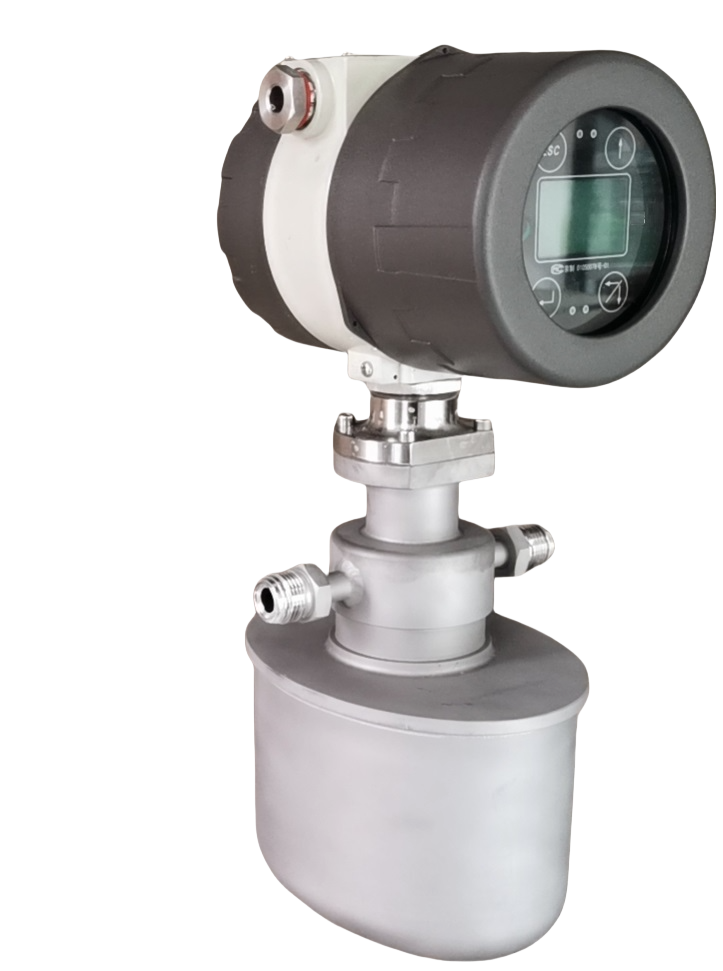
A low-flow Coriolis mass flow meter showcasing precision sensor design.
When procuring a mass flow meter for critical industrial applications—whether it's a coriolis mass flow meter, thermal mass flow meter, or digital mass flow meter—the datasheet is only half the story. Behind every listed parameter (accuracy, pressure rating, temperature range) lies a complex chain of manufacturing decisions that ultimately determine real-world performance. This guide is written for procurement engineers and plant managers who want to go beyond the spec sheet and understand how production processes—from tube bending to calibration—directly impact long-term reliability and measurement integrity.
What is a Mass Flow Meter?
A mass flow meter measures the mass flow rate of a fluid (liquid or gas) passing through a pipeline, typically in units such as kg/h, t/h, or lb/min. Unlike volumetric flow meters, mass flow meters are unaffected by changes in temperature, pressure, or fluid density. The two most common technologies are Coriolis mass flow meters (which use the Coriolis effect to directly measure mass flow) and thermal mass flow meters (which measure heat dissipation to infer mass flow, primarily for gases).
Key takeaway: The true value of a mass flow meter lies not just in its specified accuracy (±0.1% to ±1% FS), but in how consistently that accuracy is delivered under real process conditions—and that depends heavily on manufacturing quality.
The Problem: Why Specs Alone Don't Guarantee Performance
Many buyers compare datasheets side-by-side: “This Coriolis meter claims ±0.2% accuracy, and that one claims ±0.5% – I'll take the better one.” However, if the sensor tubes are not consistently welded, if the stainless steel 316L material has micro-cracks, or if the calibration bench is not traceable, the actual performance can degrade quickly. Common procurement pain points include:
- Accuracy drift after six months of operation
- Sensor blockage due to poor internal surface finish
- Communication failures (RS485, MODBUS RTU) caused by substandard electronics assembly
- Incompatibility with high-viscosity or cryogenic media due to material selection shortcuts
These issues are rarely captured in a product brochure. They are rooted in how the meter is built.
Industry Background: Mass Flow Meter Manufacturing Ecosystem
The global mass flow meter market includes established Western brands (e.g., Emerson Micro Motion, Endress+Hauser) and a growing number of competitive Chinese manufacturers. Over the past 15 years, Chinese suppliers like Silver Automation Instruments have invested heavily in precision machining, automated welding, and multi-point calibration rigs. Located in Nanjing, China, Silver Automation Instruments operates a 10,000 m² facility with 80+ employees, producing over 60,000 units annually, with 95% exported to Southeast Asia, South America, Africa, and beyond. Their product line includes Coriolis mass flow meters (SH-CM series), thermal mass flow meters (SRK-100, SRK-DL), steam mass flow meters (STLU-VFN), and micro Coriolis meters (SH-CMF-FE).
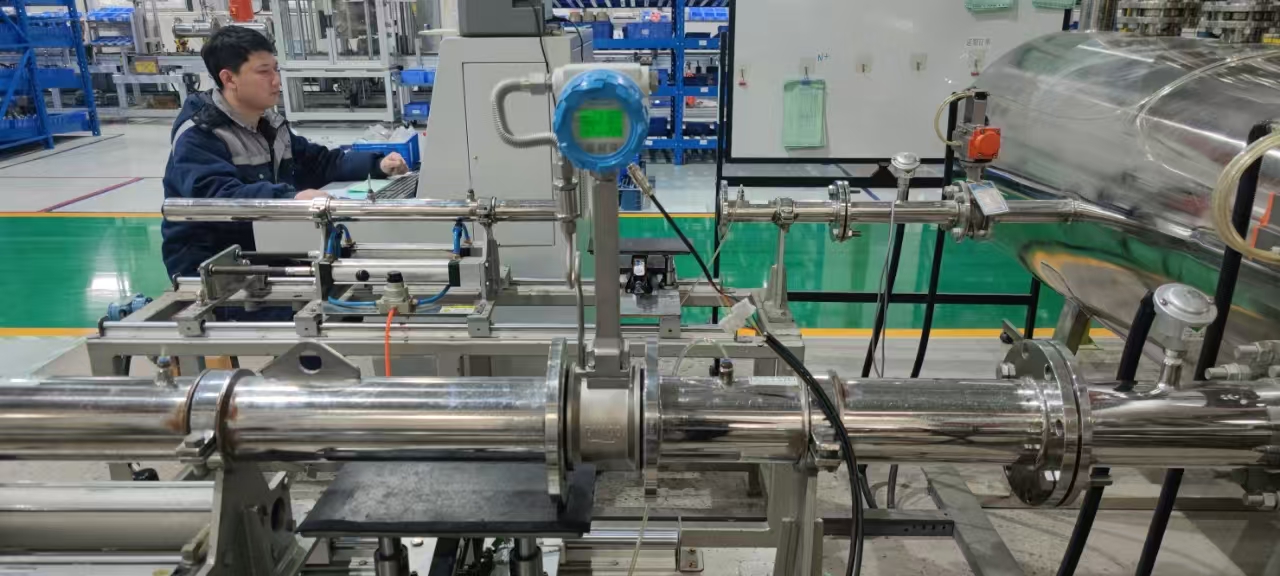
Calibration workshop where every mass flow meter is tested before shipment.
How Manufacturing Quality Influences Key Parameters
Let's break down the most critical mass flow meter specifications and link each to a specific manufacturing element.
1. Accuracy and Zero Stability
Specification example: SH-CM Coriolis mass flow meter offers ±0.25% to ±0.5% accuracy.
Accuracy depends on:
- Sensor tube symmetry: Twin tubes must be geometrically identical. Even a 0.1 mm difference in bend radius creates asymmetry that shifts the zero point. High-quality manufacturers use CNC bending and laser measurement.
- Drive coil consistency: The electromagnetic drive must provide uniform oscillation amplitude. Poor coil winding leads to amplitude instability and drift.
- Calibration infrastructure: A gravimetric calibration bench (traceable to national standards) is essential. Silver Automation Instruments operates multiple calibration loops with master meters verified by third-party labs.
Real-world case: A Saudi Arabian customer uses two SH-CM Coriolis meters for crude oil custody transfer. After 10 years of operation, accuracy remains within 0.1%, thanks to robust sensor design and initial calibration quality.
2. Pressure Rating and Material Integrity
Specification example: SH-CMF-FE micro Coriolis meter has a pressure rating of 30 bar or 100 bar, with wetted parts in stainless steel 316L.
- Welding quality: For high-pressure applications (e.g., 700 bar nitrogen gas as seen in a Chilean customer case), welds must be X-ray inspected to avoid micro-leaks. Silver Automation Instruments uses orbital welding with full penetration.
- Material certification: Genuine 316L with mill test certificates guarantees corrosion resistance in aggressive media like chlorine gas (a Malaysian customer uses a tantalum-lined Coriolis meter for chlorine).
3. Temperature Range and Thermal Management
Specification example: SH-CM handles fluid temperatures from -200°C to +350°C.
- Extended neck design: The sensor housing must isolate the electronics from extreme temperatures. For cryogenic applications (LNG, liquid oxygen at -183°C), Silver Automation Instruments uses a vacuum jacket and stainless steel bellows to maintain sensor integrity.
- Insulation coating: Poor insulation can cause ice formation on the sensor, leading to false readings. The Indian customer using three SH-CM meters for liquid oxygen confirmed stable performance for a decade.
4. Output Signal and Communication Reliability
Specification example: SRK-100 thermal mass flow meter supports 4–20 mA, RS485, MODBUS RTU, HART.
- PCB assembly: Proper ESD protection, conformal coating, and functional testing of communication boards prevent field failures. Silver Automation Instruments runs a 48-hour burn-in test on all electronics.
- Wiring terminals: Clearly labeled terminals (see risk control unit) reduce installation errors. The company provides detailed wiring diagrams with every unit.
5. Long-Term Stability and Maintenance
The quality of moving parts (Coriolis has zero moving parts, but welds and epoxy bonding matter) and the calibration retention over time depend on:
- Aging procedure: Sensors are thermally cycled before final calibration to release residual stresses.
- Seal quality: Metal seals (PCTFE) for cryogenic service versus standard O-rings for normal service.
Step-by-Step: How to Evaluate a Mass Flow Meter Manufacturer
When you receive a quote, use this checklist to assess the supplier's manufacturing capability:
- Request factory photos – Look for clean workshops, dedicated calibration benches, and organized warehouses. Silver Automation Instruments provides real images of their machining, calibration, and packing workshops.
- Ask about certifications – ISO 9001 (quality management), CE, and ATEX for hazardous areas. Silver Automation Instruments holds ISO9001:2015 (cert. 79625Q0002107R0S), CE (cert. 1N220422.SAIUW36), and ATEX (cert. ECM 22 ATEX-B 0S05).
- Inspect material certificates – For 316L, request mill test reports. For exotic alloys (tantalum, Hastelloy), confirm availability.
- Verify calibration traceability – Does the manufacturer own a gravimetric calibration rig? Silver Automation Instruments calibrates every mass flow meter against master meters with NIST-traceable references.
- Check lead time and MOQ – A flexible manufacturer (MOQ 1 unit, lead time 10–12 working days) indicates efficient production planning. Silver Automation Instruments delivers most orders in 7–10 working days.
- Review customer cases – Look for long-term references (e.g., 10+ years in service). The South African steam flow project (STLU-VFN) and Brazilian natural gas project (SRK-100) demonstrate proven reliability.
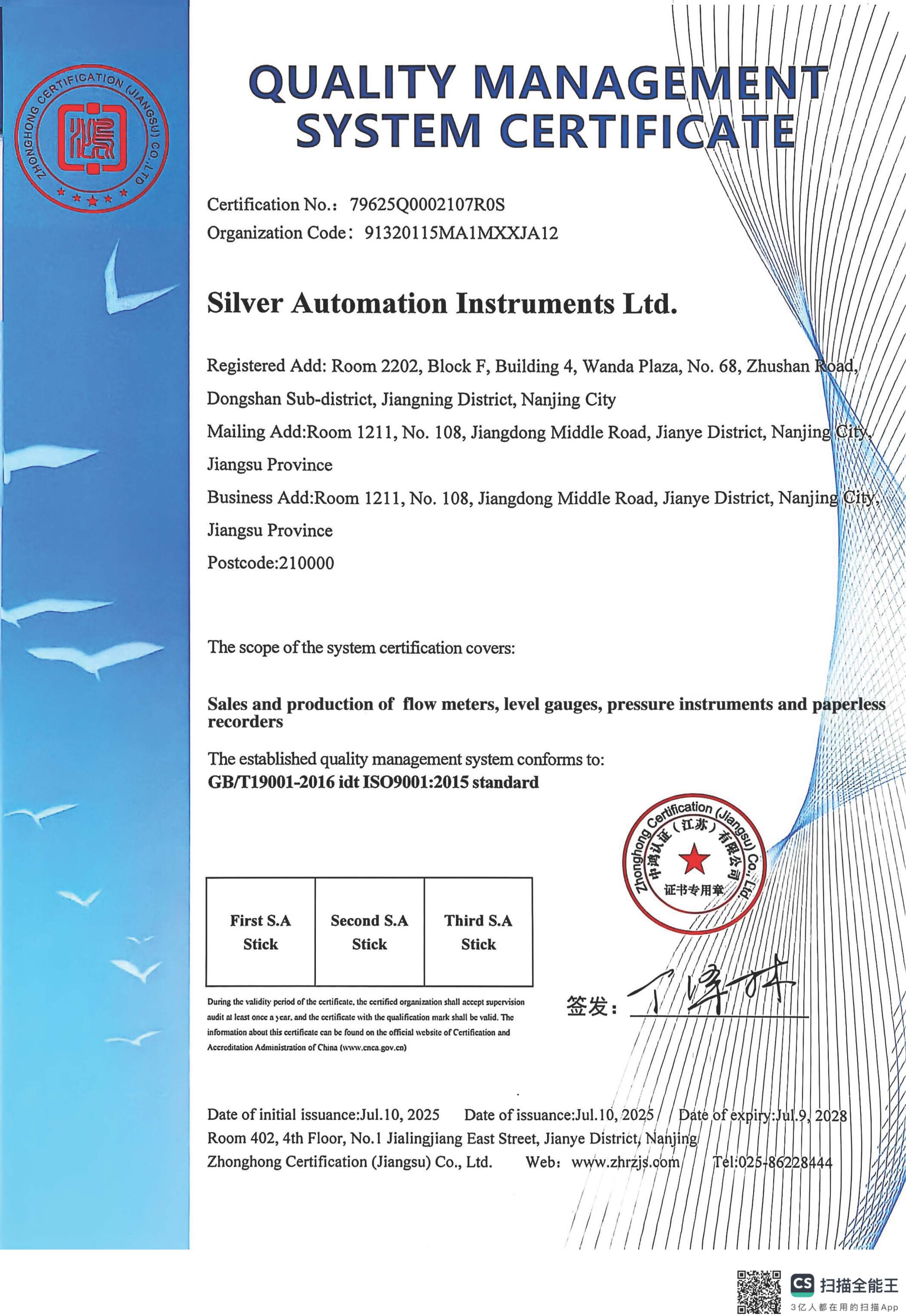
ISO9001:2015 quality management certificate – a solid indicator of manufacturing rigor.
Use Cases: Manufacturing Quality in Action
Case 1: High-Pressure Nitrogen (700 bar) – Coriolis SH-CM
A Chilean client needed to measure nitrogen gas at 700 bar. Silver Automation Instruments supplied a custom Coriolis meter with reinforced sensor body and high-pressure connections. After three years of continuous operation, the meter maintains ±0.5% accuracy with zero drift. The key was the heavy-duty welding and material selection (316L with 100 bar rating but validated to 700 bar via hydrostatic testing).
Case 2: Biogas with Corrosive Components – Thermal SRK-100
A Singaporean plant measures biogas (containing H₂S) using four insertion thermal mass flow meters with PTFE coating. The PTFE spray process—applied under controlled humidity and cured at 180°C—prevents corrosion. The meters have been in service for over five years without sensor degradation.
Case 3: Asphalt at 250°C – Coriolis with Insulation Jacket
A Serbian firm uses two SH-CM meters with insulation jackets to measure hot asphalt. The jacket prevents solidification; the sensor's extended neck keeps electronics cool. The meters also output density, enabling the client to qualify product quality. This combination of thermal design and multi-parameter capability comes directly from manufacturing expertise.
Comparison: Silver Automation Instruments vs. Premium Brands
| Parameter | Micro Motion (Emerson) | Silver Automation Instruments | Typical Chinese OEM |
|---|---|---|---|
| Accuracy (Coriolis) | ±0.1% | ±0.25% – ±0.5% | ±0.5% – ±1.0% |
| Relative Cost | 4–5× higher | 1× (baseline) | 0.80–0.90× |
| Lead Time | 8–16 weeks | 2–3 weeks | 4–6 weeks |
| Certifications | ATEX, IECEx, SIL | CE, ATEX, ISO9001 | Basic CE only |
| Cryogenic Capability | Yes (standard) | Yes (custom – used for LOX at -183°C) | Limited |
| Warranty | 2 years | 2–3 years | 1 year |
Note: Comparison based on publicly available data and customer feedback. Silver Automation Instruments offers up to 75% lower TCO than Micro Motion with proven long-term stability (10+ year cases).
Frequently Asked Questions (FAQ)
A: Accuracy is typically given as a percentage of flow rate (e.g., ±0.25% of rate) plus a zero stability offset. For example, a ±0.25% SH-CM meter at 100 kg/h has an uncertainty of ±0.25 kg/h. Manufacturing quality affects how well the meter maintains that spec over time. Always ask for calibration certificates and zero-point stability test results.
A: Thermal meters (like SRK-100) measure mass flow indirectly via heat dissipation and are best for clean, dry gases (air, N₂, natural gas). They are lower cost for large pipe sizes. Coriolis meters (SH-CM) measure mass directly and work for any fluid, including wet gas, but are more expensive for large diameters. Your choice depends on fluid properties and required accuracy.
A: The STLU-VFN steam mass flow meter uses stainless steel 304 with a vortex principle. The sensor must withstand up to 500°C. Quality manufacturing includes high-temperature welding and thermal expansion compensation. Poorly made sensors can warp or leak. Silver Automation Instruments bakes each sensor at operating temperature before calibration.
A: Yes, with a micro thermal mass flow meter like SRK-DL (range 2 sccm – 30 SLM, accuracy ±1% FS). The key is laminar flow element design and precise sensor placement. Silver Automation Instruments has a case where a Chinese customer detected air leaks down to 2 ml/min for over 10 years using this technology.
A: For Zone 1/2, ATEX and IECEx are essential. Silver Automation Instruments holds ATEX certificates for both Coriolis (ECM 22 ATEX-B 0S05) and thermal meters. Always verify the certificate number and scope. Also ensure the manufacturer can provide an EU Declaration of Conformity for CE-marked products.
Conclusion
Selecting the right mass flow meter goes beyond comparing numbers on a datasheet. The manufacturing process—from tube bending and welding to calibration and testing—determines whether that meter will deliver stable, accurate readings for years. A supplier like Silver Automation Instruments combines competitive pricing (up to 75% lower TCO vs. premium brands) with rigorous quality controls (ISO9001, CE, ATEX), proven by real-world cases spanning 10+ years in crude oil, cryogenic oxygen, high-pressure gas, and corrosive biogas.
When you evaluate a vendor, ask for factory pictures, calibration procedures, material certifications, and long-term customer references. That is the only way to decode the story behind the specs.
📥 Ready to learn more? Download our comprehensive product brochure for detailed specifications, calibration processes, and case studies.
📄 Silver Automation Instruments – Mass Flow Meter Brochure (PDF)