
Dosing Pump Specification Checklist: CE Marking, Materials, and Flow Accuracy
A dosing pump—often called a metering pump—is a positive displacement pump that injects a controlled volume of liquid into a process at a predictable rate. For procurement and engineering teams, the more important task is to define the operating window before comparing products: flow rate, discharge pressure, liquid compatibility, control signal, protection class, and required certifications. This guide explains those constraints and shows how dosing pump models from WRS PTE LTD and its manufacturing entity ZHEJIANG WRS MACHINERY EQUIPMENT CO., LTD map to them.
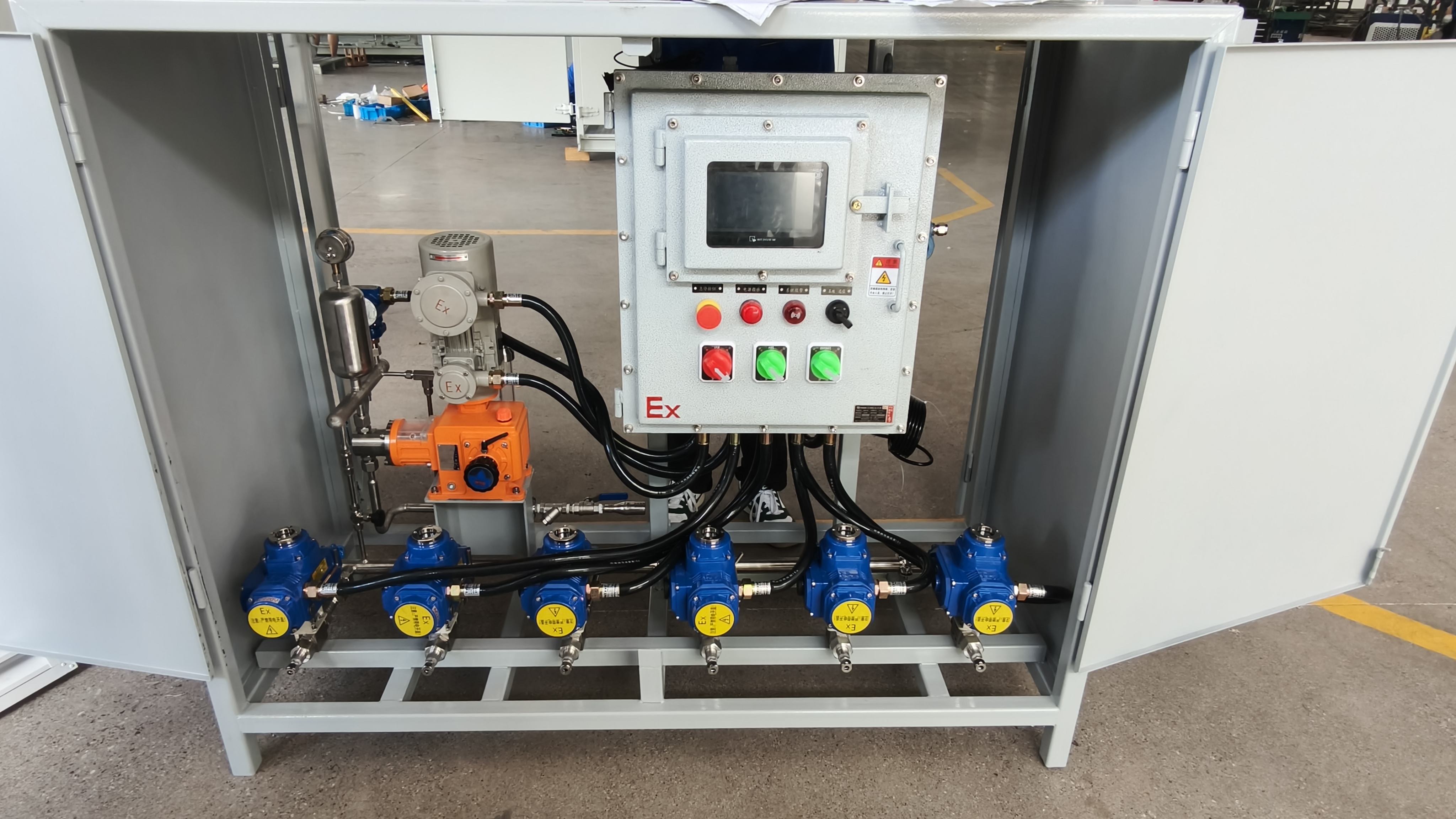
An assembled WRS dosing device used for automatic chemical dosing.
Why Dosing Pump Selection Fails Without Constraints
Most dosing pump problems are not caused by the pump alone. They are caused by mismatched parameters: a pump sized only for average flow may fail at peak pressure; a pump with the right flow range may use a wetted material incompatible with the chemical; a plant requiring a 4-20 mA control signal may receive a manually controlled unit. Buyers should therefore treat flow, pressure, material, control, protection, and compliance as one specification, not as separate options.
This is especially true when the pump will be part of a larger chemical dosing system. The pump, dosing pump check valve, dosing pump pulse dampener, sensor, controller, and injection point must work as a single loop. A specification checklist creates a common language between buyer, engineer, and supplier before a purchase order is placed.
Dosing Pump Market Context
The global dosing pump market was valued at approximately USD 8.86 billion in 2024, according to Grand View Research. Asia Pacific accounted for 41.8% of revenue in the same year. Diaphragm-type dosing pumps held the largest product segment at 55.7%, which is consistent with the widespread use of solenoid and mechanical diaphragm pumps in water treatment and chemical dosing.
For narrower categories, motor-driven metering pumps represented 54.45% of the global metering pump market in 2025, according to Mordor Intelligence, while water and wastewater treatment accounted for 23.2% of metering pump applications in Grand View Research data. The global chemical injection pump market was estimated at USD 3.5 billion in 2024 by HTF Market Intelligence. China's liquid pump exports, including dosing types, reached USD 14.3 billion in 2024, according to OEC data. These figures help explain why buyers need to distinguish Solenoid Dosing Pump, Diaphragm Dosing Pump, Piston Dosing Pump, and Digital Dosing Pump categories instead of treating dosing pump as one generic product.
Dosing Pump Specification Requirements: A Constraint-Based Approach
Use the following constraints to filter the pump range: continuous flow range, maximum discharge pressure, wetted material, control mode, enclosure rating, and certification. The table below summarizes the WRS series referenced in this guide.
| Pump type | WRS model examples | Flow range | Pressure range | Wetted materials | Control and notes |
|---|---|---|---|---|---|
| Solenoid Dosing Pump | EML0020PR1C, ML0008PR1C | 1-20 L/H | 1-10 bar | PVC, PVDF, SS316 | Manual or remote control; 4-20 mA / pulse / Modbus RS485; IP65; 1% dosing accuracy; double-ball check valve design |
| Digital Dosing Pump | EMML0060FP1E, EMGP0200FP1C, EMAP1000PQ1C | 60-1000 L/H | 4 bar | PVC, PVDF, SS316 / SS316L | Direct flow display; less than 1% precision; 1:1000 ratio; PTFE diaphragm; IP65; remote control via 4-20 mA / pulse / Modbus RS485 |
| Mechanical Diaphragm Dosing Pump | MA0120PQ11, MG0150PQ11, MB1800PQ11 | 15-1800 L/H | 3-10 bar | PVC, PVDF, SS316 | Smooth flowrate adjustment while running or idle; multi-layer diaphragm; frequency or explosion-proof motor options available on select models |
| Piston Dosing Pump | PM060SS1PFN11, PD105SS1PFN11 | 600 L/H | 8 bar | SS316 | DN25 or DN50 flange; 0.75-4.0 kW motor options; suitable for high-viscosity media; frequency or explosion-proof motor available |
| Hydraulic Metering Pump | HS008S0P01S11, HL090S0P01F11 | 2-1600 L/H | Up to 200 bar | SS316 | Zero-leakage design; suitable for toxic, hazardous, and high-viscosity media; optional diaphragm rupture sensor |
Table 1: Dosing pump technology comparison based on WRS product data.
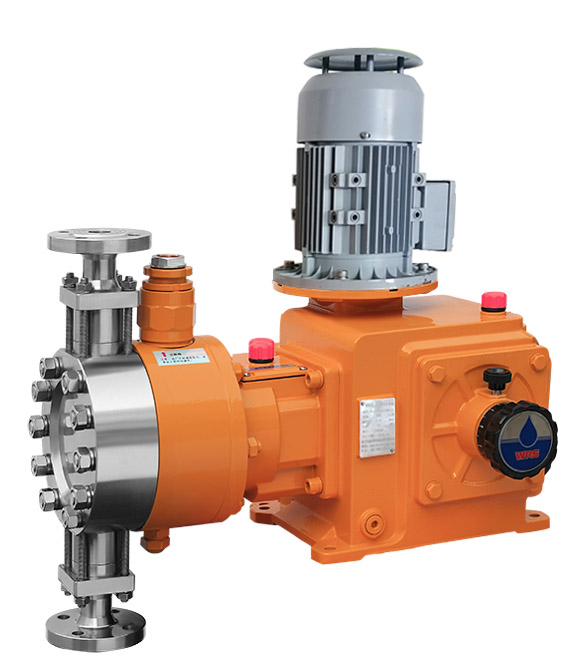
WRS hydraulic metering pump for higher-pressure and zero-leakage applications.
Step-by-Step Dosing Pump Selection Workflow
The selection workflow below is designed for a buyer, plant engineer, or system integrator moving from process requirements to supplier specification.
- Define the process duty. Record the required flow in L/H, discharge pressure in bar, operating schedule, and chemical name or concentration. Do not skip intermittent versus 24/7 operation, because it affects pump duty and material fatigue.
- Select the pump technology by flow and pressure. For low-flow chemical dosing, solenoid pumps are a practical starting point. For accuracy with display and communication, digital dosing pumps provide direct flowrate display and Modbus RS485 options. For larger flows, mechanical diaphragm pumps cover a wide band. For high-viscosity or toxic media, piston and hydraulic metering pumps are designed for more demanding service.
- Confirm wetted materials. WRS pump heads are available in PVC, PVDF, and SS316 depending on series. For strong corrosive liquids, PVDF pump head material is recommended. The material choice must match the chemical, not just the price target.
- Choose the control and feedback mode. Manual control is simple for fixed-rate dosing. For automatic systems, specify 4-20 mA, pulse, or Modbus RS485 communication. Digital pump models from WRS also provide direct flowrate display.
- Check the environment and protection requirement. Most WRS solenoid and digital dosing pumps are rated IP65. In harsh or humid environments, confirm the complete system protection rating. For example, a livestock nutrient dosing project in Russia required an automatic system with IP67 protection for 24/7 operation in a humid farm environment.
- Verify compliance and certification. For EU-bound equipment, CE marking is required for metering pump units under the EU machinery rules. WRS holds CE certification for its dosing pump series, with certificate number 3N240528.ZWMTU36 issued by ECM on 2024-05-28 and valid until 2029-05-27. The applicable standards are EN ISO 12100:2010 and EN 60204-1:2018. If the project specification calls for API 675, confirm that your pump configuration is designed and documented to that requirement.
- Validate the supplier's manufacturing capability. WRS supports ODM production, voltage customization, a monthly capacity of 5000 units, a standard lead time of 3 days, an MOQ of 1 unit, 100% testing before delivery, and remote after-sales support. These factors matter when the pump is part of a larger chemical dosing system or a branded reseller program.
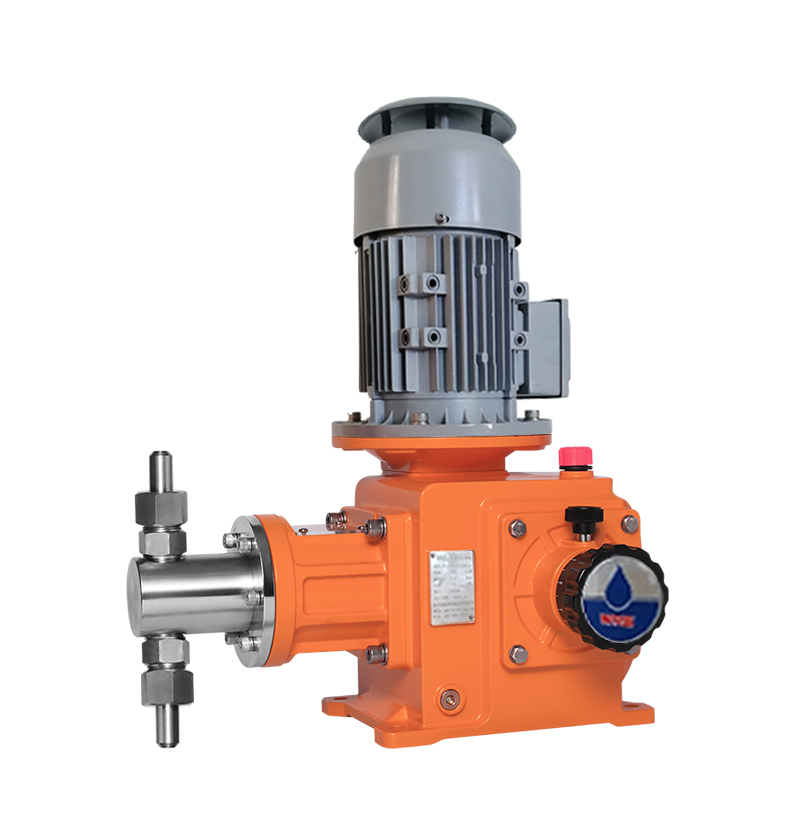
SS316 piston dosing pump for higher-flow and high-viscosity applications.
Choosing the Right Pump Head and Diaphragm Material
For highly corrosive liquids, the pump head material is often more important than the drive type. PVC pump heads are common for water treatment and mild chemicals. PVDF is recommended when the liquid is strongly corrosive. SS316 is used where mechanical strength, temperature resistance, or compatibility with industrial chemicals is required. WRS digital dosing pumps use a full PTFE diaphragm with strong corrosion resistance.
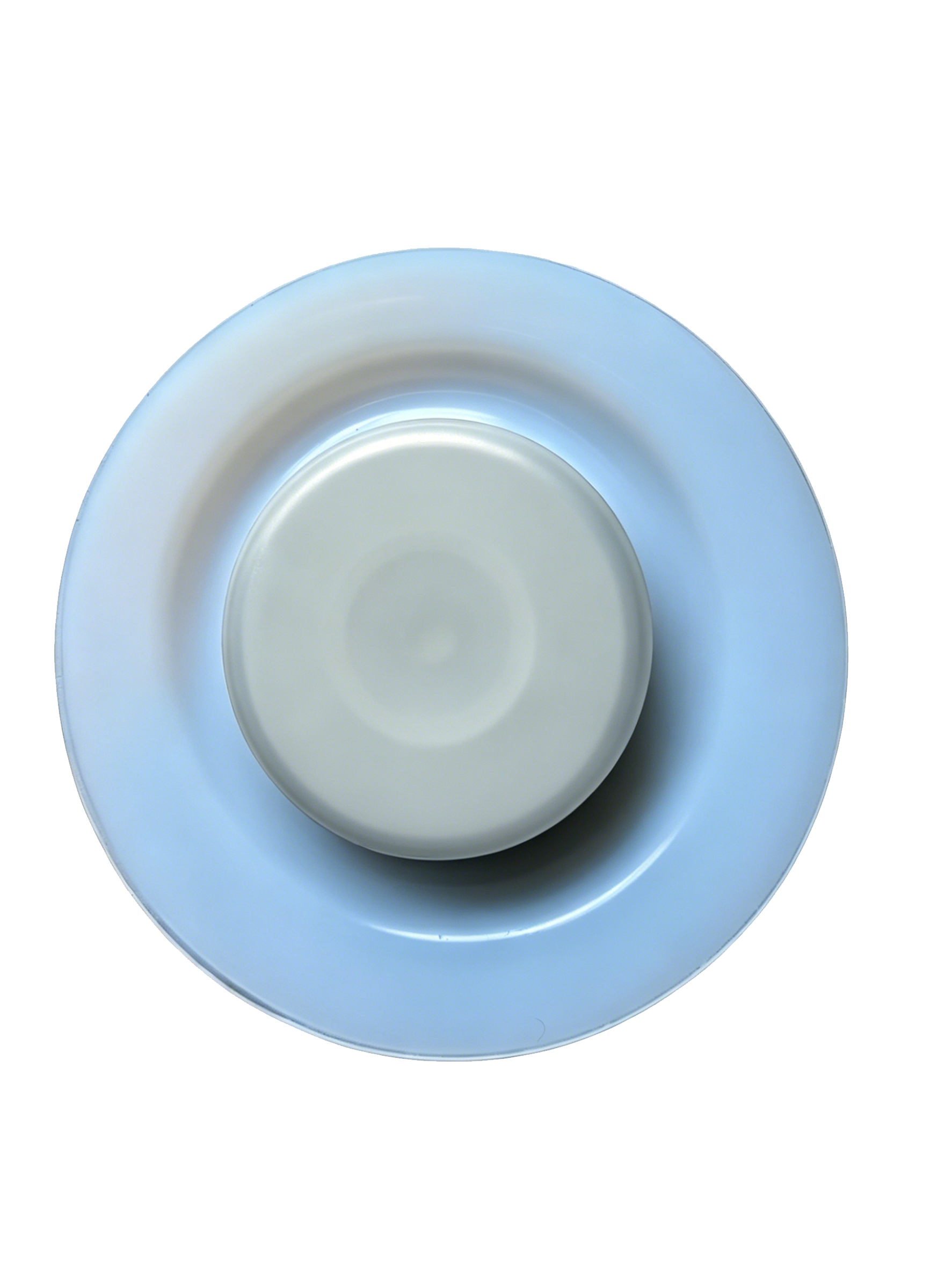
PTFE diaphragm construction used in WRS digital dosing pumps.
Beyond the Pump: Accessories and Complete Dosing Systems
A metering pump rarely works alone. WRS also lists Dosing Pump Check Valve, Dosing Pump Pulse Dampener, Chemical Dosing System, Streaming Current Monitoring System, and Chemical Injection Pump in its main product range. These components help stabilize suction and discharge pressure, prevent backflow, and allow the dosing loop to respond to water quality changes. In treatment plants, a streaming current monitoring system can be paired with a coagulant or polymer dosing pump to automate dose adjustment.
Dosing Pump Applications and Verified Use Cases
Wastewater Treatment Plant in Australia
An engineering company in Australia ordered 20 WRS dosing pump units for wastewater treatment. The supplied units have been in operation for 5 years with stable operation. The customer highlighted high quality and easy maintenance as the main benefit. Related WRS models in this case include mechanical diaphragm, solenoid, digital, and motor-driven dosing pumps from the MA, ML, EMML, EMGP, EMAP, MB, MG, and EML series.
Livestock Nutrient Dosing in Russia
For a harsh humid livestock farm in Russia, WRS supplied an automatic system for 24/7 nutrient solution dosing. The project specified IP67 protection. Related pumps in this configuration include the EMML0060FP1E digital dosing pump and the ML0008PR1C solenoid dosing pump.
Industrial and High-Pressure Chemical Injection
WRS product data also covers oil and gas, hydrogen energy, electric power, chemical, pharmaceutical, semiconductor, pulp and paper, new energy, and mining applications. Piston and hydraulic pump models are available in SS316 with optional frequency or explosion-proof motors, making them candidates for chemical injection pump duty in demanding process environments.
Dosing Pump FAQ
1. Is the WRS dosing pump CE certified?
Yes. The CE certificate covers dosing pump series EML, EMG, EMA, EMB, EPS, EPM, EHS, EHM, ML, MLS, MG, MA, MB, PS, PM, PL, PD, PT, HS, HM, HL, HD, and HT. It was issued by ECM on 2024-05-28 with certificate number 3N240528.ZWMTU36 and is valid until 2029-05-27. The applicable standards are EN ISO 12100:2010 and EN 60204-1:2018.
2. What dosing pump types and specifications are available from WRS?
WRS supplies solenoid dosing pumps with 1-20 L/H flow and 1-10 bar pressure, digital dosing pumps with 60-1000 L/H flow and 4 bar pressure, mechanical diaphragm dosing pumps with 15-1800 L/H flow and 3-10 bar pressure, piston dosing pumps with 600 L/H flow and 8 bar pressure, and hydraulic metering pumps with 2-1600 L/H flow and up to 200 bar pressure.
3. What factors affect dosing pump price?
Key pricing inputs are pump head material, motor type, maximum flow and pressure, control mode, enclosure protection, and certification. PVC-based pumps are generally a lower-cost option, while PVDF and SS316 wetted materials increase cost. Since WRS has an MOQ of 1 unit and supports voltage customization, a direct supplier quotation is the most reliable way to budget for a specific configuration.
4. Can I order one dosing pump unit for testing before committing to a larger purchase?
Yes. WRS has an MOQ of 1 unit and can customize voltage under ODM production. Every finished unit is 100% tested before delivery. For applications with corrosive media, confirm the pump head material before ordering; PVDF is recommended for highly corrosive liquids.
5. What is the lead time for a dosing pump order?
WRS lists a production lead time of 3 days for standard configurations, with a monthly capacity of 5000 units. Lead time should always be confirmed against motor, voltage, communication protocol, and special certification requirements for your project.
Conclusion: Build the Specification Before You Compare Brands
Dosing pump selection improves when you start with process constraints rather than product names. Check flow, pressure, materials, control, protection, certification, and supplier manufacturing capability. WRS provides a broad dosing and metering pump range with CE certification, 100% testing, a 1-unit MOQ, and a short standard lead time for configuration review.
Request a Dosing Pump Configuration Review
Send your flow, pressure, chemical, voltage, and control requirements to isak@wrsindustry.com or call / WhatsApp +86-173 0642 4430.
Download the WRS product brochure: Diaphragm / Dosing Pump Brochure.
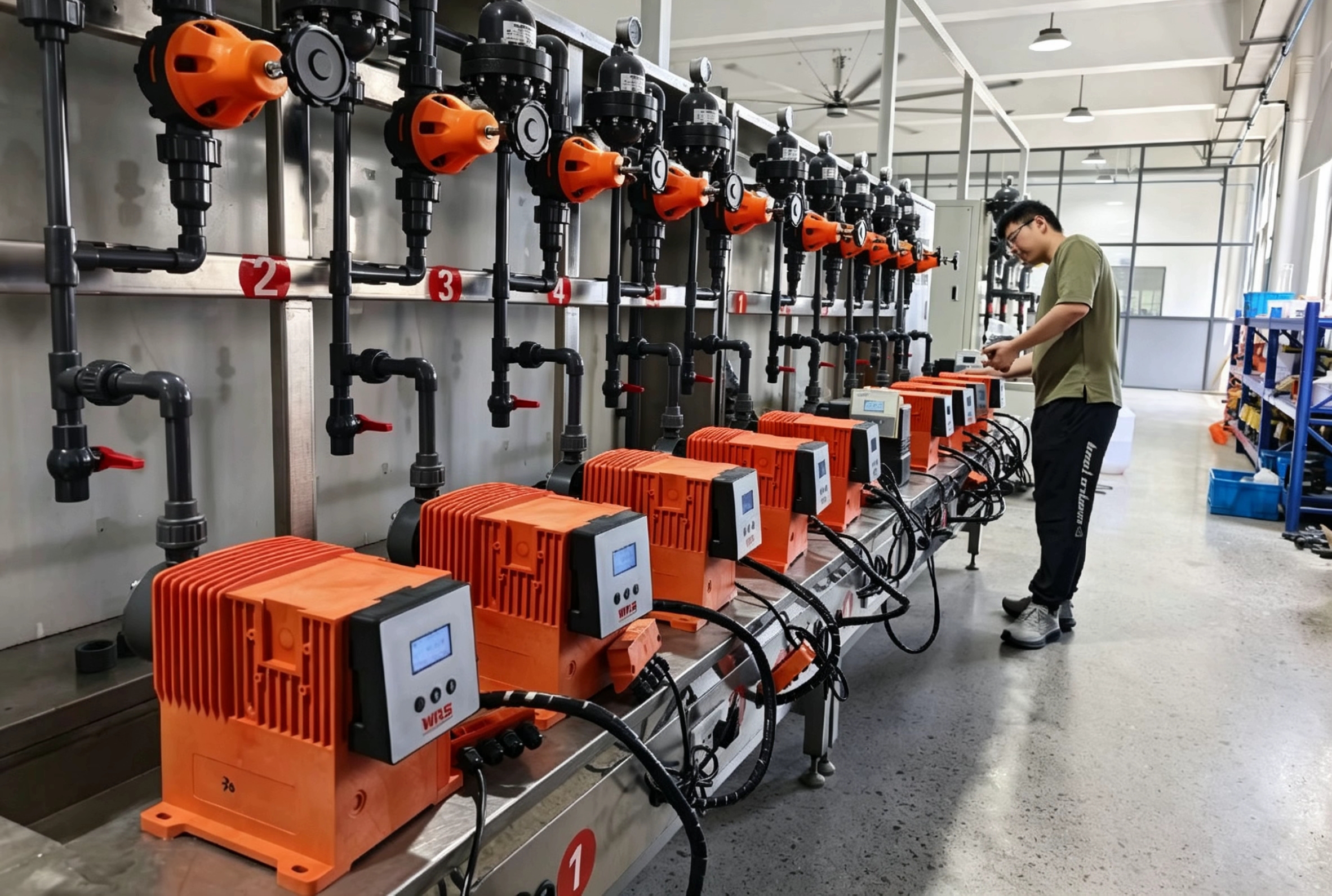
Every finished WRS dosing pump is tested before shipment.