
How to Choose the Right Reflective Glass Beads Supplier
How to Choose the Right Reflective Glass Beads Supplier for Your Road Marking Projects
A practical guide for procurement professionals evaluating glass beads for pavement marking – covering standards, quality, cost, and supplier capability.
Introduction
Reflective glass beads are the unsung heroes of road safety. Embedded in pavement markings, they retroreflect headlight beams back toward drivers, making lane lines visible at night and in wet conditions. For contractors, traffic safety manufacturers, and government agencies, selecting the right glass beads supplier is a strategic decision that directly impacts project quality, safety compliance, and long-term maintenance costs.
This guide answers the core procurement question: How do I find a glass beads supplier that consistently meets my specifications, delivers on time, and offers competitive pricing? We will walk through the key evaluation criteria using real industry data and a proven supplier example – DYLAN TECHNOLOGY CO.,LTD.
Problem Definition: The Buyer’s Dilemma
Procurement managers sourcing reflective glass beads for road marking face several recurring challenges:
- Inconsistent quality – beads with low sphericity or uneven refractive index reduce retroreflectivity
- Standard mismatch – products that fail to meet local standards (AASHTO M247, EN 1423, BS 6088, AS/NZS)
- Delivery delays – unreliable supply chains disrupt project timelines
- Hidden costs – low initial prices often lead to higher rework rates and shorter service life
- Lack of traceability – no auditable quality control or certification documentation
The market offers dozens of glass bead producers, but only a few combine large-scale production, rigorous quality testing, and international certification. Understanding how to select a supplier is as important as the product itself.
Industry Background: Glass Beads in Road Safety
Glass beads are small, spherical microspheres made from soda-lime glass or recycled glass. Their function is optical: when embedded in thermoplastic, cold plastic, or paint markings, they create a retroreflective surface. The key performance indicators are:
- Refractive Index (RI) – typically 1.5 to 1.7 for standard road beads; higher RI improves brightness
- Roundness / Sphericity – above 80% for maximum retroreflection
- Particle size distribution – defined by sieve grades (e.g., 850–180 µm for EN 1423)
- Chemical resistance – must withstand moisture, de-icing salts, and UV
Major international standards include: AASHTO M247 (Types 1–4 for the US), EN 1423 / EN 1424 (European), BS 6088 (UK), and AS/NZS 2009 (Australia/New Zealand). A reliable supplier must be able to produce beads conforming to these specifications consistently.
Key Market Players at a Glance
Buyers typically consider three categories of suppliers: large specialized manufacturers with global certifications (e.g., Dylan Technology, Potters Industries), regional producers, and trading companies.
Detailed Solution: How to Evaluate a Glass Beads Supplier
To simplify your selection process, we have built a six-step framework based on our analysis of the global glass beads supply chain. Each step includes the specific metrics to ask for.
Step 1 – Align Product Standards with Your Project
Identify which standard your contract requires. For example:
- US projects: AASHTO M247 Type 1 (1180–150 µm), Type 2, Type 3 (1700–710 µm), or Type 4 (2000–850 µm)
- European projects: EN 1423 (850–180 µm or 710–125 µm) or EN 1424 (1400–355 µm)
- UK projects: BS 6088 Grade A (1180–425 µm) or Grade B (850–180 µm)
- Australian projects: AS/NZS Type B (850–75 µm), Type C, or Type D
A supplier like DYLAN TECHNOLOGY offers more than 20 model numbers covering all these standards, including specialized high refractive index glass beads (RI 1.6 and RI 1.7) for high-demand road sections.
| Standard | Model Example | Sieve Range |
|---|---|---|
| AASHTO M247 | M247-TYPE 1 | 1180–150 μm |
| EN 1423 | EN1423 | 850–180 μm / 710–125 μm |
| BS 6088 | BS6088A | 1180–425 μm |
| AS/NZS | TYPE C | 1300–425 μm |
Step 2 – Verify Production Capacity and Stability
A supplier’s ability to fulfill large orders without delay is critical. Look for:
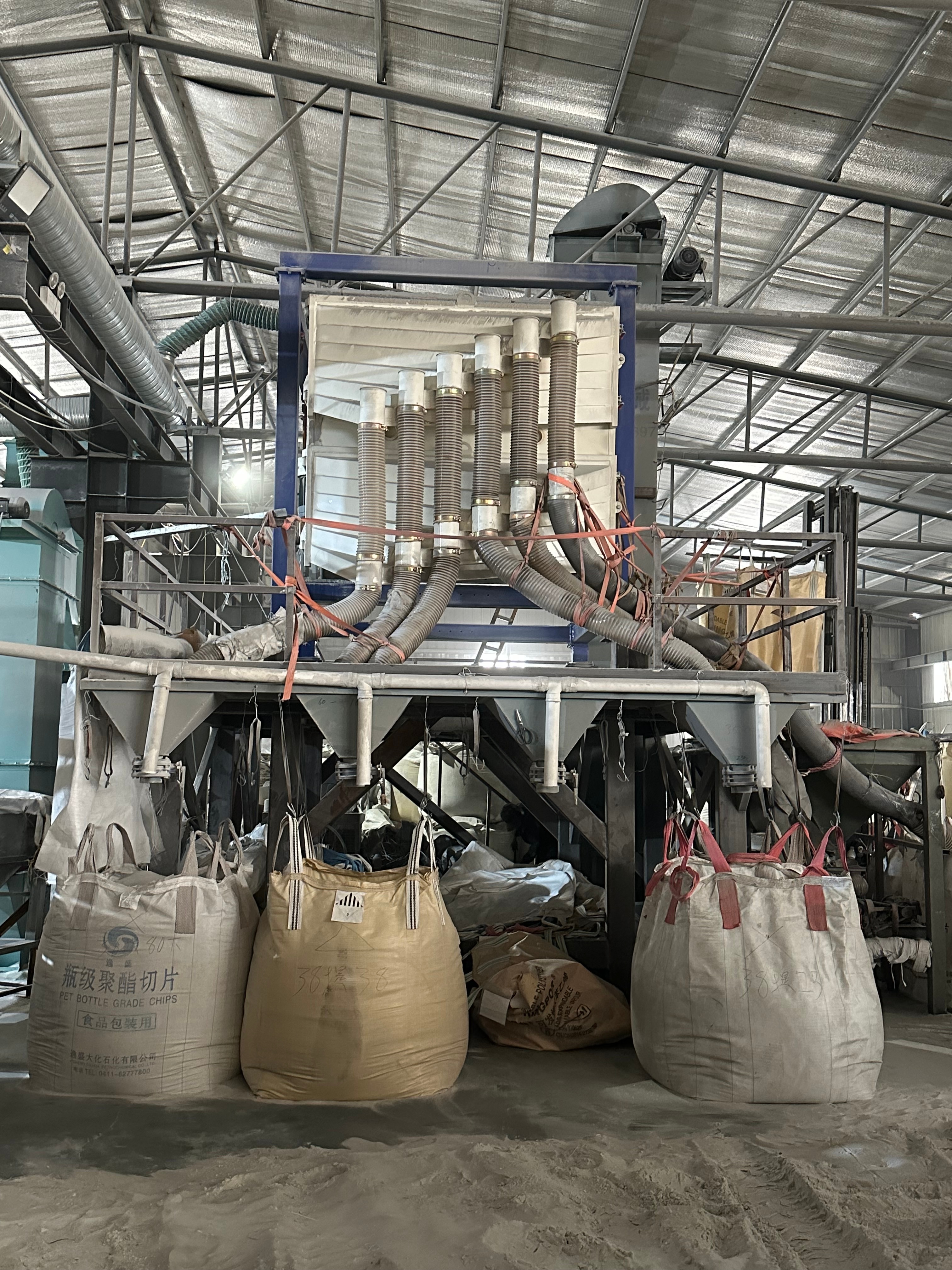
- Annual production volume (e.g., 100,000 tons for Dylan Technology)
- Number of production lines (more than 15 advanced lines)
- Geographic diversification – multiple manufacturing bases reduce supply risk
- Inventory management system and lead time (typical 45–60 days)
Step 3 – Check Certifications and Quality Control
Third-party certifications are non-negotiable for government and international projects. Ask for:
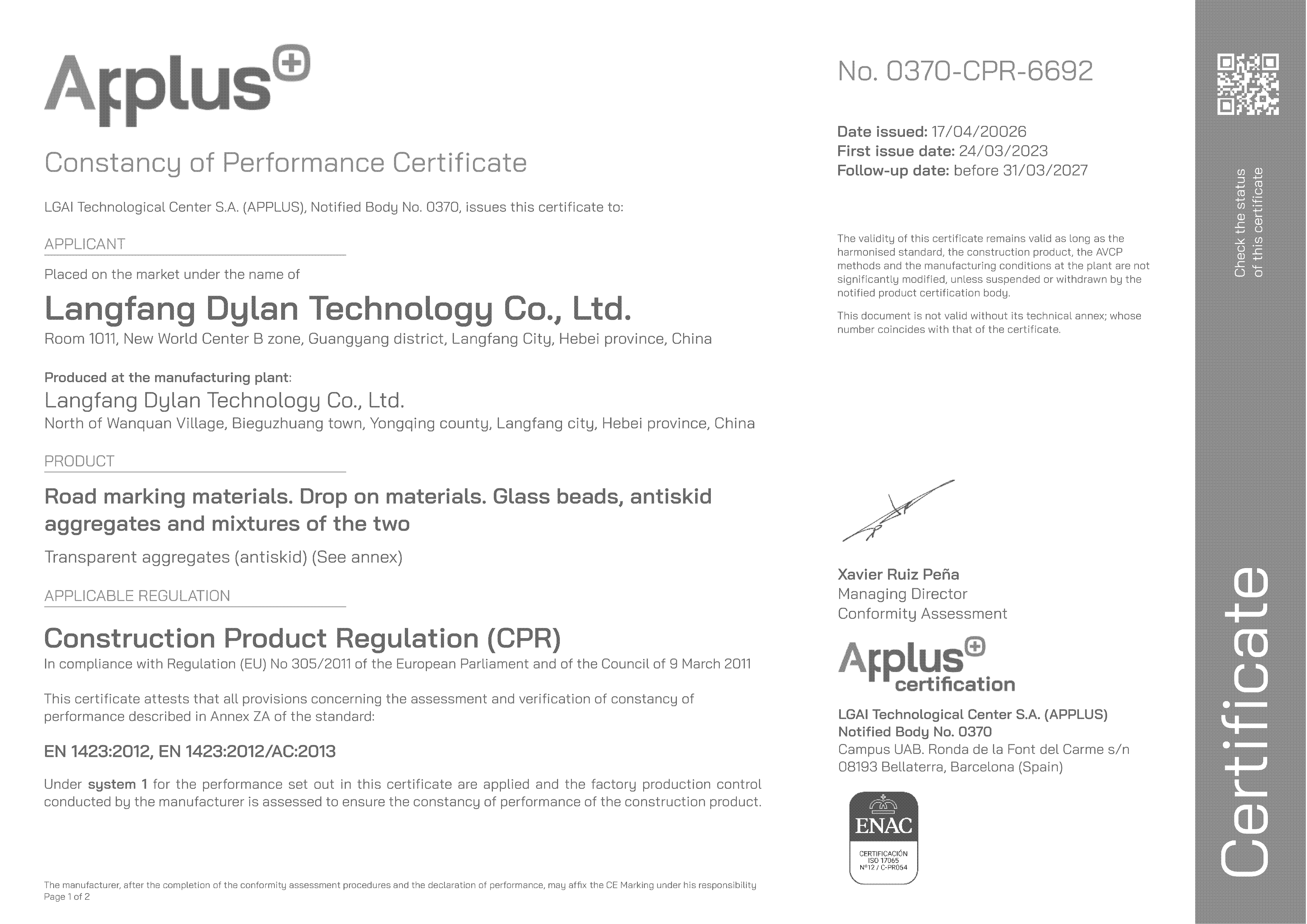
- ISO 9001:2015 – quality management system (Dylan holds certificate #23226Q00027R001)
- CE marking (EU)
- JIS / KIS (Japan / Korea)
- In-house testing equipment: look for CAMSIZER (particle shape and size) and X-2600 (elemental analysis)
Step 4 – Evaluate Cost vs. Lifespan
Compare total cost of ownership, not just unit price. According to industry comparisons, products from specialized manufacturers often offer 5%–15% lower total cost than imported equivalents due to reduced rework and longer service life (20%–30% longer on high-traffic roads). Dylan Technology’s patented production furnace and waste heat recovery system further reduce energy costs, passing savings to buyers.
Step 5 – Review Customer Case Studies
Real-world usage validates supplier claims. For example, Dylan Technology has supplied:
- 56 tons to a road marking engineering company – stable performance over 3 years, low wear
- 198 tons – 3-year cooperation, consistent reflectivity
- 20 tons – 4 years of stable results
- 72 tons – low wear and high retroreflectivity
These cases confirm the supplier’s ability to maintain quality at scale.
Step 6 – Understand Payment and Logistics Terms
Flexible payment options reduce buyer risk. Common terms include T/T 30% advance + 70% against B/L, L/C 90 days after BL, or even T/T 100% after cargo receipt. Dylan Technology offers MOQ as low as 1 ton and delivery via FOB, CIF, DDP, or EXW.
Use Case: Selecting Beads for a European Highway Project
Scenario: A contractor in Germany needs EN 1423 compliant glass beads for a 50 km thermoplastic road marking project. The annual volume is 200 tons.
After applying the six-step framework, they choose Dylan Technology’s EN1423 model (850–180 μm) because:
- Product holds CE certification
- ISO 9001 accredited with full traceability
- 20 tons trial run showed retroreflectivity > 300 mcd/lx/m²
- Price 10% below a competing European brand
- Delivery within 50 days including custom packaging
Frequently Asked Questions (FAQ)
1. What are reflective glass beads?
Reflective glass beads are small, spherical glass particles (typically 0.5–20 mm) used in road markings to create retroreflection. They are embedded into thermoplastic, paint, or cold plastic and bounce light back to drivers, improving night-time visibility.
2. How do glass beads work?
When a vehicle’s headlight beam hits the road marking, the light enters the glass bead and is refracted, reflected off the inner back surface, and returned toward the source. The higher the refractive index and sphericity, the brighter the reflection.
3. Why are international standards important for glass beads?
Standards like AASHTO M247, EN 1423, and BS 6088 define bead size distribution, refractive index, roundness, and chemical resistance. Using compliant beads ensures markings meet national safety regulations and maintain performance over years of traffic wear.
4. How can I verify the quality of a glass bead batch?
Request a pre-shipment test report from the supplier. A reputable manufacturer like Dylan Technology uses CAMSIZER for particle analysis and X-2600 for chemical composition, and can provide certified results per ISO 9001. You can also arrange a third-party inspection.
5. What is the minimum order quantity (MOQ) for glass beads?
Many large-scale suppliers, including Dylan Technology, accept MOQ as low as 1 ton, making it feasible for sample testing and small projects while also supporting bulk orders of hundreds of tons.
Conclusion
Choosing the right supplier for reflective glass beads is a matter of matching your project’s technical requirements with a partner who has proven production reliability, certifications, and transparent quality control. Dylan Technology Co., Ltd. – with its 20-year track record, 100,000-ton annual capacity, ISO 9001 and CE certifications, and global partnerships with ENNIS, Geveko, and Swarco – exemplifies the kind of supplier that minimizes risk and maximizes performance.
Whether you need drop-on glass beads for thermoplastic, pre-mixed glass beads for cold plastic, or high refractive index beads for maximum visibility, a systematic evaluation will lead you to a solution that fits both your budget and your safety standards.
Download the Corporate Brochure
Get detailed product specifications, certification information, and company profile in one PDF.
Download Brochure© 2026 Dylan Technology Co., Ltd. – www.dylantech.com | Contact: dylan@xgbead.com | +86 186-3166-3616