 300000
 500
500

How to Evaluate Villa Windows Supplier Capacity & Lead Times: A Buyer's Guide
How to Evaluate Villa Windows Supplier Capacity & Lead Times: A Practical Buyer's Guide
When sourcing luxury villa windows and doors, global buyers consistently rank production capacity and delivery lead times among their top three concerns. A beautiful product specification means nothing if the supplier cannot fulfill your order volume or if the delivery date slips, causing costly project delays. This guide dissects the key indicators that separate reliable high-capacity manufacturers from trading companies or small workshops, using real-world data and case studies from Foshan Nanhai Edun Home Technology Co., Ltd. (EDUCE brand) to illustrate best practices.
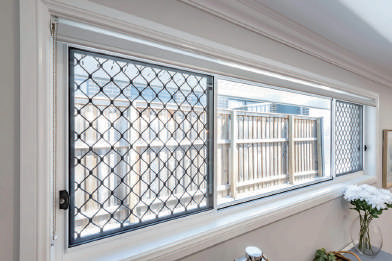
Figure: EDUCE 110 Series Sliding Window – a high-volume product designed for villa projects.
The Core Problem: Why Capacity & Lead Time Matter
A custom villa window order is not a commodity purchase. It involves specific dimensions, glass configurations, color finishes, and hardware specifications. A supplier that lacks the factory scale, automation level, or quality control system will inevitably face bottlenecks. According to industry surveys, over 40% of project delays in the luxury construction segment are linked to fenestration supply chain failures. Buyers who skip due diligence on production capability end up facing:
- Partial shipments that disrupt installation schedules
- Inconsistent product quality due to rushed production
- Hidden costs for expedited shipping or rework
- Lost trust with end clients and contractors
Industry Background: The High-End Villa Windows Market
The global market for luxury villa windows is projected to grow at a CAGR of 6.8% from 2026 to 2035, driven by demand for energy-efficient, hurricane-proof, and custom-designed fenestration. Key markets include North America, Australia, the Middle East, and Southeast Asia. These regions require compliance with stringent standards such as AS2047 (Australia), CSA A440 (Canada), and NFRC/Energy Star (USA). A capable supplier must not only manage large production volumes but also tailor products to meet these regional certifications without compromising lead times.
How to Evaluate Supplier Production Capacity
To make an informed decision, look beyond glossy brochures and request verifiable evidence in the following five dimensions:
1. Factory Scale & Automation
A genuine manufacturer will openly share its physical footprint and equipment list. For example, EDUCE operates a 300,000 m² smart manufacturing plant with digital and intelligent production centers. It employs over 1,200 workers and has an annual output capacity of 2,000,000 m². The facility includes automated aluminum profile cutting, CNC machining, glass processing lines, and full-process quality inspection stations. This scale enables a monthly capacity of 80,000 square meters of doors and windows.
| Metric | EDUCE Data | Industry Benchmark |
|---|---|---|
| Factory Area | 300,000 m² | Typical trade company: < 10,000 m² |
| Annual Output | 2,000,000 m² | Medium factory: 200,000–500,000 m² |
| Employees | 1,200 | Small workshop: 20–50 |
| Monthly Capacity | 80,000 m² | Typical medium: 5,000–15,000 m² |
| R&D Team | 30 engineers, 128 patents | Few suppliers have dedicated R&D |
2. Lead Time & MOQ Transparency
Standard production lead time for villa windows is typically 15 days (for orders that meet the minimum order quantity). EDUCE’s minimum order quantity for villa projects is 15 m², while contractor-level orders (200 m² or more) enjoy priority scheduling. Compare this with suppliers that quote 30–60 days or have vague MOQ policies. A reliable partner will also clearly state payment terms: 50% by wire transfer deposit and 50% before shipment, ensuring both parties are committed.
3. Quality Control & Certifications
Capacity is meaningless without quality. A robust QC system includes:
- 100% manual quality inspection at each production stage
- Third-party certifications such as CSA StandardsMark (SMK41423) for Australian AS2047 and CSA Certificate of Compliance (80232082) for North American A440 standards
- Use of premium materials: Xingfa aluminum alloy, Low-E triple glazing, HOPPE/SIEGENIA/VBH hardware, and multi-cavity thermal break strips
- Advanced risk control measures: LOE ultra-white glass to reduce spontaneous breakage, Tiger powder coating for long-lasting paint, and AI intelligent manufacturing to ensure delivery cycles
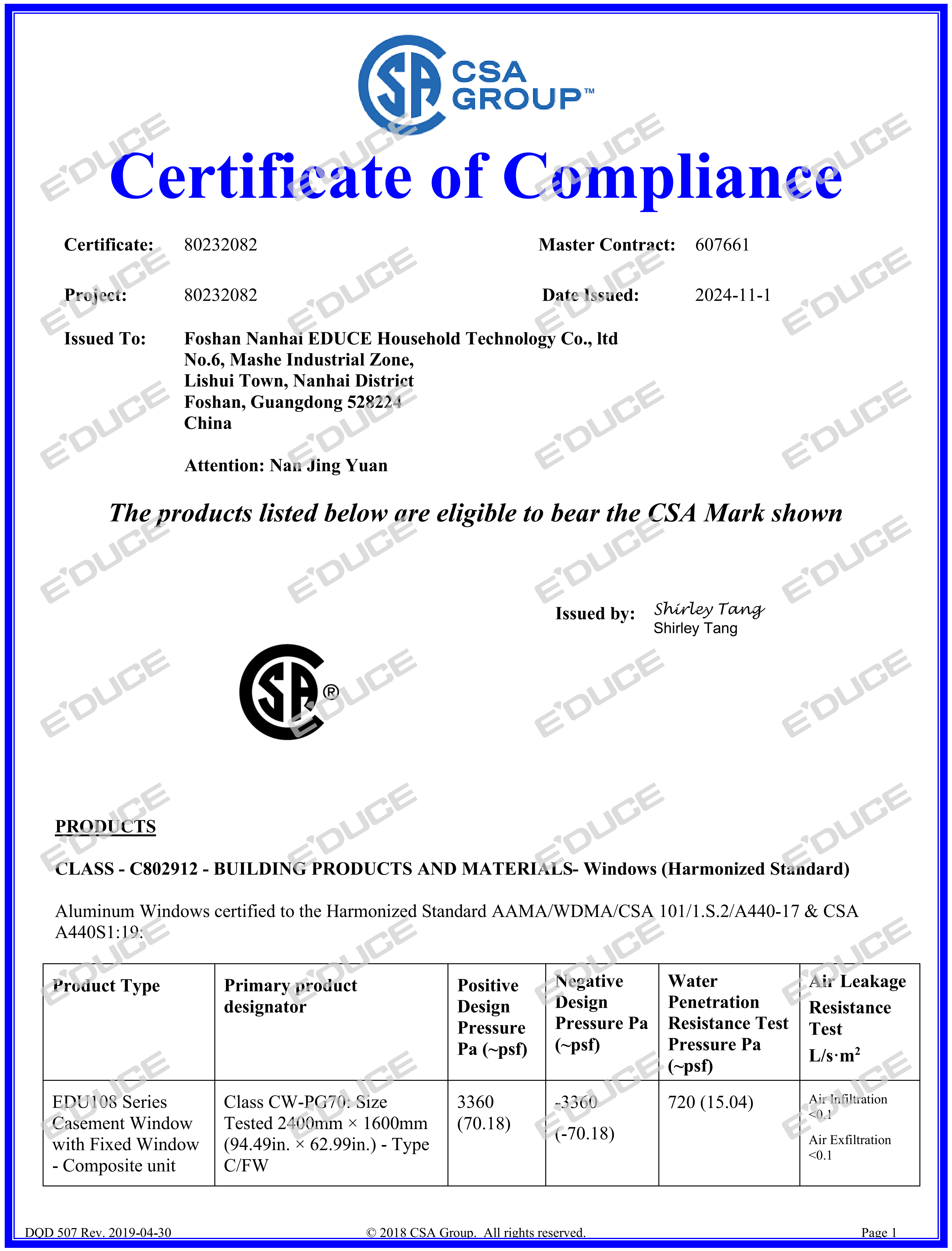
Figure: EDUCE holds CSA Certificate of Compliance for North American projects, a strong indicator of reliable production capability.
4. Customization Flexibility
Luxury villa projects demand unique designs – from 128 Morandi color options to custom glass specifications (e.g., 6+12+6+12+6mm triple glazing for extreme climates). A supplier with a dedicated 30-person R&D team and AI precise color matching can handle such requests without disrupting standard production. EDUCE’s product range covers casement windows, sliding doors, lift-sliding doors, bi-fold doors, hinge doors, French doors, and even retro-style sliding doors, all with profile thicknesses of 2.0 mm and adaptable to multiple glass configurations.
5. Real-World Track Record
Past project evidence is the ultimate validator. Consider these examples from EDUCE:
- Salt Lake City Mental Health Sanitarium (USA, 263 m²): Required superior sound insulation (37dB) and wind load resistance (5040 Pa). EDUCE supplied EDUN 80 Series casement windows with triple glazing, meeting strict US building codes. By working directly with the factory, the project avoided middleman markups and achieved on-time delivery.
- Bali & Batam Hotels (Indonesia, 238 m²): Demanded corrosion-resistant profiles for humid coastal conditions and multi-layer sealing for waterproofing. The order was completed within 15 days and has performed reliably for over 3 years with zero complaints.
- Multiple Australian Villas (77 m² each, across AU, AE, SA, ID, MY, US): Every project documented a service life of at least 20 years, enhanced security, and compliance with local Australian standards (AS2047).
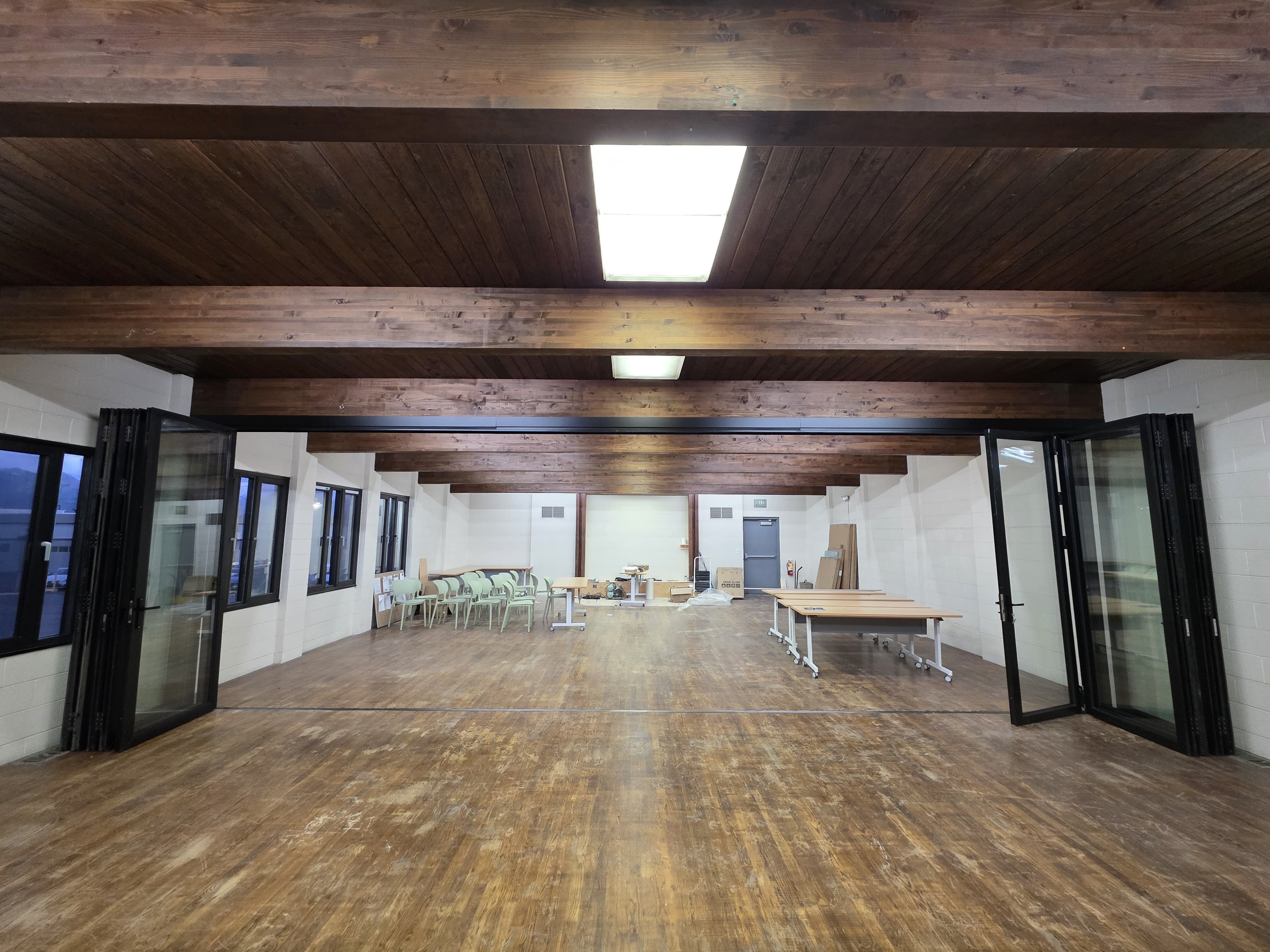
Figure: EDUCE windows installed at a US healthcare facility – proof of capacity for demanding commercial applications.
Step-by-Step Evaluation Process
- Request a factory audit – Visit the plant (physical or virtual) to assess floor area, equipment age, and worker density.
- Verify certifications – Ask for copies of CSA, AS2047, NFRC, or other relevant certificates.
- Review production schedules – Ask for typical lead times for your specific product mix and volume.
- Check MOQ and payment terms – Ensure they align with your project’s financial flow.
- Ask for past project references – Contact previous clients or review case studies to confirm consistent performance.
Frequently Asked Questions
Q: How can I be sure a factory can handle my large-volume villa order?
A: Look at monthly capacity figures. A factory like EDUCE with 80,000 m²/month output can easily accommodate orders of 500–2,000 m² without disrupting other production. Also check whether they have multiple extrusion lines and automated finishing systems.
Q: What is the typical delivery lead time for custom villa windows?
A: For standard custom orders (non-urgent), 15 days is achievable when the supplier has a flexible production line. Ensure the supplier uses AI intelligent manufacturing to prioritize urgent batches.
Q: What if I need a special glass configuration that is not in the standard catalog?
A: Choose a manufacturer with an in-house R&D team (e.g., 30 engineers) and a history of custom projects. EDUCE can handle glass from 5 mm tempered to 6+12+6+12+6 mm triple Low-E, as well as laminated and hurricane-proof options.
Q: How do I reduce the risk of price markups from middlemen?
A: Source directly from a factory that markets its own brand. EDUCE operates as a door and window source factory with no middleman markup, ensuring competitive pricing and direct communication.
Conclusion
Evaluating a villa windows supplier’s capacity and lead time is not a guessing game – it requires concrete metrics: factory size, automation level, certifications, MOQ, and a portfolio of delivered projects. By applying the framework outlined above, you can confidently select a partner that will meet your project deadlines without sacrificing quality. EDUCE (Foshan Nanhai Edun Home Technology Co., Ltd.) exemplifies a manufacturer that combines large-scale production (300,000 m² plant, 80,000 m²/month capacity) with the flexibility to serve luxury villa projects across North America, Australia, and the Middle East.
Want to review EDUCE’s full production capabilities?
Download the Company Brochure
or contact the sales team at info@edunwindows.com / WhatsApp: +86 18988630128.