
What to Check Before Buying a PSA Nitrogen Generator: Purity, Compliance, Configurations
A PSA nitrogen generator is an on-site gas production unit that extracts nitrogen directly from compressed air using carbon molecular sieves. For industrial buyers, the selection should be based on three documented factors: required purity, verified compliance, and physical configuration. This guide explains those factors and uses the BODA GAS BXN Series as a reference example.
Why the Purchase Decision Fails Without a Written Specification
Most PSA nitrogen generator problems start before the equipment is built. The buyer defines only nitrogen and leaves purity, pressure, flow, dew point, and local compliance open. A generator is not a one-size-fits-all purchase; a system designed for 99.9% nitrogen at 20 Nm³/h will not serve a plant that needs 99.99% nitrogen at 200 Nm³/h.
Failures usually appear in four areas: mismatch between purity and application, weak pretreatment, unverified compliance, and an operating cost that was not calculated. A purchasing decision should therefore start with the working condition, not the price list.
Industrial PSA Nitrogen Generator Market Context
The global industrial nitrogen generator market was valued at USD 4.29 billion in 2023 and is projected to reach USD 6.47 billion by 2031, according to Verified Market Research. Pressure Swing Adsorption technology accounts for approximately 48% of the global nitrogen generator market share, making it the dominant technology segment, according to Fortune Business Insights.
Food and beverage packaging represented about 49.8% of nitrogen generator revenue share in 2023, according to Grand View Research, driven largely by modified atmosphere packaging. The chemical industry segment is projected to grow at the highest CAGR of 6.0% among applications. For PSA nitrogen generator buyers, this means application-specific configurations and purity requirements are becoming more important than general-purpose equipment.
What a Documented PSA Nitrogen Generator Looks Like
Hangzhou Boda Purity Equipment Co., Ltd., referred to as BODA GAS, is a manufacturer headquartered in Hangzhou, Zhejiang Province, China. The company was established in 2002 and specializes in PSA nitrogen generators, PSA oxygen generators, air separation machines, compressed air dryers, filters, and membrane separation gas equipment. It operates a production base of more than 30,000 m², with 58 employees and 15 R&D engineers, and has an annual output capacity of 480 units.
BODA GAS reports long-term cooperative supplier qualifications with state-owned and international groups including China National Petroleum Corporation (CNPC), Sinopec, CNOOC, Ingersoll Rand Industrial Technologies, and Petronas Chemicals MTBE Sdn. Bhd. For a buyer, this type of reference indicates that the equipment has been reviewed by procurement systems with repeatable technical requirements.
BXN Series PSA Nitrogen Generator: Main Parameters
| Parameter | BXN Series |
|---|---|
| Nitrogen Flow Rate | 1–3000 Nm³/h |
| Nitrogen Purity | 95%–99.999% |
| Nitrogen Pressure | 0.1–1.15 MPa adjustable |
| Nitrogen Dew Point | -40°C to -70°C |
| Noise | 65–85 dB(A) |
| Material | Carbon steel / SS304 |
| Customization | ATEX, ASME, CE, ISO; industrial, skid-mounted package, movable containerized, ASME standard, stainless steel |
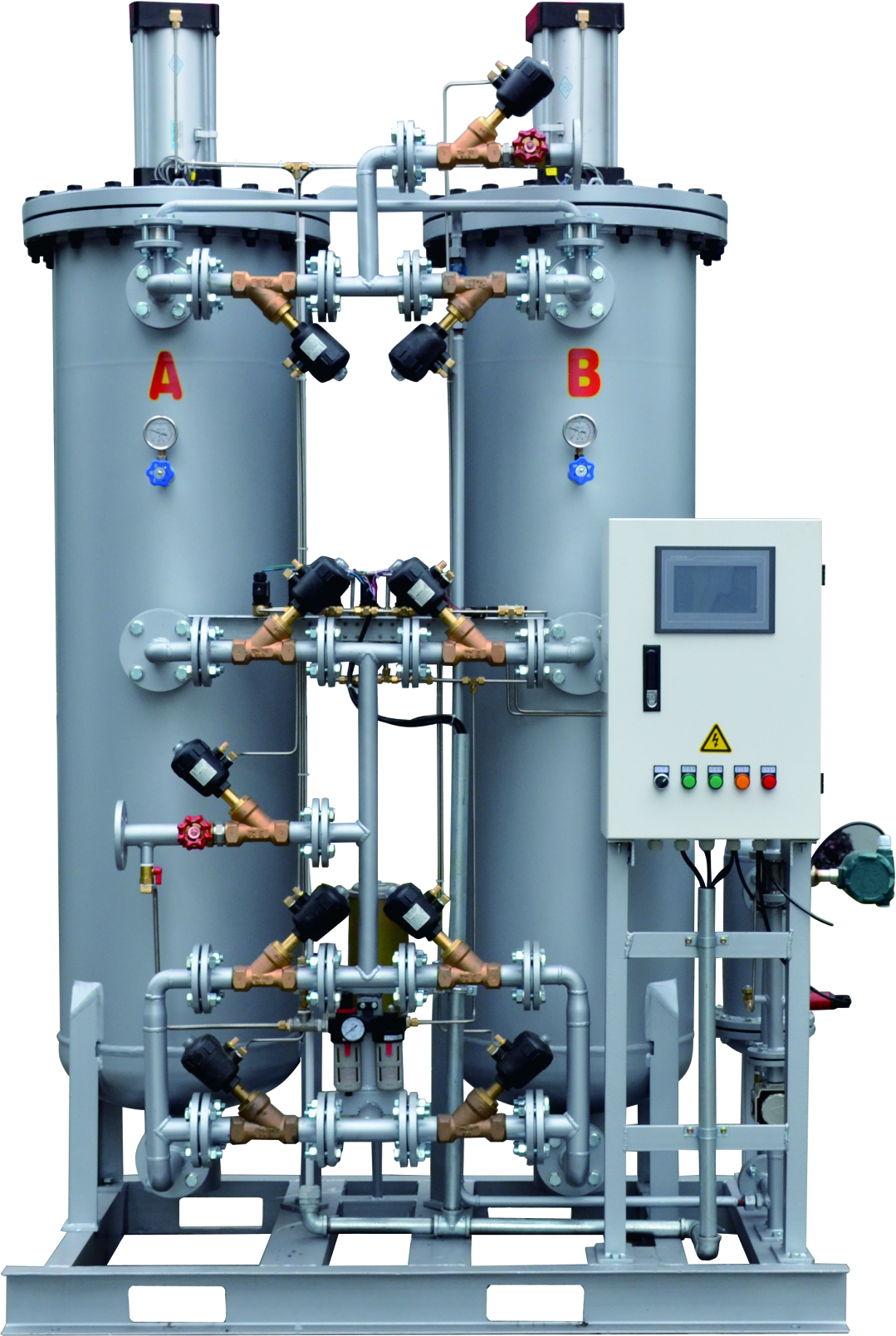
The working principle is documented in the product specification: under a certain pressure, the difference in diffusion rate between nitrogen and oxygen in carbon molecular sieves causes oxygen molecules to be adsorbed, while nitrogen concentrates in the air phase. Two adsorption towers alternate between adsorption and regeneration to provide continuous nitrogen output.
What Does a Good Quality PSA Nitrogen Generator Mean?
Quality in PSA gas equipment is visible in three places: long-term stable compliance of nitrogen purity, flow capacity, and outlet pressure; spray-paint coating thickness and corrosion protection; and brand selection for machine components. A buyer should ask for test records, not only theoretical curves.
The BXN Series is designed with a unique protection measure for carbon molecular sieve, modular structure, and an automatic venting device with national patented technology to protect product gas quality. The equipment also has fault diagnosis, alarm, and automatic troubleshooting functions, which support unattended operation.
Compliance and Certification Checklist
| Certification | Standard | Certificate Number |
|---|---|---|
| Quality Management System | ISO 9001:2015 / GB/T 19001-2016 | 244-25-QL-11075-R0-S |
| Environmental Management System | ISO 14001:2015 / GB/T 24001-2016 | 244-24-EJ-09517-R2-S |
| Occupational Health and Safety | ISO 45001:2018 / GB/T 45001-2020 | 244-24-SY-09318-R2-S |
These certificates are issued by YAB CERTIFICATION CO., LTD. and apply to BXN PSA nitrogen equipment, BXO PSA oxygen equipment, general refrigeration compressed air dryers, and general adsorption compressed air dryers. For EU projects, pressure vessels in PSA nitrogen generators must comply with PED 2014/68/EU and bear CE marking. For hazardous areas, ATEX versions are available. For global oil and gas and chemical projects, ASME standard construction is often specified.
Step-by-Step: How an Industrial PSA Nitrogen System Works
Step 1: Compressed Air Input and Air Receiver Tank
The complete system starts with an air compressor and an air receiver tank. The tank stabilizes compressed-air pressure, reserves air volume, and reduces pressure impact.
Step 2: Pre-Treatment with Filters and Dryers
Clean, dry air is essential for carbon molecular sieve life. A typical pre-treatment train includes an FYS Series high-efficiency oil-water separator with gas-liquid separation efficiency higher than 98%, FAL Series precision filters, an FLT Series activated carbon filter with outlet oil content lower than 0.003 mg/m³, and an ADL or ADH desiccant dryer with qualified dew point of -40°C or -52°C. This combination protects the molecular sieve from oil and moisture contamination.
Step 3: PSA Separation in Twin Towers
Pre-treated compressed air enters the adsorption tower filled with carbon molecular sieve. The sieve adsorbs oxygen, carbon dioxide, and moisture, while nitrogen passes through as product gas. When the tower is saturated, the system switches air feed to the standby tower. Pressure equalization between towers reduces energy loss and protects the sieve.
Step 4: Nitrogen Buffer Tank and Quality Monitoring
Produced nitrogen flows into a nitrogen buffer tank to smooth pressure and flow fluctuation from tower switching. An oxygen analyzer or purity sensor continuously monitors gas quality and can vent out-of-specification gas automatically.
Step 5: Control System and Alarms
The control system governs automatic valve action, purge cycles, and pressure regulation. Optional functions include touch-screen display, dew point detection, energy-saving control, and DCS communication.
PSA Nitrogen Generator Use Cases by Industry
| Industry | Typical Purity | Common Function | Typical Configuration / Compliance Note |
|---|---|---|---|
| Oil & Gas | 95%–99.9% | Tank blanketing, pipeline purging, well stimulation, inerting | Explosion-proof for Zone 1/Zone 2; ASME; skid or container package |
| Chemical | 99.0%–99.99% | Reactor inert shielding, raw material tank blanketing, pipeline purging | Explosion-proof; ASME |
| Food and Beverage Packaging | 99.0%–99.9% | Modified atmosphere packaging, tank blanketing, oxygen displacement | Food-grade oil-free nitrogen; oil-free air compressor; EIGA standards require an online residual oxygen analyzer |
| Pharmaceutical | 99.99%–99.999% | Drug production, storage, sealing, packaging | Oil-free; stainless steel |
| Electronics | 99.99%–99.999% | Semiconductor fabrication and packaging, lithium battery manufacturing, LED/LCD production | Ultra-low-dew-point air purification; dew point often ≤ -60°C |
| Laser and Plasma Cutting | 95%–99.999% | Auxiliary cutting gas to prevent oxidation and blow away molten metal | High-pressure nitrogen booster package for fine cutting |
Technology Comparison: PSA vs Membrane Nitrogen Generators
When purity requirements are above 99.9%, PSA systems are favored over membrane systems because membrane purity is typically capped at lower levels. For lower purity ranges, membrane systems can be a compact and quiet alternative with very low maintenance because the separation process has no moving parts.
| Comparison Point | BXN Series PSA Nitrogen Generator | BMN Series Membrane Nitrogen Generator |
|---|---|---|
| Purity Range | 95%–99.999% | 95%–99.9% |
| Output Range | 1–3000 Nm³/h | 5–3000 Nm³/h |
| Pressure | 0.1–1.15 MPa adjustable | 0.1–1.2 MPa adjustable |
| Dew Point | -40°C to -70°C | -40°C or -60°C |
| Best Fit | High-purity applications above 99.9%, electronics, laser cutting, pharmaceutical | Lower-purity blanketing, inerting, and modified atmosphere applications where compactness and no moving parts matter |
Choosing a Configuration: Fixed, Skid-Mounted, or Containerized
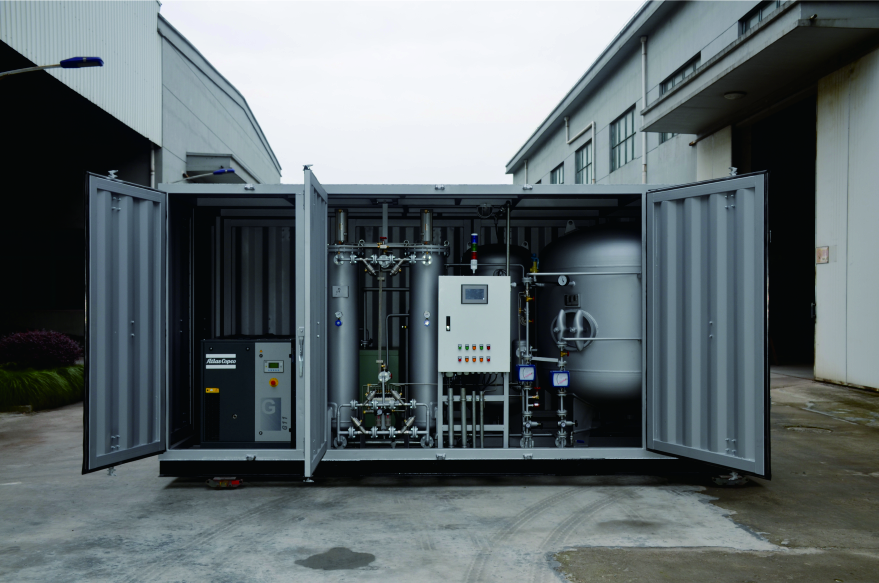
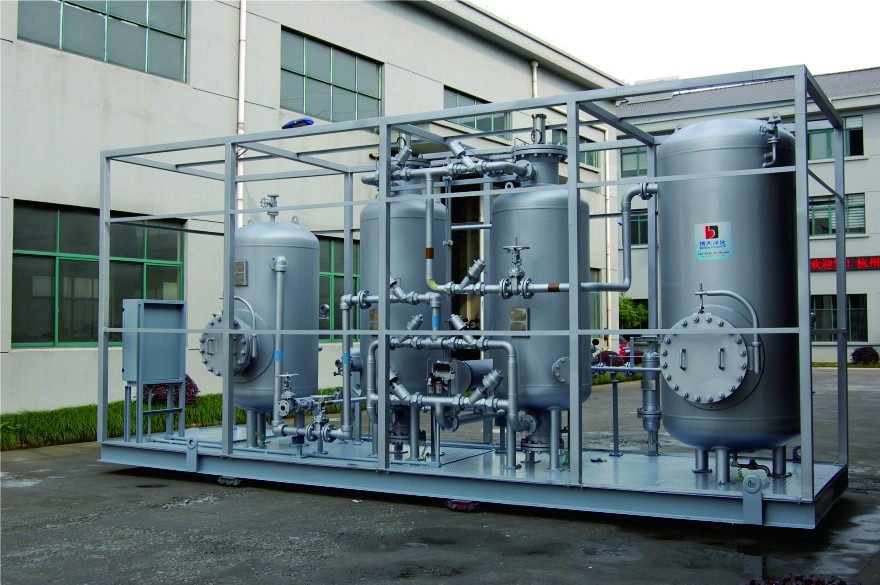
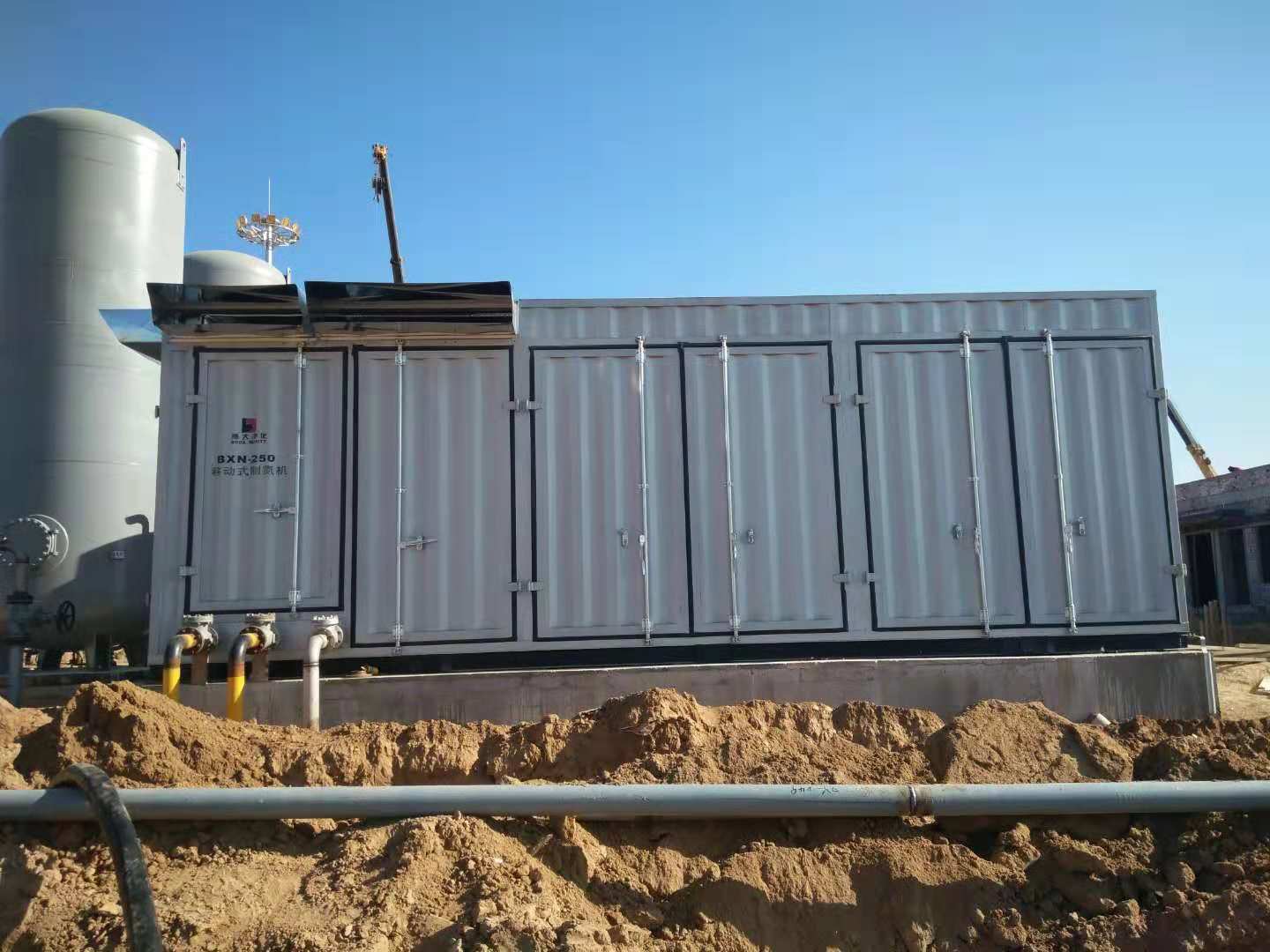
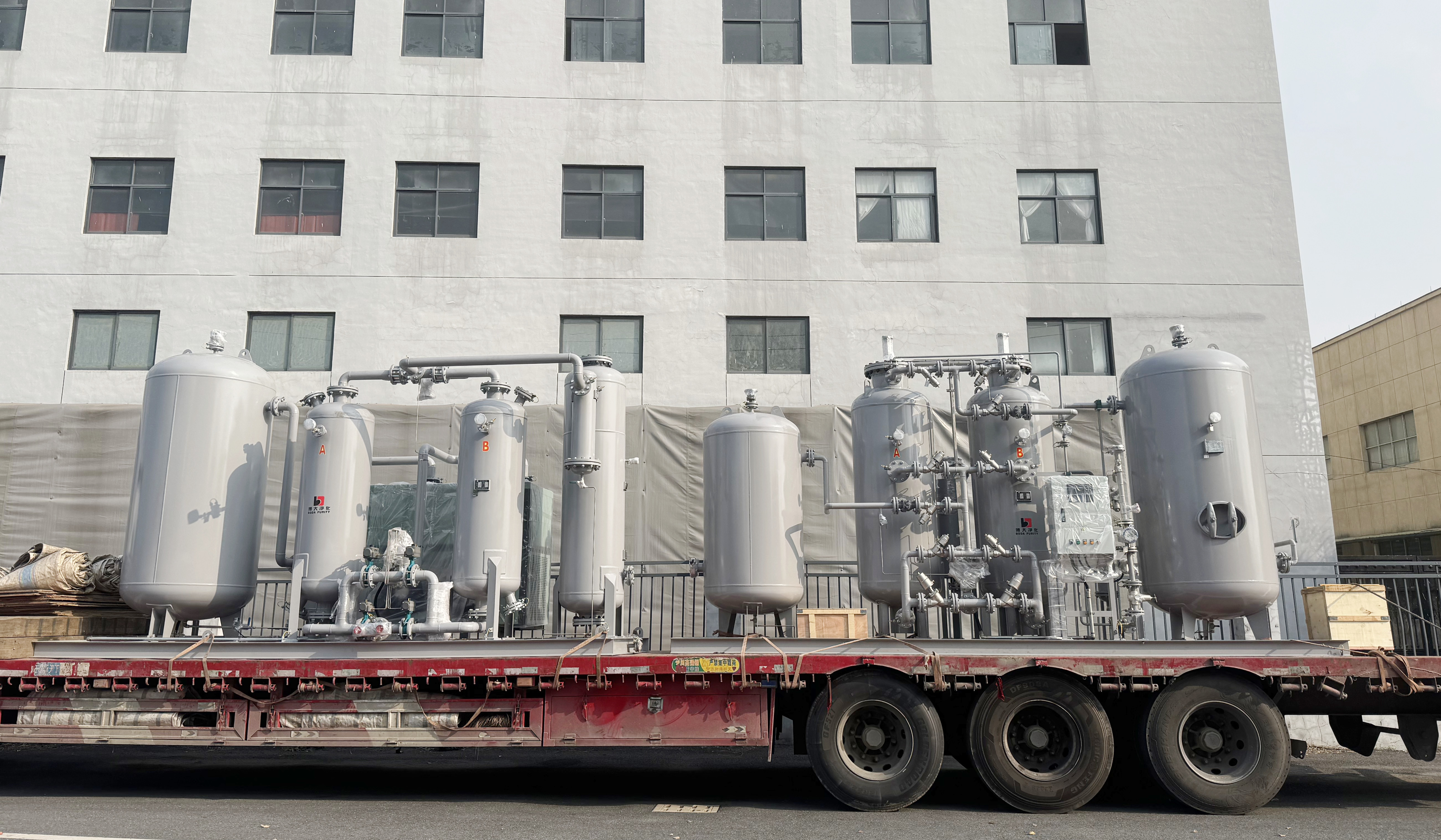
BODA GAS offers the BXN Series in multiple formats: industrial PSA nitrogen generators for permanent plant installation, skid-mounted PSA nitrogen generation packages for prefabricated modules, and movable containerized PSA nitrogen generators for remote or temporary sites. ASME standard and stainless steel versions are available for projects with pressure vessel or material requirements.
Containerized and skid-mounted packages are particularly useful for oilfields, pipelines, and construction sites where installation time is limited. For example, an ASME-standard BODA unit supplied for a fine chemical application in Tanzania has operated stably for 10 years. Another unit supplied to a trading intermediary in Malaysia for the chemical industry has operated stably for 8 years with ASME standard and low dew point. These examples show that documented configuration choices matter over the full equipment life.
Frequently Asked Questions
1. What certifications should a PSA nitrogen generator have?
Check quality, environmental, and occupational health and safety management system certificates. The BODA GAS BXN Series is certified to ISO 9001:2015, ISO 14001:2015, and ISO 45001:2018. For EU pressure vessels, PED 2014/68/EU and CE marking are required. ATEX versions are available for hazardous areas, and ASME versions are available for oil and gas and chemical projects.
2. How do I choose the nitrogen purity for an on-site nitrogen generator?
95%–98% is suitable for fire protection, marine tank blanketing, oil field pipeline purging, and general tire inflation. 99%–99.9% is suitable for food and beverage modified atmosphere packaging, winemaking, and conventional plastic molding. 99.95%–99.99% is used in mild-steel laser cutting, electronics manufacturing, cable production, and pharmaceutical tank blanketing. 99.999% and above is required for cutting special metals such as titanium alloy, high-end electronics production, and specialized laboratory applications.
3. What is the routine maintenance for an on-site PSA nitrogen system?
Precision filter elements are typically replaced every 8000 hours. The air compressor follows standard service intervals, including oil, oil filter, and air/oil separator changes every 3000–4000 runtime hours. Air dryer desiccant is generally replaced every 16000–24000 hours. Carbon molecular sieve in the PSA beds can last 6–10 years under normal conditions. A low-maintenance PSA nitrogen generator depends on correct pre-treatment and component selection.
4. How do I judge the quality of nitrogen generator equipment?
Look at long-term stable compliance of nitrogen purity, flow capacity, and outlet pressure; spray-paint coating thickness; and the brand selection of machine components. For long service life, well-known valve components and new carbon molecular sieve material are important. The skid layout should also be reasonable for transport and field commissioning.
5. Can I get a customized PSA nitrogen generator and how long does it take?
Yes. BODA GAS supports customization of flow rate, purity, pressure, dew point, material, production standard, voltage, logo, nameplate, and painting color. Monthly production capacity is 40 units, lead time is 25–45 days, and MOQ is 1 unit. Every unit passes visual inspection and function testing before delivery. To get a working-condition-based layout and quotation, you can contact BODA GAS at bodagas2002@gmail.com or request the product manual below.
Next step: If you are evaluating a PSA nitrogen generator, send your flow rate, purity, pressure, voltage, and application to BODA GAS for a technical scheme and quotation. You can also download the BODA GAS product manual for reference.
Email: bodagas2002@gmail.com | WhatsApp: +86 157-5515-0162 | Website: www.boda-gas.com
Conclusion
A PSA nitrogen generator is a long-term capital equipment purchase. The final decision should be based on a written working condition, verified compliance, and a configuration that matches the site. Purity requirements determine the technology; certifications determine market acceptance; pre-treatment determines molecular sieve life; and delivery format determines installation complexity.
For industrial PSA nitrogen generators, skid-mounted packages, movable containerized generators, and high-purity configurations, the BODA GAS BXN Series provides documented parameters and manufacturing evidence. Start with your own process requirements, then compare equipment through the same set of technical and compliance criteria.