The Ultimate Buyer’s Guide to Fiberglass Fabric for Marine, Wind Energy, and Industrial Applications
The Ultimate Buyer’s Guide to Fiberglass Fabric: How to Choose the Right Reinforcement for Your Composite Project
Selecting the correct fiberglass fabric is one of the most critical decisions in composite manufacturing. With numerous weaves, weights, and fiber architectures available, buyers often face confusion choosing the right reinforcement for boat hulls, wind blades, UAV structures, or industrial panels. This guide provides a systematic framework to evaluate fiberglass fabric options, compare performance characteristics, and identify a reliable supplier.
Problem Definition: Why Choosing the Wrong Fiberglass Fabric Costs Time and Money
Many composite manufacturers experience delamination, resin-rich areas, or premature failure because they selected a fabric that does not match the process (e.g., using woven roving for vacuum infusion instead of non-crimp fabric) or whose weight is too heavy for the laminate design. According to industry feedback, improper material selection can increase scrap rates by up to 15% and extend production lead times. The core challenge is aligning fabric properties—such as fiber orientation, areal weight, and wet-out characteristics—with the project’s structural requirements and manufacturing method.
Industry Background: Fiberglass Fabric Across Key Sectors
Fiberglass fabrics serve as the backbone of lightweight composite structures. Guangdong Cinon New Material Technology Co., Ltd. (CINON), established in 2022, specializes in fiberglass reinforcements and lightweight core materials for marine, transportation, wind energy, industrial, and aerospace composite applications. The company’s 40,000 m² facility produces annual capacity of 1,200,000 m², with a dedicated R&D team of 25 engineers. Key industries using fiberglass fabric include:
- Marine & Yacht Building: Hulls, decks, bulkheads – requiring low water absorption and corrosion resistance.
- Wind Energy: Turbine blades, nacelle structures – demanding fatigue resistance and high strength-to-weight ratio.
- Transportation: Truck bodies, bus panels, rail interiors – needing impact resistance and weight reduction.
- Aerospace & UAV: Wings, fuselages – requiring ultra-lightweight and high stiffness.
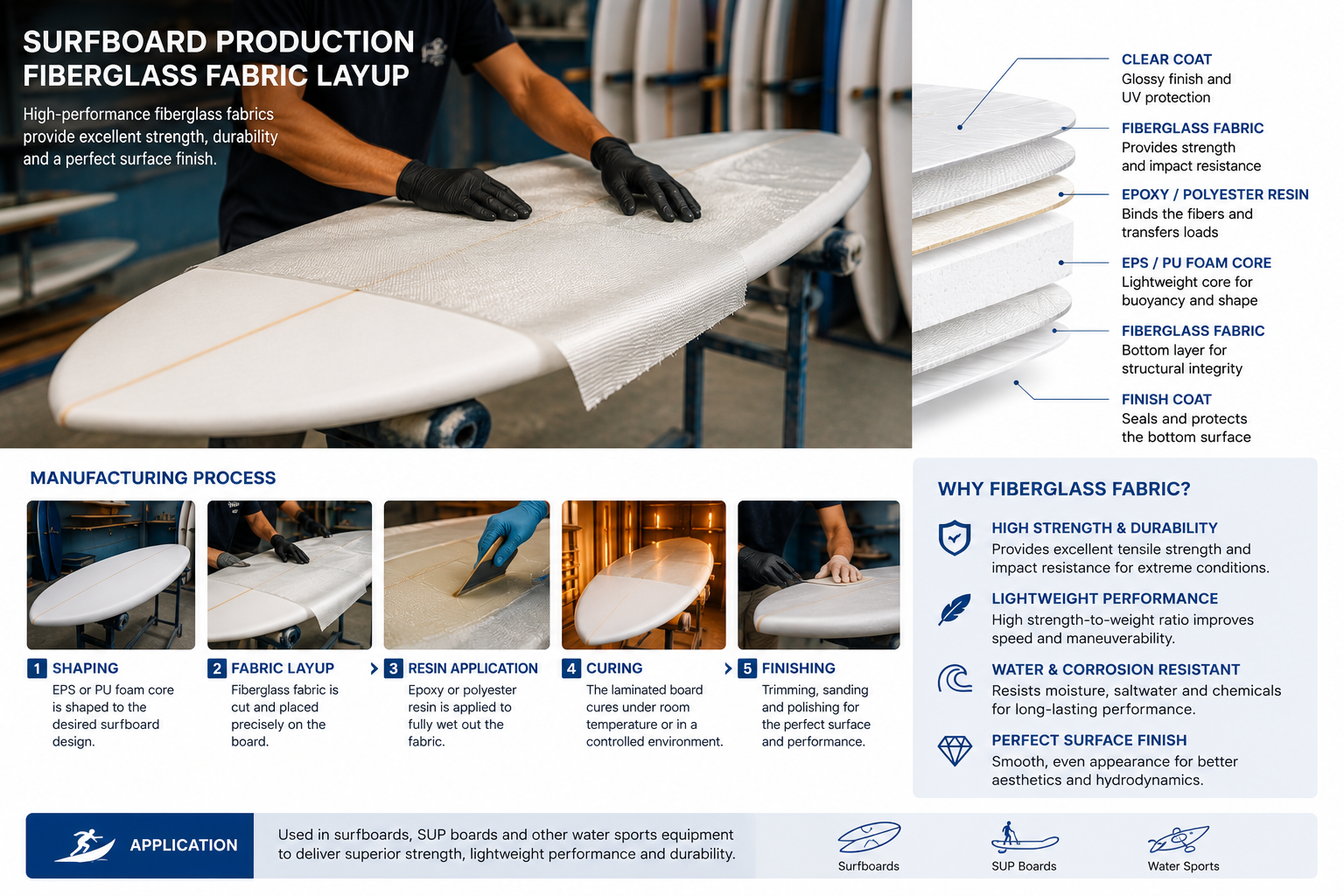
- Sports & Leisure: Surfboards, kayaks, paddle boards – prioritizing weight reduction and flex memory.
- Industrial Composites: FRP panels, machine enclosures – needing corrosion resistance and structural performance.
- Composite Tooling: RTM molds – requiring dimensional stability and thermal cycling resistance.
Detailed Solution: Understanding Fiberglass Fabric Types
Fiberglass fabrics fall into two primary categories based on weave architecture:
1. Woven Fiberglass Fabric (Plain Weave)
CINON’s Light Weight Fiberglass Cloth is a plain woven E-glass fabric available in weights from 25 to 400 g/m² and widths of 1000 mm or 1010 mm. It offers excellent conformability and smooth surface finish, making it ideal for:
- Surfboard manufacturing
- UAV and drone structures
- Composite tooling
- Sporting goods
- Lightweight industrial laminates
2. Multiaxial Non-Crimp Fabric (NCF)
CINON’s Multiaxial Fiberglass Fabrics are structural reinforcements made of alkali-free glass fiber, available in unidirectional, biaxial (0°/90° or ±45°), triaxial, and quadriaxial orientations. Weight ranges from 400 to 1500 g/m², with moisture content <0.2% and combustible matter 2.0%–8.0%. These fabrics provide straighter fiber alignment and higher structural efficiency than woven rovings, with up to 20–30% higher laminate performance. They are best suited for:
- Wind turbine blade shells
- Yacht hulls and decks
- Automotive structural components
- Large containers
Step-by-Step Selection Process
- Define the application and operating conditions: Saltwater? High temperature? Dynamic loads? Static loads?
- Identify critical mechanical requirements: Strength, stiffness, impact resistance, fatigue life.
- Choose fabric architecture: For vacuum infusion with complex curves, plain weave or biaxial NCF; for high-strength structural components, biaxial/triaxial NCF.
- Select areal weight: 25–400 g/m² for surfacing layers, 400–1500 g/m² for primary laminates.
- Verify process compatibility: Does the fabric allow good resin flow in vacuum infusion or RTM? CINON’s multiaxial fabrics are optimized for vacuum, hand layup, RTM, and VARTM.
- Evaluate supplier credentials: Check certifications (ISO 9001, ISO 14001, ISO 45001), production capacity, technical support, and export experience.
- Request samples and technical data: CINON provides pre-shipment testing, quality test reports, and first-piece inspection before mass production.
Use Cases: Real-World Applications of Fiberglass Fabric
| Industry | Client Country | Application | Result |
|---|---|---|---|
| Marine & Yacht | Australia | Boat hull materials | Smooth surface, easy wet-out, better finish |
| UAV Manufacturing | Germany | UAV structures | Ultra-lightweight, high stiffness |
| Transportation Panel | Mexico | Truck body panels | Lightweighting, improved corrosion resistance |
| RV Manufacturing | United States | FRP panels | Low weight, anti-UV performance, uniform thickness |
| Sports Equipment | Thailand | Surfboards | Weight reduction, performance improvement |
FAQ: Common Buyer Questions About Fiberglass Fabric
Q: What is the difference between fiberglass fabric and carbon fiber?
A: Fiberglass offers 3–5x lower material cost and better impact resistance, while carbon fiber provides 2–4x higher stiffness. For marine, industrial, and construction applications, fiberglass is more cost-effective. Carbon fiber is preferred for aerospace and high-performance racing structures.
Q: How do I select fiberglass fabric for vacuum infusion?
A: Choose non-crimp multiaxial fabrics (e.g., biaxial or triaxial) with good resin flow channels. CINON’s multiaxial fabrics have optimized fiber architecture for excellent wet-out under vacuum. Light weight plain weave fabrics (25–200 g/m²) work well for surface layers.
Q: Which fiberglass fabric is best for boat hulls?
A: Biaxial (0°/90° or ±45°) multiaxial fabrics are commonly used for hull skins, providing high strength and stiffness. Core mat and PET foam cores are used in sandwich constructions for weight reduction. CINON supplies complete material kits for marine builders.
Q: How can I verify fiberglass fabric quality?
A: Request a quality test report including density, weight per square meter, fiber orientation, and tensile strength. CINON performs 100% inspection before shipment and provides batch performance verification reports.
Q: What certifications should a fiberglass fabric supplier have?
A: Look for ISO 9001:2015 (quality management), ISO 14001:2015 (environmental), and ISO 45001:2018 (occupational health). CINON holds all three certifications, ensuring consistent quality and responsible manufacturing.
How to Choose a Fiberglass Fabric Supplier
When evaluating suppliers, consider these criteria:
- Product range: Does the supplier offer both woven and multiaxial fabrics covering a wide weight range?
- Technical support: CINON provides engineering support from material selection to process optimization, helping customers avoid incorrect material selection.
- Quality control: Pre-shipment tests, dimensional inspection, and batch verification. CINON uses 100% on-line inspection for all dimensions.
- Export experience: 100% export ratio with main markets in Europe, North America, and Asia-Pacific. Reinforced packaging and FOB/CIF delivery options.
- Lead time & MOQ: CINON offers 15–30 days lead time with MOQ of 1000 m². Small trial orders (e.g., 100 m²) are available upon request.
Conclusion
Choosing the right fiberglass fabric directly impacts your composite product’s performance, cost, and production efficiency. By understanding the differences between woven and non-crimp fabrics, matching fabric architecture to your process, and partnering with a certified supplier like Guangdong Cinon New Material Technology Co., Ltd., you can build stronger, lighter, and more durable composite structures. For personalized support, contact CINON’s technical team.
Contact Information
Name: Waylon
Email: waylon@cinoncomposites.com
Phone: +86 186-2098-8848
WhatsApp: +86 135-8036-3674
Website: https://cinoncomposites.com/
Address: Building 3, No.1, viheng Lane, jinnan Second Street, Dachongkou Village, shawan Street, Panyu District, Guangzhou, China
Download CINON’s complete product catalog: Cinon Composites Catalog (PDF)