How to Choose the Right Functional Yarn: A Buyer’s Decision Framework for Photochromic, Thermochromic, Reflective, and Luminous Yarn
How to Choose the Right Functional Yarn: A Buyer’s Decision Framework for Photochromic, Thermochromic, Reflective, and Luminous Yarn
Functional yarns are transforming the textile industry by enabling smart, interactive, and performance-driven fabrics. But for procurement professionals and brand owners, selecting among Photochromic Yarn, Thermochromic Yarn, Reflective Yarn, and Luminous Yarn can be overwhelming. This practical guide breaks down the key differences, provides a step-by-step selection process, and shares real-world case studies to help you make an informed decision.
1. Problem Definition: The Challenge of Functional Yarn Selection
When sourcing functional yarn, buyers often face a “technology dilemma”: which type of smart yarn delivers the best visual or performance effect for their specific product? Common mistakes include choosing a yarn that requires electricity when a passive effect would suffice, or selecting a color-change yarn with an inappropriate activation temperature for the end use. The core problem is mapping functional yarn capabilities to real-world application requirements—a process that demands technical clarity, certification awareness, and supplier reliability.
2. Industry Background: The Rise of High-tech Functional Yarn
The global smart textiles market is projected to exceed $10 billion by 2030, with functional yarns like UV color-changing (photochromic), heat-reactive (thermochromic), reflective, and luminous materials driving innovation in fashion, sportswear, outdoor gear, children’s apparel, and safety wear. According to data from the MONALISHAMAGIC R&D team (Dongguan Yuexiong Textile Co., Ltd.), demand for these yarns has grown over 40% year-over-year since 2024, especially among brands seeking instant product differentiation without electronic components.
Importantly, color-changing yarns require no electricity, battery, heating device, or electronic component—the effect is activated naturally by sunlight, UV light, or heat exposure, making them inherently safe and easy to integrate into conventional knitting and weaving processes.
3. Detailed Solution: Compare the Four Core Functional Yarn Types
Below is a comprehensive comparison table that clarifies the functional trigger, visible effect, typical applications, and key advantages of each yarn category.
| Yarn Type | Functional Trigger | Visual Effect | Best Applications |
|---|---|---|---|
| Photochromic Yarn | Sunlight / UV exposure | Color changes from indoor shade to outdoor vibrant color (e.g., white → pink, beige → purple) | Outdoor fashion, children’s apparel, wedding dress decoration, festival wear, UV-reactive accessories |
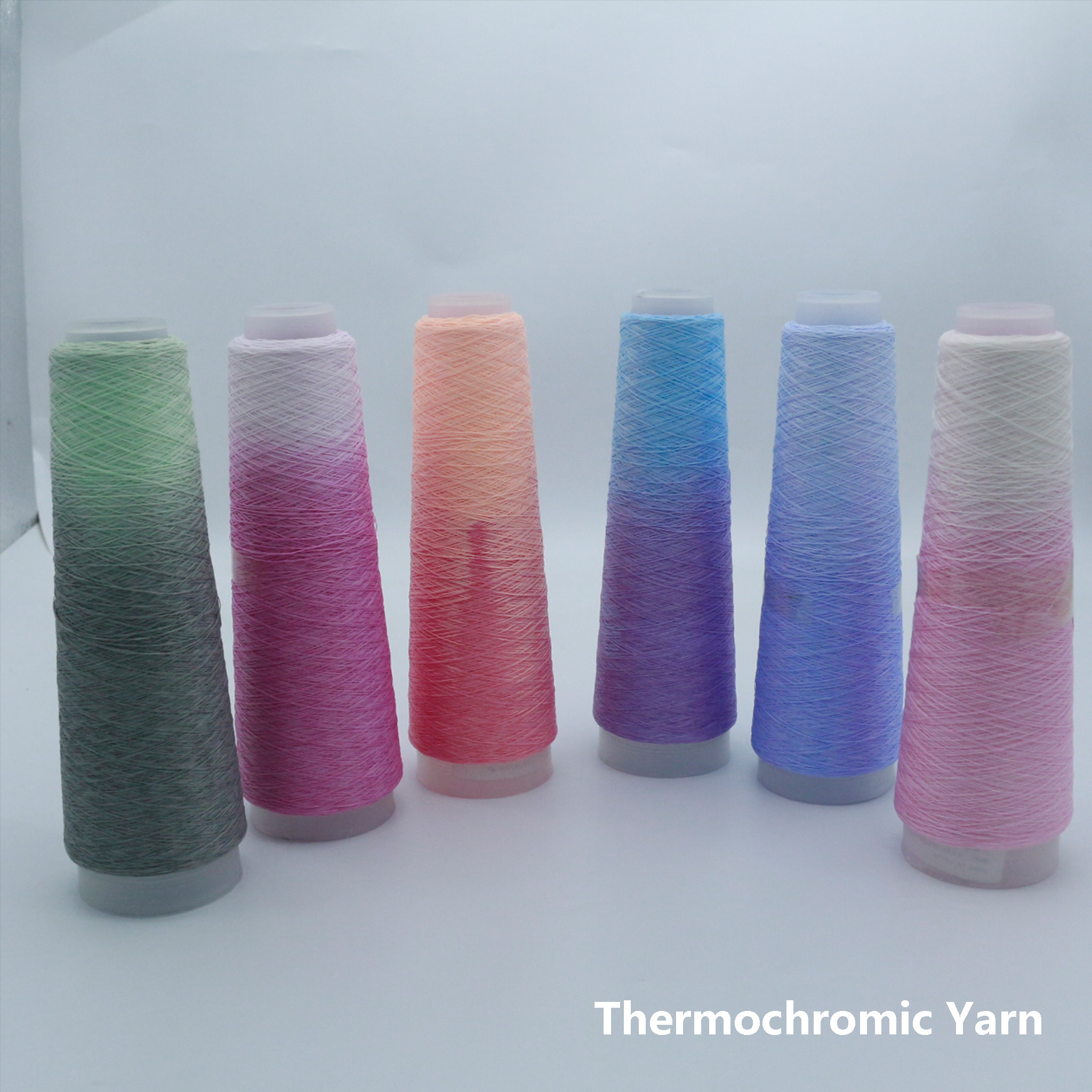
| Thermochromic Yarn | Temperature / body heat / warm touch | Color shifts at a target temperature (e.g., black → white, purple → pink) – reversible | Interactive fashion, heat-reactive knitwear, intimate apparel, sportswear, thermal wear |
| Reflective Yarn | Direct light (car headlights, flashlights, outdoor illumination) | Retroreflective glow – high visibility at night | Safety apparel, cycling/running wear, uniforms, pet leashes, children’s outerwear |
| Luminous Yarn (Glow-in-the-Dark) | Absorption of light (sunlight / artificial light) then emits glow in darkness | Long-afterglow in green, blue, or aqua; recharges repeatedly without electricity | Creative textiles, festival apparel, Halloween costumes, safety decorations, toys |
- Photochromic yarn provides 100% visible color change under UV exposure, with a yarn count range from 0.5/1NM to 200/2NM, and supports multi-material customization (e.g., cotton, linen, wool, Tencel, polyester).
- Thermochromic yarn can be customized with activation temperatures ranging from 15°C to 50°C, making it suitable for both cooler climates and direct body contact.
- Reflective yarn is available in recycled polyester options (GRS certified) and can be integrated directly into knitting, weaving, or embroidery without special equipment.
- Luminous yarn uses photoluminescent pigments that are REACH compliant and free from radioactive substances; afterglow duration can exceed 8 hours after sufficient charging.
4. Step-by-Step Selection Guide
Follow this 6-step process to identify the optimal functional yarn for your project:
Step 1: Define the End‑Use Environment
Ask: Will the garment be worn primarily indoors or outdoors? If the product needs to change color under sunlight, photochromic yarn is ideal. For a product that responds to body temperature (e.g., an intimate apparel piece that shifts color with warmth), thermochromic yarn is the right choice. For night visibility, choose reflective or luminous yarn depending on whether a light source is available to charge the material.
Step 2: Evaluate Functional Trigger & Durability
All four categories are passive (no batteries or electronics). However, check the specific performance: photochromic yarn may fade under prolonged intense UV; thermochromic yarn’s response speed depends on the ambient temperature difference; reflective yarn’s brightness varies by construction; luminous yarn requires periodic recharging. At MONALISHAMAGIC, we offer UV-stabilized photochromic and temperature-resistant thermochromic formulations to ensure durability.
Step 3: Select Base Material & Yarn Count
All functional effects can be applied to a wide range of base fibers: cotton, linen, cashmere, wool, Tencel, silk, paper yarn, and synthetic blends. Yarn count options range from 0.5/1NM (bulky) to 200/2NM (fine). For example, a lightweight summer scarf might use a 2/48NM cotton‑thermochromic blend, while a winter hat could use a 1/7NM acrylic‑luminous yarn.
Step 4: Verify Certifications & Compliance
Ensure the yarn meets your target market’s standards. Dongguan Yuexiong Textile Co., Ltd. (brand MONALISHAMAGIC) holds multiple certifications including GRS (Global Recycled Standard), BCI (Better Cotton Initiative), OEKO-TEX, FSC Chain of Custody for paper yarns, and RAF (Responsible Animal Fiber) for wool/cashmere. The company also has an Invention Patent (ZL 2023 1 1305729.5) for waterless dyeing of color-changing yarns, ensuring eco-friendly production.
Step 5: Request Samples & Small‑Batch Trials
Reliable suppliers offer sample support from 5 kg MOQ. Test the yarn under realistic conditions: expose photochromic samples to actual sunlight, heat thermochromic samples with a hair dryer, and check reflective brightness in a dark room with a flashlight. MONALISHAMAGIC provides free hand‑feel and function test samples for qualified buyers.
Step 6: Evaluate Supplier R&D & Lead Time
Choose a manufacturer with in‑house R&D capabilities. Dongguan Yuexiong Textile employs 20 engineers and has a monthly production capacity of 1,000 tons, with typical lead times of 7–15 days. Their flexibility in color, count, and functional customization is critical for brands needing rapid iteration.
5. Real‑World Use Cases
Case 1: High‑end Sensual Lingerie Brand (Thermochromic)
Client type: High‑end sensual lingerie brand
Application: Integrating thermochromic yarn into intimate apparel to achieve body‑temperature‑responsive color changes.
Result: Colors shift instantly with body temperature, creating a viral “magic” effect that generated massive market premiums.
Highlight: Patented thermochromic yarn with fast response, skin‑safe formulation, and durable color change after repeated washes.
Case 2: Outdoor Apparel Brand (Far‑infrared Heating Yarn)
Client type: Outdoor apparel brand
Application: Developing active heating system yarns for thermal clothing in extreme cold environments.
Result: The yarn performs excellently in −20°C environments, providing active heating while maintaining high tenacity and wash durability.
Highlight: Custom‑developed heating yarn with stable performance at −20°C, combining efficient heating with high strength and washability.
6. Frequently Asked Questions (FAQ)
Q: Do photochromic and thermochromic yarns require any electronic components to work?
A: No. These yarns are purely passive. Color-changing yarns require no electricity, battery, heating device, or electronic component—the color change is activated naturally by sunlight, UV light, or heat exposure. This makes them safe, lightweight, and easy to integrate into standard textile production lines.
Q: What is the minimum order quantity (MOQ) for functional yarn?
A: At MONALISHAMAGIC (Dongguan Yuexiong Textile), the MOQ is as low as 5 kg for sample development. Bulk orders can be scaled up with a typical lead time of 7–15 days. This flexibility is ideal for designer collections and brand pilot runs.
Q: Can reflective yarn be used for knitting, or is it only for sewing/embroidery?
A: Reflective yarn is available as a knitting yarn (e.g., 2/30D, 2/70D) and can be directly knitted on standard circular or flat knitting machines. It produces a durable retroreflective effect suitable for sweaters, hats, gloves, and even pet accessories.
Q: How can I verify the quality of functional yarn before bulk production?
A: Request free samples for hand feel and functional testing. Reliable suppliers provide pre‑shipment inspection and can arrange third‑party testing (e.g., SGS, Intertek, OEKO‑TEX). For example, MONALISHAMAGIC holds Intertek test reports for photochromic yarn (GZHT91138296) and thermochromic yarn (GZHT91138300) under the Adidas A‑01 policy, as well as EU standard antibacterial testing (EN 17134‑2:2023).
7. Conclusion
Selecting the right functional yarn is a strategic decision that impacts product performance, brand perception, and market success. By systematically evaluating the application environment, required functional trigger, base material, certifications, and supplier capabilities, procurement teams can avoid costly mistakes and accelerate time‑to‑market.
For brands and manufacturers seeking a trusted partner, Dongguan Yuexiong Textile Co., Ltd. (MONALISHAMAGIC) offers a vertically integrated solution: from R&D of patented photochromic, thermochromic, reflective, and luminous yarns to full OEM/ODM services with global certifications (GRS, BCI, OEKO‑TEX, FSC, RAF). With a 2,000 sqm factory, 20‑engineer R&D team, and 1,000‑ton monthly capacity, they empower your smart textile innovation.
Download Company Brochure (PDF)
Want to discuss your specific functional yarn requirements? Contact Alan Li at alanli@monalishamagic.blmgeo.cloud or WhatsApp +86 137-1023-8299.