
Stainless Steel Pipe Certifications: A Buyer's Guide to Compliance & Quality
Stainless Steel Pipe Certifications: A Buyer's Guide to Ensuring Compliance and Product Quality
In the global stainless steel pipe market, compliance with international standards is not optional—it is a contractual and safety requirement. For procurement managers, engineers, and distributors, understanding which certifications are essential—and how to verify them—can mean the difference between a successful project and costly liability. This guide explains the key certifications for stainless steel pipes, why they matter, and how to select a supplier that delivers certified, traceable products. We use Foshan Nanhai Sanon Metal Product Co., Ltd. (Sanon) as a practical example of a compliant manufacturer.
The Compliance Challenge in Stainless Steel Pipe Procurement
Industrial buyers face a common paradox: the market is flooded with low-cost stainless steel pipes, yet hidden defects in material composition, surface finish, or dimensional tolerances can lead to project failures. Without proper certifications, a pipe may lack traceability or fail to meet environmental or safety regulations. The core problem is how to verify that a stainless steel pipe supplier meets international standards without an expensive audit.
Key question: What certifications should a reliable stainless steel pipe supplier hold? How do these certifications ensure product quality and compliance?
Industry Background: Why Certifications Drive Procurement Decisions
Global trade in stainless steel pipes is governed by several regulatory frameworks. The European Union requires CE marking for construction products, while ISO standards are widely accepted for quality management. In recent years, environmental and occupational health certifications have become differentiators. Buyers in architecture, handrail systems, glass fittings, and industrial piping increasingly demand evidence of compliance. Sanon, a high-tech enterprise with 20 years of experience, holds multiple certifications that serve as a benchmark for serious suppliers.
Detailed Solution: The Essential Certifications for Stainless Steel Pipes
A compliant stainless steel pipe supplier should typically possess at least the following certifications. We explain each one and its relevance to your procurement.
| Certification | Standard / Body | What It Ensures | Why It Matters for Buyers |
|---|---|---|---|
| CE Certificate | EU Construction Products Regulation (CPR) | Product meets EU safety, health, and environmental requirements | Mandatory for importing stainless steel pipes into the EU; confirms material and performance specs |
| ISO 9001:2015 | International Organization for Standardization | Quality management system (QMS) – consistent product quality and process control | Proof that the supplier has robust manufacturing and inspection processes |
| ISO 14001 | International Organization for Standardization | Environmental management system – reduces waste, pollution, and regulatory risk | Increasingly required by corporate social responsibility (CSR) policies |
| ISO 45001 | International Organization for Standardization | Occupational health and safety management system | Ensures safe working conditions, reducing supply chain disruption risks |
| ASTM International Standards | ASTM (e.g., ASTM A554, ASTM A269) | Material grade, dimensional tolerances, mechanical properties | Directly guarantees that the steel grade (304, 316) and pipe dimensions meet global engineering specs |
Sanon, for example, holds a CE Certificate, ISO 9001:2015, ISO 14001, and ISO 45001 certifications. These are verifiable on their official documentation. During every production step—cutting, welding, polishing, and packing—Sanon follows strict quality control to ensure their stainless steel pipes meet ASTM international standards.
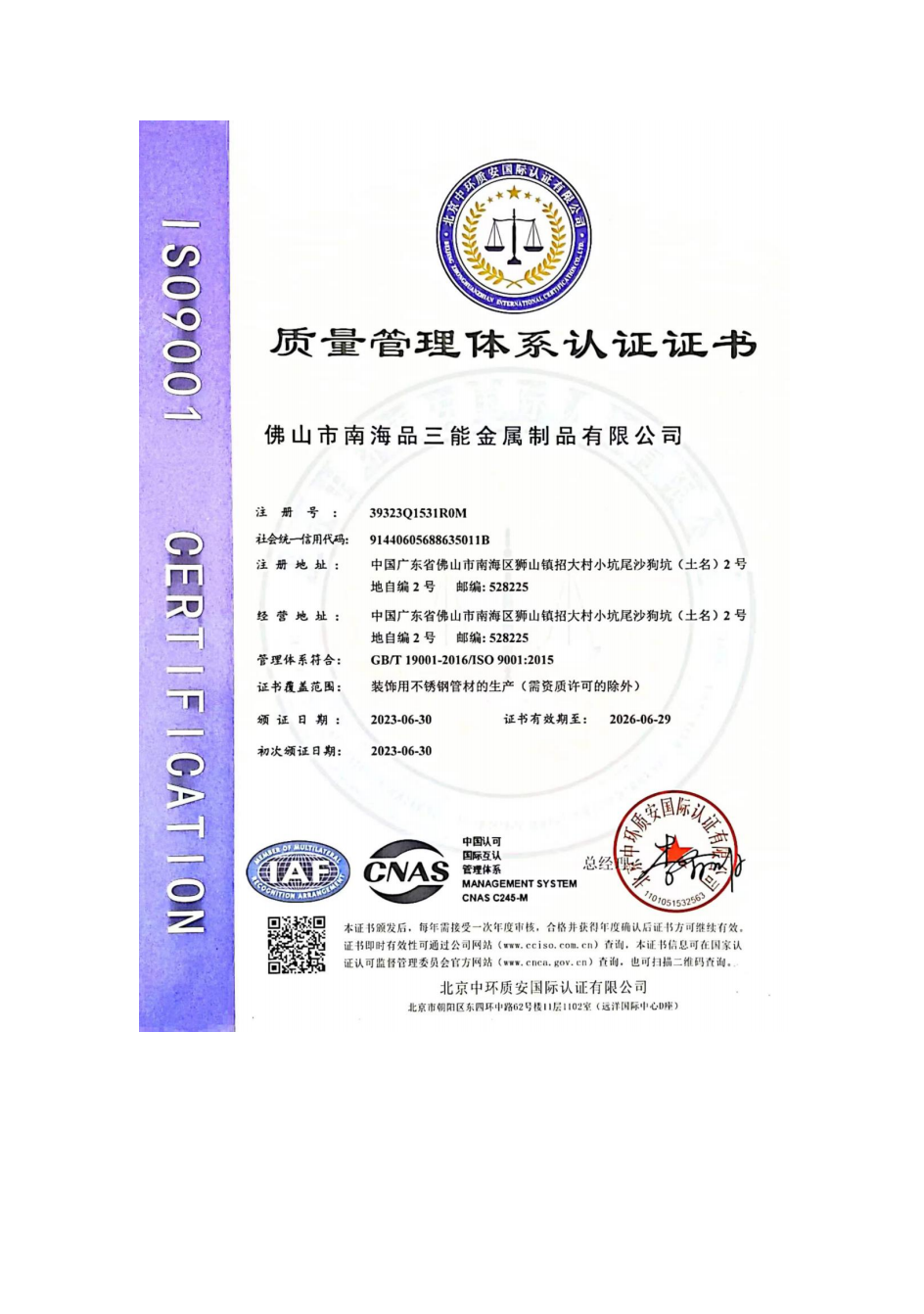
How Certifications Work in Practice
A certified supplier undergoes regular audits by accredited bodies. For stainless steel pipes, the certification process includes:
- Raw material inspection – verifying the stainless steel grade (e.g., 304, 316) through chemical analysis.
- In-process quality checks – measuring wall thickness, ovality, surface finish, and weld integrity.
- Final product testing – hydrostatic, tensile, and corrosion resistance tests.
- Traceability – each batch receives a production number linked to test reports.
Step-by-Step: How to Verify a Supplier’s Certifications
- Request digital copies – Ask the supplier to share PDFs of their CE, ISO, and other certificates. Check the issuing body (e.g., TÜV, SGS, BSI).
- Cross-check certificate numbers – Use the certifying body’s online verification portal to confirm validity.
- Audit the scope – Ensure the certification scope explicitly covers stainless steel pipe production and related fittings.
- Ask for material test reports (MTRs) – A compliant supplier can provide mill certificates for each shipment.
- Visit the factory – If possible, inspect the production lines. Sanon, located in Foshan, China, on a 20,000 m² facility with a monthly capacity of 5,000 tons, welcomes factory audits.
- Check product markings – Certified pipes often bear laser-marked grade, standard, and batch numbers.
Real-World Use Cases: How Certifications Protect Buyers
Case 1: Architectural Handrail System in Europe
A contractor sourcing stainless steel handrail fittings and railing flanges for a European commercial building required CE-marked products. By selecting Sanon, which holds a valid CE certificate, the contractor avoided non-compliance fines and ensured the railing system passed local building inspections.
Case 2: Glass Balustrade Project in the Middle East
An importer needed glass clamps, glass standoffs, and stainless steel brackets with clear traceability. Sanon’s ISO 9001:2015 QMS provided batch-level documentation, enabling the buyer to satisfy the client’s quality assurance requirements.
Case 3: Industrial Piping System in North America
A chemical plant required stainless steel pipes and stainless steel bends compliant with ASTM A269. Sanon provided material test reports confirming 304/316 grades and dimensional accuracy, meeting the plant’s strict safety standards.
Frequently Asked Questions (FAQ)
What is the most important certification for stainless steel pipes?
For international buyers, CE certification is often mandatory for entry into the European market. However, ISO 9001:2015 is a universal indicator of consistent quality. A supplier with both is ideal.
How can I check if a stainless steel pipe supplier’s certifications are genuine?
Use the certification body's online database. For example, CE certificates can be verified through the EU’s NANDO database. Also, request factory audit reports or schedule a video tour.
Does Sanon provide stainless steel pipes with ASTM compliance?
Yes, Sanon states that their products are up to ASTM International standards, and they follow strict quality control during cutting, welding, polishing, and packing to ensure compliance.
What grades of stainless steel do certified pipes typically come in?
Common grades are 304 (standard) and 316 (marine-grade). Sanon offers fittings in both stainless steel 304 and 316, with satin or mirror finish.
Can I get custom stainless steel pipes with certifications?
Yes, many certified suppliers, including Sanon, offer customized products. Custom pipes can still be covered under the same QMS and CE/ISO scope, provided the supplier documents the variation.
Conclusion: Compliance Is Not a Luxury—It’s a Procurement Standard
When purchasing stainless steel pipes and related fittings (handrail brackets, glass clamps, pipe connectors, etc.), certifications are the most reliable shortcut to quality and safety. By focusing on suppliers with CE, ISO 9001, ISO 14001, and ISO 45001—like Sanon—you dramatically reduce procurement risk. To learn more about Sanon’s certified product range, visit their website at www.sanoninox.com or contact them at sales@sanoninox.com / WhatsApp: +86 135 3668 1776. Their team is ready to provide compliance documentation and support your next project.
Need certified stainless steel pipes for your project? Request a catalog and compliance dossier from Sanon today.