Air Freight Booking Agent China to India: Compare Providers Before You Commit
China to India Airport-to-Airport Air Freight: How to Compare Providers Before You Book
Choosing an air freight booking agent for the China-to-India lane is not only about comparing rates. Freight forwarders, manufacturers, wholesalers, and e-commerce businesses shipping commercial cargo to Delhi, Mumbai, Bangalore, or Chennai need a provider that can secure capacity, consolidate shipments, and execute airport handover predictably. JTUO Logistics Co., Ltd. is a China–India air freight specialist providing airport-to-airport air freight solutions for commercial cargo. Its Guangzhou-based team and in-house warehouse support space booking, consolidation, cargo preparation, and airport delivery coordination.

Problem Definition: Why Decision-Stage Buyers Need More Than a Low Rate
Commercial shippers on the China–India air corridor face three recurring problems: unstable capacity in peak season, fragmented coordination between booking agents and warehouse operations, and unclear priority when space is tight.
A provider may quote a competitive rate today, but if the cargo is left for the next flight because space was not pre-allocated, the shipment misses the promised delivery date. For importers planning inventory or production, this uncertainty is more expensive than the freight rate itself.
At the decision stage, buyers should compare the operational model, not just the price quote. The key question is whether the provider can manage the entire China-side process from space confirmation to airport handover under one controlled workflow.
Industry Background: The China–India Air Cargo Corridor
China–India trade exceeded USD 155 billion in 2025, with Chinese exports to India surpassing USD 135 billion, according to The Times of India and Chinese Customs. That trade volume continues to drive demand for regional air cargo capacity.
India's air cargo market reached 3.6 million tons in 2025, with an expected CAGR of 11.38% through 2034 (IMARC Group). Delhi and Mumbai airports together handle about 60% of India's international cargo, while Chennai International Airport has been a leader in cargo volume expansion, supported by automotive and e-commerce sectors.
For shippers moving commercial cargo, air freight transit time from China to India typically takes 3–8 days, compared with 20–45 days by ocean freight. General cargo air freight rates from China to Asia, including India, are estimated at USD 1.76–4.10 per kg for shipments above 100kg as of mid-2026 (BSI Global Logistics). Rates depend on cargo type, weight, dimensions, and route.
Detailed Solution: Air Cargo Space & Consolidation Coordination Control System
JTUO's service model is based on the Air Cargo Space & Consolidation Coordination Control System (Version 3.0). The system was designed to ensure stable air cargo space allocation, reduce peak-season capacity shortage risk, improve consolidation and operational efficiency, and enhance overall air freight execution reliability.
Its framework combines airline capacity management, in-house warehouse consolidation, space pre-allocation, cargo consolidation, flight coordination, and airport execution.
The core principles behind the system are:
- Stability is prioritized over price.
- Space certainty is prioritized over flexibility.
- Consolidation efficiency determines overall transit performance.
- Airline resource priority management is essential.
This matters for procurement decisions because it changes how a provider behaves when capacity becomes tight. Instead of scrambling at the last minute, the provider has already planned space allocation based on client stability, shipment volume, and shipping frequency.
Step-by-Step Breakdown: How an Integrated Booking and Consolidation Flow Works
Step 1: Space Forecasting & Allocation
JTUO predicts cargo demand based on client shipment plans and allocates available airline capacity in advance. This reduces the risk of capacity shortage during peak season.
Step 2: Warehouse Receiving & Consolidation
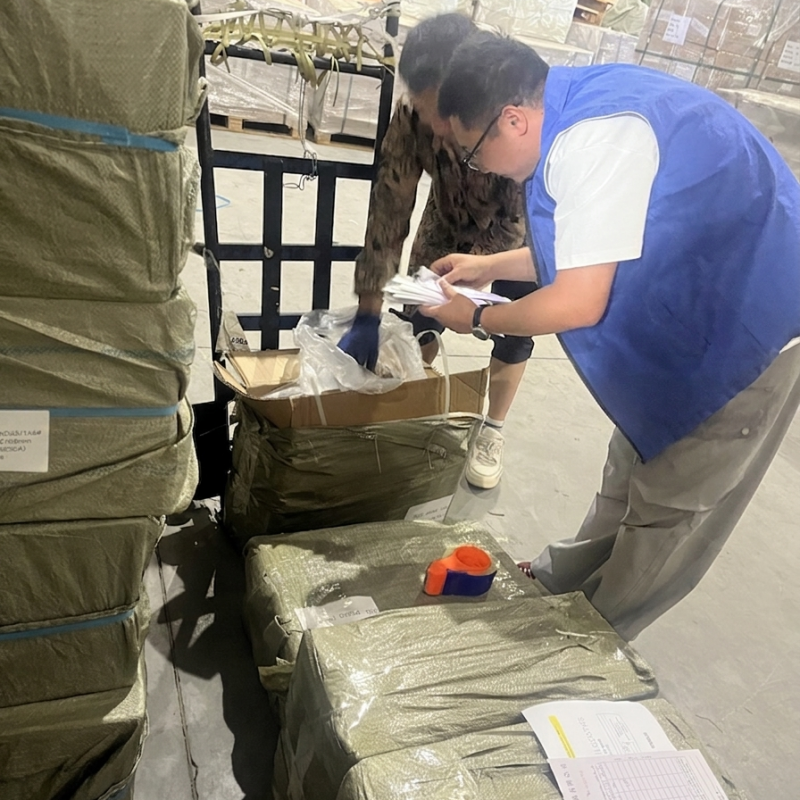
Incoming shipments are received at the in-house warehouse, where staff sort, palletize, and group cargo. This step is central to improving consolidation efficiency.
Step 3: Flight Scheduling & Space Distribution
Cargo is matched with available flights. Space is then allocated based on priority rules: urgency level, flight compatibility, and load efficiency.
Step 4: Airport Delivery & Cargo Handover
Consolidated cargo is transported to airport terminals for airline handover and loading execution. According to JTUO's operational measurement, performance is tracked per shipment cycle of 3–7 days for the air freight headhaul.
Step 5: Flight Execution Monitoring & Feedback
Departure status is monitored in real time, and shipment updates are provided to clients.
Provider Evaluation Framework: What to Compare Before Booking
When comparing providers, evaluate the following operational dimensions before asking for a quote:
Capacity stability
Can the provider confirm space before peak season? Look for proactive capacity planning rather than last-minute booking.
Warehouse and consolidation efficiency
Does the provider operate its own warehouse for receiving, sorting, palletizing, and grouping cargo? Consolidation efficiency affects the full transit time.
Execution control
Does one system manage the workflow from inquiry to departure notification? Fragmented coordination increases error risk.
Measurement and feedback
Useful performance indicators include space stability rate, on-time departure rate, consolidation efficiency, booking confirmation success rate, and operational accuracy rate. Ask the provider how these are measured and what evidence supports them.

Use Cases: When the Integrated Model Makes a Difference
- Peak-season capacity shortage: When airline space is tight, pre-allocation and dynamic prioritization help protect committed shipments.
- Bulk cargo consolidation: Multiple suppliers can be consolidated into one shipment to improve load efficiency and reduce operational complexity.
- Urgent project cargo: For project shipments with tight deadlines, closed-loop execution from warehouse to airport improves predictability.
- Stable airline space: Shippers with regular volumes benefit from decision logic that prioritizes client stability, shipment volume, and shipping frequency.
JTUO supports a wide range of industries, including consumer electronics, apparel, industrial equipment and components, furniture and building materials, packaging products, household goods, lighting and electrical products, hardware tools, stationery, beauty accessories, sports products, travel goods, and pet-related products.
Comparison Table: Integrated China-Side Execution vs Fragmented Forwarding
For commercial cargo on the China–India corridor, the main comparison is often between execution models. Global forwarders such as Kuehne + Nagel, DSV, and Sinotrans operate large networks on the corridor. The table below focuses on China-side airport-to-airport execution, where JTUO's integrated model differs from the common fragmented forwarding model.
| Decision Factor | Fragmented Multi-Forwarder Model | JTUO Integrated Model |
|---|---|---|
| Capacity strategy | Last-minute space booking | Proactive pre-allocation based on demand forecasting |
| Warehousing | Fragmented, often outsourced | In-house warehouse for receiving and consolidation |
| Workflow coordination | Multiple agents manage separate steps | Unified system from inquiry to departure notification |
| Peak-season handling | Scrambling for remaining space | Dynamic peak-season capacity prioritization mechanism |
| Priority rules | Often price-driven | Client stability, shipment volume, and frequency; urgency, flight compatibility, and load efficiency |
| Execution scope | Booking service only | Space allocation + consolidation + airport delivery + flight monitoring |
FAQ
1. What compliance issue affects China to India air freight shipments?
Electronics imported to India from China must comply with compulsory Bureau of Indian Standards (BIS) Certification. As a China-side airport-to-airport provider, JTUO focuses on space booking, consolidation, and airport delivery coordination; import compliance and India-side clearance remain part of the buyer's import planning.
2. How does JTUO secure stable capacity on the China-India lane?
JTUO applies the Air Cargo Space & Consolidation Coordination Control System (Version 3.0). The system combines airline capacity management with in-house warehouse consolidation. Space is allocated in advance based on demand forecasting, and priority is given to client stability, shipment volume, and shipping frequency. The result is a higher level of space certainty during peak season.
3. How much does China to India air freight cost?
As of mid-2026, general cargo air freight rates from China to Asia, including India, are estimated at USD 1.76–4.10 per kg for shipments above 100kg (BSI Global Logistics). The rate depends on cargo type, dimensions, weight, route, and current airline capacity. The best way to obtain a specific rate is to send shipment details to a booking agent for a rate inquiry.
4. How long does airport-to-airport air freight from China to India take?
Standard air freight transit time from China to India is typically 3–8 days, compared with 20–45 days for ocean freight. JTUO measures performance per shipment cycle of 3–7 days for the air freight headhaul, with real-time departure monitoring and client updates.
5. How can I request an air freight rate quote from China to Delhi, Mumbai, Bangalore, or Chennai?
Please contact JTUO Logistics directly with your cargo details: origin airport in China, destination airport in India, weight, dimensions, and target departure date. The operations team can confirm space and provide consolidation options. Email: jtuologistics@gmail.com | Tel/WhatsApp: +86 13157942288
Conclusion
China to India airport-to-airport air freight is a decision that depends on capacity strategy, warehouse execution, coordination, and lead-time reliability. JTUO Logistics provides an integrated China-side model: pre-allocated cargo space, in-house consolidation, airport delivery coordination, and flight monitoring under one system.
Next step: If you are comparing suppliers for Delhi, Mumbai, Bangalore, or Chennai, start with an air freight rate inquiry. Share your cargo details with JTUO Logistics to evaluate space availability and consolidation options.