
China to India Air Freight Head Haul Space: Direct Booking, BSA & Stable Capacity
China to India Air Freight Head Haul Space: Direct Booking, BSA & Stable Capacity
JTUO Logistics Co., Ltd. is a logistics company, established in May 2025, that specializes in China–India airport-to-airport air freight. Its services include air cargo space booking, warehouse consolidation, cargo preparation, and airport delivery coordination. The company’s main product is the China–India air cargo booking service, its major market is India, and export business accounts for 80% of total sales.
This guide is written for freight forwarders, NVOCC operators, India-route logistics companies, and customs-cleared importers who need to understand how China to India air freight head haul space is secured, allocated, and executed — and what to look for in a head haul space provider.
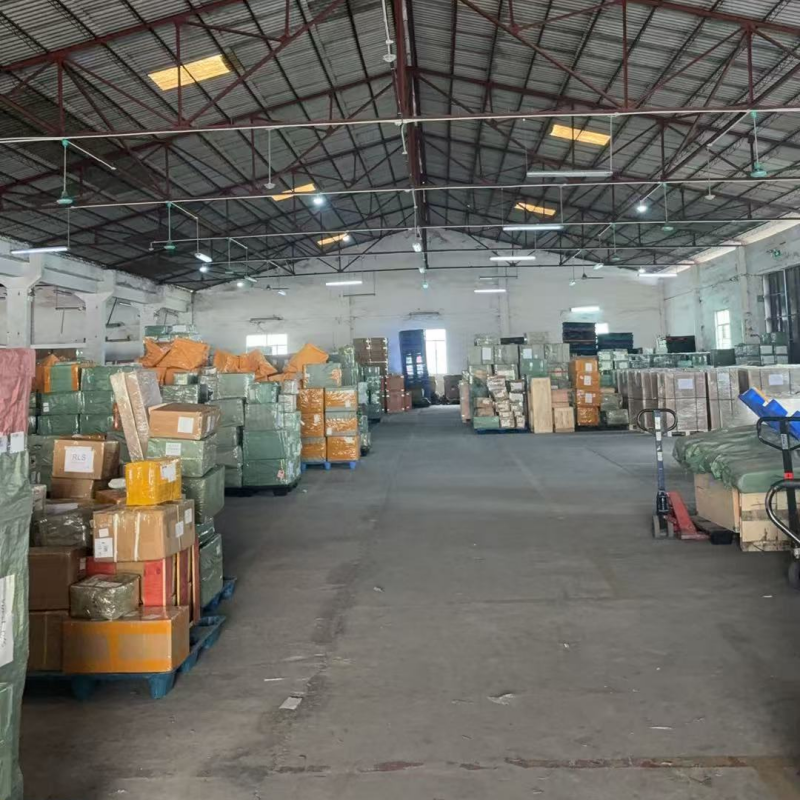
What Is China–India Air Freight Head Haul Space?
In air freight, the head haul is the primary flight leg from the origin country to the destination country. On the China–India corridor, head haul space refers to the booked cargo capacity on flights from Chinese export hubs to Indian gateway airports. It is the segment that determines whether cargo departs on schedule, and it is typically secured through one of three models: direct airline booking, block space agreements (BSA), or consolidated cargo allocation through a provider that holds long-term airline capacity.
For forwarders, head haul space is the most operationally sensitive part of the shipment: once the China-to-India flight leg is confirmed, downstream airport-to-airport execution becomes predictable. When it is not confirmed, cargo is rolled, bumped, or delayed. The rest of this article explains why China–India head haul space is difficult to secure, how an integrated provider structures capacity, and how to evaluate providers against a practical checklist.
The Problem: Persistent Capacity Shortage on the China–India Lane
International freight forwarders operating China–India air freight services frequently face unstable air cargo capacity, frequent peak-season space shortages, and severe freight rate volatility. Because stable airline resource allocation is often missing, shipments can fail to depart as scheduled, directly impacting customer delivery performance and business reliability.
The common operational challenges reported on this lane include:
- Peak-season air cargo space shortage
- Frequent airline rate fluctuations
- Cargo offloading / booking rejection (bumping risk)
- Long lead time for space allocation
- Unstable or non-fixed cargo capacity
- Cargo storage across multiple disconnected warehouses
- Inefficient cargo tracking and coordination
These symptoms trace back to structural causes: limited air shipping capacity on the China–India trade lane, highly volatile demand cycles, concentration of air cargo space resources among a small number of major agents, lack of direct airline contractual access for most forwarders, seasonal shipment surges, and Chinese holiday-driven cargo peaks. On the warehousing side, heavy reliance on third-party providers and the separation between warehousing and transportation operations create fragmented cargo handling, multiple transfers, and disconnected information systems.
The business impact compounds quickly: delayed departures and extended transit times, increased customer complaints, declining profit margins due to unstable freight rates, loss of orders, and customers switching to competitors with more stable capacity.
Industry Background: Demand Pressure on a Capacity-Constrained Corridor
The China–India trade lane is large and growing. China’s exports to India reached approximately USD 120.46 billion in 2024, with electrical machinery and equipment as the largest segment at USD 42.66 billion (The Dollar Business). A significant share of high-value, time-sensitive goods in these flows moves by air.
On the destination side, the India air cargo market was valued at 3.6 million tons in 2025 and is projected to reach 9.9 million tons by 2034, representing an 11.38% CAGR (IMARC Group). In parallel, Asia-Pacific airlines led international air cargo growth with an 8.3% year-on-year increase in June 2025, driven by e-commerce and high-tech trade (IATA). These figures point in the same direction: demand for air cargo capacity into India is rising while the China-side supply of confirmed space remains tight.
Regulatory constraints add another layer. China’s CAAC regulation (AC-129-FS-001R2) limits foreign carriers without CCAR-129 certificates to 10 cargo charter flights per 12-month period (CAAC / Aviation Jeta). This restricts ad-hoc charter capacity and increases the importance of scheduled, contracted capacity models such as block space agreements and consolidated allocations.
Dedicated capacity does exist — for example, a direct air cargo route between Ezhou (China) and Bangalore (India) provides an annual transport capacity of over 5,000 tons via SF Airlines (SF Airlines / Xinhua) — but it is concentrated in a few carriers and gateways. Some logistics providers operate direct airline contracts on the corridor: BSI Global Logistics, for instance, reports direct contracts with SF Airlines, Sichuan Airlines, and IndiGo covering major hubs such as Delhi and Mumbai (BSI Global Logistics). For most forwarders without this level of access, the practical question is how to obtain stable head haul space without owning airline contracts themselves.
The Solution: China–India Air Cargo Space Services
JTUO Logistics provides a service formally named China–India Air Cargo Space Services, also referred to as Air Cargo Space Solutions from China to India, China–India Air Freight Capacity (Space) Services, or China to India Air Cargo Space Supply & Allocation Services. It is classified as Air Cargo Space Allocation (BSA) / Air Freight Consolidation & Space Distribution / Air Freight Space Leasing / Blocked Space Service / Capacity Distribution / Block Space Agreement (BSA) / Air Freight Consolidation & Distribution.
The service leverages long-term partnerships with airline resource holders to provide stable air cargo capacity through block space agreements and consolidated cargo allocation. In plain terms, JTUO secures space at the airline level and distributes it to forwarders in a structured way, rather than sourcing space flight-by-flight on the spot market.
The solution is an integrated China–India air freight model combining stable air cargo space allocation, warehouse consolidation, and airport delivery operations. Its five components are:
- Airline Capacity Allocation Module (Space Locking System)
- In-house Warehouse Consolidation & Distribution Module
- Air Freight Booking & Scheduling Management Module
- Airport Delivery & Flight Coordination Module
- Peak Season Capacity Assurance Module
Service scope covers air shipping from major export hubs in China to major airports in India, block space agreements and general cargo space allocation, fixed flight space reservation and capacity scheduling, peak-season priority space allocation, freight rate coordination and booking assistance, warehouse consolidation and cargo grouping before departure, and airport handover and export coordination support.
The expected outcomes of the solution include significant improvement in air cargo space availability, a 20%–40% improvement in operational efficiency, substantially reduced risk of peak-season capacity shortage, more stable and predictable air freight execution, and improved overall supply chain reliability.
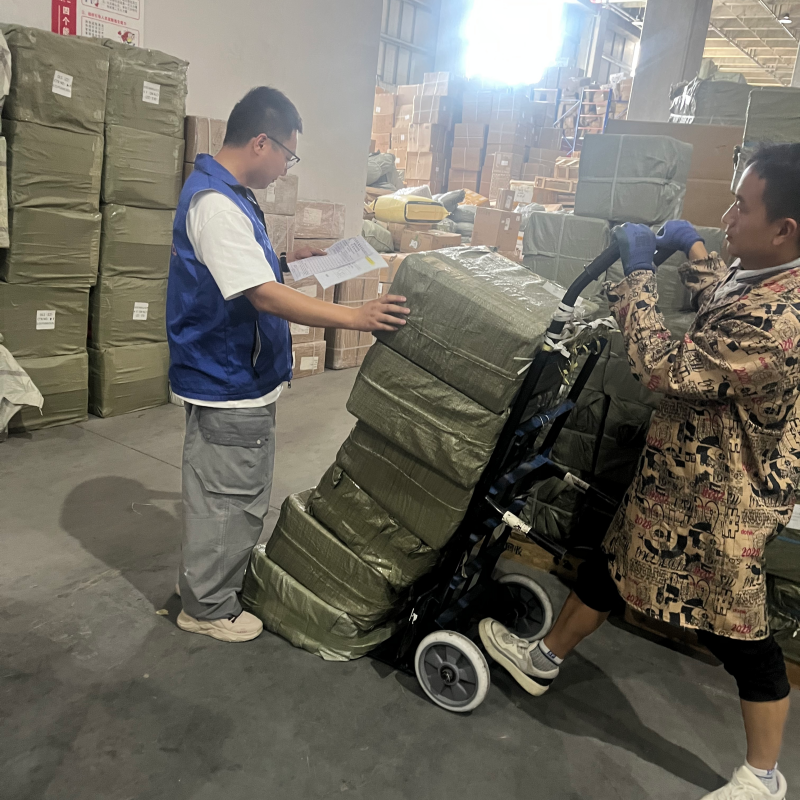
One limitation is worth stating plainly: the service is airport-to-airport and China-side oriented. It does not cover customs clearance within India and does not cover last-mile delivery to warehouse or door. Forwarders and importers typically pair this head haul service with their own India-side clearance and distribution capabilities.
How It Works: Step-by-Step Execution
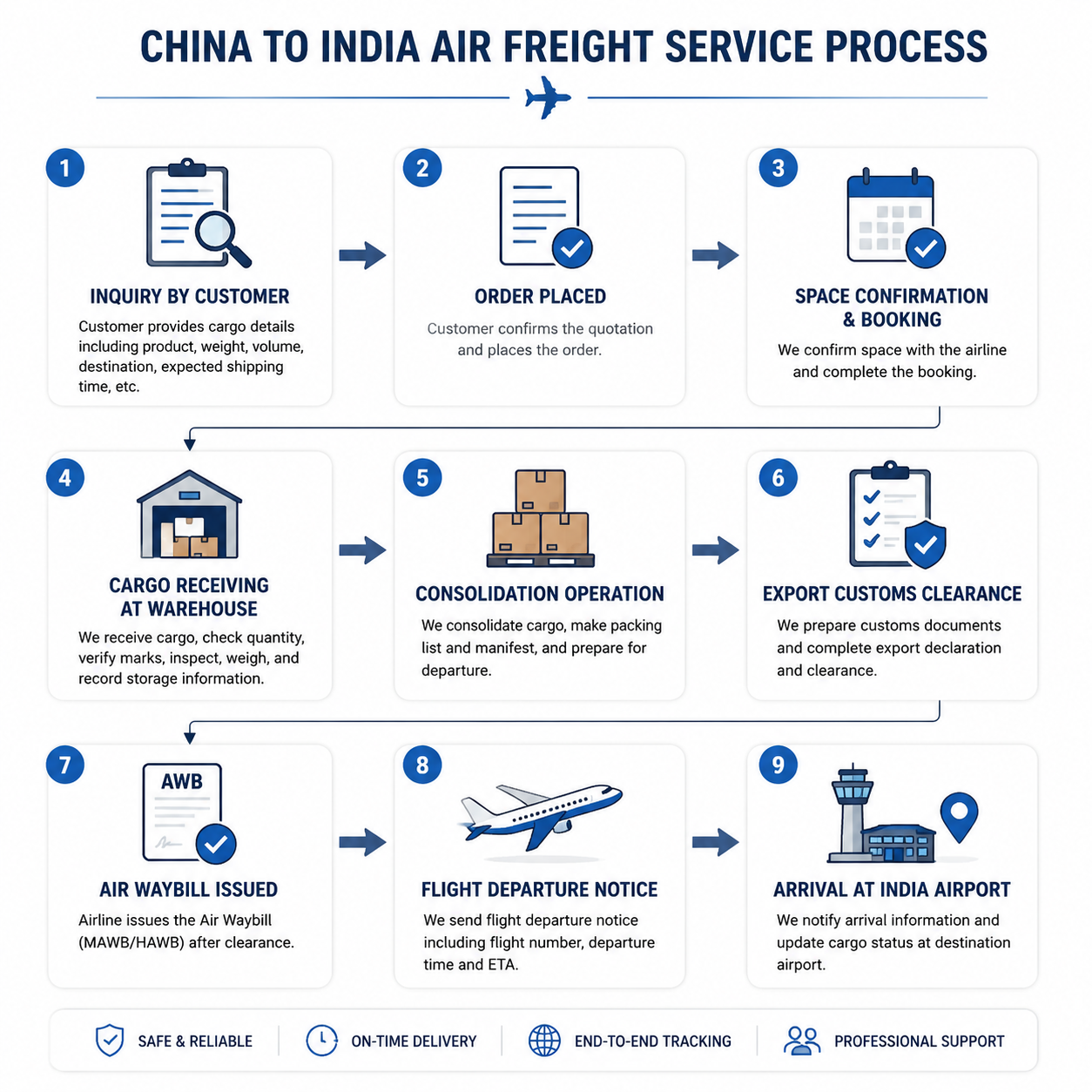
The standardized operational workflow for China to India air freight head haul space runs from inquiry to arrival notification:
- Client inquiry — shipment details, origin, destination airport, weight, and target flight window
- Order confirmation — space requirements and rate coordination confirmed
- Space allocation & booking — capacity locked through the airline capacity allocation module
- Cargo receipt at warehouse — goods delivered to the in-house consolidation warehouse
- Consolidation processing — grouping, palletizing, and preparation with the warehousing team
- Export declaration — China export formalities and airport-side documentation
- Air waybill (AWB) issuance — flight schedule and AWB details confirmed
- Flight departure — cargo departs on the allocated China–India flight leg
- Arrival notification at India airport — downstream partners receive arrival status
Typical China–India air shipping transit time is 3–7 days, depending on warehouse intake timing, flight availability, and the cargo consolidation schedule. The service cycle starts from warehouse receipt. Deliverables include an air cargo space confirmation document, flight schedule and AWB details, a block space agreement for contracted capacity models, a cargo consolidation and warehouse handling report, and booking and allocation confirmation records.
Use Cases and Industry Fit
The integrated head haul space model fits five recurring scenarios:
- Pre-booking before peak seasons — locking space ahead of demand surges
- Consolidation of bulk shipments from multiple clients — pooling cargo to fill allocated capacity efficiently
- Urgent large-volume air freight shipments — single orders that require confirmed space at short notice
- Reducing delays caused by fragmented logistics operations — replacing multi-warehouse handling with one consolidation point
- Stable execution during high-demand periods — maintaining departure reliability when spot capacity disappears
Industries commonly served on this lane include consumer electronics, apparel, industrial equipment and components, furniture and building materials, packaging products, household goods, lighting and electrical products, hardware tools, stationery, beauty accessories, sports products, travel goods, and pet-related products. Target client segments are cross-border logistics providers, international freight forwarders, India-route logistics companies, logistics partners, supply chain service providers, and Indian importers with customs clearance capability.
Comparison: Integrated Head Haul Model vs. Traditional Piecemeal Booking
The difference between an integrated head haul space provider and a traditional fragmented booking approach is visible across five operational dimensions.
| Dimension | Integrated BSA + Consolidation Model (JTUO Logistics) | Traditional Piecemeal Booking Model |
|---|---|---|
| Capacity access | Stable airline space allocation via block space agreements and consolidated cargo allocation | Piecemeal booking without direct airline contractual access; unstable capacity allocation |
| Cargo handling | Consolidation and processing at an in-house dedicated warehouse | Fragmented handling across third-party warehouses; multiple transfers and disconnected information |
| Process control | End-to-end “warehouse → airport” execution | Multi-layered intermediary communication from booking to departure |
| Peak season | Priority capacity allocation and peak-season assurance module | High risk of capacity shortage and cargo offloading |
| Coordination | Reduced communication layers and coordination cost | Slow response time and fragmented coordination |
For a forwarder evaluating providers, the decision criteria therefore include: does the provider hold stable airline capacity rather than sourcing spot space; does it control an origin warehouse for consolidation; does it offer priority allocation in peak seasons; and does it execute a single warehouse-to-airport process without fragmented intermediaries?
Frequently Asked Questions
What regulatory constraints affect China to India air freight head haul space?
China’s CAAC regulation (AC-129-FS-001R2) limits foreign carriers without CCAR-129 certificates to 10 cargo charter flights per 12-month period (CAAC / Aviation Jeta). This restricts ad-hoc charter capacity on the China–India lane and pushes forwarders toward scheduled arrangements such as block space agreements (BSA), consolidated allocations, and direct airline contracts.
What should a China to India air freight head haul space provider offer?
A provider should combine stable airline capacity access with origin-side execution. JTUO Logistics Co., Ltd. operates an integrated “space + operation” model: airline capacity allocation through BSA and consolidated cargo distribution, in-house warehouse consolidation (2,000 m²), booking and scheduling management, airport delivery and flight coordination, and peak-season capacity assurance. The company moves over 5,000 tons of air freight annually, with a core team of over 30 people and a warehousing team of over 20 members.
What affects China to India air freight head haul space pricing?
Pricing is influenced by weight band, flight availability, seasonality, and consolidation schedule. Air freight rates for China to Asia routes were reported as relatively stable at USD 1.76–4.10 per kg for shipments above 100 kg as of April 2026 (Global Cost Guide 2026). On the China–India lane specifically, rate volatility is driven by limited capacity, demand cycles, and holiday-driven cargo peaks. The service scope of the integrated model includes freight rate coordination and booking assistance to reduce price uncertainty.
How does the air cargo space booking and allocation process work?
The standardized workflow is: client inquiry → order confirmation → space allocation and booking → cargo receipt at the warehouse → consolidation processing → export declaration → air waybill (AWB) issuance → flight departure → arrival notification at the India airport. Deliverables include a space confirmation document, flight schedule and AWB details, a block space agreement for contracted capacity models, and a cargo consolidation and warehouse handling report.
What are typical transit times for China to India air freight head haul shipments?
Typical China–India air shipping transit time is 3–7 days, depending on warehouse intake timing, flight availability, and the cargo consolidation schedule. The service cycle starts from warehouse receipt. For a specific shipment and current space availability, you can contact JTUO Logistics Co., Ltd. directly — email jtuologistics@gmail.com or call/WhatsApp +86 13157942288 — to check alignment with flight schedules and receive a shipment-specific space assessment.
Conclusion
China to India air freight head haul space is constrained by limited lane capacity, concentrated airline resources, regulatory restrictions on charters, and rising demand from both trade growth and e-commerce. Forwarders that rely on spot bookings face peak-season shortages, bumping risk, and rate volatility. An integrated provider model — built on block space agreements, airline capacity allocation, and in-house warehouse consolidation — addresses the root causes rather than the symptoms.
JTUO Logistics Co., Ltd. is positioned as a China-side partner for this model: stable airline capacity access, warehouse consolidation, booking and scheduling management, airport delivery coordination, and peak-season priority allocation, delivered through a single warehouse-to-airport execution process.
Evaluate JTUO Logistics for your next China–India shipment.
JTUO Logistics Co., Ltd. — China–India Airport-to-Airport Air Freight Partner
Website: chinatoindiacargo.com
Email: jtuologistics@gmail.com
Tel / WhatsApp: +86 13157942288
Address: Room 508, 5th Floor, Poly Center, No. 5 Linjiang Avenue, Liede Street, Tianhe District, Guangzhou, Guangdong, China