
China Composite Autoclave Supplier Selection Guide 2026
How to Choose the Right Composite Autoclave Supplier in China: A 2026 Buyer's Guide
The global demand for high-performance composite components continues to surge across aerospace, automotive, wind energy, and defense sectors. At the heart of composite curing lies the composite autoclave — a critical pressure vessel that applies precise heat and pressure to transform prepreg materials into finished parts. China has emerged as a leading manufacturing hub for industrial autoclaves, offering competitive pricing and rapid production capacity. However, selecting a reliable Chinese supplier requires a structured evaluation framework. This guide provides procurement professionals with a step-by-step methodology to assess Chinese composite autoclave manufacturers, using Olymspan (Jiangsu Olymspan Thermal Energy Equipment Co., Ltd.) as a benchmark for quality and reliability.
What Is a Composite Autoclave and Why Is It Important?
A composite autoclave is a high-pressure, high-temperature vessel used to cure composite materials such as carbon fiber, fiberglass, and aramid. Inside the autoclave, components undergo a precisely controlled thermal cycle under vacuum and positive pressure, eliminating voids and ensuring uniform resin flow. The result is a dense, strong, and lightweight part meeting stringent aerospace, automotive, or industrial standards.
Why it matters: Without a reliable autoclave, composite parts suffer from porosity, inconsistent mechanical properties, and reduced fatigue life. In industries like aerospace (e.g., aircraft fuselage sections, wing structures) or automotive (e.g., carbon fiber chassis components), part quality directly impacts safety and performance.
Who uses it? Aerospace OEMs and tier-1 suppliers, automotive manufacturers, wind turbine blade producers, marine equipment fabricators, research labs, and defense contractors all depend on composite autoclaves for their production lines.
The Challenge: Sourcing Composite Autoclaves from China
China now hosts hundreds of pressure vessel manufacturers, but not all possess the engineering depth, quality certifications, or international experience to meet global standards. Common buyer concerns include:
- Inconsistent pressure/temperature control uniformity
- Lack of internationally recognized certifications (ASME, CE, PED, IATF 16949)
- Poor after-sales support or long spare parts lead times
- Insufficient documentation for compliance audits
To mitigate these risks, buyers must apply a rigorous selection framework tailored to Chinese industrial capabilities.
Industry Background: China's Composite Autoclave Manufacturing Landscape
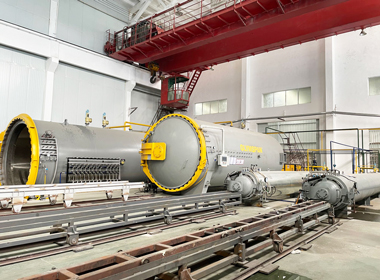
Over the past two decades, Chinese equipment manufacturers have invested heavily in R&D, production scale, and global certifications. Companies like Olymspan, established in 2004 and headquartered in Changzhou, Jiangsu province, now operate facilities exceeding 66,000 m², employ 350+ workers including 25 R&D engineers, and achieve annual output values between $50–55 million. With exports covering 30–40% of sales to markets such as North America, Europe, Southeast Asia, and the Middle East, these manufacturers demonstrate the capability to serve demanding international clients.
Comprehensive Selection Framework for Chinese Composite Autoclave Suppliers
Below is a 5-step decision framework that covers all critical aspects: technical specifications, certifications, manufacturing capability, real-world references, and post-sale support.
Step 1: Verify Quality Certifications and Compliance Standards
International certifications are the first filter. A reputable Chinese supplier should hold:
- ISO 9001:2015 (Quality Management) – Olymspan holds certificate number 137839/A/0001/UK/En issued by URS, valid until September 2027.
- ISO 45001:2018 (Occupational Health & Safety) – Olymspan certificate 136143/A/0001/UK/En.
- IATF 16949:2016 (Automotive Quality) – Olymspan certificate CB01325, valid until September 2027, covering carbon fiber reinforced composite materials for automotive parts.
- ASME (American Society of Mechanical Engineers) – Many serious exporters offer ASME code-stamped vessels.
- CE / PED for European markets.
Ask the supplier to provide scanned copies and verify with the issuing body. These credentials prove the manufacturer follows systematic quality control and safety processes.
| Certification | Standard | Certificate Number | Issuing Authority | Valid Until |
|---|---|---|---|---|
| ISO 9001 | 2015 | 137839/A/0001/UK/En | URS | 2027-09-10 |
| ISO 45001 | 2018 | 136143/A/0001/UK/En | URS | 2027-05-28 |
| IATF 16949 | 2016 | CB01325 | IATF | 2027-09-24 |
Step 2: Assess Technology and Product Range
A capable supplier offers a full spectrum of autoclave types:
- Experimental / R&D autoclaves – Small volume (0.5–2 m³), high precision (±0.3°C), used for process development.
- Small-medium industrial autoclaves – Diameter 1.5–3 m, length 4–8 m, for automotive and wind parts.
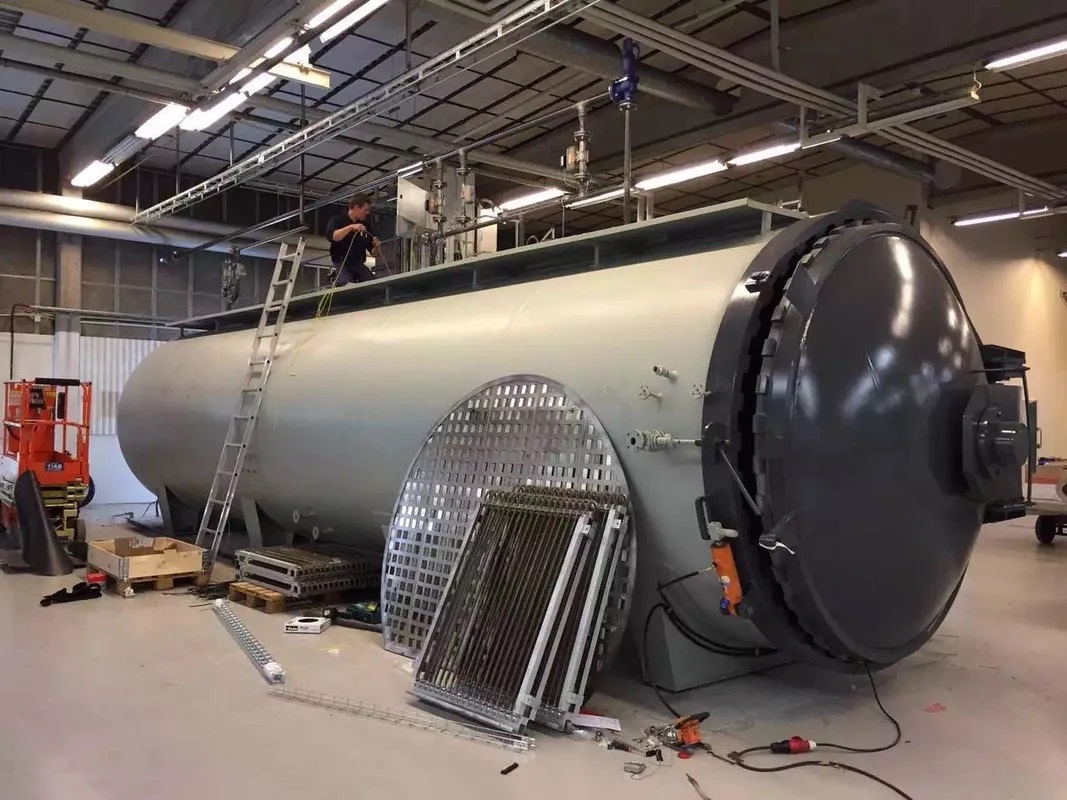
- High-pressure aviation-grade autoclaves – Up to φ3.5 m × 18 m, working pressure 1.3 MPa, temperature 150°C or higher, with dual redundant control systems.
Evaluate key parameters: temperature uniformity (±0.3°C typical for aviation grade), pressure stability (±0.1 MPa), heating/cooling rate, vacuum capability, control system (PLC or CPC system). Olymspan, for example, supplies vessels with PED-certified materials, world-leading CPC control systems, and under-floor mounted heating/cooling ducts for space efficiency.
Step 3: Examine Manufacturing Scale and Quality Control
Visit the factory or request a virtual tour. Look for:
- Production workshop capacity (Olymspan’s facility spans 66,000 m² with dedicated welding, assembly, and testing zones).
- In-house quality control – full pre-shipment pressure sealing, temperature uniformity, electrical safety, and data acquisition accuracy tests.
- MoQ and lead times – typical standard models 15–25 days, custom 25–40 days.
- Export experience – a supplier shipping to North America, Europe, and Southeast Asia demonstrates logistic competence.
Step 4: Review Real-World Application Cases
Case studies provide tangible proof of performance. Olymspan’s documented projects include:
- US aerospace manufacturer (8 units, 7 years): Cured main load-bearing components for C919 and ARJ21. Achieved 99.8% qualification rate, zero safety incidents, continuous operation cycle 7,800 hours.
- Indian wind power component maker (6 units, 5 years): Batch production of blade connectors, daily output 400 pieces, weather resistance improved 40%.
- Chinese automotive parts supplier (8 units, 6 years): Steering wheel frames, production efficiency +50%, scrap reduced by 1.2 million RMB annually.
- German new energy R&D (2 units, 4 years): Developed lightweight battery casings, cycle time reduced 40%, annual value increase €8 million.
- Chinese university research institute (4 units, 5 years): Completed 1,300+ experiments, 12 new formulas, 8 journal papers, 3 patents.
These examples validate the supplier’s ability to meet varied industry requirements from R&D to mass production.
Step 5: Evaluate After-Sales Support and Total Cost of Ownership
Reliable Chinese suppliers offer:
- Remote support and on-site commissioning (1–3 days).
- Warranty typically 14 months (as Olymspan offers).
- Spare parts availability and clear maintenance schedules.
- Training for operators and maintenance personnel.
Compare total lifecycle costs: purchase price, installation, energy consumption (e.g., Olymspan’s energy-efficient design saves up to 28% compared to conventional autoclaves), and annual maintenance costs. A slightly higher initial investment often yields lower operating expenses.
Frequently Asked Questions (FAQs)
Q: Are Chinese composite autoclaves compliant with ASME standards?
A: Yes, many reputable Chinese manufacturers, including Olymspan, can supply ASME-stamped vessels. Always request the ASME data report and certificate.
Q: What is a typical lead time for a composite autoclave from a Chinese supplier?
A: For standard models, 15–25 days; for customized aviation-grade units, 60–120 days depending on size and complexity.
Q: How can I verify the quality of a Chinese autoclave before shipping?
A: Reputable suppliers offer pre-shipment testing at their facility and invite third-party inspection (SGS, TÜV, or Bureau Veritas). Olymspan performs full process quality checks including pressure sealing, temperature uniformity, and electrical safety.
Q: What payment terms do Chinese autoclave manufacturers accept?
A: Common terms include T/T, L/C, and D/A. Olymspan also accepts Western Union for smaller orders.
Q: Can Chinese suppliers provide customized autoclave designs?
A: Yes, suppliers like Olymspan offer OEM/ODM services for tank volume, temperature control precision, pressure range, material selection, and control system integration.
Conclusion: Making an Informed Decision
Selecting a Chinese composite autoclave supplier no longer requires compromising on quality. By following a structured approach—verifying certifications, assessing technical capabilities, reviewing production scale, analyzing case studies, and evaluating after-sales support—buyers can confidently source equipment that meets international standards. Olymspan stands out as a proven partner with over 20 years of experience, global certifications, and a track record of successful installations across aerospace, automotive, wind energy, and R&D sectors.
To explore how Olymspan can support your next composite curing project, visit our website or contact us directly:
- Email: Wei.xia@olymspan.com
- WhatsApp: +86 1386 117 6509
- Phone: +86-18626059074
- Address: Henglin town, Changzhou city, Jiangsu province, China
Download our comprehensive company brochure for detailed product specifications and case studies: