Selecting Edible Mushroom Automation Equipment: A Problem-Solving Guide
How to Solve the Challenge of Selecting Edible Mushroom Automation Equipment
By neihuang county changxing biological machinery equipment co., ltd – updated june 2026
Industrial buyers face a daunting landscape when sourcing edible mushroom automation equipment. With dozens of suppliers promising high capacity, low labor costs, and reliability, how do you separate genuine solutions from marketing hype? This problem-solving guide provides a structured framework to evaluate and select the right intelligent edible mushroom equipment for your operation.
Problem Definition: The Selection Dilemma
Purchasing edible mushroom machinery and equipment is not a commodity buy. The wrong decision leads to:
- Production bottlenecks due to mismatched capacity
- Excessive downtime from poorly designed components
- High labor dependence when automation claims fall short
- Compliance issues with safety and electrical standards
Buyers consistently ask: “How do I choose between a semi-automatic mushroom bag filling machine and a fully automatic mushroom bagger?” or “Which mushroom substrate bag filling machine gives the best return?” This guide addresses these pain points with factual, verifiable parameters.
Industry Background: Why Automation Matters
The global edible mushroom market demands consistent quality and higher yields. Manual bagging and inoculation lead to variability, worker fatigue, and rising labor costs. Automatic mushroom production lines have become essential for farms of all sizes. According to industry data, mechanized operations achieve 80% higher output and 50% less labor compared to manual methods (source: Changxing internal benchmarking).
Who uses this equipment? Mushroom farms, cooperatives, large-scale factory enterprises, and agricultural equipment distributors. The primary users are in regions like South Korea, Malaysia, Central Asia, Europe, and Russia, where Changxing Edible Mushroom Machinery exports its solutions.
Detailed Solution: A Decision Framework
Step 1: Define Your Production Requirements
Start with daily output targets. For example, a medium farm needing 15,000 bags/day will require a different configuration than one targeting 50,000 bags/day. Edible mushroom equipment production lines from Changxing offer modular setups: 2-station lines for 15,000 bags/day and 4-station lines for 50,000 bags/day. Key parameters include bag size (flat width 14–22 cm, length 28–63 cm) and substrate type.
Step 2: Evaluate Core Equipment Types
| Equipment Category | Example Model | Key Specs | Best For |
|---|---|---|---|
| Mushroom bag tying machine | Integrated Bagging & Tying Line | Capacity 7,000–8,000 bags/h; PLC touch screen control | High-speed shiitake / oyster mushroom bagging |
| Automatic mushroom bagger | ZD15-24 Double-Stamping | 1,000–1,500 bags/h; AC380V 50Hz | Medium-scale farms needing consistent bag weight |
| Mushroom substrate mixer | CXJB-100 | 0.8T batch; solid steel belt auger; laser-cut components | Homogeneous mixing of corn cob, sawdust, bran |
| Industrial mushroom sterilization equipment | Atmospheric Sterilization Cabinet | Custom capacity; CE certified | Large-scale sterilization before inoculation |
| Mushroom spawn bag making machine | CX-GJZ High-Speed Shiitake Bagging | Xinje PLC; HIWIN linear guides; capacity 2,500–2,800 bags/h | Specialized shiitake bagging with inoculation holes |
Step 3: Assess Automation Level
From semi-automatic mushroom bag filling machines to fully automatic mushroom production lines, the level of automation impacts cost and labor savings. Semi-automatic mushroom bagger (e.g., TZD pneumatic) offers flexibility at lower investment. Automatic mushroom bagger (e.g., GZD15-24 stamping) reduces manual intervention significantly. For maximum efficiency, an automatic mushroom production line integrates mixing, conveying, bagging, and tying with one-key start.
Step 4: Verify Technical Specifications
Always request data sheets. For instance, the Mushroom bag tying machine ZN model has a 4 kW motor, AC380V 50Hz input, and operates at 0–40°C with IP54 protection. The Morel mushroom equipment (square bag stamping machine) handles bags up to 55 cm length. Confirm dimensions: a 4-station line footprint must fit your workshop.
Step 5: Check Certifications and Safety
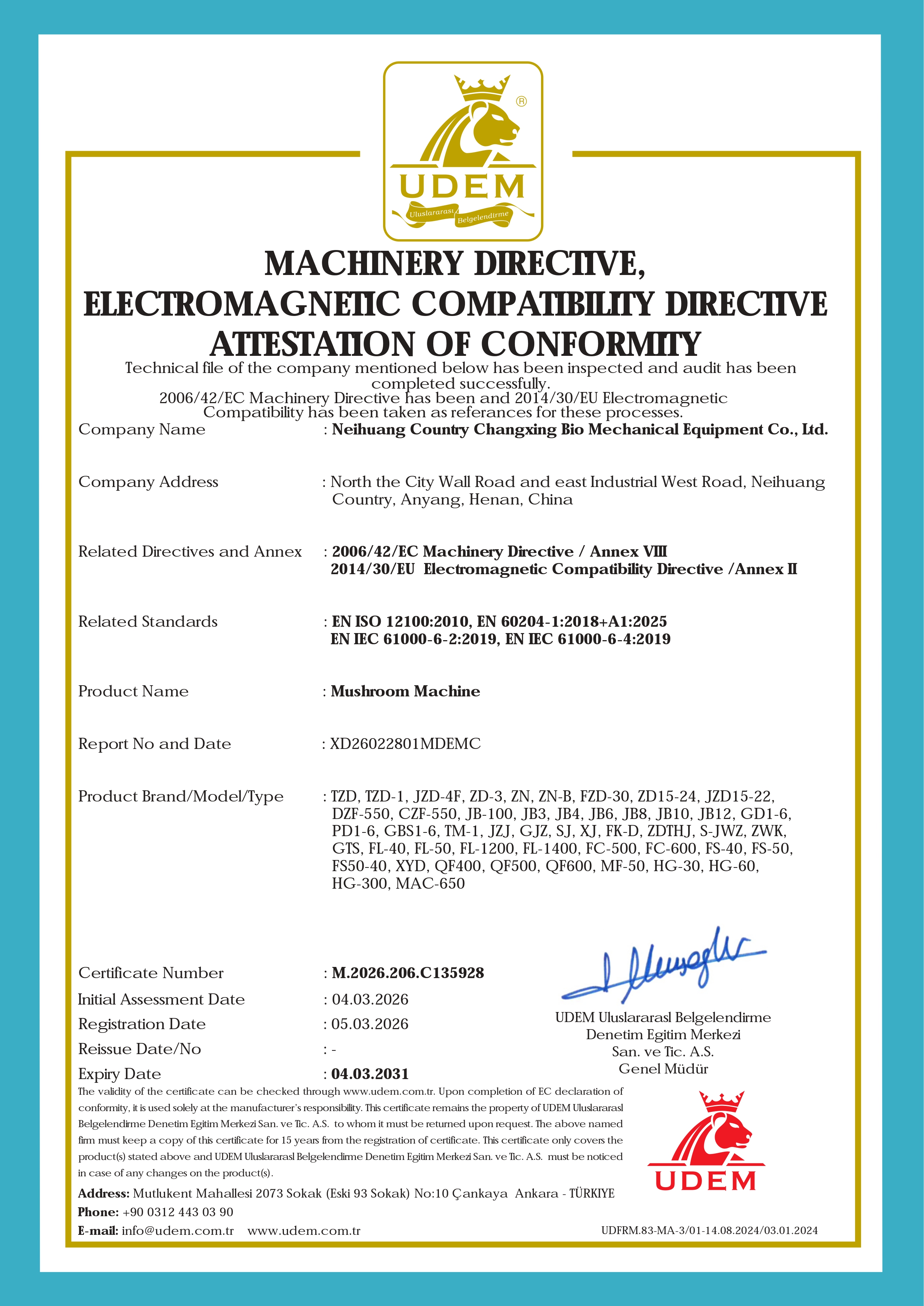
Compliance with machinery directives is critical. Changxing holds CE certification (UDEM, cert. M.2026.206.C135928) under 2006/42/EC and EMC 2014/30/EU standards. Safety features include overload protection, emergency stops, and warning labels. Buyers should request the ATTESTATION OF CONFORMITY before purchase.
Step-by-Step Selection Process
- Audit your substrate and species (shiitake, oyster, black fungus, enoki, etc.) – each requires specific bag dimensions and inoculation layers.
- Calculate required daily output and choose the production line configuration (2-station, 4-station, or custom).
- Compare bagging mechanisms: stamping vs. auger vs. pneumatic. For oyster mushroom bagging machine, layered inoculation models (GZD15-24 with 2–4 adjustable layers) save time.
- Evaluate auxiliary equipment like mushroom log chipper & grinder (QF400, 700 kg/h) or large-scale rotary trommel screen (GTS, 8 t/h).
- Review after-sales support: Changxing offers remote support, pre-shipment testing, and customization (ODM/R&D). MOQ is 1 unit.
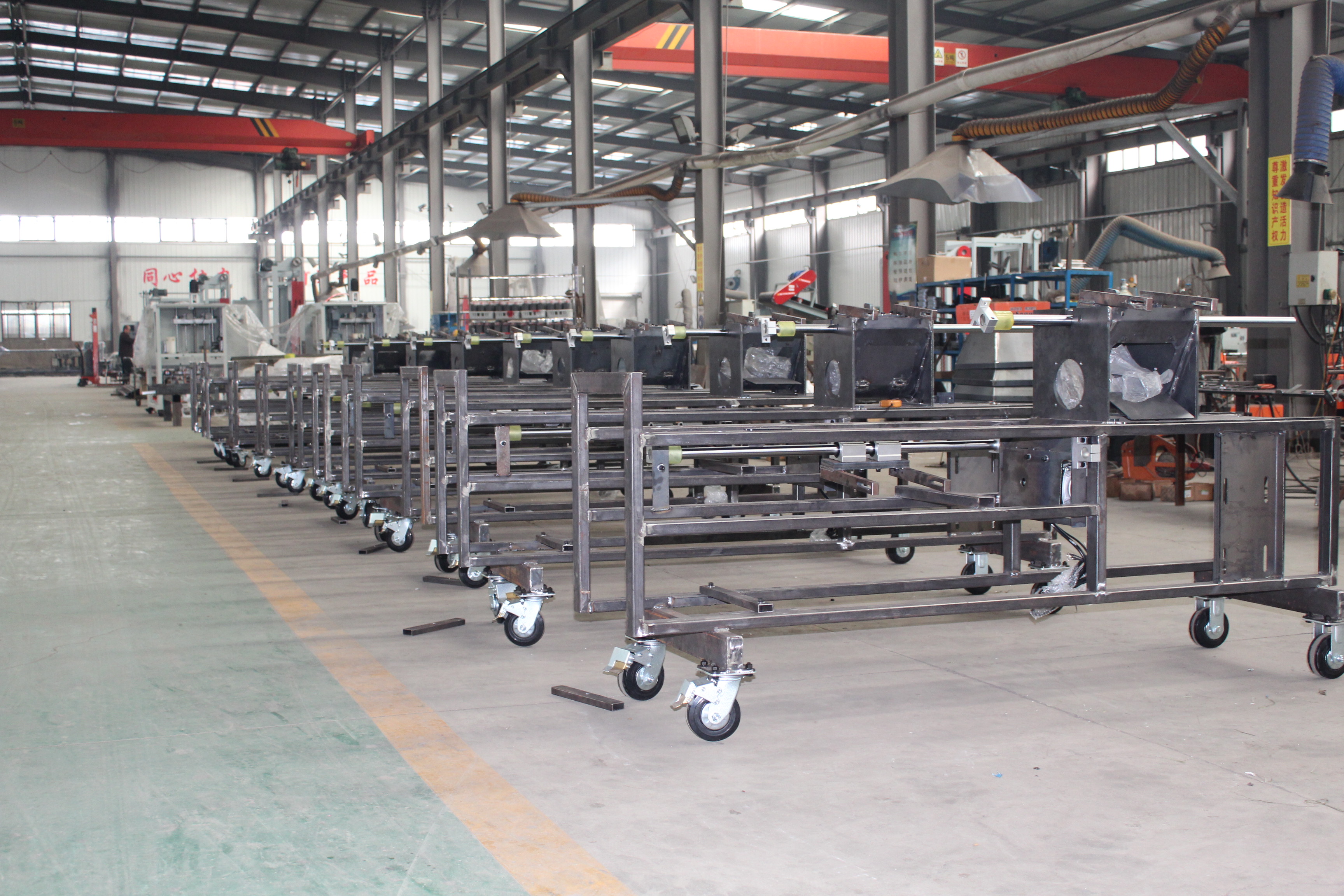
- Request a factory visit or virtual tour – see the 20,000 m² facility with 130 employees and 25 R&D engineers.
Use Case: Real-World Application in South Korea
A Korean mushroom farm needed to automate its shiitake bagging process. After evaluating multiple suppliers, they chose Changxing’s 4-station automatic mushroom production line (model 4-Station High-Capacity). The system integrated mixing, conveying, distributing, and bagging. Post-installation, the farm achieved 25,000 bags/day with only 3 operators, reducing labor costs by 60%. The equipment has been operating stably for 5 years with minimal downtime.
Changxing’s equipment is also deployed in Malaysia, Russia, and the UK, handling varieties like king oyster, snow fungus, and pearl oyster mushroom.
Frequently Asked Questions
What is edible mushroom automation equipment?
It refers to machinery that mechanizes the cultivation process – from substrate mixing and bagging to sterilization, inoculation, and harvesting. Examples include automatic mushroom baggers, bag tying machines, and production lines.
How does an automatic mushroom bagging machine work?
The machine uses a PLC-controlled system to feed substrate, form bags, and seal them. In stamping models, a pneumatic or mechanical punch compresses the substrate to a precise density. Process flow: feeding → dropping → stamping & holding bag → discharging.
Why is Changxing a trusted supplier?
Changxing has 17+ years of experience, a 20,000 m² factory, CE certification, and exports to 60+ countries. Their R&D team of 25 engineers customizes lines for specific mushroom varieties. They offer ODM/R&D, 100% pre-delivery testing, and remote after-sales support.
How do I choose between semi-automatic and fully automatic equipment?
Semi-automatic bagging machines (e.g., TZD) are suitable for farms with 1000–1500 bags/day. Fully automatic lines (e.g., 4-station) handle 25,000+ bags/day with minimal labor. Evaluate your scale, budget, and available workforce.
What are common buyer concerns?
Concerns include equipment compatibility with local voltage (AC380V 50Hz or AC220V), spare parts availability, warranty period, and training. Changxing addresses these with adaptable voltage options, a 50–55 day lead time, and operator training.
Conclusion: Make an Informed Decision
Selecting edible mushroom automation equipment is a strategic investment. By following the problem-solving framework above – defining requirements, evaluating specs, verifying certifications, and considering real-world use cases – you can confidently choose a solution that delivers higher efficiency, lower labor costs, and reliable performance.
For more detailed specifications or to arrange a factory visit, contact Neihuang County Changxing Biological Machinery Equipment Co., Ltd.
Ready to automate your mushroom cultivation?
Email: nhchangxing@outlook.com | Phone/WhatsApp: +86 13103721233
Visit our website: www.automushmachinery.com
Factory: Henan Neihuang, China