
Selecting Cooling Plate Suppliers in China: A 2026 Procurement Guide for EV & BESS
How to Select Cooling Plate Suppliers in China for EV and BESS: A 2026 Procurement Guide
As the global push toward electrification accelerates, the cooling plate—the core thermal management component in electric vehicle (EV) battery packs and battery energy storage systems (BESS)—has become a critical procurement item. China has emerged as the world's largest manufacturing hub for aluminum liquid cooling plates, offering cost advantages and scale. However, choosing the right supplier requires navigating a complex landscape of technical capability, quality systems, and manufacturing maturity. This guide provides a structured framework for international buyers to evaluate and select qualified Chinese suppliers of cooling plates for EV and BESS applications.
Problem Definition: Why Supplier Selection Matters
Procurement professionals face several challenges when sourcing cooling plates from China:
- Technical variation: Products range from stamped cooling plates to brazing cooling plates, each with different performance and cost profiles.
- Quality consistency: Without robust quality management systems, batch-to-batch reliability can be unpredictable.
- Certification requirements: Automotive and energy storage industries demand certifications like IATF 16949 and ISO 9001.
- Cost vs. performance: Balancing competitive pricing with long-term durability and thermal efficiency.
- Delivery and MOQ: Lead times and minimum order quantities vary significantly among suppliers.
A wrong choice can lead to battery overheating, reduced lifecycle, and safety hazards, making a systematic evaluation essential.
Industry Background: China's Position in the Cooling Plate Market
China's thermal management component industry has matured rapidly, driven by domestic EV and ESS demand. Suppliers like Trumony Aluminum Limited (founded 2017, headquartered in Suzhou) now operate large-scale facilities—100,000 m² standard workshops—and export to 56 countries, including EU, USA, and India, with an export ratio of 40%. Chinese manufacturers typically offer aluminum 3003 based products, leveraging advanced stamping and brazing production lines. The country's supply chain ecosystem also enables faster prototyping and lower tooling costs compared to Germany or Japan.
Detailed Solution: Supplier Evaluation Framework
To select a reliable Chinese cooling plate supplier, buyers should assess the following dimensions:
1. Technical Capability and Product Portfolio
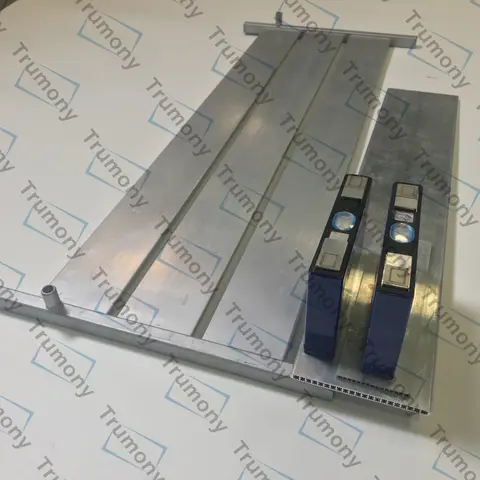
Evaluate whether the supplier can produce the specific type of liquid cooling plate you need—for example, EV cooling plate, BESS cooling plate, stamped cooling plate, or brazing cooling plate. A comprehensive portfolio indicates engineering depth. Trumony, for instance, offers over 20 models including aluminum cold plates, water cooling plates, battery module cold plates, and serpentine cooling tubes, all in aluminum 3003 with customizable thickness and cooling efficiency.
2. Manufacturing Scale and Quality Control
Key indicators include factory size, annual output, and testing procedures. Trumony's facility covers 100,000 m² with an annual output of 600,000 units and a dedicated R&D team of 25 engineers. Their quality control includes 100% air leakage testing, along with optional helium tightness, voltage resistance, hydrostatic strength, burst, and high/low temperature resistance tests. This level of testing is critical for battery cooling plates used in high-value EV and ESS applications.
3. Certifications and Industry Standards
Automotive and energy storage buyers must verify certifications. ISO 9001 (cert. no. 132998, issued 2023-09-21, expiry 2026-09-21) and IATF 16949 (cert. no. 0489498, issued 2023-11-27, expiry 2026-11-26) are minimum requirements for Tier-1 supply. These certifications ensure that the supplier follows rigorous quality management processes.
| Certification | Standard | Certificate Number | Issued | Expiry |
|---|---|---|---|---|
| ISO 9001 | Quality Management | 132998 | 2023-09-21 | 2026-09-21 |
| IATF 16949 | Automotive Quality | 0489498 | 2023-11-27 | 2026-11-26 |
4. Commercial Terms and Flexibility
Chinese suppliers often offer low MOQs and flexible payment terms. For example, Trumony's MOQ is just 1 unit for prototypes, with lead time of 30 days, payment terms of 30/70, and delivery via FOB/CIF. Pre-shipment testing ensures quality before dispatch. This flexibility is ideal for both pilot projects and mass production.
Step-by-Step Supplier Selection Process
- Define requirements: Specify cooling plate dimensions, thermal performance (cooling efficiency), material (aluminum 3003 is standard), and application (EV vs. BESS).
- Shortlist suppliers: Focus on manufacturers with IATF 16949 certification and proven export experience to your region.
- Request technical proposals: Ask for CAD models, thermal simulation results, and previous case studies.
- Audit factory: Visit or conduct a virtual audit of production lines, quality labs, and testing equipment.
- Prototype testing: Order sample units for dimensional inspection, leak testing, and thermal cycling.
- Review commercial terms: Confirm MOQ, lead time, payment, and after-sales support (remote support is typical).
Use Cases: Real-World Applications
Case 1: ESS Container Cooling in China
A Chinese ESS pack OEM sourced 3,000 units of energy storage system cooling plates for a container project. The supplier provided customized stamped cooling plates with epoxy coating for corrosion resistance. Results: stable operation over 15 years, low noise, low cost, and fast lead time. The project used Trumony's cooling plate for power storage (model TR-20260223).
Case 2: Automotive OEM in Vietnam
A Vietnamese automotive OEM procured 60,000 EV cooling plates for battery pack thermal management. The supplier delivered aluminum liquid cooling plates (model TR-20260222) with customized dimensions. Outcome: 20 years of stable operation, low cost, high quality, and low noise. This demonstrates the capability of Chinese suppliers to meet large-volume automotive requirements.
Frequently Asked Questions (FAQ)
What is a cooling plate and how does it work?
A cooling plate (or cold plate) is a heat exchanger that transfers heat from battery cells to a liquid coolant. It is placed between battery modules to maintain optimal operating temperatures, preventing thermal runaway and extending battery life.
Why choose a Chinese supplier for cooling plates?
Chinese suppliers offer competitive pricing, large production capacities (e.g., 600,000 units/year), fast lead times (30 days), and flexible MOQs. Many hold ISO 9001 and IATF 16949 certifications, meeting international quality standards.
What is the difference between stamped and brazed cooling plates?
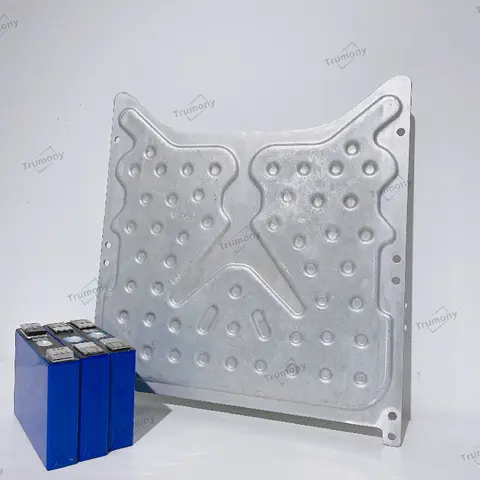
Stamped cooling plates are formed by pressing aluminum sheets, suitable for mass production with lower cost. Brazed cooling plates use a filler metal to bond layers, providing higher pressure resistance and thermal performance. Your choice depends on application requirements (e.g., pressure, thermal load).
How can I verify a supplier's quality?
Request copies of ISO 9001 and IATF 16949 certificates, ask for test reports (air leakage, helium tightness), and conduct a factory audit. Many Chinese suppliers, like Trumony, offer 100% air leakage testing as standard.
What are common buyer concerns and how to address them?
Concerns include quality consistency, communication barriers, and after-sales support. Mitigate by selecting suppliers with English-speaking sales teams (e.g., Tracy at tracy@trumony.com), clear payment terms (30/70), and remote support. Use pre-shipment inspection to ensure quality.
Conclusion
Selecting a cooling plate supplier in China for EV and BESS applications requires a systematic approach focusing on technical capability, certifications, production scale, and commercial flexibility. By following the framework outlined above—define requirements, evaluate shortlisted suppliers, audit production, test prototypes, and negotiate terms—you can secure a reliable partner. Suppliers like Trumony Aluminum Limited exemplify the best of Chinese manufacturing: large-scale, certified, and customer-centric. For inquiries, contact Tracy at +86 13584862808 or tracy@trumony.com. Visit www.trumony.com for more product information.