
Decoding Magnetic Pump Technical Parameters: How Manufacturing Quality Affects Performance
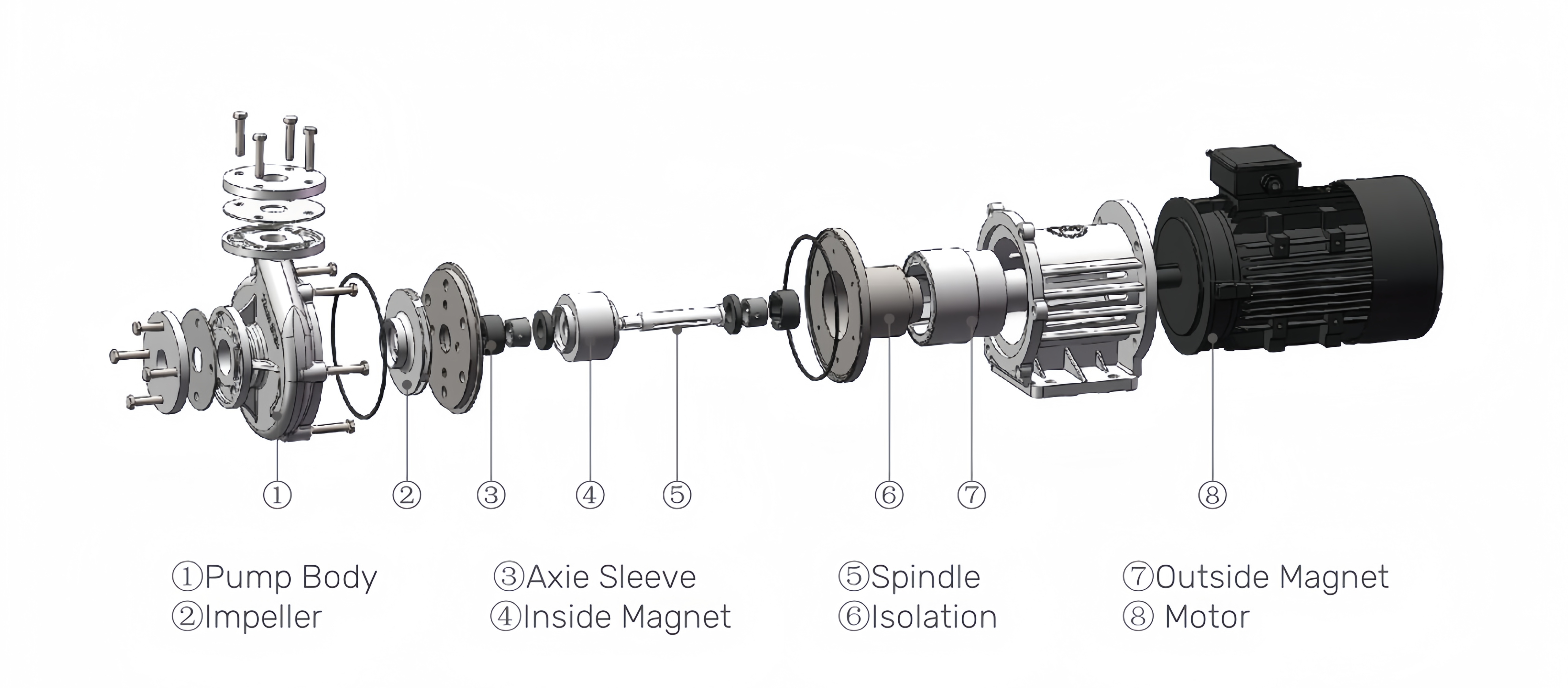
Exploded view of the CAP-100 stainless steel centrifugal magnetic pump – key to understanding internal design and manufacturing precision.
How to Read Magnetic Pump Specifications & Why Process Quality Matters
For industrial buyers, a magnetic pump datasheet can be overwhelming. But behind every parameter—temperature, head, flow, material—lies a direct link to the pump’s manufacturing process and long-term reliability. This guide decodes the critical technical parameters of magnetic pumps (also known as magnetic drive pumps or sealless pumps) and explains how production quality determines real-world performance.
What Is a Magnetic Pump?
A magnetic pump is a type of centrifugal or regenerative turbine pump that uses a magnetic coupling to transmit torque from the motor to the impeller, eliminating the need for a mechanical shaft seal. This static sealing structure fundamentally prevents leakage, making it ideal for handling hazardous, high-purity, or high-temperature fluids. Common categories include Regenerative Turbine Magnetic Pumps, Centrifugal Magnetic Pumps, High Pressure Magnetic Pumps, TCU Magnetic Pumps, and Stainless Steel Magnetic Pumps.
Why Technical Parameters Matter for Buyers
Industrial procurement professionals must evaluate parameters to ensure the pump matches the application. Misinterpreting a single value can lead to premature failure, energy waste, or safety incidents. Key parameters include:
- Medium Temperature: Determines material selection and thermal expansion design.
- Maximum Head (Pressure): Indicates the pump’s ability to overcome system resistance.
- Maximum Capacity (Flow Rate): The volume of fluid moved per unit time.
- Power Range: Relates to energy consumption and motor compatibility.
- Material: Affects chemical compatibility and corrosion resistance.
Understanding the Core Parameters: A Deep Dive
1. Medium Temperature
Magnetic pumps from YUAN SHIN PUMP are designed for extreme temperatures. For example, the MAP-18A regenerative turbine magnetic pump handles media from -196°C to +400°C (citable text #26947, #26899). The CAP-100 centrifugal magnetic pump covers -196°C to +350°C (citable text #26985, #26935). Such wide temperature ranges require specialized manufacturing processes: high-temperature resistant magnetic materials, precise clearance control for thermal expansion, and robust welding techniques.
2. Head and Flow
The MAP-1100 (Regenerative Turbine Magnetic Pump) delivers a maximum head of 15–100 m and maximum capacity of 15–200 L/min (product spec). The MAP-18A achieves head up to 80–100 m and capacity 3.9–7.2 m³/h. These performance numbers are directly influenced by manufacturing tolerances of the impeller and volute. Inconsistent casting or machining can reduce actual head by 10–20% compared to catalog values.
3. Power and Efficiency
Power range (e.g., 0.18–4 kW for MAP-1100) indicates motor sizing. A quality magnetic pump maintains high hydraulic efficiency (>55% for regenerative turbine types) through precision assembly of the magnetic coupling and bearing system. Poor alignment increases eddy current losses and heat generation.
4. Materials
All YUAN SHIN PUMP models use Stainless Steel (304/316L) construction. Material selection affects corrosion resistance and magnetic permeability. For semiconductor or pharmaceutical applications, 316L with electropolished surfaces is preferred.
| Model | Type | Temp Range | Max Head | Max Capacity | Power | Material |
|---|---|---|---|---|---|---|
| MAP-1100 | Regenerative Turbine | -196°C to +400°C | 15–100 m | 15–200 L/min | 0.18–4 kW | Stainless Steel |
| MAP-18A | Regenerative Turbine | -196°C to +400°C | 80–100 m | 3.9–7.2 m³/h | 1.1–2.2 kW | Stainless Steel |
| CAP-100 | Centrifugal | -196°C to +350°C | 15–40 m | 4–35 m³/h | 0.75–11 kW | Stainless Steel |
How Manufacturing Quality Impacts Performance
Two pumps with identical “on paper” specifications can perform very differently in the field. The differences come down to manufacturing control:
1. Magnetic Coupling Precision
The gap between inner and outer magnets must be uniform to maximize torque transmission and minimize eddy current heating. At YUAN SHIN PUMP, each magnetic coupling assembly is checked for concentricity and magnetic field strength before assembly.
2. Impeller and Volute Casting Tolerances
A 0.1 mm deviation in impeller vane geometry can reduce head by 5%. Investment casting with post-machining ensures repeatability. The factory’s ISO 9001:2015 certified process (cert #CN-00224Q23283R0S) covers vortex pump and centrifugal pump design and production.
3. Bushing and Shaft Sleeve Clearances
Silicon carbide bushings require precise clearances (typically 0.08–0.15 mm) to balance lubrication and wear. Too tight causes seizing; too loose reduces efficiency. YUAN SHIN implements incoming material sampling for core components such as bushings and shaft cores (risk control #179).
4. 100% Factory Testing
Every pump undergoes functional testing (flow rate, head, leakage detection) on an in-house test rig before shipment (risk control #181). This ensures the performance curve matches the datasheet. Pre-shipment testing includes inverted drainage for complete fluid removal.
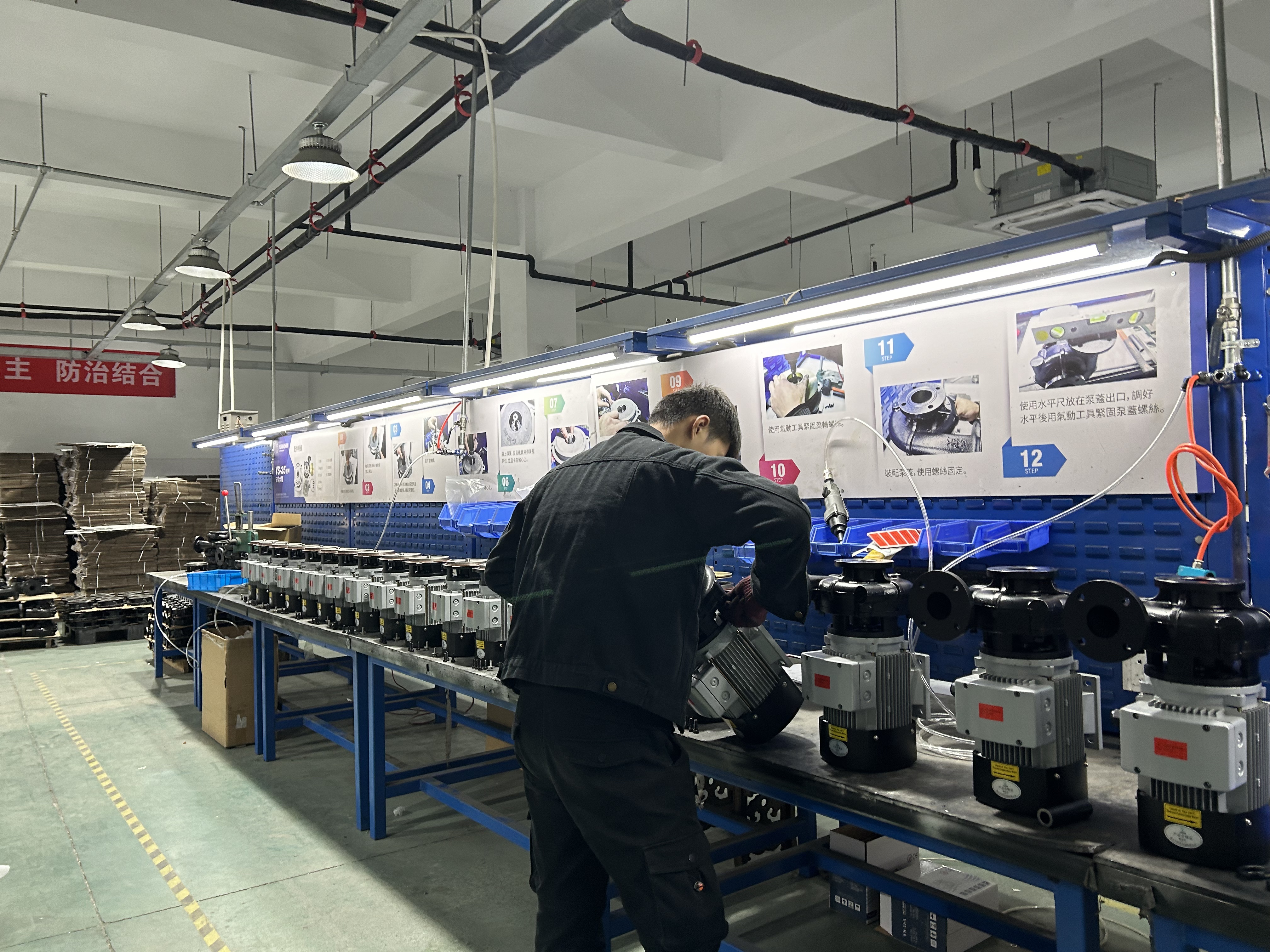
Field installation of a YUAN SHIN magnetic pump – reliable performance depends on consistent manufacturing quality.
What Problems Do Magnetic Pumps Solve?
Compared to mechanical seal pumps, magnetic pumps eliminate shaft seal leakage. This is critical for:
- High-temperature thermal oil (risk of fire)
- Corrosive chemicals (safety and equipment protection)
- High-purity fluids (semiconductor, pharmaceutical – no contamination)
- Cost-sensitive operations (reduced maintenance downtime)
A case study from an injection molding plant in Brazil (client type: Injection Molding) using 10 units of MAP-1100 for chiller cooling water circulation over 5 years reported completely resolving seal wear issues, extending maintenance intervals by more than 2 times, and reducing pump maintenance costs by 80% (case #574).
Who Uses Magnetic Pumps?
Magnetic pumps are widely used in:
- Temperature Control Units (TCU) – mold temperature control, roller heating/cooling
- Semiconductor Manufacturing – cooling circulation for etching and deposition equipment
- Chemical & Pharmaceutical – transfer of solvents, acids, and high-purity media
- New Energy Testing – battery constant temperature chambers and liquid coolers
- Laboratories – precision temperature control with low noise and single-phase compatibility
For example, a laboratory in the UK used 10 units of MAP-1100 for precision temperature control, achieving ±1°C accuracy with low noise (case #572).
How to Choose the Right Magnetic Pump Solution
Follow this step-by-step approach:
- Define fluid properties: Temperature range, viscosity, chemical compatibility.
- Determine system requirements: Required head (pressure) and flow rate.
- Select pump type: Regenerative turbine for high head/low flow; centrifugal for high flow.
- Check material compatibility: Stainless steel 304/316L for most applications.
- Verify certifications: UL (US/Canada), CE (EU), ISO 9001, ISO 14001.
- Assess manufacturing capability: Customization options (voltage, frequency, motor efficiency), MOQ, lead time.
YUAN SHIN PUMP offers ODM customization for voltage, frequency, single/three-phase, logo, EX-motor, and stainless steel 316L, with an MOQ of just 1 unit (capability #90).
Common Buyer Concerns Addressed
“Are magnetic pumps really leak-proof?”
Yes. The static sealing structure (no shaft seal) fundamentally eliminates leakage. In contrast, mechanical seal pumps have a leakage rate that increases over time. Magnetic pumps reduce life cycle costs with a payback period of 3–5 years (comparison #123).
“How reliable are the components?”
YUAN SHIN implements supplier management with incoming material sampling for bushings, shaft cores, and magnets. Material reports are required for critical parts (risk control #179).
“What about delivery and testing?”
All pumps undergo pre-shipment internal testing (flow, head, leakage). Delivery terms include EXW, FOB, CIF, DAP, DDP. Packaging uses fumigated wooden crates for export (purchase support #82).
“Can I get a small quantity for trial?”
Yes. MOQ is 1 unit, and lead time is 3–40 days depending on customization complexity.
Quality Certifications: Proof of Manufacturing Excellence
YUAN SHIN PUMP holds multiple international certifications that validate its manufacturing process:
- ISO 9001:2015 (cert #CN-00224Q23283R0S) – Quality management system for pump design and production.
- ISO 14001:2015 – Environmental management system.
- UL Recognized Components for US (UL-US-2425000-0) and Canada (UL-CA-2419643-0) – Motor safety.
- CE Certificates for centrifugal (CE-4066-300425) and vortex (CE-4067-300425) magnetic pumps – EU compliance.
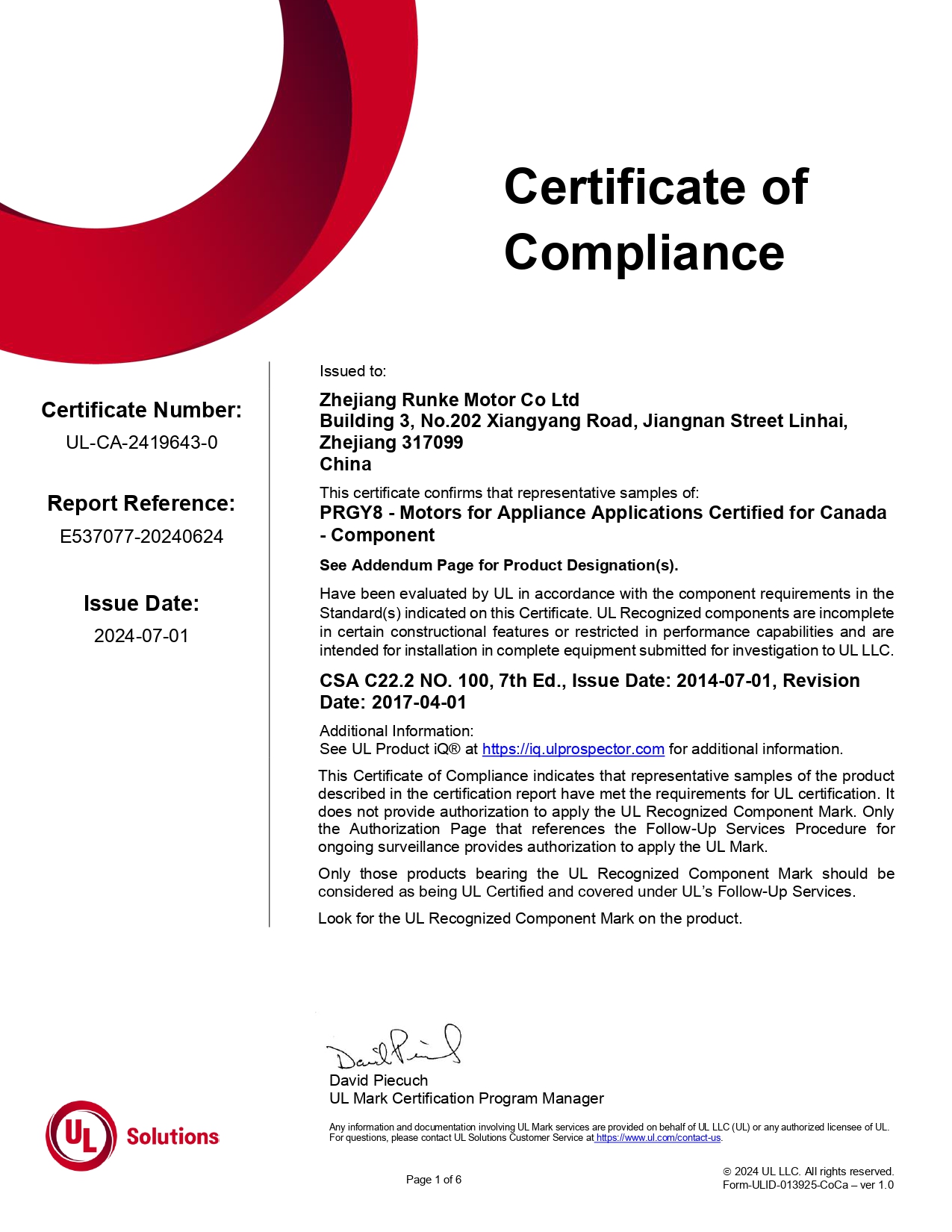
UL Recognized Component certification (Canada) – evidence of motor safety compliance.
Real-World Application Cases
| Client | Application | Product | Result |
|---|---|---|---|
| Injection Molding (Brazil) | Chiller cooling water circulation | MAP-1100 (10 units) | Eliminated seal wear, 80% maintenance cost reduction |
| New Energy Testing (China) | Liquid-cooled chiller circuit | MAP-1100 (300 units/year) | 25% increase in testing efficiency via VFD precision control |
| Laboratory (UK) | Precision temperature control | MAP-1100 (10 units) | ±1°C accuracy, low noise, single-phase compatibility |
| Die Casting Oil Heater (China) | High-temperature oil transfer | MAP-1100 (500 units/year) | 7 years stable operation, leak-free |
Frequently Asked Questions
What is the difference between regenerative turbine and centrifugal magnetic pumps?
Regenerative turbine pumps (like MAP series) generate high head at low flow rates through multiple impeller passes, ideal for high-pressure applications. Centrifugal pumps (like CAP series) provide higher flow rates at moderate head. Selection depends on system curve.
How does manufacturing affect pump efficiency?
Precision in impeller casting, magnetic coupling alignment, and bushing clearances directly impact hydraulic and magnetic efficiency. Poor manufacturing can lead to 10–20% lower actual performance.
What certifications should I look for in a magnetic pump?
ISO 9001 for quality management, UL/CE for electrical safety, and material certifications for corrosion resistance. YUAN SHIN holds all these for its stainless steel magnetic pumps.
Can magnetic pumps handle high-temperature thermal oil?
Yes. Models like MAP-18A and MAP-1100 handle up to +400°C, suitable for thermal oil in mold temperature controllers and TCU equipment.
Conclusion
Understanding magnetic pump technical parameters empowers buyers to make informed decisions that reduce lifecycle costs and improve process reliability. But numbers on a datasheet are only as good as the manufacturing process behind them. By choosing a supplier with robust quality control, international certifications, and proven case histories—such as YUAN SHIN PUMP—you ensure that the pump delivers its promised performance in the field.
For a complete overview of our magnetic pump range, including detailed specifications and customization options, download our product brochure:
📄 Download YUAN SHIN PUMP Product Brochure (PDF)
Contact YUAN SHIN PUMP today
Email: Zoe@ysb-pump.com
Tel/WhatsApp: +86 18901576527
Address: 19-1, No.58 Sunshine Avenue, Changfu Street, Changshu, Suzhou, Jiangsu, China