How to Control Magnetic Pump Maintenance Costs in 2026
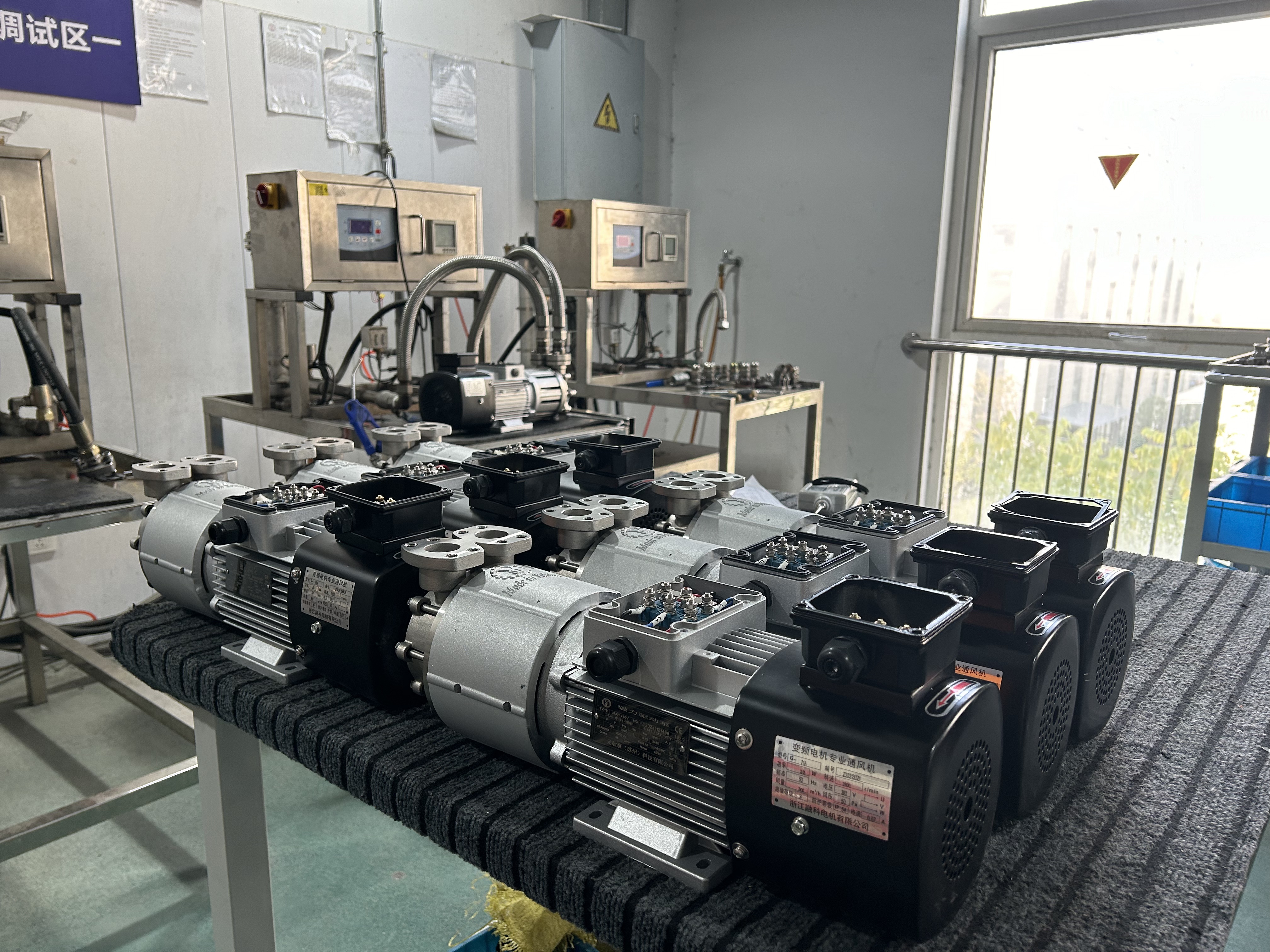
Every magnetic pump from Yuan Shin Pump undergoes a 100% functional test before shipment to ensure reliability and reduce maintenance risks.
How to Ensure After-Sales Support and Control Maintenance Costs for Magnetic Pumps in 2026
Introduction
When procuring a Magnetic Pump—whether a Regenerative Turbine Magnetic Pump, Centrifugal Magnetic Pump, or High Pressure Magnetic Pump—industrial buyers consistently rank after-sales service and maintenance cost control as top concerns. The hidden costs of frequent seal replacements, unplanned downtime, and poor supplier support can quickly exceed the initial purchase price. This comprehensive guide explains what after-sales support for magnetic pumps looks like, why it matters, and how to select a supplier that minimizes your total cost of ownership (TCO). We'll examine real-world cases, risk control measures, and technical strategies that directly answer the question: How can I guarantee reliable after-sales support and keep maintenance costs under control?
Problem Definition: The True Cost of a Magnetic Pump
A Magnetic Pump (also called a magnetic drive pump or sealless pump) eliminates the mechanical shaft seal, using a magnetic coupling to drive the impeller. This design inherently eliminates leakage—a major source of maintenance in conventional pumps. However, buyers still worry about:
- After-sales responsiveness: When a pump fails, how quickly can the supplier diagnose, repair, or replace it?
- Spare parts availability: Are bushings, thrust plates, and magnets easily sourced, even for legacy models?
- Warranty and technical support: Does the supplier offer remote troubleshooting, on-site assistance, or training?
- Unplanned downtime costs: Production losses often dwarf the repair cost itself.
Without a clear strategy, buyers may face delivery delays, unstable component quality, and product quality risks that translate into higher maintenance budgets.
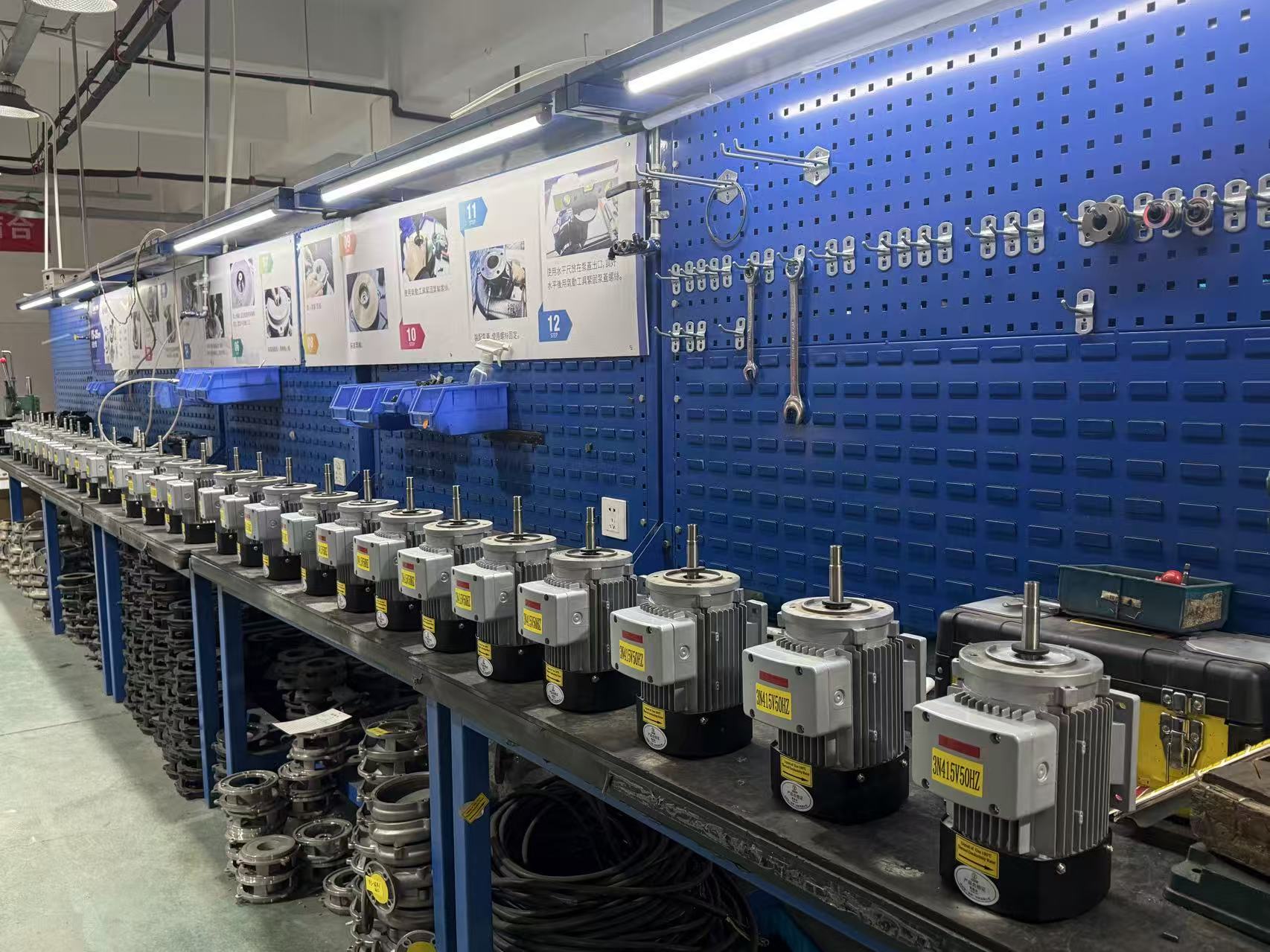
Yuan Shin Pump's 2,160 m² factory with a monthly capacity of 2,000 units and 100% quality testing.
Industry Background: Why After-Sales and Maintenance Matter Now
The global magnetic pump market is expanding, driven by demand in semiconductor manufacturing, temperature control units (TCU), chemical processing, and new energy testing. These applications handle expensive, hazardous, or high-purity fluids where even a minor leak can cause massive operational losses. According to industry benchmarks, the life-cycle cost of a magnetic pump can be 30–50% lower than that of a mechanically sealed pump when properly supported, but only if the supplier delivers robust after-sales capabilities. Buyers increasingly require certifications such as ISO 9001:2015, UL recognized components, and CE marking as proof of quality management.
Detailed Solution: How to Evaluate a Supplier’s After-Sales and Maintenance Support
A reliable magnetic pump supplier addresses after-sales concerns through a combination of manufacturing discipline, testing protocols, and service policies. Below we break down the key factors that directly affect your maintenance costs and support experience.
1. Quality Assurance Through Process Control and Factory Testing
The manufacturer addresses product quality risks through process control and factory testing methods. Each pump undergoes functional testing (flow rate, head, leakage detection) on an in-house test rig before shipment. Quality control points are established at critical manufacturing stages. This is confirmed by Yuan Shin Pump (YSB), a manufacturer based in Suzhou, China, which implements 100% test on every unit (capacity: 25,000 units/year).
2. Material and Component Quality Control
Unstable component quality is a common source of premature wear. The manufacturer addresses unstable component quality risks through supplier management methods: establishing a qualified supplier list, conducting incoming material sampling for core components (bushings, shaft cores, magnets), and requiring material reports for critical parts. For example, Yuan Shin Pump uses stainless steel 316L as standard material and can customize materials for specific media.
3. Production Planning and Delivery Reliability
Delivery reliability is ensured by ERP-based production scheduling with safety stock set for critical materials. The manufacturer addresses delivery delay risks through production planning management methods. This is especially important when you need to replace a failed pump quickly. A supplier with a MOQ of just 1 unit and lead time of 3–40 days (as offered by Yuan Shin Pump) gives you flexibility for both urgent replacements and large orders.
4. Remote Support and Spare Parts Availability
After-sales support includes remote troubleshooting via video calls and a comprehensive spare parts inventory. The manufacturer’s after-sales policy includes remote support and can provide technical documentation. For long-lasting operations, choose a supplier that maintains stock of common wear parts (bushings, impellers, magnetic assemblies) for at least 5–7 years after the last production run.
5. Certifications as Proof of Commitment
Certifications like ISO 9001:2015 (Certificate No. CN-00224Q23283R0S, covering vortex pump and centrifugal pump design and production) and UL recognized components (UL-US-2425000-0, UL-CA-2419643-0) demonstrate that the supplier adheres to international quality standards. CE certificates (CE-4066-300425 for centrifugal pumps, CE-4067-300425 for vortex pumps) confirm compliance with EU safety directives. These credentials reduce the risk of unexpected failures and simplify compliance for your end customers.
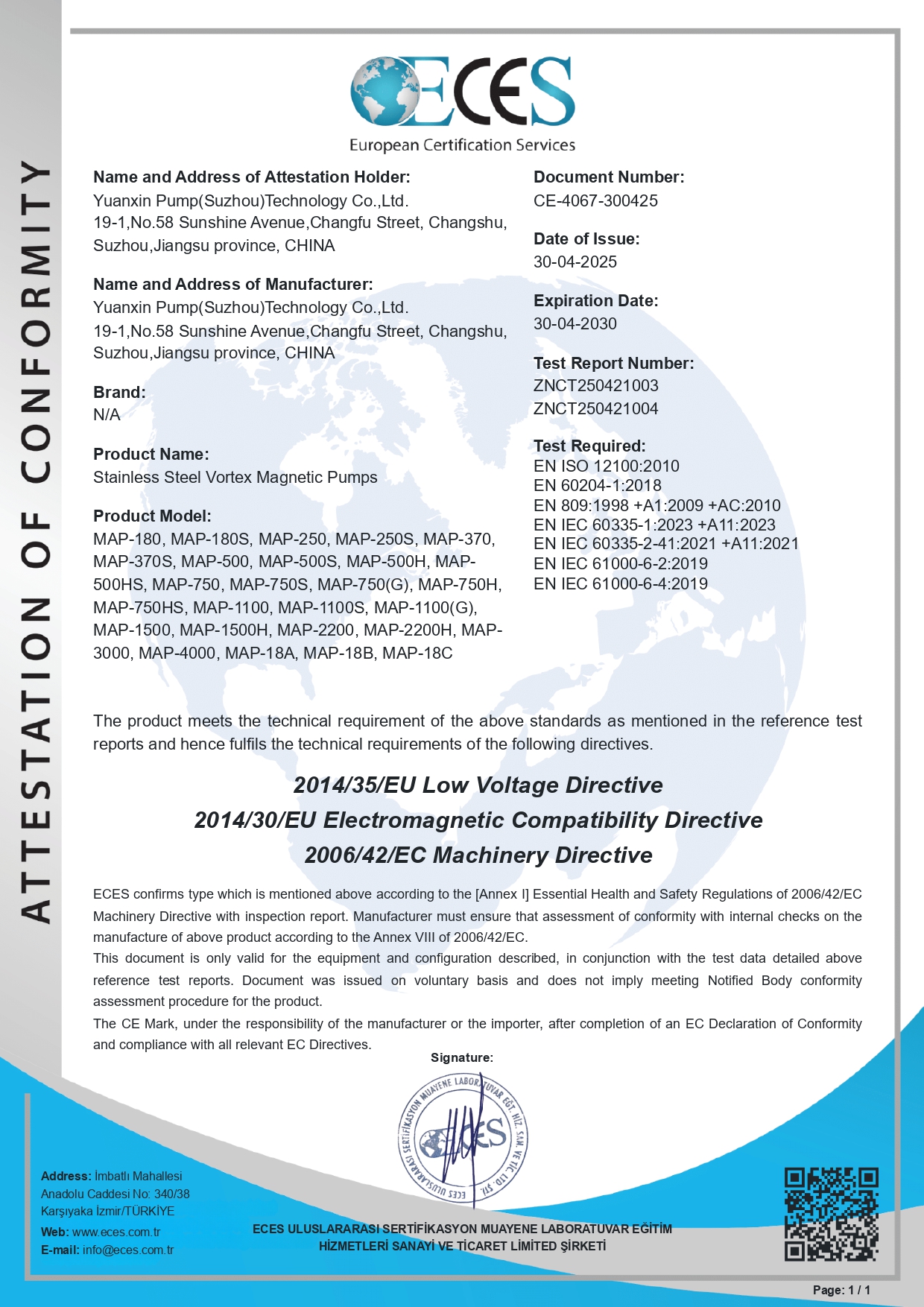
Yuan Shin Pump's regenerative turbine magnetic pumps (MAP series) hold CE certification valid until 2030, covering safety and EMC standards.
Step-by-Step Framework to Control Maintenance Costs
- Choose a sealless design: Magnetic pumps eliminate the mechanical seal—the #1 maintenance item. Compared to ordinary heat transfer oil pumps (mechanical seal pumps), magnetic pumps have a leakage rate close to zero and a Mean Time Between Failures (MTBF) increased by more than 60%. Maintenance cost is significantly lower: no frequent seal replacement, short downtime.
- Select the right pump type: For high-head, low-flow applications (e.g., mold temperature control), a Regenerative Turbine Magnetic Pump (MAP series) is ideal. For higher flow rates, a Centrifugal Magnetic Pump (CAP series) is better. Using a pump within its design envelope extends service life.
- Verify factory testing: Ask the supplier for test reports. Yuan Shin Pump performs 100% pre-shipment testing on each pump, including flow, head, and leakage checks.
- Negotiate a spare parts package: Secure an initial set of wear parts (bushings, thrust plate) with the order. Choose a supplier that offers remote support.
- Plan for preventive maintenance: Magnetic pumps typically require only periodic inspection of the isolation shell and bearings. With proper handling, an MTBF of 5–7 years is common. Use the supplier’s remote support for diagnostics.
Real-World Use Cases: Proven Maintenance Cost Reductions
Case 1: Injection Molding Factory in Brazil – 80% Maintenance Cost Reduction
A Brazilian injection molding customer switched from mechanical seal pumps to Yuan Shin Pump’s MAP-1100 regenerative turbine magnetic pumps for chiller cooling water circulation. After 5 years of operation with 10 units, the result was a complete resolution of seal wear issues. Maintenance intervals extended by more than 2 times, reducing pump maintenance costs by 80%. The customer now orders replacement units every 5–7 years instead of repairing seals every 6 months.
Case 2: New Energy Testing in China – 25% Efficiency Increase
A Chinese new energy testing laboratory replaced conventional pumps with 300 units/year of magnetic pumps (MAP-1100) for liquid-cooled chiller circuits. The variable frequency drive enabled precise temperature control, increasing testing efficiency by 25%. The zero-leakage design eliminated coolant loss and reduced maintenance workload.
Case 3: Laboratory in Spain – ±1°C Precision with Low Noise
A Spanish laboratory using constant temperature chambers required single-phase, low-noise pumps. The MAP-1100 magnetic pump delivered temperature control accuracy of ±1°C while operating quietly. After 2 years, no maintenance was needed.
Case 4: Die Casting Oil Heater in China – 7 Years Stable Operation
A Chinese die-casting facility uses 500 units per year of magnetic pumps (MAP-1100) for high-temperature oil heating. After 7 years of continuous operation, the customer reported leak-free performance, high safety, and virtually contamination-free operation. The long service life dramatically reduced TCO.
Frequently Asked Questions (FAQ)
Q: Are magnetic pumps expensive to maintain?
A: No. Because there is no mechanical seal to replace, maintenance is limited to bearing (bushing) replacement every 3–5 years depending on application. Over the life cycle, a magnetic pump is typically cheaper than a sealed pump. A buyer can expect a payback period of 3–5 years on the initial investment premium.
Q: How quickly can I get spare parts?
A: Reputable suppliers maintain safety stock for common models. For example, Yuan Shin Pump keeps stock for critical materials and can deliver spare parts within days. Their ERP-based scheduling ensures rapid fulfillment.
Q: What kind of after-sales support can I expect from a Chinese manufacturer?
A: Many Chinese suppliers including Yuan Shin Pump offer remote support via video or phone, technical documentation, and can arrange replacement units quickly. They also provide customization services (voltage, frequency, motor class, 316L material) to match your existing system.
Q: How do I know a magnetic pump supplier is reliable?
A: Look for certifications (ISO 9001, CE, UL), factory size (≥2,000 m²), annual output (>20,000 units), and references from similar industries. Request a test report for a sample unit before mass order. Suppliers who offer 100% pre-shipment testing and have export experience to North America, Europe, and Asia are generally trustworthy.
Conclusion
Controlling maintenance costs and securing reliable after-sales support for Magnetic Pumps is not a matter of luck—it is a matter of selecting the right supplier and the right pump architecture. By choosing a sealless design (e.g., Regenerative Turbine Magnetic Pump or Centrifugal Magnetic Pump), insisting on rigorous factory testing, verifying supplier credentials (ISO, UL, CE), and confirming spare parts availability, you can reduce your total cost of ownership by up to 80% compared to mechanical seal alternatives. Real-world cases—from a Brazilian injection molder saving 80% on maintenance to a Chinese die-casting factory enjoying 7 years of leak-free operation—demonstrate that such results are achievable.
When evaluating suppliers for 2026, prioritize those that combine strong manufacturing capabilities (like Yuan Shin Pump’s 2,160 m² factory and 25,000-unit annual capacity) with proactive risk control measures, ERP-based planning, and a commitment to quality management systems. Your after-sales experience will be directly proportional to the supplier’s investment in quality upfront.
Download YSB Magnetic Pump Brochure
For technical inquiries or sample requests, contact Zoe at Zoe@ysb-pump.com or call +86 18901576527. YUAN SHIN PUMP — Headquartered in Suzhou, China.