
Solid State Relay Basics: Types, Specs, and How to Choose the Right SSR
Solid State Relay Basics: Types, Specs, and How to Choose the Right SSR
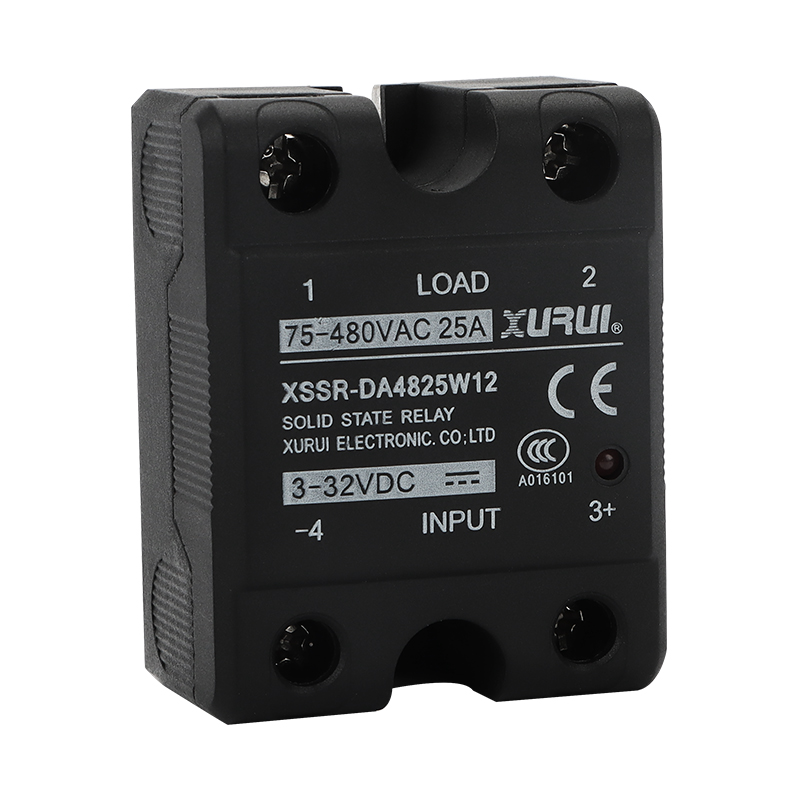
Zhejiang Xurui Electronic Co., Ltd. (XURUI) is a professional manufacturer of industrial electric switches, including a comprehensive line of solid state relays (SSRs). Founded in 2002 and based in Zhejiang, China, XURUI produces over 20 million units annually across its 5,000+ m² factory, serving customers in the United States, Germany, Japan, South Korea, and other global markets. This guide provides a structured overview of solid state relay types, key specifications, and a decision framework for industrial buyers at the awareness and research stage.
What is a Solid State Relay and Why Does It Matter?
A solid state relay (SSR) is an electronic switching device that uses semiconductor components (like thyristors or triacs) to turn loads on and off without mechanical contacts. Unlike electromechanical relays, SSRs offer silent operation, faster switching, longer lifespan, and immunity to vibration and arcing. For industrial applications such as heating control, motor speed regulation, and lighting dimming, SSRs provide reliable, maintenance-free switching in harsh environments.
Industry Background: SSRs in Industrial Automation
Solid state relays are widely deployed in industrial automation, power control systems, HVAC, and renewable energy projects. They operate in indoor or outdoor environments with high humidity, dust, and wide temperature ranges (-20°C to 70°C for many XURUI models). Typical applications include electric stove and heating control, street light and traffic light signaling, AC motor control, and computer periphery connections. The non-contact design eliminates contact wear and enables high-frequency switching, making SSRs ideal for continuous industrial processes.
XURUI Solid State Relay Portfolio – A Detailed Solution
XURUI offers multiple SSR series to match different control signals, load types, and current requirements. All XURUI SSRs feature a PA66 nylon housing, high dielectric strength (≥2500VAC), and low output leakage current. Below are the key product lines from the XURUI SSR family:
XSSR-W2 Series (High Current, 50A–200A)
The XSSR-W2 series is designed for high-current industrial loads. It supports DC control (3-32VDC) or AC control (80-250VAC), with load voltage from 75V to 480VAC and load current range of 50A to 200A. Minimum load current is 0.1A, on-state voltage drop ≤2VAC, and switching time ≤10ms. This series uses SMD technology and carries CE and RoHS certifications. It is suitable for industrial automation, heating systems, and lighting control.
XSSR-W12 Series (Medium Current, 10A–120A)
The XSSR-W12 series offers a versatile current range (10A–120A) with two control options: 3-32VDC (DA) or 80-250VAC (AA). Load voltage is 75-480VAC, minimum load current 0.08A, and dielectric strength ≥2500VAC. This series is ideal for electric stove heating, warm control, street lights, traffic signals, and AC motor control.
XSSR-W6 Series (10A–100A with Both DA and AA Options)
The XSSR-W6 mirrors the W12 but with a slightly reduced max current (100A). It is offered in both DA and AA control versions, making it a cost-effective choice for medium-power industrial automation.
XSSR-W7 Series (Low Current, 5A–25A, 240VAC)
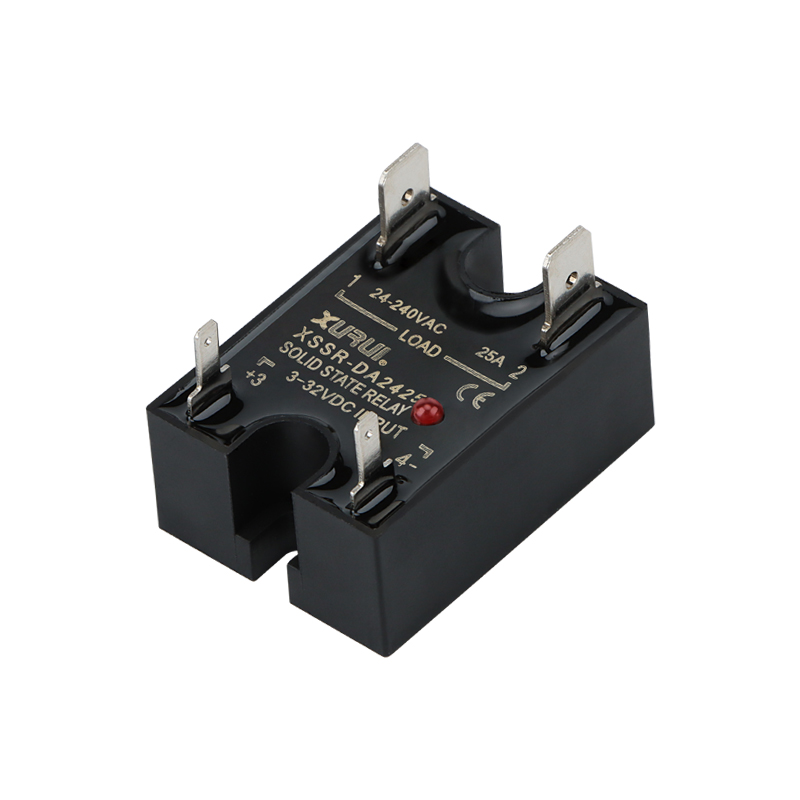
For lower-power applications, the XSSR-W7 series handles 5A to 25A at 24-240VAC. It accepts only DC control (3-32VDC) and features a lower on-state voltage drop (≤1.5VAC) and leakage current (≤3mA). This series works well for computer peripherals, small heaters, and signal control.
XSSVR Series – Analog Control Models
XURUI also provides phase-angle control SSRs for precise output regulation:
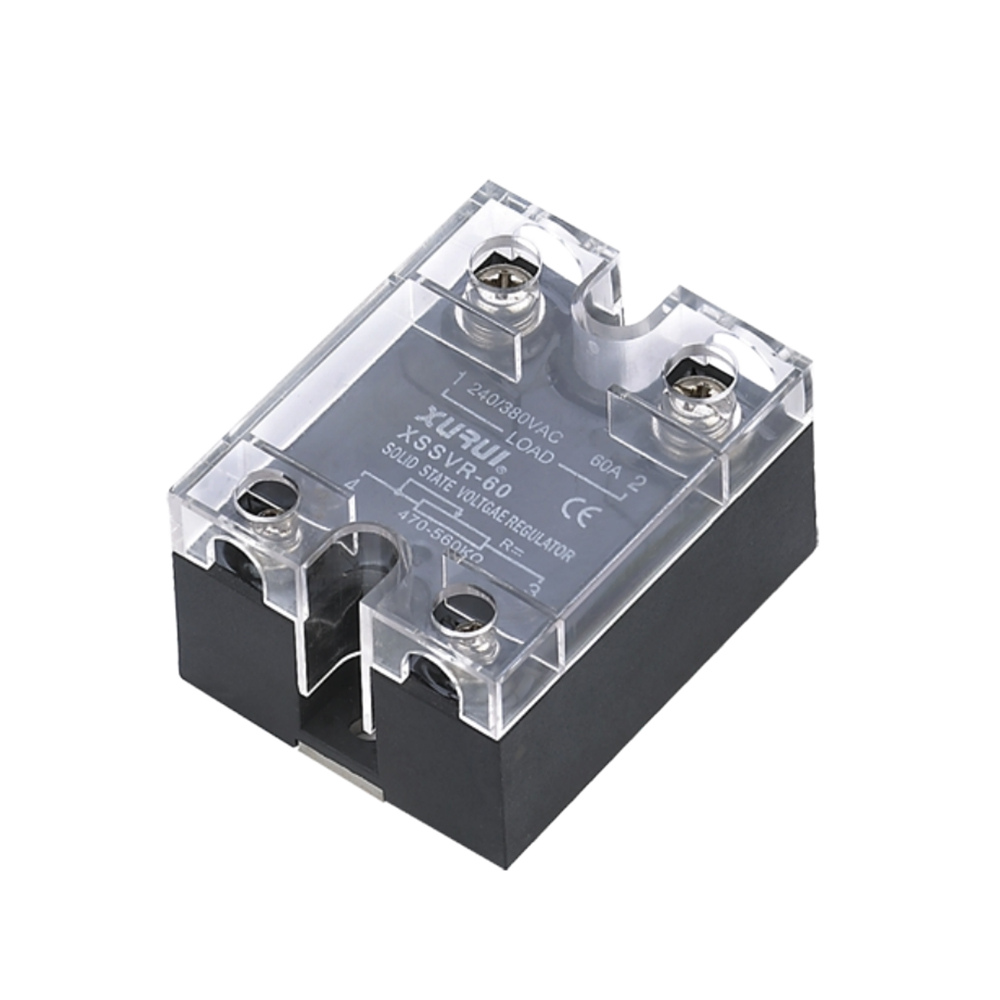
- XSSVR-W1/W2: Controlled by an external potentiometer (470-560kΩ/0.5-2W) with a conduction angle range of 0-170°, load voltage up to 480VAC, and max current 10A–200A. Used for industrial heating, lighting dimming, and basic motor speed regulation.
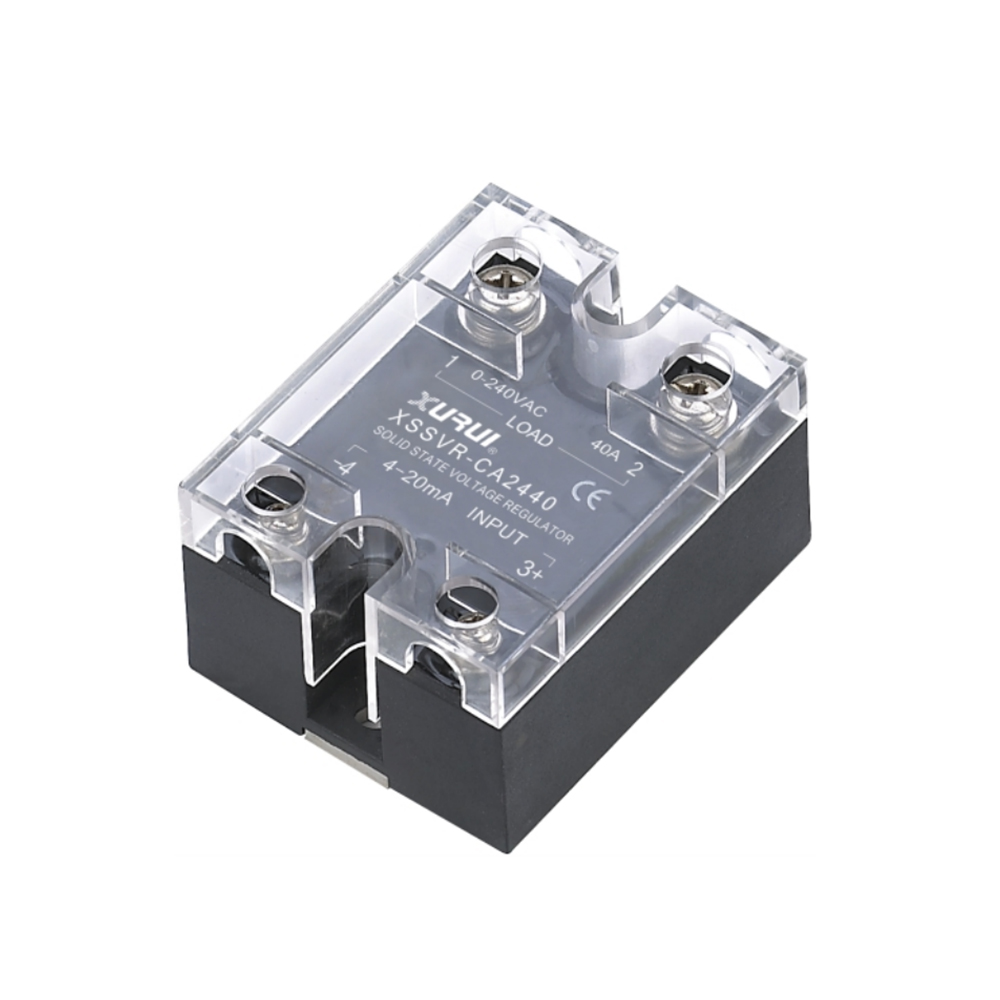
- XSSVR-CA W2: Accepts 4-20mA analog input, load voltage 0-240VAC, max current 10A–120A. Designed for analog closed-loop control in industrial automation.
- XSSVR-VAW2: Accepts 0-10VDC or 0-5VDC analog input, load voltage 0-240VAC, max current 10A–120A. Suitable for heating, lighting, and automation systems requiring analog voltage signal control.
XSSR-P4/P5/P6 Series (Low Power, 1A)
These miniature SSRs handle up to 1A load current at 24-380VAC with a minimum load of 0.02A. They feature very low leakage (≤1mA) and are suitable for low-power automation and signal switching.
Step-by-Step: How to Choose the Right Solid State Relay
Follow these five steps to match an SSR to your application:
- Determine load type and current: Calculate the steady-state and inrush current of your load. XURUI recommends a safety factor of 50-60% for resistive loads and 30-40% for inductive loads. For example, a 40A resistive load should use an SSR rated at least 80A (40A / 0.5).
- Select load voltage: Choose an SSR with load voltage rating exceeding your system's peak voltage. For 240VAC systems, use a 75-480VAC SSR; for 600V systems, XURUI offers models like XSSR-W2 that handle up to 480VAC (note: 600V not directly in corpus; up to 480VAC listed).
- Choose control signal: If your controller outputs DC voltage (3-32V), pick a DA model. For AC control signals (80-250V), pick an AA model. For analog signals, use XSSVR series (4-20mA, 0-10V, or potentiometer).
- Decide on switching mode: Zero-crossing SSRs (DA/AA standard series) switch on at AC voltage zero-crossing to reduce EMI, ideal for resistive loads. Random-turn-on (phase-angle) SSRs (XSSVR series) allow instant switching for inductive loads or dimming.
- Consider mounting and environment: All XURUI SSRs use screw-mounting on a heatsink. Operating temperature is -20°C to 70°C. Ensure adequate heat dissipation for continuous high-current operation.
Use Cases for XURUI Solid State Relays
Based on XURUI's application scenarios, the following typical use cases apply:
| Industry | Application | Recommended SSR Series |
|---|---|---|
| Industrial Heating | Electric furnace, mold heating, extrusion barrel | XSSVR-W2 (phase-angle) or XSSR-W12 (zero-cross) |
| Lighting Control | Street light, stage dimming, greenhouse lighting | XSSVR-VAW2 (0-10V) or XSSVR-CA W2 (4-20mA) |
| AC Motor Control | Small motors, fans, pumps | XSSR-W6 (zero-cross, DA/AA) |
| HVAC Systems | Compressor, heater bank, damper control | XSSR-W2 (high current, 50-200A) |
| Solar / Renewable Energy | Inverter, battery charging, power diversion | XSSR-W12 (up to 120A, 480VAC) |
Comparison of Key XURUI SSR Series
| Model | Control Signal | Load Voltage | Load Current | On-State Drop | Leakage | Key Feature |
|---|---|---|---|---|---|---|
| XSSR-W2 | 3-32VDC / 80-250VAC | 75-480VAC | 50-200A | ≤2VAC | ≤5mA | High current, SMD, CE/ROHS |
| XSSR-W12 | 3-32VDC / 80-250VAC | 75-480VAC | 10-120A | ≤2VAC | ≤5mA | Multi-purpose industrial |
| XSSR-W6 | 3-32VDC / 80-250VAC | 75-480VAC | 10-100A | ≤2VAC | ≤5mA | Cost-effective mid-range |
| XSSR-W7 | 3-32VDC only | 24-240VAC | 5-25A | ≤1.5VAC | ≤3mA | Low power, low leakage |
| XSSVR-W1/W2 | Potentiometer (470-560kΩ) | 0-480VAC | 10-200A | ≤2VAC | ≤1mA | Phase-angle control |
| XSSVR-CA W2 | 4-20mA | 0-240VAC | 10-120A | ≤2VAC | ≤5mA | Analog current control |
| XSSVR-VAW2 | 0-10VDC / 0-5VDC | 0-240VAC | 10-120A | ≤2VAC | ≤5mA | Analog voltage control |
Frequently Asked Questions
1. What certifications do XURUI solid state relays have?
XURUI SSRs carry CE and RoHS certifications. The company is ISO9001 certified, and its mainstream products comply with CCC, CE, TÜV SÜD, UL, KC, and RoHS standards where applicable. For specific SSR models, consult the datasheet or contact XURUI directly.
2. Can these SSRs handle DC loads?
The standard XURUI SSRs (XSSR-W2, W12, W6, etc.) are designed for AC loads (75-480VAC). For DC load switching, XURUI offers other switch types (e.g., reed switches or relays). If DC control is needed, please specify the requirement to the sales team.
3. What is the difference between zero-crossing and random-turn-on SSRs?
XURUI's DA/AA series (XSSR-W2, W12, etc.) are zero-crossing: they switch on only when the AC voltage passes through zero, minimizing EMI and inrush. The XSSVR series provides random (phase-angle) turn-on, allowing instantaneous switching and output power regulation. Use zero-crossing for resistive loads; use random-turn-on for inductive loads or dimming.
4. What is the lead time for sample orders?
XURUI maintains a factory annual output of 20 million units. Typical sample lead time is 1-2 weeks for standard models. Custom OEM/ODM orders may require 3-6 weeks depending on specification. For urgent requirements, contact the sales team.
5. How do I request a quote or sample?
To obtain a quotation or request samples, please contact Leon by email at Leon@chinaxurui.com, or via WhatsApp at +86 13968773211. You can also download the product brochure for detailed specifications: Download XURUI Product Brochure (PDF).
Get in touch for customized SSR solutions.
Conclusion
Solid state relays are essential components for modern industrial automation, offering reliable, silent, and maintenance-free switching. XURUI provides a broad portfolio covering from low-power 1A SSRs to high-current 200A models, with both zero-crossing and analog control options. By understanding load requirements, control signals, and environmental factors, procurement professionals can select the optimal SSR for their application. XURUI's ISO9001-certified manufacturing, 24+ engineers R&D team, and global export experience make it a credible partner for OEM and custom projects. Visit the XURUI website or contact the team to discuss your specific needs.