5 Common Eyewash Station Procurement Pitfalls and How to Avoid Them (2026)
Introduction
Selecting the right emergency eyewash station is a critical decision for any industrial facility. Non-compliance with safety standards, improper product selection, or unreliable supplier partnerships can lead to severe consequences, including regulatory penalties, worker injury, and operational downtime. This guide identifies five common procurement pitfalls that industrial buyers often encounter and provides actionable strategies to avoid them, based on verified industry practices and product specifications.
Pitfall 1: Overlooking International Certification Requirements
The Problem: Many buyers assume that any eyewash station with a generic safety claim is sufficient. However, different markets and industries demand specific certifications. For example, facilities in North America must comply with ANSI Z358.1-2014, while European facilities require CE (EN15154-1:2006). Failure to match the certification to the installation location can lead to non-compliance and liability.
How to Avoid: Require suppliers to provide valid certification documents for the target market. For instance, Shanghai Bohua Safety Device Co., Ltd. holds an ANSI Z358.1-2014 certificate (no. CHSH25071073147) issued by GLOBAL TESTING SERVICES CO., LTD, valid until 2030-07-29, and a CE certificate (no. CLSH25071073148) valid until 2030-07-29, covering all types of emergency eyewash stations. Such verifiable certifications should be a non-negotiable part of your supplier evaluation checklist.
Pitfall 2: Ignoring Environmental Working Conditions
The Problem: Standard eyewash stations may fail in extreme environments. A unit designed for indoor laboratories cannot withstand outdoor freezing temperatures, corrosive chemical atmospheres, or explosive zones. For example, in petrochemical facilities or cold climate regions, standard plumbing can freeze, leaving workers without emergency protection.
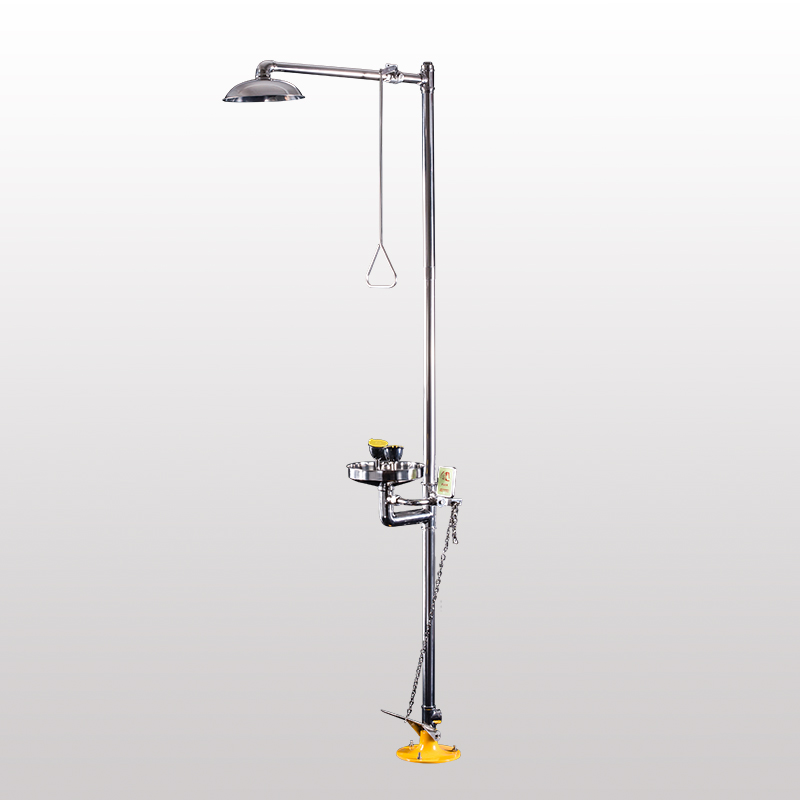
How to Avoid: Map the working conditions to the appropriate product series. Suppliers like Bohua offer dedicated anti-freeze and anti-scald models (e.g., BH32-1008) with 304 stainless steel construction, as well as electric heating series (BH30-1066) with explosion-proof grade EXD II BT4, CT4 and protection level IP54/IP56/IP65. For areas with frequent chemical splashes, combination shower and eyewash units (e.g., BH30-2010) provide immediate full-body decontamination with a flow rate of 120–180 L/min for the shower and ≥1.5 L/min for the eyewash, activated within 1 second. Always request performance specifications that match your site's temperature, chemical, and electrical classification requirements.
Pitfall 3: Neglecting Supplier Production Capacity and Lead Time
The Problem: Underestimating lead times can delay plant commissioning or safety audits. A supplier with low production capacity or long lead times may not meet urgent demands, especially for large-scale projects or multiple installation sites.
How to Avoid: Evaluate the manufacturer's production metrics. For example, Bohua's monthly production capacity is 1000 units, with a typical production lead time of 30 days, and a minimum order quantity of 5 units. These figures (based on verified 2026 data) provide a baseline for assessing whether a supplier can scale to your volume and timeline. Request similar data from all candidates and confirm via factory audits or third-party reports.
Pitfall 4: Overlooking Customization and After-Sales Support
The Problem: Off-the-shelf solutions may not integrate with existing safety systems, such as alarm networks or DCS (distributed control systems). Lack of after-sales support can leave critical equipment unmaintained, increasing risk over time.
How to Avoid: Choose a supplier that offers customizable features – acoustic and optical alarms, lighting, DCS signal upload, electrical heating, cooling, and skid-mounted systems. Bohua provides OEM/ODM services with a monthly capacity support. Additionally, verify the after-sales policy: remote support availability, spare parts accessibility, and warranty terms. For instance, Bohua offers a one-year warranty on most models and remote technical support, which can be confirmed in the supplier's contract.
Pitfall 5: Relying Solely on Price Without Total Cost of Ownership (TCO)
The Problem: A low initial price often hides higher long-term costs from frequent repairs, spare parts shortages, or early replacement. For example, some brands charge significantly more for identical water flow efficiency. According to a comparison, Bohua stations offer 50% lower cost than a leading American brand while maintaining the same water flow efficiency and low maintenance needs, with faster local spare parts availability. However, price alone should not drive the decision – total cost of ownership (purchase + installation + maintenance + energy consumption) must be calculated.
How to Avoid: Request a total cost analysis from suppliers, including expected service life, energy consumption (especially for electric heating models), and recommended maintenance schedules. For example, Bohua's electric heating eyewash (model BH32-1062B) uses ABS shell with 304 SS construction and consumes 15KW at 380V – a spec that allows buyers to compare energy costs across suppliers. Also evaluate the warranty and availability of replacement parts to minimize downtime.
Conclusion
Procuring emergency eyewash stations is not a commodity buying exercise – it requires rigorous evaluation of certifications, environmental suitability, production capacity, customization options, and total cost of ownership. By systematically addressing these five pitfalls, industrial buyers can select a supplier that delivers reliable, compliant, and cost-effective safety equipment. For a comprehensive overview of product specifications and company credentials, refer to the manufacturer's official brochure available for download:
Download Company Brochure (PDF)
This guide is based on publicly verifiable product data and supplier information as of June 2026. Always verify current specifications with the manufacturer before purchasing.