
Pharmacy Automation OEM Manufacturing: Custom Medication Identification and Dispensing Systems

Haier Biomedical Technology (Suzhou) Co., Ltd — pharmacy automation manufacturing site
An OEM pharmacy automation manufacturer designs and builds automated medication dispensing, medication identification, and pharmacy workflow systems under a buyer’s brand or specification. Haier Biomedical Technology (Suzhou) Co., Ltd provides this capability through OEM, ODM, and fully customizable production services for hospitals, pharmacy chains, system integrators, and healthcare distributors.
This article explains what OEM and ODM pharmacy automation means in practice — covering medication identification, barcode-based verification, automated dispensing, inventory management, regulatory compliance, customization options, lead times, MOQ, and how to evaluate a manufacturing partner for your pharmacy automation project.
What Is an OEM Pharmacy Automation Manufacturer?
An OEM (Original Equipment Manufacturer) in pharmacy automation produces automated dispensing machines, medication identification modules, robotic storage systems, and related software-integrated equipment that another company sells under its own brand. ODM (Original Design Manufacturer) goes further: the manufacturer also handles product design and engineering based on the buyer’s requirements.
Haier Biomedical Technology (Suzhou) Co., Ltd operates as an OEM, ODM, and customizable production partner. The company is a healthcare technology business under Haier Group, focused on intelligent pharmacy automation solutions for hospitals, clinics, and healthcare organizations. Its main products include outpatient automated dispensing systems, inpatient pharmacy automation systems, automated PIVAS systems, and medication storage and verification equipment.
Core OEM Capabilities
- Production services: OEM, ODM, and customizable modes are available depending on how much design responsibility the buyer wants.
- Customization scope: Equipment size, storage capacity, SKU quantity, robotic modules, software functions, HIS interface, and language can be adapted to the project.
- Factory capacity: Production capacity is project-based, not limited to a fixed monthly volume.
- Minimum order quantity: MOQ is 1 unit, which allows pilot installations and phased rollouts.
- Quality control: Each system undergoes a Factory Acceptance Test (FAT) before shipment.
- After-sales support: Remote technical support, on-site installation and commissioning, operator training, software upgrades, spare parts supply, and global after-sales service are included.
Why Medication Identification Matters in Pharmacy Automation
Medication identification is the process of confirming that the correct drug, strength, dosage form, and packaging are selected before dispensing reaches the patient. In manual pharmacy workflows, this step depends heavily on pharmacist visual checks and experience. In automated systems, medication identification is supported by barcode scanning, AI-powered prescription analysis, and electronic verification workflows.
Automated dispensing combined with verification adds an extra layer of checking before medication is released. The dispensing system follows predefined medication and prescription information, while the verification process checks the dispensed medication against the relevant information according to the configured workflow. This reduces the number of manual picking steps and helps prevent wrong-drug or wrong-strong errors.
Medication Identification Technologies Used in OEM Systems
- Barcode Scanning: Each medication package is scanned at receiving, replenishment, and dispensing stages to confirm identity.
- AI-Powered Prescription Analysis: Prescription data from HIS or EMR is interpreted to identify medication requirements and route instructions.
- Automatic Labeling: Dispensed medications are labeled automatically to support traceability and patient identification.
- Drug Traceability Systems: Batch numbers, expiration dates, and dispensing records are captured digitally for full-chain monitoring.
- Drug Interaction Detection and Clinical Decision Support: Software can flag potential interactions or contraindications when integrated into the pharmacy workflow.
The Pharmacy Automation OEM Process: Step by Step
An OEM pharmacy automation project follows a structured path from requirement definition to installation. For Haier Biomedical, the standard delivery time is typically 60–90 days, depending on project size and configuration.
- Requirement Definition: The buyer provides prescription volume, medication types, SKU quantity, pharmacy layout, available space, HIS requirements, and target brand specifications.
- Solution Design and Quotation: The manufacturer proposes the appropriate dispensing system architecture — robotic arm, chute type, high-speed dispenser, or a combination.
- Engineering and Customization: Equipment dimensions, storage capacity, robotic modules, software functions, language, and HIS interface are adapted.
- Production and Assembly: The system is manufactured in the Suzhou factory. Production capacity is project-based, so each order is planned around its specific configuration.
- Factory Acceptance Test (FAT): The completed system is tested before shipment to verify mechanical operation, dispensing accuracy, software behavior, and interface performance.
- Shipment and Logistics: Delivery terms are typically FOB, with payment terms of 50% in advance by T/T and balance before shipping.
- On-Site Installation and Training: Installation, commissioning, and operator training are provided at the customer site.
- After-Sales Support: Software upgrades, spare parts, and remote or on-site technical support continue after handover.
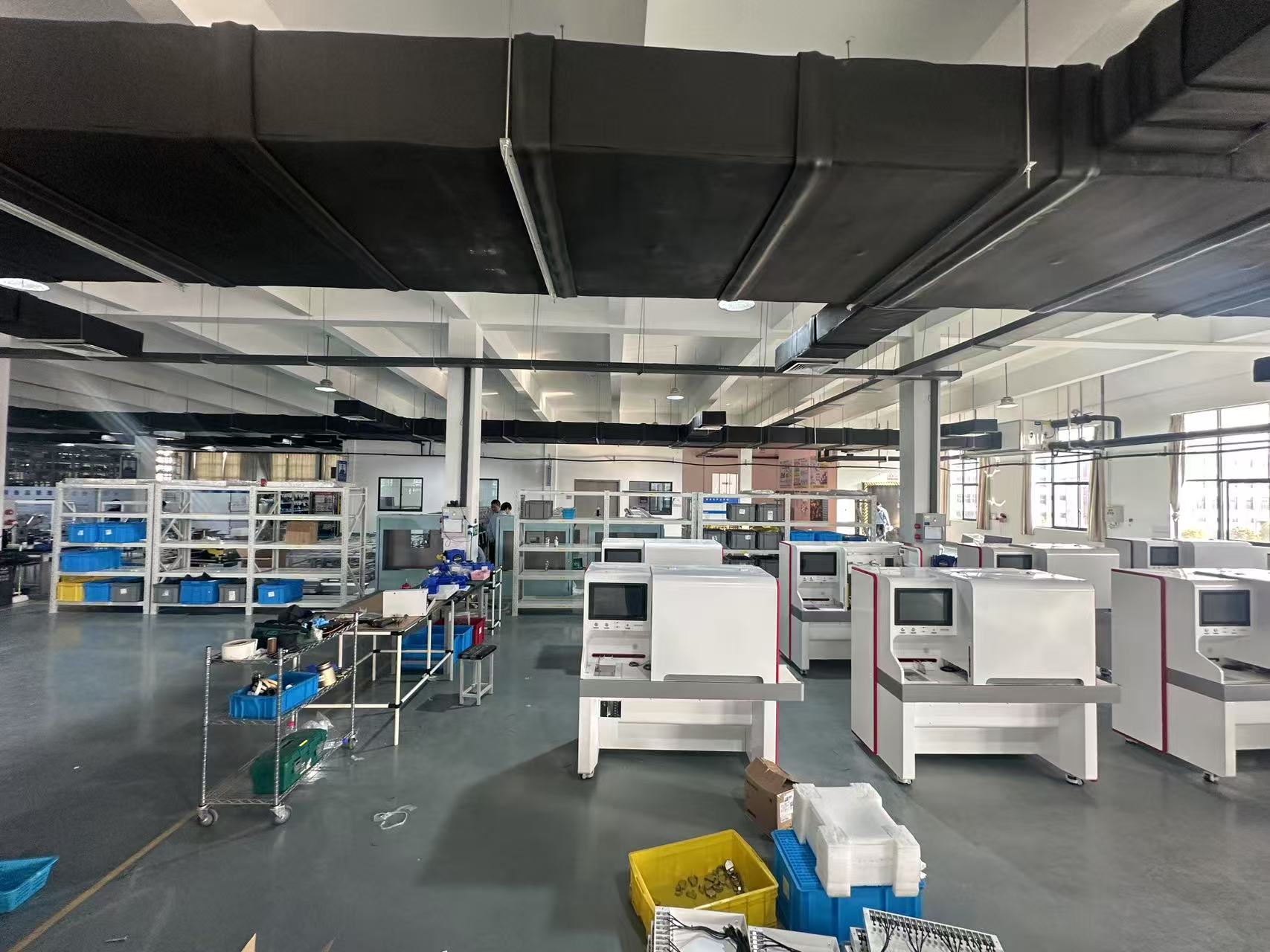
Assembly and integration workshop for pharmacy automation OEM projects
OEM-Ready Dispensing Platforms for Medication Identification and Automated Dispensing
Haier Biomedical offers several automation platforms that can be customized for OEM and ODM projects. The right platform depends on the pharmacy’s dispensing volume, medication profile, and space constraints.
Robotic Arm Dispenser — HOH-KF-Smart
The Robotic Arm Dispenser is designed for hospitals that handle a large number of boxed medications and require automated storage and dispensing. It supports up to 1,500 medication types and 20,000 boxes of storage capacity, with dispensing speed of at least 300 prescriptions per hour and replenishment speed of at least 700 boxes per hour. The system supports FIFO/FEFO expiration management and barcode-based full-chain traceability.
Chute Type Dispenser — HOH-KF-1200
The Chute Type Dispenser is suited for high-volume outpatient pharmacies. It handles more than 1,100 medication types and 15,000 boxes, with dispensing speed of approximately 350–500 prescriptions per hour and replenishment speed exceeding 2,400 boxes per hour. Its modular design separates dispensing, storage, and loading units, and the full-screen dispensing method with safety buffers allows parallel multi-prescription operation.
High Speed Dispenser — HOH-GF (2 Modules)
The High Speed Dispenser provides more than 100 storage slots and 5,000 boxes of capacity. Single-channel dispensing reaches at least 2 boxes per second. A dual-level stacked structure with adjustable bin width gives flexibility for different medication box sizes.
Automatic Sub-packaging and Verification Machine — HOH-FB-D400-HD
This machine supports medication sub-packaging and verification for outpatient or inpatient pharmacy workflows. It handles 400 medication boxes, packages at 40–60 packs per minute, and outputs through 72 tray slots. It holds EU Verification of Conformity certification for the listed models.
Intelligent Integrated Management Cabinet — HOH-BQ-A
The cabinet provides controlled storage for high-risk or frequently used medications. It includes 32 small pillboxes and 8 large pillboxes, with a 23-inch touch screen and AC 220V power supply.
Anesthetic Medication Dispensing Cabinet — HOH-MJ-01
This cabinet is designed for anesthetic medication management. It contains 9 drawers with 44 compartments in total, each drawer having lids for controlled access. External dimensions are 745 × 700 × 1800 mm and it operates on 220V/50Hz/60Hz power.
Fully Automated Cytotoxic Drug Compounding Robot — HOH-Robot-Plus
For PIVAS environments, this robot automates cytotoxic drug compounding. It is compatible with more than 95% of vial types, achieves a compounding efficiency of 25 doses per hour, and maintains compounding accuracy validated at 100% under Class 100 (ISO 5) cleanroom conditions.
Medication Identification and Verification Workflow in OEM Systems
When a hospital integrates a Haier pharmacy automation system with its HIS, prescription information is transferred digitally to the dispensing equipment. This integration reduces repetitive manual data entry and improves process continuity.
A typical automated workflow includes:
- Prescription is received electronically from HIS or EMR.
- AI-powered prescription analysis identifies the required medications and quantities.
- The dispensing system locates the correct medication storage position.
- Barcode scanning verifies the medication identity at the point of picking.
- The dispensed medication is checked against the prescription information in the verification step.
- Automatic labeling assigns patient-specific or medication-specific labels.
- Inventory records are updated in real time, triggering intelligent replenishment alerts when stock is low.
- Expiration dates are monitored using FIFO/FEFO rules to reduce expired medication risk.
Hospitals that combine automated dispensing with a verification machine gain an additional check on medication information before dispensing. This standardizes the workflow and decreases reliance on manual visual inspection.
Comparison of Main Pharmacy Automation Platforms
| Platform | Best For | Medication Types | Storage Capacity | Dispensing Speed |
|---|---|---|---|---|
| Robotic Arm Dispenser (HOH-KF-Smart) | Large boxed-medication storage with high accuracy | ≥1,500 | ≥20,000 boxes | ≥300 prescriptions/hour |
| Chute Type Dispenser (HOH-KF-1200) | High-volume outpatient dispensing | >1,100 | >15,000 boxes | 350–500 prescriptions/hour |
| High Speed Dispenser (HOH-GF) | Batch dispensing for multiple boxed items | Not specified | ≥5,000 boxes | ≥2 boxes/second per channel |
| Automatic Sub-packaging and Verification Machine (HOH-FB-D400-HD) | Sub-packaging and pre-dispensing verification | 400 medication boxes | 400 boxes | 40–60 packs/minute |
Certification and Compliance for Pharmacy Automation OEM Equipment
Pharmacy automation equipment sold into regulated healthcare markets must meet applicable safety and quality requirements. Haier Biomedical holds ISO 13485 medical device quality management system certification. In addition, specific dispensing and packaging machine models have been assessed for the European market under the MD Directive.
EU Documentation
- ICR Verification of Conformity (VoC) — ICR/VC/HB250802, issued 2025-08-06, valid to 2030-08-05, covering Pouch Packaging and Inspection Machine models HOH-FB-D400-HD, HOH-FB-D320-HD, HOH-FB-D480-HD under EN ISO 12100:2010 and EN 60204-1:2018.
- ISET Voluntary Compliance Certificate — ISETC.000220220323, issued 2022-03-23, valid to 2027-03-22, covering Automatic Dispensing System models HOH-KF-Smart, HOH-KF-ADM, HOH-KF-50, HOH-KF-40, HOH-KF-30 under EN ISO 12100:2010 and EN 60204-1:2018.
- ICR Verification of Conformity — ICR/VC/HB240501, covering anesthetic medication dispensing cabinets and intelligent integrated management cabinets under EN 60204-1:2018 and EN ISO 12100:2010.
- ICR Verification of Conformity — ICR/VC/HB250403, covering Highspeed Dispensing System models HOH-GF-36 through HOH-GF-200.
- ICR Verification of Conformity — ICR/VC/HB250402, covering Automatic Dispensing System models HOH-KF-1200, HOH-KF-900, HOH-KF-600, HOH-KF-Smart, HOH-KF-ADM, HOH-KF-50, HOH-KF-40, HOH-KF-30Z.
For OEM buyers, the availability of certification documentation is an important due diligence point. The cert number, authority, scope, and validity period should all be verified against the specific equipment model being purchased.
Use Cases: OEM Projects in Southeast Asian Hospitals
Case 1: Customized Universal Dispenser System for a Private Hospital in Thailand
A private hospital in Thailand deployed one set of a customized Universal Dispenser System in its outpatient pharmacy. The system was adapted to local medication packaging characteristics in Thailand, allowing stable automated dispensing across various medication formats. It integrated with the hospital HIS and supported modular expansion. The outcome was improved dispensing accuracy during peak hours and reduced repetitive tasks for pharmacists.
Case 2: Intelligent Pharmacy Automation System for a General Hospital in Vietnam
A general hospital in Vietnam received one set of an Intelligent Pharmacy Automation System for its outpatient pharmacy. The system was customized to the hospital’s pharmacy layout and workflow, with HIS integration covering intelligent storage, automated dispensing, and digital pharmacy management. The project reduced patient waiting time and improved medication management efficiency.
How to Select a Pharmacy Automation OEM Partner
OEM selection should not be based only on a product brochure. The following criteria help buyers evaluate whether a manufacturer can deliver a project-ready system.
1. Customization Breadth
Confirm that the manufacturer can modify equipment size, storage capacity, SKU quantity, robotic modules, software functions, HIS interface, and language. If your local market has unique medication packaging — such as Thailand’s specialized formats — the manufacturer must be willing to engineer around them.
2. Integration Capability
The system must connect with hospital information systems such as HIS and EMR. Ask which standard interfaces are supported and whether integration testing is included in the project scope.
3. Regulatory Documentation
For EU-market projects, ask for the Verification of Conformity certificate applicable to the exact model. For other markets, confirm the available standards and certifications, including ISO 13485.
4. Production and Delivery Terms
Check MOQ, lead time, and delivery method. Haier Biomedical’s standard lead time is 60–90 days, MOQ is 1 unit, and delivery method is FOB with FAT supported before shipment.
5. After-Sales Support Structure
OEM buyers need more than hardware delivery. Remote technical support, on-site installation and commissioning, operator training, software upgrades, spare parts supply, and global after-sales service should be clearly defined in the agreement.
Frequently Asked Questions
Is pharmacy automation suitable for every hospital?
Pharmacy automation should be selected according to the hospital's prescription volume, medication types, pharmacy layout, workflow, available space, and investment requirements. Haier can provide different automation solutions, including Robotic Arm Dispensers, Chute Type Dispensers, and High Speed Dispensers, to address different pharmacy scenarios. For high-volume boxed medication dispensing with accuracy as a priority, the Robotic Arm Dispenser can be considered. For very high daily prescription volumes requiring faster dispensing, the Chute Type Dispenser supports simultaneous dispensing and replenishment with full-screen medication drop.
Can pharmacy automation reduce medication picking errors?
Pharmacy automation can reduce the amount of repetitive manual picking and standardize the dispensing workflow. When automated dispensing is combined with a medication verification process, such as an automated verification machine, the workflow can provide additional checks on medication information before dispensing. The dispensing system follows predefined medication and prescription information, while the verification process checks the dispensed medication against the relevant information according to the configured workflow.
Can pharmacy automation systems integrate with a hospital HIS?
Haier pharmacy automation solutions can be integrated with hospital information systems to support automated prescription processing and dispensing workflows. Depending on the project requirements, the system can connect with HIS/EMR and other hospital systems, allowing prescription information to be transferred to the pharmacy automation system for medication dispensing. The hospital system sends prescription information through the defined interface, and the pharmacy automation system processes the prescription according to configured dispensing rules and equipment workflows.
What types of hospitals are suitable for a Robotic Arm Dispenser?
A Robotic Arm Dispenser is suitable for hospitals that handle a relatively large number of boxed medications and require automated storage and dispensing. Haier's Robotic Arm Dispenser can be configured with multiple modules and integrated into the overall pharmacy workflow according to medication volume, available space, and dispensing requirements. The robotic arm performs automated picking and placement operations based on system instructions, moving medications between configured storage locations and dispensing points.
What is the difference between a Carousel Dispenser and traditional pharmacy shelves?
A Carousel Dispenser provides organized medication storage and automated access to configured medication positions, while traditional shelves rely more heavily on pharmacists to locate and retrieve medications manually. Haier Carousel Dispenser solutions can be configured for outpatient pharmacy workflows based on SKU requirements, medication volume, and available space. The system identifies the required medication position and rotates or moves the storage structure to bring the corresponding medication location to the dispensing position.
Can automated dispensing machines improve pharmacy efficiency?
Haier automated dispensing equipment can automate repetitive medication picking and dispensing processes, allowing pharmacists to spend less time on routine handling and more time on professional pharmacy services. Products such as the Haier Robotic Arm Dispenser and Chute Type Dispenser can be configured according to different pharmacy workflows and dispensing requirements. Automated equipment receives dispensing instructions, identifies the corresponding medication storage location or dispensing unit, and performs the configured dispensing operation according to the system workflow.
Conclusion
Pharmacy automation OEM and ODM partnerships allow hospitals, pharmacy chains, and integrators to deploy customized medication identification and automated dispensing systems without building manufacturing capability in-house. A qualified OEM partner contributes not only hardware but also engineering customization, HIS integration, regulatory documentation, FAT-based quality control, and long-term after-sales support.
When evaluating an OEM pharmacy automation manufacturer, focus on customization breadth, medication identification and verification workflows, compliance documentation, integration flexibility, production terms, and service infrastructure. Haier Biomedical Technology (Suzhou) Co., Ltd offers OEM, ODM, and customizable production services with a project-based factory capacity, MOQ of 1 unit, typical lead time of 60–90 days, and a portfolio of automated dispensing platforms used in hospitals across Asia and other international markets.
Planning a pharmacy automation OEM project?
Request the full product catalog and configuration guide to evaluate which dispensing platform fits your medication types, prescription volume, space, and branding requirements.