What Certifications Do Rubber Products Need? A 2026 Compliance Guide for Buyers
What Certifications Do Rubber Products Need? A 2026 Compliance Guide for Buyers
When sourcing custom rubber parts — from EPDM gaskets and silicone seals to rubber grommets and food-grade O-rings — one question dominates every procurement professional’s checklist: What certifications do these rubber products need, and how can I ensure compliance? In 2026, with stricter global quality standards and supply chain scrutiny, a rubber parts manufacturer’s certifications are no longer optional; they are a direct indicator of reliability, process control, and long-term cost savings.
This guide provides a structured framework for buyers to evaluate the essential certifications for industrial rubber products, understand the compliance mechanisms, and select a manufacturer that meets both regulatory and operational requirements. We’ll explore the key quality management systems, material-grade certifications, and the practical steps to verify a supplier’s claim.
The Buyer’s Compliance Challenge
Procurement professionals face several pain points when verifying rubber product compliance:
- Which certifications are mandatory for automotive vs. food vs. medical applications?
- How can I confirm a supplier’s ISO 9001 or IATF 16949 certificate is valid and not just a marketing claim?
- What does “FDA-grade” really mean for rubber seals or gaskets?
- How does the manufacturer ensure consistent quality across high-volume production runs?
Failing to address these questions can lead to defective parts, production downtime, regulatory fines, and damaged brand reputation. A single batch of under-cured rubber dampers or an O-ring with air bubbles can cause catastrophic failure in a hydraulic system.
Industry Context: Why Certifications Matter More Than Ever
In 2026, the global rubber products market is driven by demanding end-use sectors:
- Automotive: Requires IATF 16949 certification for any direct supplier to major OEMs.
- Food & Beverage: Demands FDA 21 CFR 177.2600 compliance for rubber in contact with food.
- Medical Devices: Needs USP Class VI or ISO 10993 biocompatibility for silicone rubber components.
- Industrial Machinery: Often requires ISO 9001 as a baseline, plus specific material certificates.
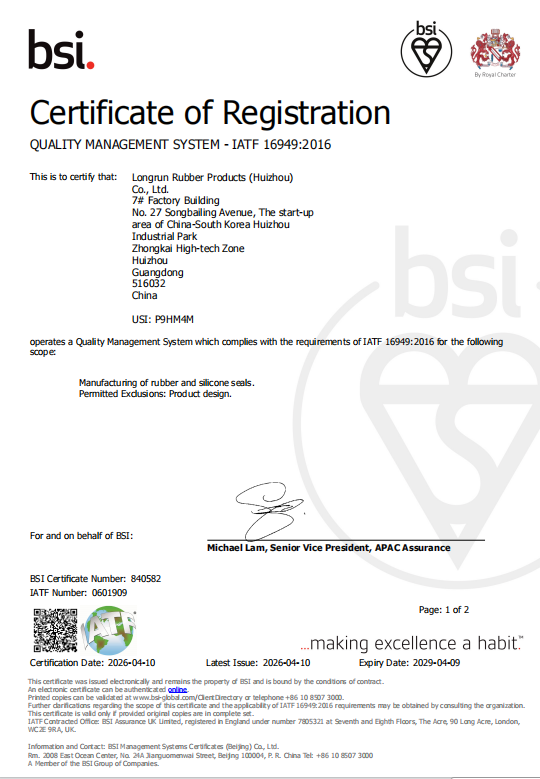
Beyond industry mandates, certifications serve as a proxy for process maturity. A manufacturer that invests in IATF 16949 (which builds on ISO 9001 with additional automotive-specific requirements like FMEA, Control Plan, and MSA) demonstrates a culture of defect prevention rather than detection.
Essential Certifications for Rubber Products
The table below summarizes the primary certifications and their relevance to different rubber product categories:
| Certification / Standard | Scope | Typical Products | Issuing Body |
|---|---|---|---|
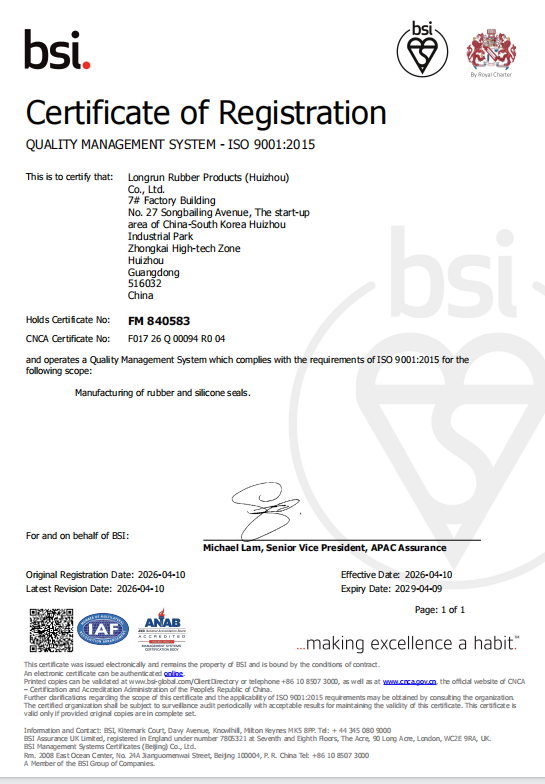
| ISO 9001:2015 | General quality management system | All custom rubber parts (seals, gaskets, o-rings, washers, grommets) | BSI (example: FM 840583) |
| IATF 16949:2016 | Automotive quality management (includes ISO 9001 plus automotive-specific) | Rubber dampers, engine seals, automotive o-rings | BSI (example: 0601909) |
| FDA 21 CFR 177.2600 | Rubber articles intended for repeated food contact | Food-grade silicone seals, sanitary gaskets, rubber washers | FDA (USA) |
| USP Class VI / ISO 10993 | Biocompatibility for medical devices | Medical silicone rubber, silicone O-rings, drug delivery seals | USP / ISO |
| REACH / RoHS | Chemical substance restrictions (EU) | All rubber products exported to EU | ECHA (EU) |
How Manufacturers Ensure Compliance: Beyond the Certificate
A certification alone is not enough. Buyers must understand how the manufacturer operationalizes compliance. Based on industry best practices and verified supplier data, the following risk-control mechanisms are critical:
1. FMEA-Based Process Control
Manufacturing risks such as short shot, insufficient filling, bubbling, air bubbles, blistering, under-cured, and incompletely cured defects are systematically addressed through Failure Mode and Effects Analysis (FMEA). Combined with a strict Control Plan (CP), this approach ensures every process step is monitored and controlled.
2. 100% Automated Visual Inspection
Leading manufacturers employ CCD (Charged Coupled Device) automated vision inspection for 100% of products. This eliminates human error and detects micro-defects invisible to the naked eye.
3. Qualified Personnel and Training
Key production positions are assigned to qualified professionals for strict supervision. All quality-related personnel undergo systematic training before assuming their roles, ensuring consistent execution of quality standards.
4. Material Traceability and Testing
From raw material inbound to finished product shipment, traceability is maintained. Physical property tests — tensile strength, elongation, tear strength, hardness, compression set — are performed regularly. For example, a case study shows a food/medical client achieved tensile strength ≥8 MPa, elongation ≥450%, and tear strength ≥35 kN/m over a 5-year cooperation.
Step-by-Step: How to Ensure Compliance When Purchasing Rubber Products
Follow this practical checklist when evaluating a rubber parts manufacturer:
- Define your industry requirements. Automotive? Food? Medical? Each has its own mandatory certification.
- Request certificates directly from the supplier. Cross-check the certificate number (e.g., FM 840583) with the issuing body (BSI). Verify the scope covers “Manufacturing of rubber and silicone seals.”
- Ask for FMEA and Control Plan documentation. A compliant manufacturer will share these process control documents under NDA.
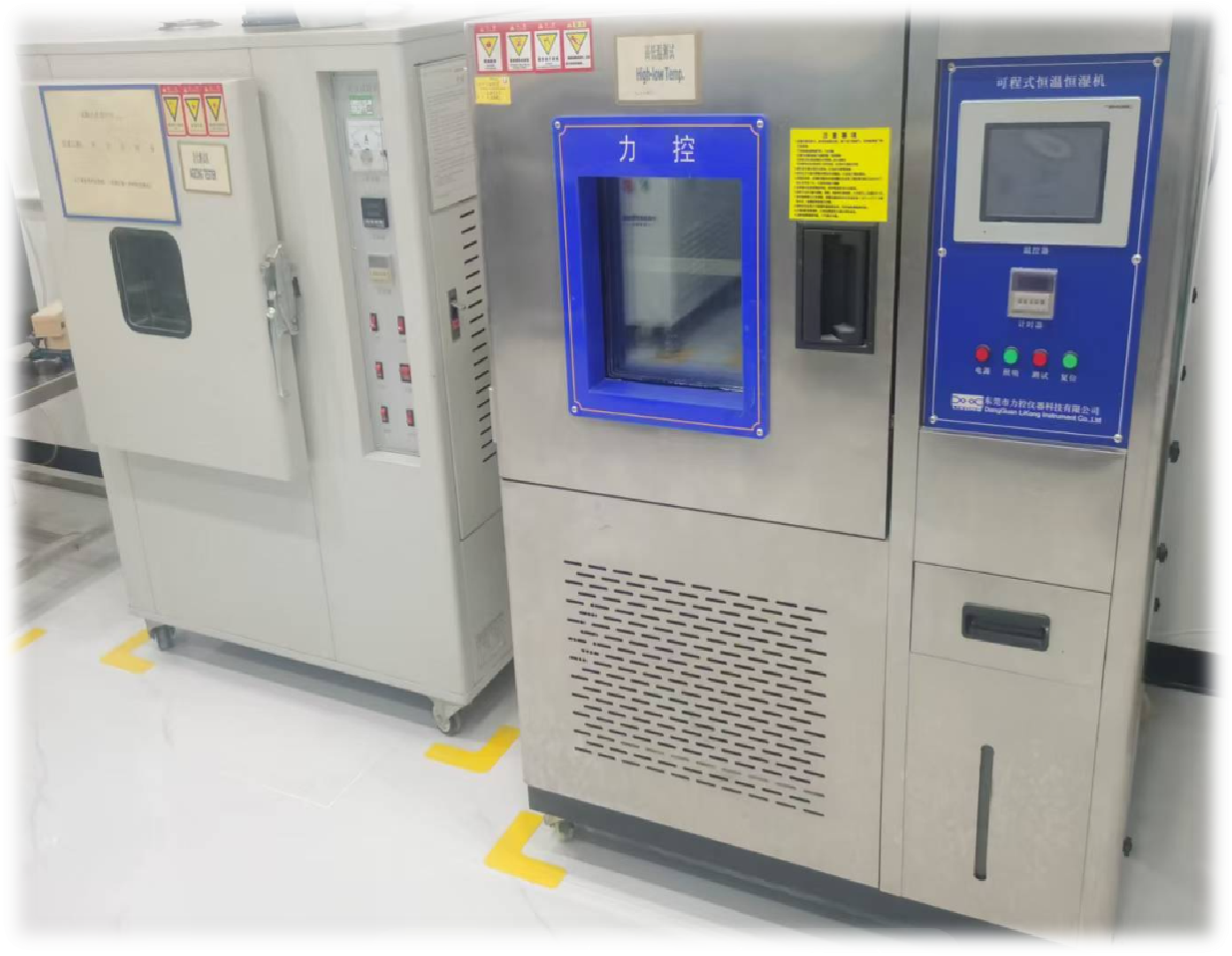
- Inspect the quality laboratory. Look for aging test machines, tensile testers, rheometers, and auto-sorting machines. These indicate investment in quality.
- Request sample inspection reports. Ask for Cpk values, defect rates, and dimensional accuracy data. A target of Cpk > 1.33 and defect rate < 150 ppm is typical for high-quality production.
- Conduct a third-party audit or inspection. Many buyers hire inspection agencies to verify pre-shipment quality.
Real Use Cases: Compliance in Action
Case 1: Food & Medical Rubber Seals (US Client)
Product: Custom rubber gaskets for food processing and medical equipment.
Duration: 5 years continuous supply, 3 million units annually.
Compliance Highlights: The manufacturer maintained IATF 16949 and ISO 9001 certifications, performed 100% CCD inspection, and achieved Cpk > 1.33 with a defect rate below 150 ppm. The rubber formulation was optimized for FDA compliance, resulting in tensile strength ≥8 MPa and elongation ≥450%.
Case 2: Automotive Rubber Dampers (US OEM)
Product: Rubber dampers and vibration mounts for chassis and powertrain applications.
Duration: 5 years, 1 million units annually.
Compliance Highlights: The parts met IATF 16949 requirements, with strong rubber-to-plastic bonding. The process achieved defect rate < 150 ppm, and dimensional precision enabled automated assembly without rework.
Frequently Asked Questions (FAQ)
Conclusion: Choose a Certified Partner for Peace of Mind
In the complex world of custom rubber parts procurement, certifications are your first line of defense against quality failures. By focusing on ISO 9001, IATF 16949, FDA, and material-grade standards, and by verifying the supplier’s actual compliance mechanisms (FMEA, 100% inspection, qualified personnel), you can dramatically reduce supply chain risk.
Longrun Rubber Products Co., Ltd., established in 2005 with a 10,000 m² factory and 120 employees, exemplifies a certified manufacturer that combines dual ISO 9001 and IATF 16949 certifications with rigorous process control. They offer end-to-end custom molding for rubber gaskets, seals, O-rings, dampers, grommets, washers, and more — in materials including EPDM, NBR, Silicone, FKM, and medical-grade silicone.
For a deeper dive into their quality systems and product capabilities, download the company brochure below.
Download Longrun Rubber’s Company Brochure
Access full product portfolio, certifications, and quality process details.
Contact Information:
Longrun Rubber Products (Huizhou) Co., Ltd.
Email: tommyliu@longrunrubber.com / hang@longrunrubber.com
Tel: +86 13006697998
WhatsApp: +86 13006697998
Address: 7# factory building, No. 27 Songbailing Avenue, The start-up area of China-South Korea Huizhou Industrial Park, Zhongkai High-tech Zone, Huizhou, Guangdong, 516302, China.
Website: https://www.longrunrubber.com/