Dental Zirconia Blocks: A Practical Guide for Dental Labs
Dental Zirconia Blocks: A Practical Guide for Dental Labs
A dental zirconia block is a prefabricated CAD/CAM milling blank that dental laboratories convert into crowns, bridges, veneers and implant-supported restorations. It is made from yttria-stabilized zirconium dioxide, which provides high mechanical strength and tooth-like esthetics. Because the block is milled in a pre-sintered state and then densified in a sintering furnace, the choice of block directly influences fit accuracy, shade result, chipping resistance and overall workflow efficiency. This guide is written for laboratory managers, technicians and purchasing staff who are researching dental zirconia blocks and want to understand how to select and process them reliably.
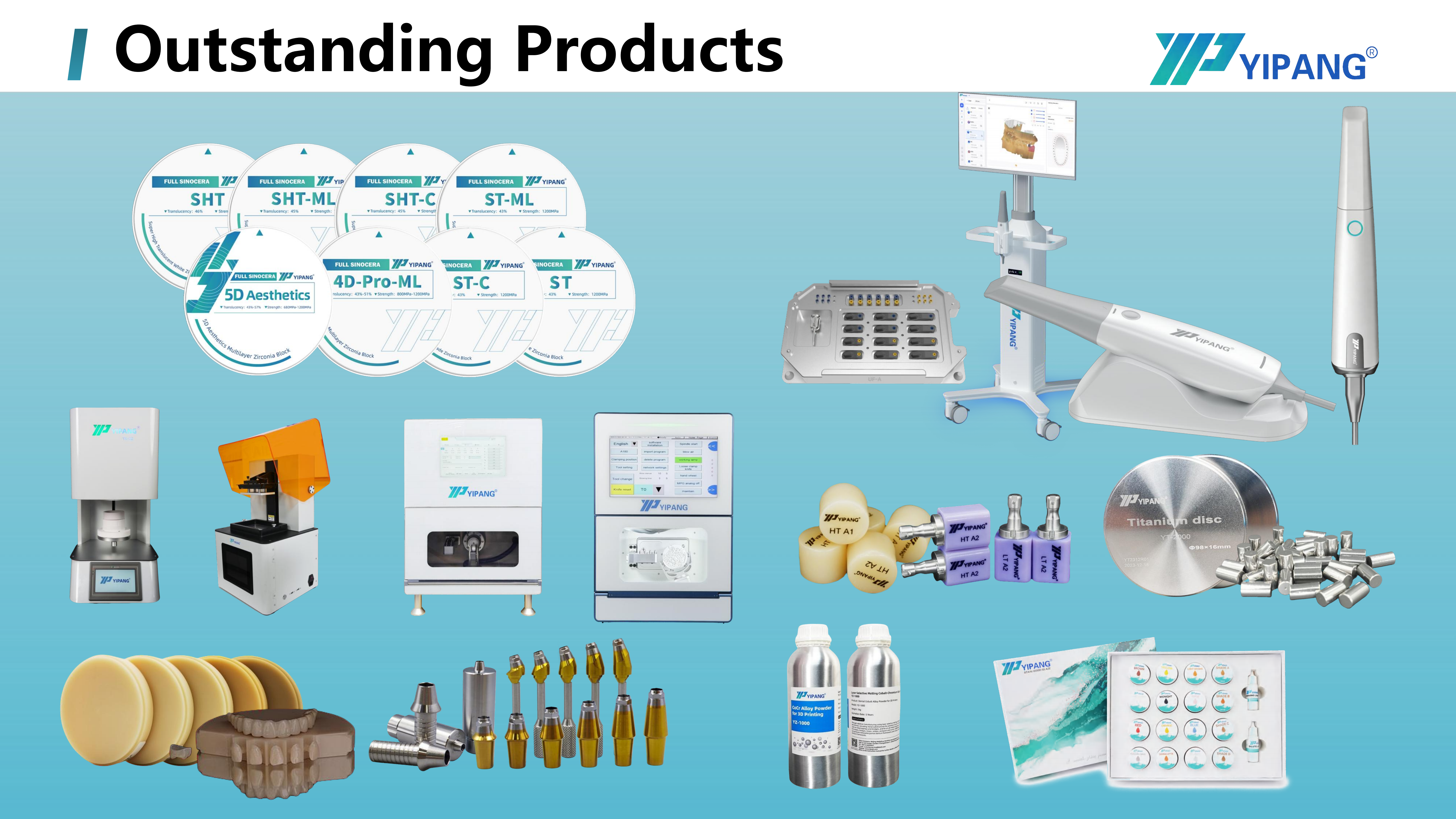
YIPANG 4D-PRO-ML dental zirconia block for CAD/CAM milling
Why Zirconia Blocks Are Central to Modern Dental CAD/CAM
Zirconia has become one of the most widely used materials in modern dental CAD/CAM because it combines high fracture resistance with the ability to be milled to precise dimensions. In a typical digital workflow, the technician designs the restoration on a computer, mills it from a zirconia block using a dental milling machine, and then sinters it in a dental sintering furnace to achieve final density and strength.
When evaluating dental zirconia blocks, laboratories usually consider four properties:
- Flexural strength — determines resistance to chipping, cracking and fracture under occlusal load.
- Translucency — determines how well the restoration mimics the natural tooth, especially in the anterior zone.
- Shade system — determines the accuracy of color gradients from the cervical to the incisal area.
- Sintering behavior — determines shrinkage consistency and dimensional stability after firing.
A block that performs well in all four areas simplifies laboratory work and reduces refabrication.
The Problem: Zirconia Block Selection Is a Risk Decision
Selecting a zirconia block is not only a purchasing decision; it is also a technical risk decision. The most frequently reported failure in zirconia restorations is chipping or cracking after sintering. In practice, this failure can be traced to two root causes: an improper sintering profile, or inherent defects inside the zirconia blank. If the heating curve is too aggressive, or if the blank contains internal defects, the finished restoration may fail at the sintering stage.
Risk to manage: Chipping and cracks after zirconia sintering.
Typical triggers: Improper sintering profile settings; inherent defects inside the zirconia blank.
Mitigation: Follow the recommended sintering profile; inspect blanks before sintering. Any chipped or cracked blank should be scrapped and must not be used for the final restoration.
Another common issue is shade mismatch. The final color of a zirconia restoration depends on both the block and the sintering conditions. Laboratories that use multiple brands often struggle with inconsistent shade results between batches. A third challenge is compatibility: the block must fit the laboratory's existing milling machines, sintering furnaces and scanning equipment.
Industry Background: Material Quality and Supplier System
Dental prosthetics production has shifted from conventional layering and casting toward digital fabrication. CAD/CAM materials such as zirconia blocks, lithium disilicate glass ceramics and press ingots are now standard inputs in dental laboratories worldwide, and the supporting ecosystem includes dental lab scanners, intraoral scanners, milling machines, 3D printers, sintering furnaces and finishing tools.
YIPANG is a self-developed brand owned by Beijing Weijiahua Dentistry Equipment Co., Ltd. (WJH), a dental equipment manufacturer and distributor based in Beijing, China. WJH was established in 1996 and has been active in China's dental industry for nearly thirty years. The company operates a 2,000 m² facility with 80 employees and an annual output value of about US$10 million. A team of 25 professional engineers is engaged in dental material formula research, process optimization and new product development.
WJH exports 40%–55% of its products to the Middle East, Southeast Asia, South America, North America, Eastern Europe, North Africa and Australia. Within China, the parent company serves more than 1,000 dental laboratory customers. Since 1991, the parent company has represented international dental brands including VITA, Ivoclar, Dentsply, Amann Girrbach and Noritake, which gives the team long-standing experience in material evaluation and laboratory applications.
YIPANG's product line covers the main needs of a digital dental laboratory, including zirconia blocks, glass ceramics, press ingots, PMMA, wax discs, titanium blocks, implant abutments, 3D scanners, intraoral scanners, milling machines, 3D printers and sintering furnaces. For a laboratory, this system-level portfolio means that several steps of the CAD/CAM workflow — scanning, design, milling, printing and sintering — can be evaluated together.
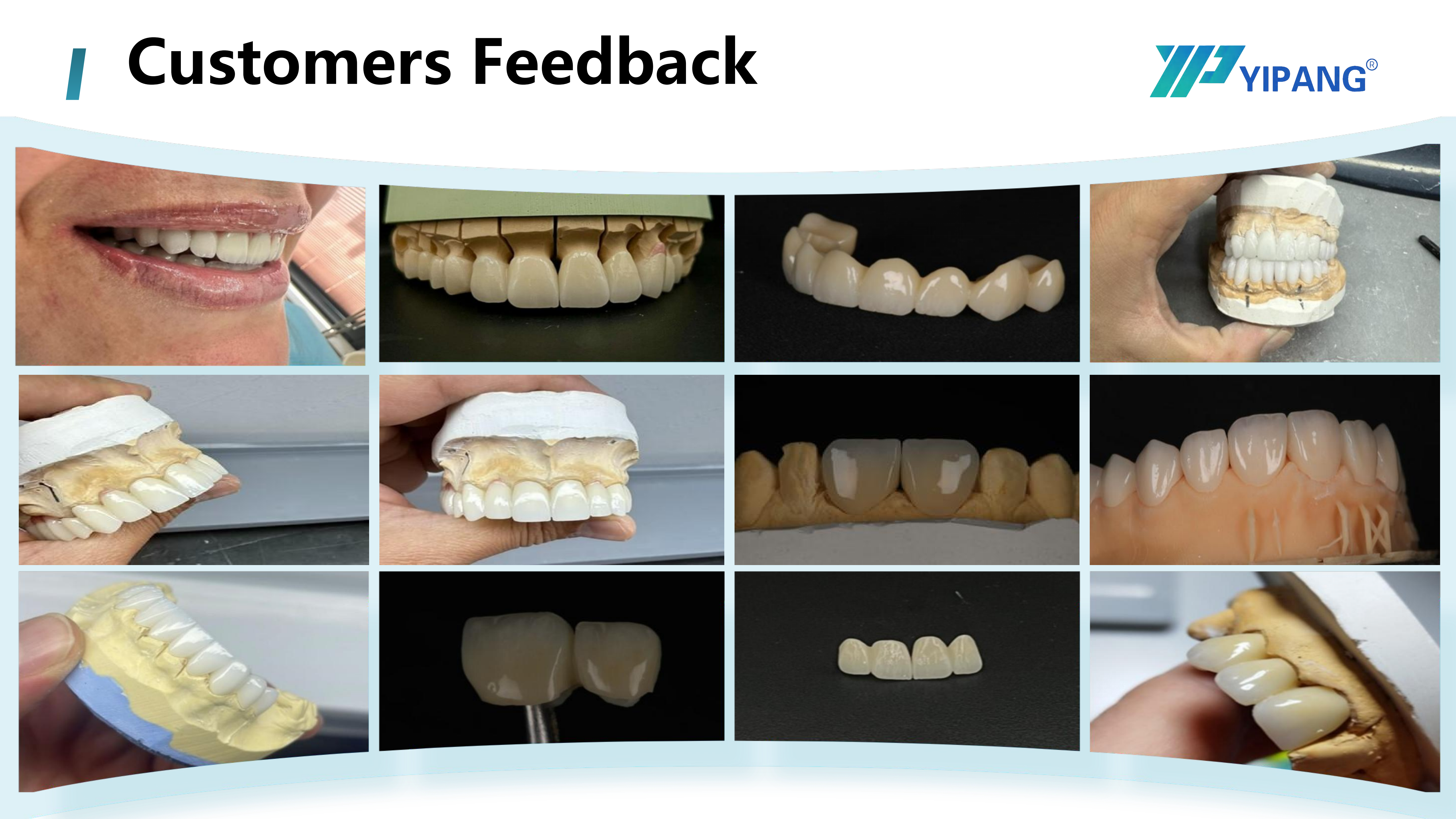
Zirconia block production and factory environment at WJH
Detailed Solution: YIPANG 4D-PRO-ML Dental Zirconia Block
The YIPANG 4D-PRO-ML zirconia block is a dental zirconia disc designed for CAD/CAM milling. It belongs to the ML multilayer shade series, which means the color gradient is built into the block and reproduces the natural transition from the cervical to the incisal part of the tooth. The table below summarizes the published specifications.
| Parameter | Specification |
|---|---|
| Product name | Zirconia Blocks for Dental Prosthesis |
| Model | 4D-PRO-ML |
| Product type | Dental Zirconia Disc / CAD/CAM Dental Milling Blank |
| Material | Zirconium dioxide (ZrO₂), yttria-stabilized |
| Available shades | ML multilayer |
| Diameter | 98 mm |
| Thickness | 10, 12, 14, 16, 18, 20 mm |
| Sintering temperature | 1,450℃ |
| Bending strength | ≥1,200 MPa |
| Translucency | Medium translucent |
From a laboratory perspective, these specifications translate into practical benefits. The 98 mm disc diameter fits the work envelope of most mainstream dental milling machines. The six thickness options, from 10 mm to 20 mm, allow the laboratory to match material volume to the restoration type and reduce waste. The medium translucent level is positioned between high-strength opaque zirconia and highly translucent esthetic zirconia, balancing mechanical performance and appearance.
In terms of material construction, the 4D-PRO-ML is manufactured from high-quality zirconia powder, which supports stable performance and consistent batch quality. The multilayer gradient structure produces a natural restoration effect. Low shrinkage after sintering contributes to high dimensional accuracy, which improves marginal fit and reduces the need for clinical adjustments. The manufacturer states that the block is compatible with most mainstream dental milling machines and is produced under strict quality control that meets dental medical material standards.
Step-by-Step Processing Workflow
Processing a YIPANG 4D-PRO-ML zirconia block follows a standard dental CAD/CAM procedure. The sequence below is the recommended workflow for a dental laboratory.
- Scan and design. The preparation is scanned with a dental lab scanner or intraoral scanner. The restoration is designed in CAD software with appropriate wall thickness and connector dimensions.
- Mill the block. The pre-sintered zirconia block is fixed in a dental milling machine and machined with suitable dental milling burs. In the pre-sintered state the material is relatively soft, which allows efficient milling.
- Place the workpiece on a sintering tray. The milled restoration should be supported correctly to avoid deformation during high-temperature firing.
- Set the sintering curve. The recommended sintering temperature range is 1,430℃ to 1,450℃. Use a standard heating and holding procedure to guarantee low shrinkage and stable translucency.
- Cool down naturally. After the sintering cycle is complete, let the furnace cool naturally. Avoid rapid temperature changes, which can cause thermal stress and cracking.
- Inspect and finish. After cooling, inspect the restoration for cracks, chips and fit. Final contouring and polishing can be completed with dental polishing burs and conventional glaze materials.
Safety note: Avoid rapid temperature change during sintering to prevent cracking. Do not exceed the maximum sintering temperature. If a blank is chipped or cracked after sintering, scrap it — do not use it for the final restoration.
Use Cases in the Dental Laboratory
YIPANG 4D-PRO-ML zirconia blocks are used for full-contour crowns, bridges, veneers and implant superstructure restorations. The table below maps common restoration types to the material characteristics of the 4D-PRO-ML.
| Restoration type | Why 4D-PRO-ML is used | Processing note |
|---|---|---|
| Full-contour crowns | High bending strength supports a single-material restoration without veneering porcelain | Follow the standard sintering curve |
| Multi-unit bridges | High mechanical strength supports multiple connected units | Verify connector dimensions before milling |
| Posterior crowns | Balances mechanical strength and translucency | Use the recommended heating and holding profile |
| Veneers | Multilayer shade gradient supports a natural color transition | Cool down slowly after sintering |
| Implant superstructure restorations | Suitable for implant workflows when designed correctly | Inspect the blank before sintering |
In clinical practice, the material is especially indicated for posterior crowns and multi-unit bridges, where the balance between mechanical strength and translucent esthetics is critical. For anterior aesthetic cases, the multilayer shade system helps reproduce the natural color gradient.
A Framework for Comparing Dental Zirconia Blocks
Beyond the 4D-PRO-ML, laboratories comparing different zirconia blocks should apply a consistent evaluation framework. Useful criteria include:
- Published mechanical properties — check the bending strength value and the clinical indications supported by the manufacturer.
- Shade system — confirm that the shade family matches the laboratory's case mix.
- Batch consistency — a reliable material supplier should deliver stable color and mechanical properties across batches.
- Workflow compatibility — verify that the disc diameter and sintering window fit the existing milling machine and sintering furnace.
- Supplier ecosystem — a supplier that also provides scanners, milling machines, 3D printers and sintering furnaces can simplify training, integration and troubleshooting.
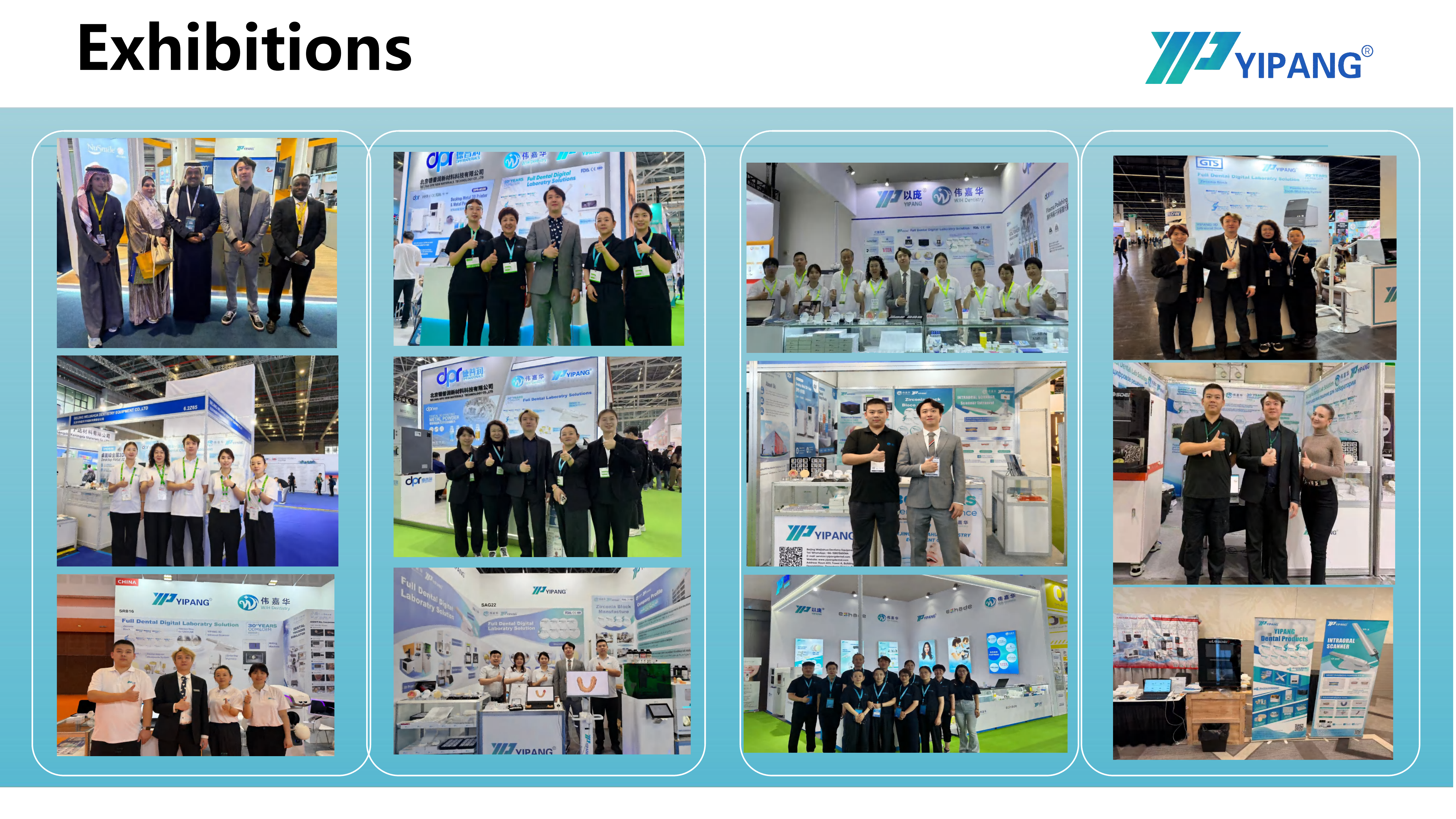
WJH business partner network behind the YIPANG brand
FAQ
How do dental labs select zirconia blocks?
Dental labs should evaluate flexural strength, shade consistency, translucency, sintering behavior and compatibility with existing equipment. The YIPANG 4D-PRO-ML zirconia block is made from Sinocera powder with high flexural strength and stable shade consistency. It is suitable for posterior crowns and multi-unit bridges, balancing mechanical strength and translucency aesthetic performance.
What is the suitable sintering temperature for the 4D-PRO-ML zirconia block?
The recommended sintering temperature range is 1,430℃–1,450℃. Follow the standard heating and holding procedure to guarantee low shrinkage and stable translucency. Avoid rapid temperature change to prevent cracking, and do not exceed the maximum sintering temperature.
Which restorations can be fabricated from YIPANG 4D-PRO-ML zirconia blocks?
The block is used for full-contour crowns, bridges, veneers and implant superstructure restorations. The material is especially suitable for posterior crowns and multi-unit bridges, where mechanical strength and translucency need to be balanced. Typical matched equipment includes a dental milling machine, a dental sintering furnace and a dental lab scanner.
Which equipment is compatible with YIPANG 4D-PRO-ML zirconia blocks?
The 4D-PRO-ML block is processed with a dental milling machine and sintered in a dental sintering furnace. The digital design step uses a dental lab scanner or intraoral scanner. The 98 mm disc format is compatible with most mainstream dental milling machines.
What should a lab do if a zirconia restoration chips or cracks after sintering?
Chipping and cracks after zirconia sintering are usually caused by an improper sintering profile or by inherent defects inside the zirconia blank. Mitigation includes following the recommended sintering profile and inspecting blanks before sintering. Chipped or cracked blanks should be scrapped and must not be used for the final restoration.
How can a dental lab request samples or a quotation for YIPANG zirconia blocks?
Dental labs can contact YIPANG/WJH directly by email at service@yipangdental.com, by phone or WhatsApp at +86-158-0156-5064. The WJH company brochure, which includes company background and product line information, is available for download and can be used as a first reference before requesting a quote.
Conclusion and Next Steps
Selecting a dental zirconia block is one of the most important decisions in a dental laboratory's digital workflow. The material must offer predictable strength, stable shades and reliable sintering behavior, and it must fit the equipment already installed in the laboratory.
The YIPANG 4D-PRO-ML block addresses these requirements with a 98 mm multilayer disc, thickness options from 10 to 20 mm, a sintering window of 1,430℃ to 1,450℃ and a published bending strength of at least 1,200 MPa. It is designed for full-contour crowns, bridges, veneers and implant superstructure restorations, and it is supported by a company that has served the dental industry since the 1990s.
For dental laboratories evaluating zirconia blocks, the practical next step is to test the material in their own workflow with a sample case.
Evaluate YIPANG 4D-PRO-ML in your laboratory
Email: service@yipangdental.com | Tel/WhatsApp: +86-158-0156-5064
Website: www.yipangdental.com