
Decoding Formwork Technical Parameters: Production Quality & Performance
Decoding Formwork Technical Parameters: How Production Quality Defines Construction Success
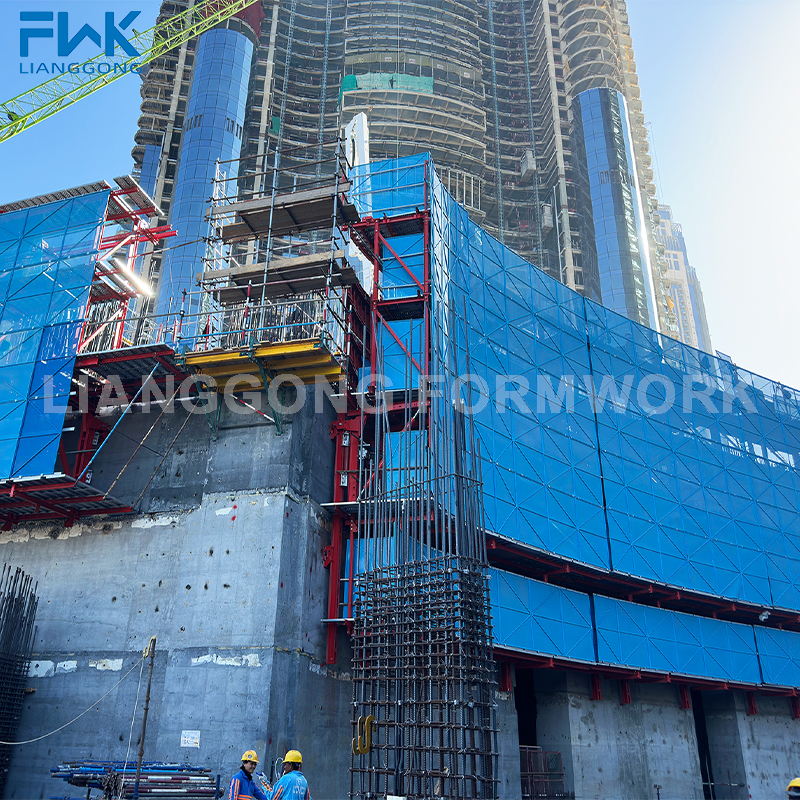
When sourcing formwork systems for high-rise, infrastructure, or tunnel projects, procurement professionals often face a common challenge: how to translate a list of technical parameters into real on-site performance? Terms like panel weight, maximum one-time casting height, permissible lateral pressure, and turnover rate can be overwhelming. Moreover, understanding how the manufacturing process influences these parameters is critical to making an informed purchasing decision.
This guide provides a systematic approach to interpreting formwork technical specifications and reveals how production quality—from material selection to welding precision—directly affects the safety, cycle time, and total cost of your project. We use FWK Lianggong Formwork (brand of Yancheng Lianggong Formwork Co., Ltd.) as a benchmark to illustrate best practices.
Defining the Problem: Why Technical Parameters Matter to Buyers
Formwork is a temporary structure that supports freshly placed concrete until it gains sufficient strength. A poorly specified or low-quality formwork system can lead to:
- Concrete surface defects (honeycombing, misalignment, poor finish)
- Safety hazards (formwork collapse, falling panels)
- Schedule delays due to slow assembly or failure to meet stripping time
- Higher lifecycle costs due to frequent replacements or repairs
Therefore, decoding the technical data sheet is not just an academic exercise—it is a risk management tool that determines project success.
Industry Context: The Evolving Formwork Market
By 2026, the global construction formwork market continues to expand, driven by urbanization, infrastructure investment, and the rise of super-tall buildings. Buyers are increasingly demanding systems that offer high reuse rates, light weight for labor efficiency, and compliance with international standards (e.g., EN 1090, ISO 3834). Manufacturers who invest in advanced production equipment, such as CNC machining centers, robotic welding, and automated shot-blasting, are better positioned to deliver consistent quality.
Detailed Solution: Interpreting Key Technical Parameters
1. Panel Weight and Handling
Why it matters: Panel weight influences labor productivity and crane dependency. Lighter panels reduce fatigue and speed up installation.
| Product Example | Panel Weight (kg/m²) | Typical Application |
|---|---|---|
| Aluminum Frame Formwork (FWK-FAF 117) | 25 kg/m² | Residential slabs, walls in tropical climates |
| 65 Steel Frame Formwork (FWK-SNF 65) | 39 kg/m² | High-rise walls, columns |
| H20 Timber Beam Formwork | 65 kg/m² | Large irregular slabs, hydraulic structures |
2. Maximum One-Time Casting Height
This parameter determines how many floors or lifts can be poured in a single cycle. For wall formwork, it directly affects the pour rate and concrete pressure. FWK's 65 steel frame formwork supports a maximum one-time casting height of 12 meters, while its aluminum frame system reaches 6 meters—ideal for typical residential floors.
3. Permissible Lateral Pressure
Measured in kN/m², this value indicates the maximum concrete pressure the formwork can withstand during pouring. Higher values allow for faster pour rates. Both the 65 Steel Frame Formwork and the Aluminum Frame Formwork are rated at 60 kN/m², which is standard for most vertical applications. For heavy civil works, FWK's trench box systems are engineered for extreme lateral earth pressures up to 130 kN/m² (based on EN 13331).
4. Material and Surface Treatment
Material choice defines durability and reuse cycles. FWK uses Q355B steel for high-strength frames, Aluminum 6061-T6 for lightweight panels, and H20 timber beams with high-density laminated veneer lumber. Surface protection includes shot-blasting and anti-corrosion painting, verified by the EN 1090-1 Factory Production Control Certificate (No. 1381-CPR-889) issued by SGS Italia.
5. Turnover Rate (Reuse Cycles)
A critical economic metric. FWK's H20 timber beam formwork achieves 26–40 reuses (double-sided), compared to conventional timber formwork that only lasts 5–8 cycles per side. Steel frame formwork can exceed 100 uses when properly maintained.
How Production Quality Affects These Parameters
Material Sourcing & Inspection
FWK's quality management system (ISO 9001:2015 certified) ensures incoming raw materials—steel profiles, plywood, aluminum extrusions—are tested for compliance before production. For example, all Q355B steel used in steel frame formwork undergoes chemical composition analysis and mechanical testing.
Precision Machining
FWK operates a Gantry Machining Center PM2060HC and CNC 5600 Double-Head Precision Saw, enabling panel dimensions with tolerances within ±1 mm. This precision ensures tight joint fitment, minimizing grout leakage and step misalignment—a common source of concrete defects.
Welding Quality
Welding is a decisive factor in formwork strength. FWK holds the ISO 3834-2 Welding Quality Management System Certificate (No. 23/1014-3834), covering fusion welding of steel structures. Industrial welding robots are employed for critical joints, ensuring consistent penetration and repeatable quality.
Surface Protection
Shot-blasting prior to painting removes rust and mill scale, improving coating adhesion. FWK's painting workshop applies anti-corrosion primer and topcoat, with film thickness verified by dry-film gauges. This extends service life even in corrosive environments (e.g., coastal projects in Indonesia or the Middle East).
Three Inspections & One Review System
FWK implements a rigorous "Three Inspections and One Review" protocol before shipment:
- Production Inspection – In-process checks on assembly, joints, and sealing.
- Quality Inspection – Final acceptance of overall rigidity, flatness, and fastening.
- Factory Inspection – Verification of material certificates and dimensional accuracy.
- General Review – Cross-check by technical department before release.
Step-by-Step: How to Evaluate a Formwork Supplier's Technical Sheet
- Identify critical parameters for your project (height, lateral pressure, weight restrictions).
- Cross-check material grades (e.g., Q355B vs Q235B; aluminum 6061-T6 vs 6063).
- Request certificates: ISO 9001, EN 1090, ISO 3834-2, and product-specific CE marks.
- Ask about turnover experience – the supplier should provide field data or case studies.
- Verify surface finish – smooth, defect-free panels indicate proper manufacturing.
- Review quality control documentation – in-process inspection records, weld reports.
Use Cases: Real-World Performance from FWK Lianggong
Case 1: Kalimantan Dam Project, Indonesia (H20 Timber Beam Formwork)
Client type: EPC contractor
Quantity: 100 sets
Application: Concrete pouring for underground powerhouses, intake tunnels, and auxiliary dam structures.
The contractor chose FWK's H20 timber beam system for its flexibility on irregular curved surfaces and high load-bearing capacity. The timber beams could be cut on-site without redesign, dramatically improving material utilization. The result: concrete surfaces required no additional grinding, saving significant finishing time and cost. The system has been in use for over ten years, demonstrating its durability.
Case 2: Hospital Project, Trinidad and Tobago (Hydraulic Auto-Climbing Formwork)
Client type: Construction company
Quantity: 70 units
Application: Reinforced concrete core walls and shear walls.
The FWK-ACB 120 hydraulic auto-climbing formwork allowed the system to climb without tower crane dependency, reducing crane congestion. The dual-cylinder synchronization error is ≤20 mm, ensuring perfect alignment floor by floor. The project met strict hospital construction tolerances and achieved a cycle time of 3–4 days per floor even in Trinidad's tropical climate.
Frequently Asked Questions (FAQ)
Q1: What is the most important technical parameter for wall formwork?
A: The maximum permissible lateral pressure determines how fast you can pour concrete. For normal walls, 60 kN/m² is standard; for high walls or self-compacting concrete, higher values are required.
Q2: How can I evaluate the real turnover rate of timber beam formwork?
A: Ask for the double-sided usage count. FWK's H20 beams achieve 26–40 uses per side when maintained correctly. Also check the moisture content and the quality of the laminated veneer.
Q3: How does welding quality affect formwork safety?
A: Poor welds can crack under load, leading to panel separation. Look for suppliers with ISO 3834-2 certification and robotic welding to ensure consistent penetration.
Q4: What surface treatment should I expect for steel formwork?
A: At minimum, shot-blasting plus anti-corrosion primer and paint. FWK applies a durable coating that withstands 35 °C outdoor exposure without blistering.
Q5: Do you offer customization for complex geometries?
A: Yes, FWK provides OEM/ODM services. Our technical department can design curved steel formwork, box culvert formwork, and tunnel lining trolleys per your drawings. Minimum order quantity is 1 set for custom products.
Conclusion
Understanding formwork technical parameters and the production processes behind them is essential for selecting a reliable system that meets project demands in safety, speed, and cost-efficiency. By focusing on material quality, precision manufacturing, and certified quality control—like those demonstrated by Yancheng Lianggong Formwork Co., Ltd. (FWK Lianggong)—buyers can avoid hidden risks and achieve superior construction outcomes.
Download our company brochure for detailed product specifications and case studies: FWK Lianggong Formwork Brochure
Yancheng Lianggong Formwork Co., Ltd.
Founded: 2010 | Factory: 12,870 m² | Employees: 230 | Annual Output: 12,000 tons | R&D Team: 45
Main Products: H20 Timber Beam Formwork, Steel Frame Formwork, Aluminum Frame Formwork, Hydraulic Auto-Climbing Formwork, Cantilever Climbing Formwork, Trench Box, Tunnel Formwork, Ring-Lock Scaffolding, and more.
Contact: David Liu | Email: sales01@lianggongform.com | Tel: +86 18201051212
Address: No. 8, Shanghai Road, Economic Development Zone, Jianhu County, Yancheng City, Jiangsu Province, China
Website: www.lianggongformwork.com