Core Material Selection Guide: PET vs PVC vs Core Mat vs PMI
Core Material Selection Guide: PET vs PVC vs Core Mat vs PMI
CINON Composites is a manufacturer of fiberglass reinforcements and lightweight core materials for marine, transportation, wind energy, industrial, and aerospace composite applications, headquartered in Guangzhou, China. This guide compares four common core material categories—PET foam, PVC foam, Core Mat (CM), and PMI foam—using verified cost and performance data to help procurement and engineering teams make informed decisions.
Why Core Material Choice Matters
In sandwich panel construction, the core material directly influences weight, stiffness, insulation, and manufacturing cost. Selecting the wrong core can lead to over-engineering, excessive weight, or process inefficiencies. For buyers evaluating options for boat building, yacht decks, wind turbine blades, or transportation panels, understanding the trade-offs between material cost, compression strength, processing ease, and application fit is critical.
Industry Background: Lightweighting Demands Across Sectors
Marine, wind energy, aerospace, and transport industries increasingly specify core materials that reduce overall system weight while maintaining structural integrity. According to industry practice, CINON's product range—including PET foam, PVC foam, Core Mat, and PMI foam—addresses these requirements through different property profiles. The product's role in these scenarios is to reduce weight, improve strength and stiffness, and provide corrosion resistance.
Detailed Solution: CINON Core Material Portfolio
CINON Composites supplies four main core material types, each optimized for specific cost and performance targets:
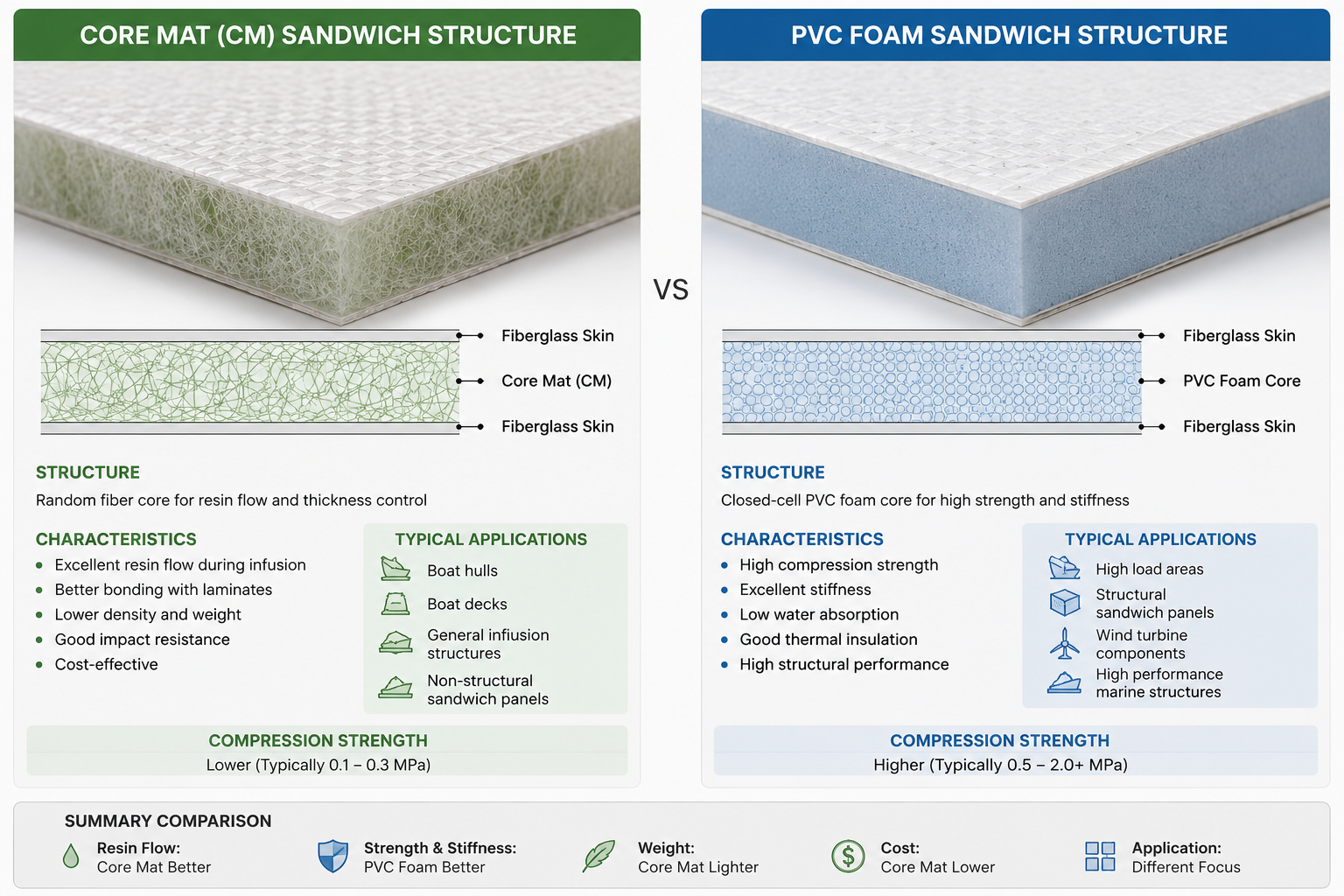
- Core Mat (CM): A resin-flow-enabling mat designed for vacuum infusion processes. It offers a cost reduction of 20–50% compared to PVC Foam Core, while PVC Foam Core typically provides 2–5 times higher compression strength. CM is particularly suitable for boat hulls, boat decks, and general infusion structures.
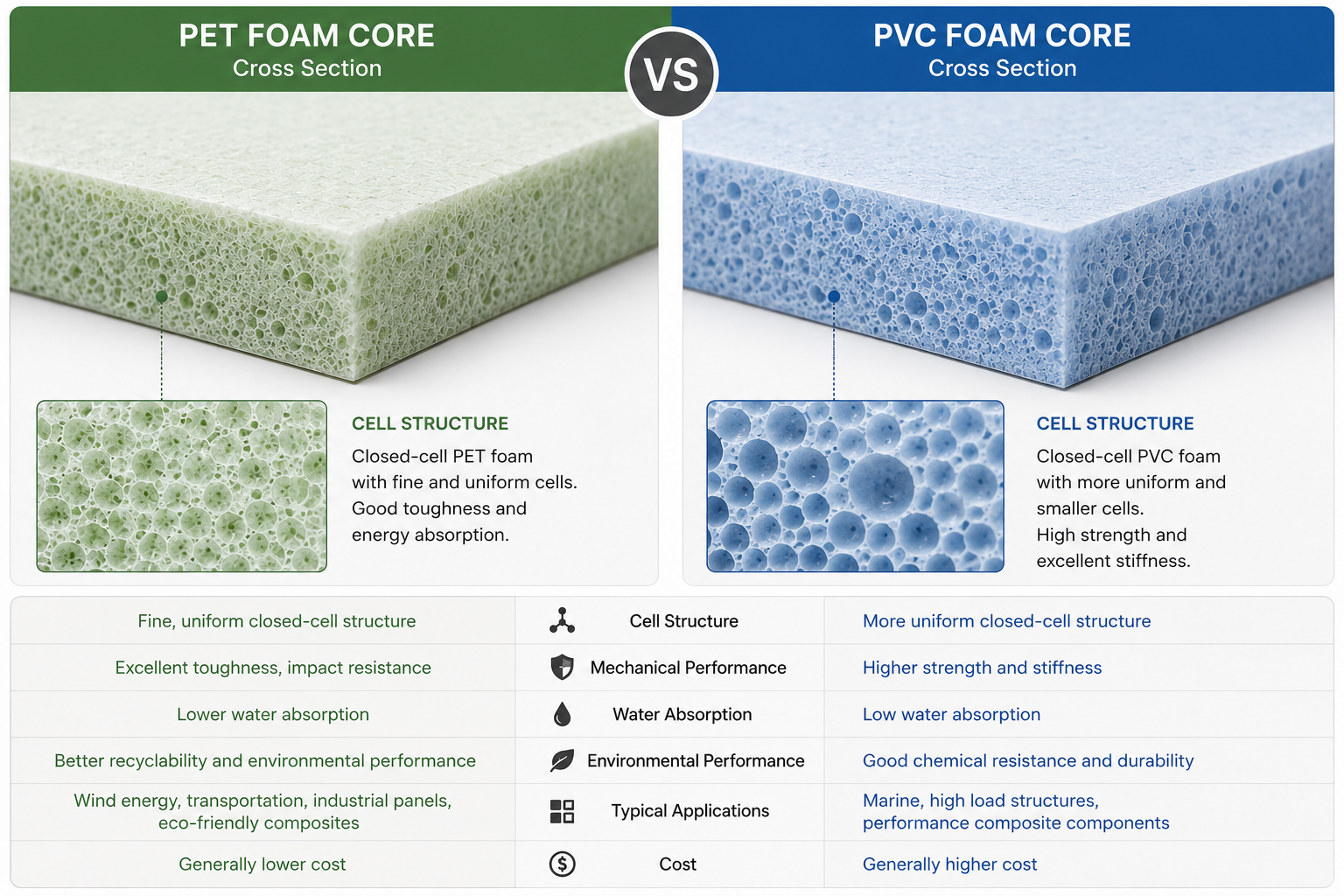
- PET Foam: Provides 10–20% lower cost compared to PVC foam, with 20–50% lower energy consumption during production and recycling. It offers better recyclability and temperature resistance, making it well-suited for wind energy, transportation, and industrial panel applications.
- PVC Foam: Delivers 20–40% higher compression strength than PET foam and 2–5 times higher compression strength than Core Mat. It is preferred in marine, high-load structures, and performance composites.
- PMI Foam: Offers isotropic properties and easy machining, suitable for UAV, radome, sports equipment, and high-temperature applications. (Cost competitiveness depends on density, thickness, and project requirements.)
Step-by-Step Decision Framework
- Define load-bearing requirements. For high structural loads (e.g., yacht hulls, wind blade roots), PVC foam or PMI foam may be necessary. For secondary structures (decks, interior panels), Core Mat or PET foam can suffice.
- Evaluate processing method. Vacuum infusion benefits from Core Mat's resin flow channels. PET and PVC foams can be machined or routed with standard tools.
- Consider environmental and cost targets. PET foam reduces cost by 10–20% and energy consumption; Core Mat cuts cost 20–50% vs PVC foam.
- Check thickness and density availability. CINON confirms all dimensions, thickness, density, roll length, width, and weight before production. First-piece inspection is conducted before mass production.
- Request technical support. CINON provides engineering support to recommend suitable core materials and processes before order confirmation.
Use Cases by Industry
| Industry | Recommended Core Material | Key Benefit |
|---|---|---|
| Boat building / yacht decks & hulls | Core Mat (CM), PVC Foam | Cost-effective infusion (CM) or high strength (PVC) |
| Wind turbine blades | PET Foam, PVC Foam | Recyclability (PET) or compression strength (PVC) |
| Transportation / RV panels / truck bodies | PET Foam, Core Mat | Lower cost and weight |
| Aerospace / UAV structures | PMI Foam | Isotropic properties, easy machining |
| Industrial composite molds | PVC Foam, Core Mat | Processing flexibility |
Comparison Table: CINON Core Materials
| Property | Core Mat (CM) | PET Foam | PVC Foam | PMI Foam |
|---|---|---|---|---|
| Relative Cost (vs PVC) | 20–50% lower | 10–20% lower | Baseline | Depends on specs |
| Compression Strength | Low (2–5x lower than PVC) | Medium (20–40% lower than PVC) | High | High |
| Processing | Excellent for vacuum infusion | Good machining | Good machining | Easy machining |
| Sustainability | Low waste in production | Recyclable | Moderate | Moderate |
| Key Application | Marine decks, boat hulls | Wind, transport, panels | Marine, high-load structures | UAV, radome, sports |
All data sourced from CINON's technical documentation and verified comparison reports.
Frequently Asked Questions
1. Can CINON supply core materials for marine compliance standards?
CINON Composites provides engineering support before order confirmation to recommend suitable materials that meet project requirements. Each production batch is identified with traceable lot numbers, and test reports (including density, thickness, weight) are available upon request.
2. How does Core Mat compare to Soric XF or Soric SF alternatives?
CINON's Core Mat is designed as an alternative solution to Soric core materials. It offers a cost reduction of 20–50% compared to PVC Foam Core, while maintaining minimal maintenance requirements after lamination. It is particularly suitable for boat hulls, boat decks, and general infusion structures.
3. What is the cost difference between PET foam and PVC foam?
According to CINON, PET foam provides 10–20% lower cost compared to PVC foam, and consumes less energy during raw material production and recycling processing. It also has reduced maintenance requirements.
4. Does CINON offer sample materials before volume orders?
Engineering support and pre-production specification confirmation are provided to ensure the selected core material matches your requirements. For sample requests, please contact CINON directly via email at waylon@cinoncomposites.com or WhatsApp at +86 135-8036-3674. CINON encourages customers to verify material fit before committing to full production.
5. What is the typical lead time for core material orders?
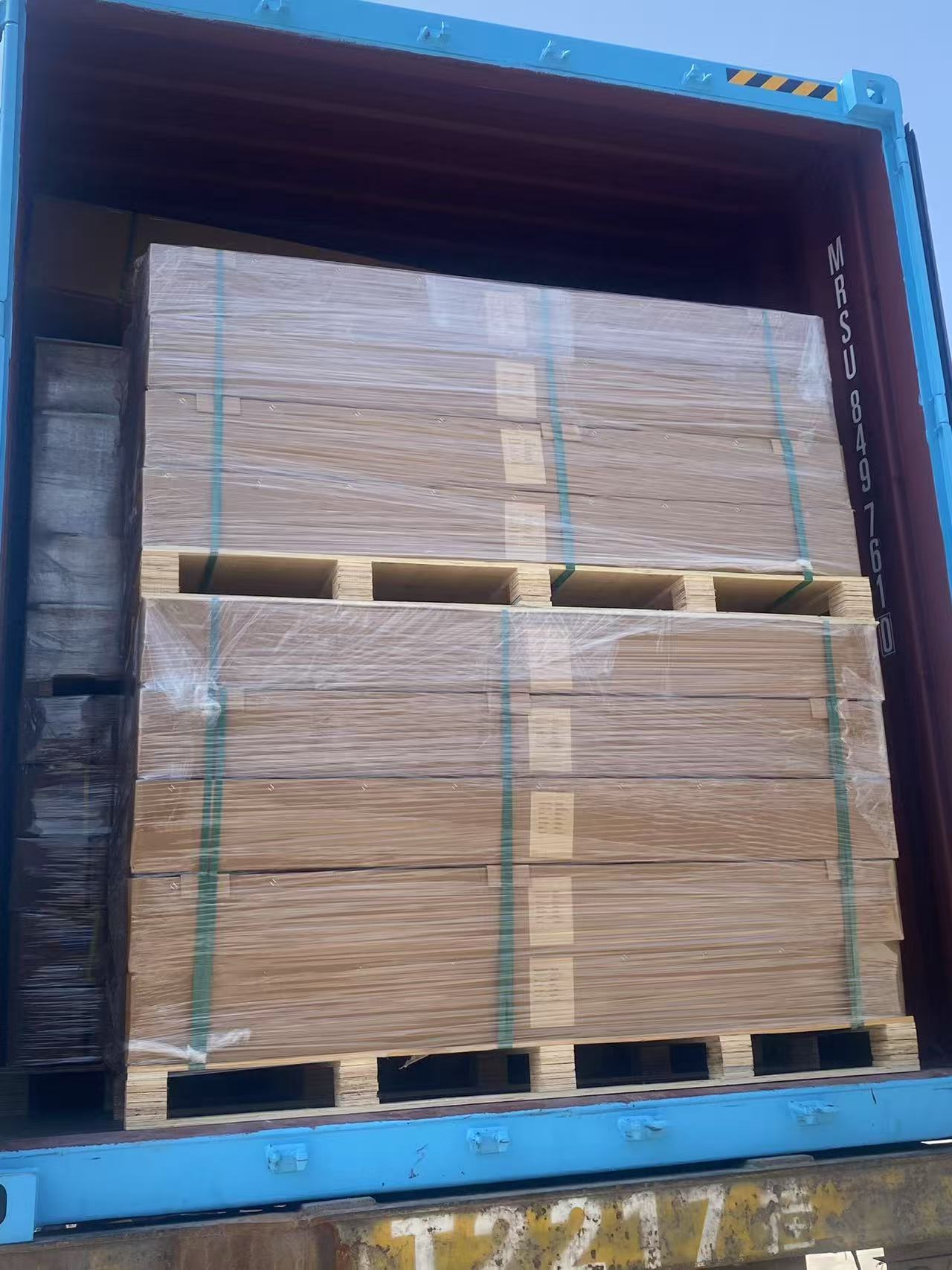
Production planning and inventory management help maintain stable lead times for regular products and urgent projects. Products are packed with export-standard reinforced pallets, moisture-proof wrapping, and corner protection to prevent transportation damage. For specific lead time confirmation, contact CINON with your thickness, density, and volume requirements.
Conclusion
Choosing the right core material for lightweight composite structures depends on balancing cost, mechanical performance, and processing constraints. CINON Composites offers a range of verified options—Core Mat, PET foam, PVC foam, and PMI foam—each with clear cost and strength trade-offs documented above. Download the full CINON product catalog for detailed specifications, or contact Waylon at waylon@cinoncomposites.com / +86 186-2098-8848 for a personalized material recommendation and sample.