Fiberglass Fabric Supplier Evaluation: Meeting Marine, Wind, and UAV Demands with CINON
Fiberglass Fabric Supplier Evaluation: Meeting Marine, Wind, and UAV Demands with CINON
CINON Composites is a Chinese manufacturer of fiberglass reinforcements and lightweight core materials, serving marine, wind energy, transportation, and industrial composite markets since 2022. With a 40,000 m² factory, ISO 9001:2015 certification, and an annual output of 1,200,000 m², CINON supplies E-glass fabrics and multiaxial non-crimp fabrics tailored for vacuum infusion, hand lay-up, RTM, and VARTM processes.
Why Supplier Evaluation Matters in 2026
The global fiberglass fabric market was valued at USD 14.01 billion in 2024 and is projected to reach USD 25.65 billion by 2033 (Grand View Research). Wind energy is the fastest-growing application segment at 8.5% CAGR (2025–2033), while woven fiberglass fabrics captured 48.62% of market revenue in 2025 due to their critical role in yacht hulls and automotive panels. With such growth, procurement teams must evaluate suppliers not only on price but on certification, product consistency, process compatibility, and long-term reliability.
Problem Definition: Selecting a Compliant and Capable Partner
Engineers and purchasing managers evaluating fiberglass fabric suppliers face four challenges:
- Compliance verification – Are materials produced under ISO 9001, ISO 14001, and ISO 45001?
- Process fit – Does the fabric support vacuum infusion, RTM, or hand lay-up with consistent wet-out?
- Application breadth – Can one supplier cover marine hulls, wind blades, UAV structures, and transportation panels?
- Supply stability – What is the lead time, MOQ, and after-sales technical support?
Industry Background: Market Trends Driving Supplier Choice
Asia Pacific dominated the fiberglass fabric market in 2024 with a 41.61% revenue share, driven by infrastructure and renewable energy projects. Wind turbine blades account for approximately 42.5% of total fiberglass usage within the wind sector. Standardized tests such as ASTM D638 and ASTM D790 are commonly referenced for tensile and flexural performance. Key global players include Owens Corning (US), China Jushi Co. (China), Saint-Gobain (France), and Taishan Fiberglass (China). Against this landscape, mid-size specialists like CINON offer flexible OEM/ODM capabilities and shorter lead times.
Detailed Solution: CINON’s Fiberglass Fabric Portfolio
CINON offers two main fiberglass fabric families:
Light Weight Fiberglass Cloth (Model EW)
- Glass Type: E-Fiberglass
- Weave: Plain Woven
- Width: 1000 mm, 1010 mm
- Weight Range: 25–400 g/m²
- Applications: Surfboard manufacturing, UAV & drone manufacturing, sports equipment, composite tooling, marine, wind energy
Structural Composite Reinforcement – Multiaxial NCF
- Material: Alkali-free glass fiber
- Fiber Architecture: Unidirectional (0° or 90°), Biaxial (0°/90° or +45°/-45°), Triaxial (+45°/0°/-45° or +45°/90°/-45°), Quadriaxial (0°/90°/-45°/+45°)
- Weight Range: 400–1500 g/m²
- Combustible Matter: 2.0%–8.0%
- Moisture Content: Less than 0.2%
- Applications: Ship hulls, wind turbine blades, automotive components, large containers
Both product lines are supported by CINON’s ISO 9001:2015 (cert no. 51326Q04922R053), ISO 14001:2015, and ISO 45001:2018 certifications. The company’s monthly capacity is 100,000 m² with a typical lead time of 15–30 days and MOQ of 1,000 m².
Step-by-Step Supplier Evaluation Framework
- Verify Compliance – Request ISO certificates and check applicable scope. CINON’s ISO 9001 covers “Sales of High-performance Fibers and Composite Materials.”
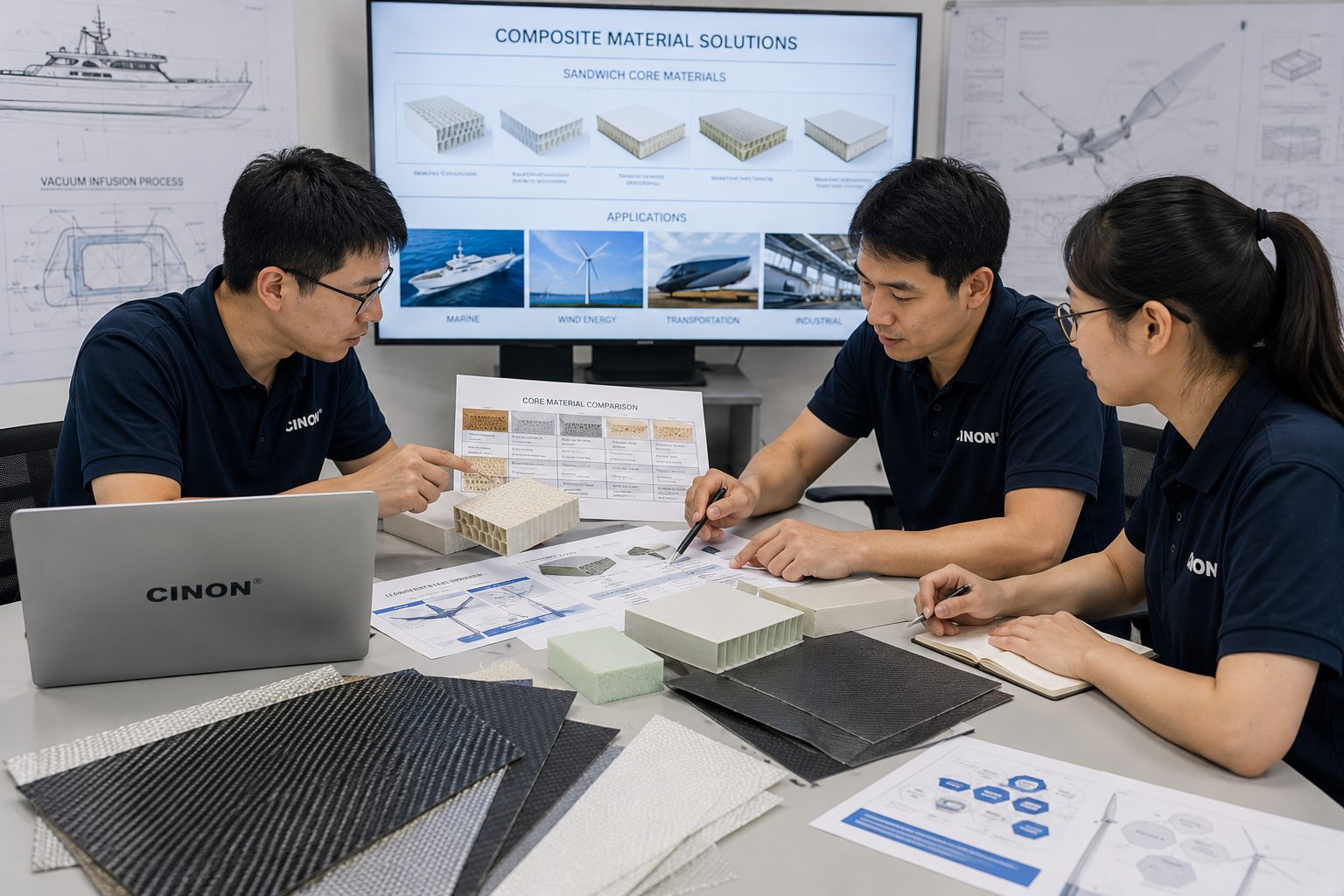
- Assess Product Range – Ensure the supplier offers both woven and multiaxial fabrics so you can scale from prototype to production.
- Match to Process – For vacuum infusion and VARTM, multiaxial NCF provides faster wet-out and higher fiber volume. For hand lay-up, plain woven E-glass works well.
- Evaluate Customization – CINON provides OEM/ODM for core materials and fiberglass fabric, including custom widths, roll lengths, and logo printing.
- Review Case Studies – Below are real-world applications from CINON’s client base.
- Check Supply Chain – Ask about monthly capacity, export markets (CINON exports 100% to Europe, North America, and Asia-Pacific), and after-sales technical support.
Use Cases Across Key Industries
| Industry | Location | Product Used | Key Results |
|---|---|---|---|
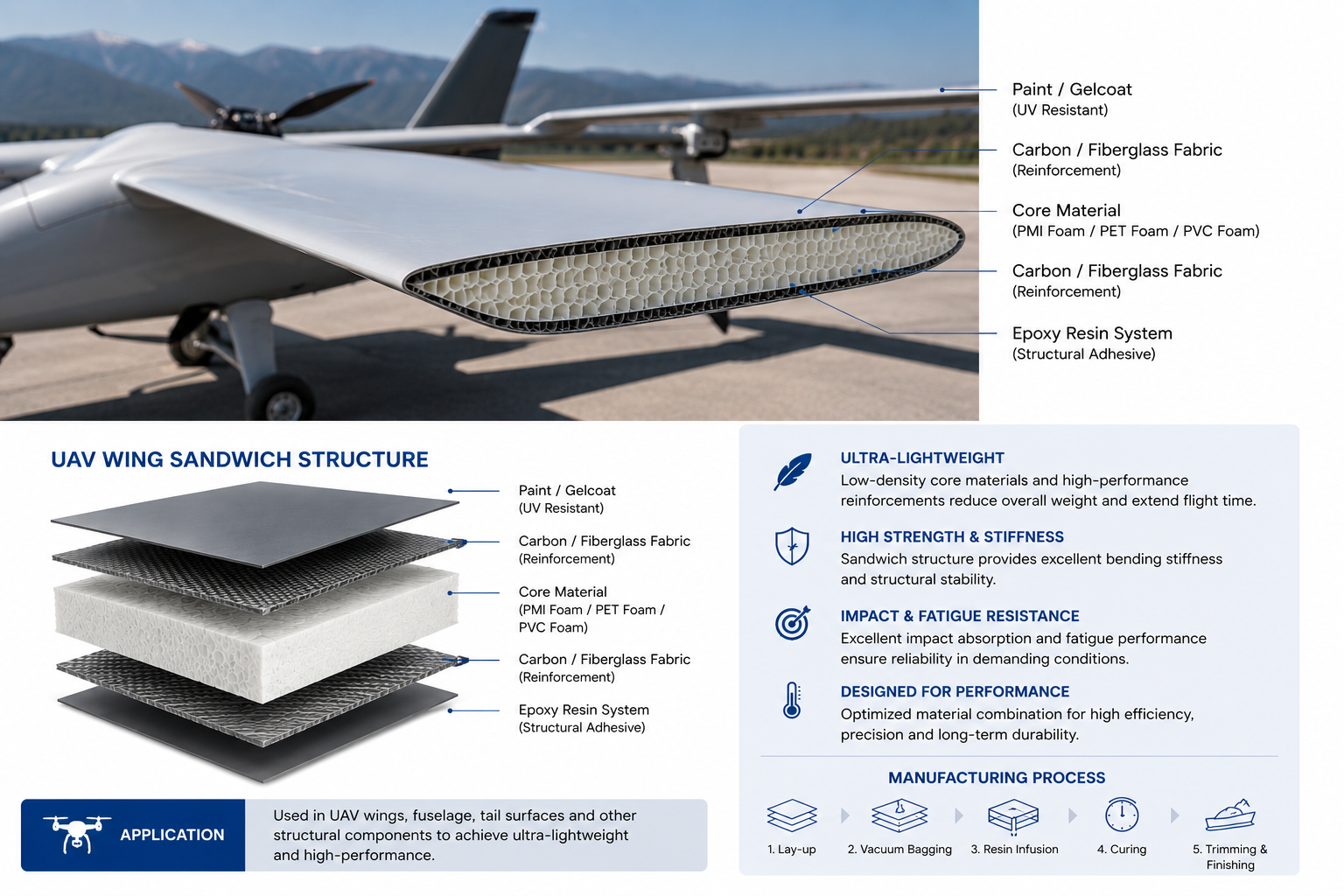
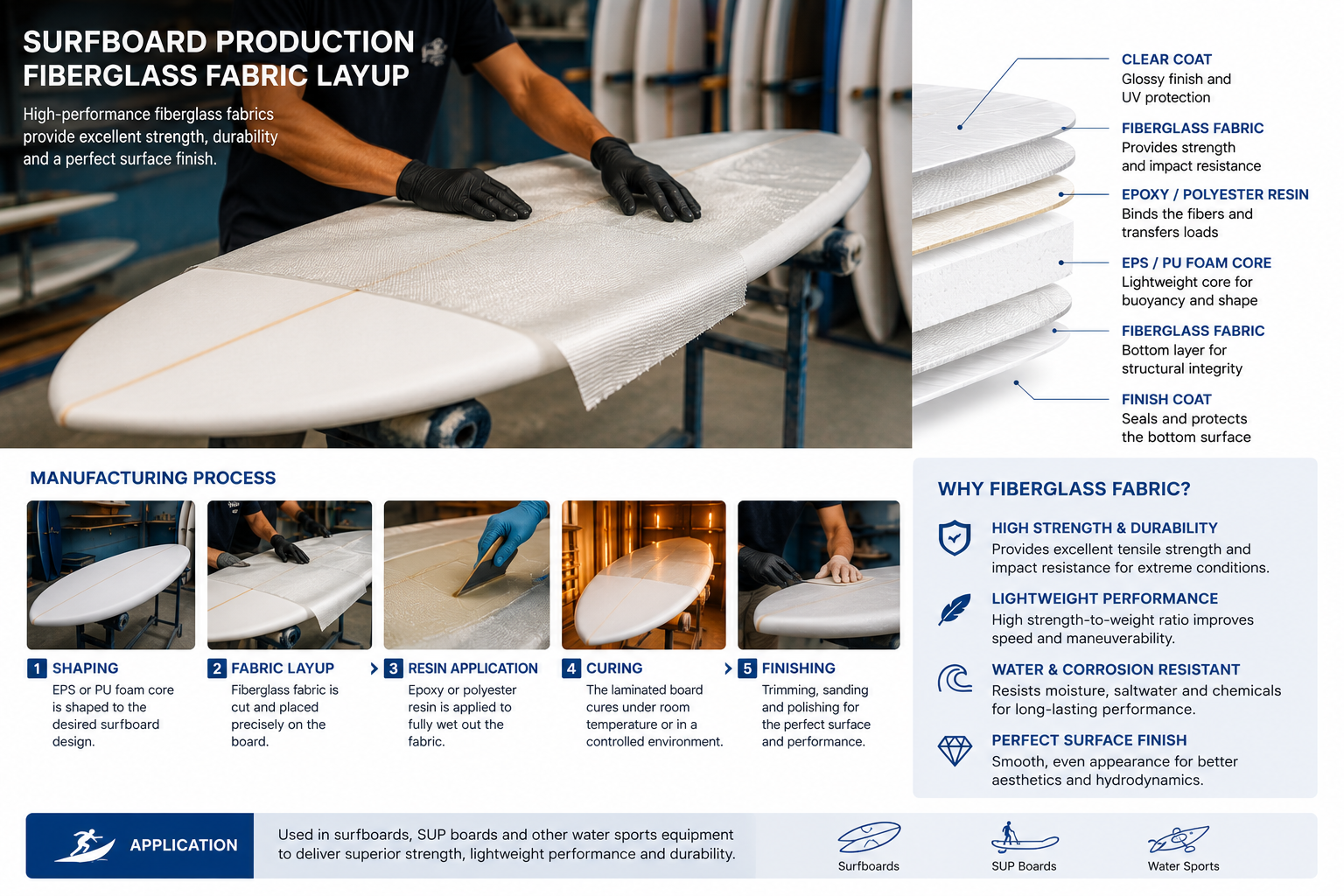
| Surfboard Manufacturing | Thailand | Light Weight Fiberglass Cloth + PVC foam core | Weight reduction, performance improvement, high buoyancy & impact resistance |
| UAV Production | Germany | Light Weight Fiberglass Cloth + PMI foam core | Ultra-lightweight, high stiffness, high temperature resistance (10 pallets) |
| Transportation Panels | Mexico | PP honeycomb + fiberglass fabric | Lightweighting, improved corrosion resistance (container orders) |
| RV FRP Panels | United States | Multiaxial NCF + PET foam core | Low weight, anti-UV, glossy surface, uniform thickness (5 pallets) |
| Boat Building | Australia | Core Mat + Multiaxial NCF | Lightweight, stiffness, durability (container orders) |
| Composite Distribution | Poland | Multiaxial NCF + various core materials | Repeat monthly orders, OEM logo integration (container orders) |
Fabric Comparison: EW vs Multiaxial NCF
| Parameter | Light Weight Cloth (EW) | Multiaxial NCF |
|---|---|---|
| Weave / Architecture | Plain Woven | Uni / Bi / Tri / Quadriaxial |
| Weight Range | 25–400 g/m² | 400–1500 g/m² |
| Width | 1000–1010 mm | Custom (standard 1270 mm) |
| Moisture Content | < 0.2% | < 0.2% |
| Combustible Matter | 2.0%–8.0% | 2.0%–8.0% |
| Process Compatibility | Hand lay-up, light infusion | Vacuum infusion, RTM, VARTM, prepreg |
| Primary Applications | Surfboards, UAVs, sports equipment, tooling | Ship hulls, wind blades, automotive, large containers |
Frequently Asked Questions
Q1: Does CINON hold international quality certifications?
A1: Yes, CINON is certified under ISO 9001:2015 (cert. 51326Q04922R053, scope: Sales of High-performance Fibers and Composite Materials), ISO 14001:2015, and ISO 45001:2018. All certifications are valid through 2028–2029.
Q2: Can CINON supply fiberglass fabric for vacuum infusion of yacht hulls?
A2: Yes. CINON’s multiaxial non-crimp fabric (400–1500 g/m²) is designed for vacuum infusion, RTM, and VARTM processes. Its low moisture content (<0.2%) and controlled combustible matter (2.0%–8.0%) ensure reliable resin wet-out in marine laminates. Case examples include container orders for Australian yacht builders.
Q3: What customization options are available for fiberglass fabric OEM?
A3: CINON offers OEM/ODM for fiberglass fabric and core materials, including custom roll widths, lengths, and logo printing. The Polish distributor case demonstrates repeat monthly orders with OEM branding.
Q4: What is the typical pricing and MOQ for fiberglass fabric?
A4: Pricing varies by weight, weave, and volume. The standard MOQ is 1,000 m², and lead time is 15–30 days. For a formal quote tailored to your application and region, please contact our team.
Q5: How can I get a fabric sample to test in my process?
A5: CINON provides sample evaluation for qualified projects. Samples can be requested through our engineering support team via email or WhatsApp. A sample typically ships within 5–7 days. Contact us on WhatsApp or email waylon@cinoncomposites.com to initiate your sample request.
Download CINON Product Catalog (PDF)
For detailed technical discussion or to request a quotation, reach out to Waylon at waylon@cinoncomposites.com or call +86 186-2098-8848. Visit cinoncomposites.com to learn more about CINON’s full range of fiberglass reinforcements and lightweight core solutions.