
Digital Label Printer vs Traditional Flexo: A Procurement Guide for Short-Run, Variable Data, and Multi-SKU Label Production
Digital Label Printer vs Traditional Flexo Printing: How to Choose for Short-Run and Variable Data Production
In the evolving landscape of label manufacturing, procurement managers and packaging converters face a critical decision: invest in a digital label printer or stick with a traditional flexographic (flexo) or letterpress printing system. While both technologies produce labels, their economic and operational profiles differ fundamentally. This guide provides a fact-based comparison to help you select the right solution for your production mix—especially if your orders include short runs, variable data, or frequent job changes.
Problem Definition: The Short-Run and Variable Data Challenge
Traditional flexo and letterpress printing rely on metal or photopolymer plates. For each new label design, a separate plate must be created, which incurs plate-making costs and setup time. For long runs (e.g., millions of identical labels), this cost is amortized effectively. However, when order quantities drop below 1,000 linear meters per SKU, or when labels require variable data such as QR codes, barcodes, serial numbers, or anti-counterfeit marks, the plate-based workflow becomes inefficient and expensive. Buyers often report that plate costs, changeover downtime, and inventory waste erode margins in short-run, multi-SKU environments.
Industry Background: Shift Toward Digital Label Printing
The global label printing market is experiencing a structural shift. Brands demand faster time-to-market, personalized packaging, and serialized traceability. E-commerce, food & beverage, cosmetics, and pharmaceutical sectors increasingly require short-run digital label printers that can produce 50 to 5,000 labels per SKU without tooling. Industry data shows that digital label printing grows at 8–12% annually, while traditional flexo grows at 2–4%. This shift drives procurement teams to evaluate Industrial Digital Label Printers as a strategic investment.
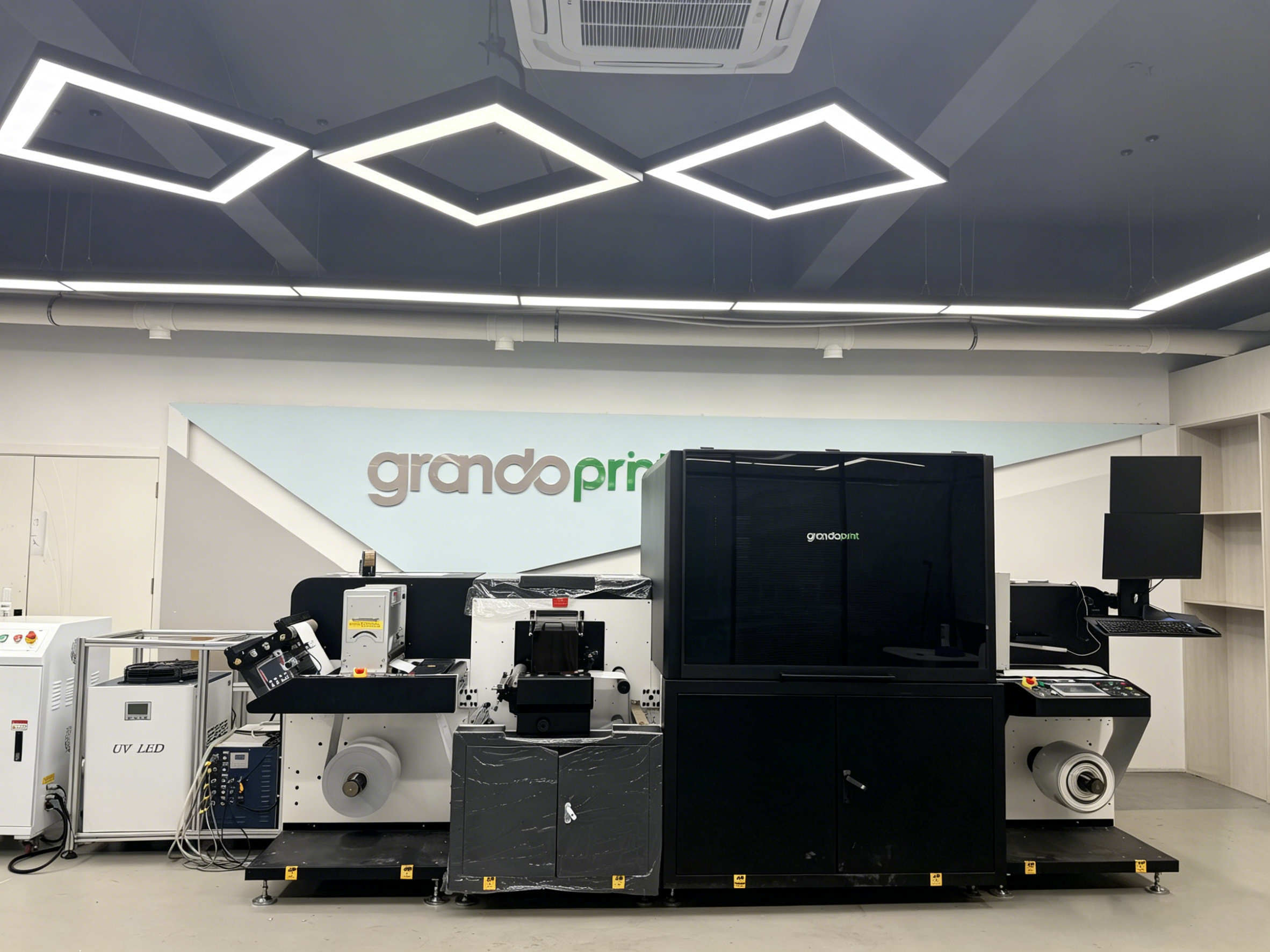
Detailed Solution: The GR350S Digital Inkjet Label Printer
The GR350S, manufactured by Nanjing Grando Digital Technology Co., Ltd. (brand: Grandoprint), is a roll-to-roll UV inkjet digital label printer designed for industrial continuous production. It eliminates plate-making entirely. Instead, it uses piezoelectric inkjet technology with Epson S3200-U1 / U3 printheads to jet UV-curable ink directly onto the substrate. Key specifications include:
| Parameter | Value |
|---|---|
| Printing Technology | Piezoelectric UV inkjet |
| Printing Width | 110–350 mm |
| Printing Speed | 20–100 m/min |
| Ink Configuration | CMYKW + optional varnish |
| Media Width | 120–360 mm (roll-to-roll) |
| Unwinding Diameter | Max. 700 mm |
| Power Consumption | 10 kW (380V three-phase) |
| Certifications | ISO 9001:2015, CE, RoHS, multiple utility model patents (e.g., anti-offset correction, paper roll shaft) |
The GR350S supports variable data processing (direct database printing, no batch PDF conversion), intelligent deviation correction, and optional pre-coating and post-coating varnish systems. It can handle a wide range of label materials including paper, PET, PP, BOPP, PE, synthetic paper, and films (with corona treatment for adhesion).
Step-by-Step Decision Framework: Digital vs Flexo
Step 1: Analyze Your Order Profile
- Average order quantity: If the majority of your orders are under 1,000 linear meters per SKU, digital printing will likely be more cost-effective.
- Number of SKUs per month: High SKU count (e.g., >50 unique labels) favors digital because changeover time is reduced to seconds.
- Variable data requirement: QR codes, barcodes, serial numbers, and anti-counterfeit features are native to digital printing.
Step 2: Evaluate Material Compatibility
The GR350S prints on both paper and film substrates. For films like PET, BOPP, or PP, a corona treatment unit can be integrated. Traditional flexo often requires special anilox rolls and plate mounting for different substrates, adding cost and complexity.
Step 3: Compare Total Cost of Ownership
| Cost Factor | Flexo / Letterpress | Digital (GR350S) |
|---|---|---|
| Plate-making cost per job | $50–$500 (per plate) | $0 |
| Setup time per job change | 30–60 minutes | 1–5 minutes |
| Ink waste per job | Moderate (setup waste) | Minimal (on-demand) |
| Make-ready waste | 50–100 linear meters | <5 meters |
| Energy consumption per label (short run) | Higher due to press heating & drying | Lower (UV LED curing, instant on/off) |
Step 4: Assess Certification & Supplier Capabilities
For regulated industries (food, cosmetics, pharmaceuticals), look for suppliers with ISO 9001:2015 certification (Grandoprint holds certificate 19926Q00205R001) and RoHS compliance. The GR350S also benefits from multiple utility model patents (e.g., anti-offset correction device – Patent ZL 2023 2 3477531.3; paper roll shaft – ZL 2024 2 1965691.4). These patents reflect R&D depth in media handling and print quality stability.
Real-World Use Case: OEM Label Converter Success
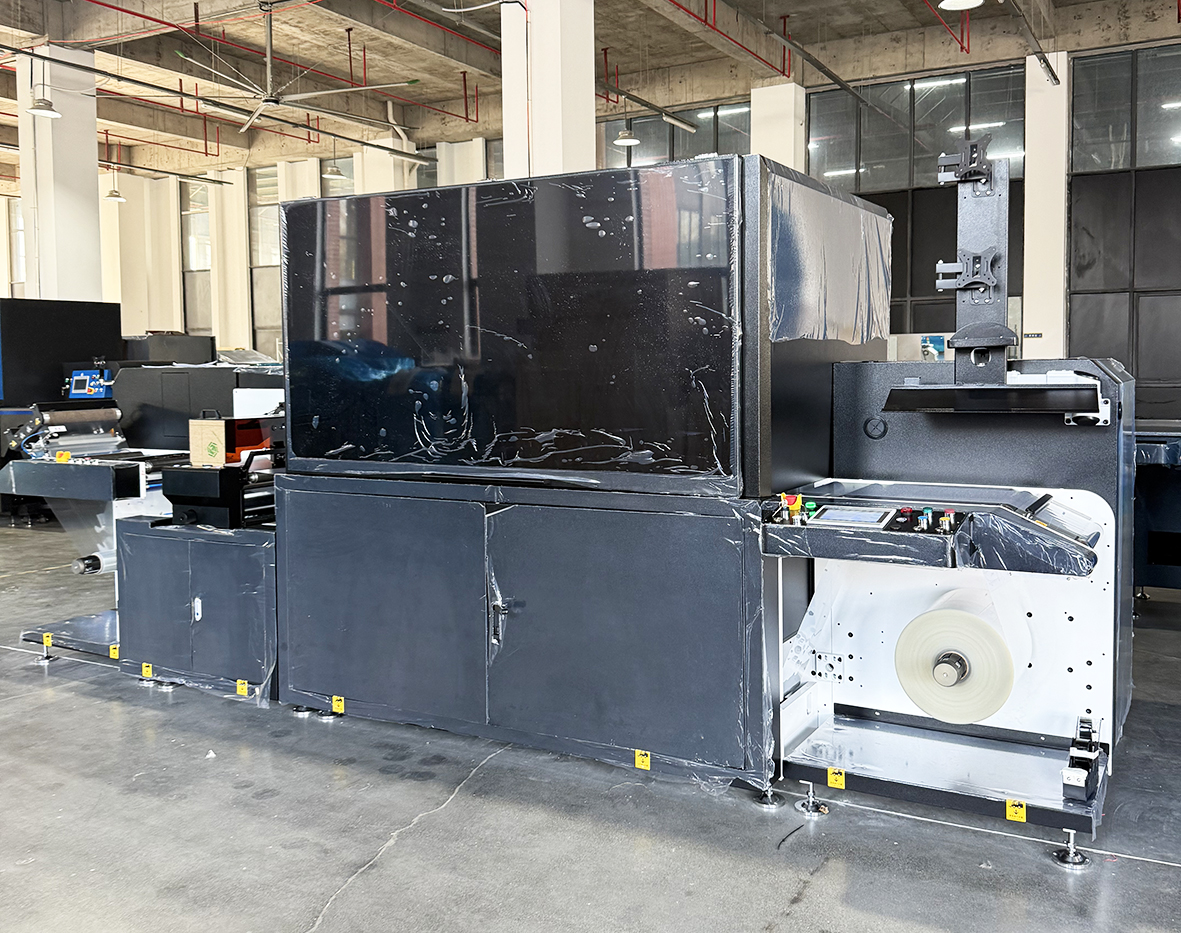
An OEM label converter based in Brazil and Italy ordered 20 units of GR350S for label printing and packaging production. After one year of operation, they reported stable operation with high printing consistency and a 30% reduction in production setup time. The machine’s ability to handle variable data and multi-SKU orders allowed them to offer faster turnaround to brand owners without increasing labor cost.
Frequently Asked Questions (FAQ)
What is a digital label printer?
A digital label printer is a printing machine that applies ink directly onto label material using digital data, without requiring physical printing plates. The GR350S uses UV inkjet technology to produce full-color labels on rolls of paper or film.
How does a digital label printer work?
It uses piezoelectric printheads (e.g., Epson S3200) to jet UV-curable ink droplets onto the substrate. The ink is instantly cured by UV lamps, allowing immediate rewinding and subsequent processing. Variable data is processed directly from a database without intermediate PDF conversion.
Why is digital label printing important?
It enables cost-effective short runs, fast job changes, variable data integration, and reduced waste—critical for modern supply chains that demand agility and personalization.
Who uses a digital label printer?
Label printing factories, packaging converters, cosmetic companies, food & beverage brands, pharmaceutical manufacturers, and logistics centers that need barcode/QR labels.
What problems does a digital label printer solve?
It solves high plate costs for small batches, long setup times, inability to print variable data, and high inventory of pre-printed labels. It also reduces waste and enables just-in-time label production.
How do I choose between digital and flexo?
If your average order quantity is low (<1,000 m), you have many SKUs, or you need variable data, choose digital. For extremely long runs (e.g., 10,000+ m per design with no data variation), flexo may still be more economical. The GR350S is optimized for the first scenario.
Common buyer concerns about digital label printers
- Print quality: Modern UV inkjet printers achieve 1200 dpi equivalent, matching flexo for most applications.
- Speed: The GR350S runs at 20–100 m/min, sufficient for mid-volume production.
- Durability: UV-cured inks are scratch-resistant and water-resistant; some applications require varnish for extra protection.
- Support & warranty: Grandoprint provides 1-year warranty, on-site commissioning, training, remote monitoring, and spare parts supply.
Conclusion
The decision between a digital label printer and a traditional flexo press hinges on your order profile. For buyers dealing with short runs, multi-SKU workflows, variable data, and fast turnarounds, the GR350S from Grandoprint offers a proven, certified, and scalable solution. With ISO 9001:2015, multiple patents, and a 20,000 m² factory capacity, Nanjing Grando Digital Technology Co., Ltd. delivers reliable equipment backed by global after-sales support.
To learn more, download the official product brochure below: