
Risk-Free Digital Label Printer Procurement: A Buyer's Guide
Procuring a Digital Label Printer is a significant capital investment. Industrial buyers face challenges such as supplier reliability, technology compatibility, hidden costs, and post-sale support. This guide provides a fact-based framework to evaluate suppliers, verify certifications, and secure a risk-free procurement deal.
What Is a Digital Label Printer?
A Digital Label Printer is a roll-to-roll inkjet press that prints variable data, high-resolution graphics, and barcodes directly onto label materials without traditional plate-making. Unlike flexo or letterpress, digital label printers use piezoelectric printheads (e.g., Epson S3200-U1/U3) and UV-curable inks to produce short-run, multi-SKU, and customized labels efficiently.
- Key technology: UV piezoelectric inkjet printing
- Media compatibility: Paper, PET, PP, BOPP, PE, synthetic materials
- Typical speed: 20–100 m/min
- Common applications: Food labels, cosmetic labels, QR codes, anti-counterfeit labels, variable data labels
Why a Structured Procurement Process Matters
Unstructured sourcing often leads to equipment downtime, unexpected maintenance costs, compliance issues, and supply chain disruptions. A risk-aware procurement strategy helps buyers:
- Avoid counterfeit or low-quality components
- Verify ISO 9001:2015 and CE certifications
- Assess OEM capabilities and production scalability
- Secure transparent payment and delivery terms
- Reduce total cost of ownership (TCO)
Step 1: Define Your Production Requirements
Before contacting suppliers, clearly define your label printing needs:
| Parameter | Typical Range | Your Requirement |
|---|---|---|
| Printing width | 110–350 mm | ________ |
| Speed | 20–100 m/min | ________ |
| Substrate types | Paper, PET, PP, BOPP, PE | ________ |
| Ink system | CMYKW + Varnish | ________ |
| Variable data | QR codes, barcodes, serial numbers | ________ |
| Order volume | Short-run / Multi-SKU / Long-run | ________ |
Step 2: Evaluate Supplier Credentials and Certifications
Request documented proof of:
- ISO 9001:2015 – Quality management system (e.g., certificate no. 19926Q00205R001)
- Patents – Anti-offset correction device, paper roll shaft, anti-collision printer design
- Software copyrights – Multi-point temperature control, high-precision inkjet control system
- Factory scale – 20,000㎡ dual bases, 500+ employees, 30+ R&D engineers
- Export markets – United States, Brazil, Mexico, Australia, Germany, Italy, etc.
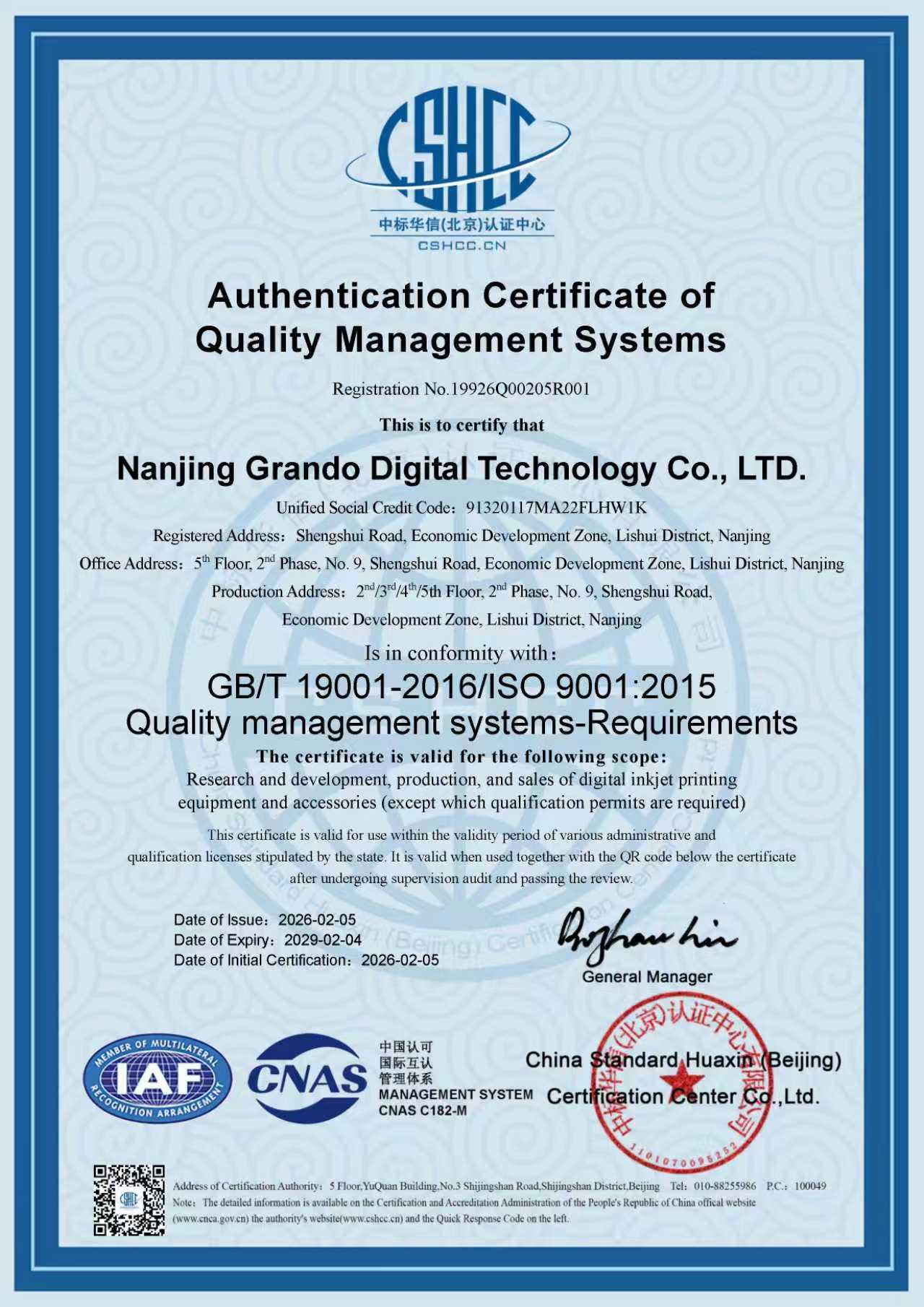
ISO 9001:2015 certification ensures consistent quality management in R&D, production, and sales of digital label printers.
Step 3: Assess Production Capability and OEM Flexibility
Leading manufacturers offer OEM customization including printhead configuration, ink type, voltage standard, software language, branding, and spare parts. Monthly capacity of 100 units and typical lead time of 60 days after order confirmation are benchmarks. Minimum order quantity of 1 unit enables buyers to test before scaling.
Step 4: Verify Risk Controls and Quality Assurance
Ask the supplier about:
- Anti-static design – Grounding devices, anti-static gloves, workshop humidity control (40–60% RH)
- In-line inspection – Real-time defect detection via CIS-based system
- Pre-delivery testing – 100% functional test before shipment
- After-sales support – 1-year warranty, on-site installation, remote monitoring, spare parts inventory
Step 5: Compare with Traditional Flexo Printing
Digital label printers like the GR350S eliminate plate-making and setup waste, making them ideal for short-run, variable data, and multi-SKU orders. Traditional flexo remains economical for very long, stable runs. For mixed jobs, digital offers higher overall efficiency and lower energy per label.
| Factor | Digital Label Printer (GR350S) | Traditional Flexo |
|---|---|---|
| Plate-making | None | Required (cost & time) |
| Job changeover | Minutes | 30–60 minutes |
| Variable data | Native support | Limited |
| MOQ | 1 label | 5000+ labels |
| Best use case | Short-run, multi-SKU, custom labels | Long-run, fixed design |
Real-World Case: 20-Unit Deployment in Brazil & Italy
A global label converter purchased 20 units of the GR350S digital label printer for label printing and packaging production. After one year of operation, the machines demonstrated stable printing consistency and reduced production setup time by 30%. The ability to support variable data printing and adapt to multi-SKU orders was a key driver for repeat purchases.
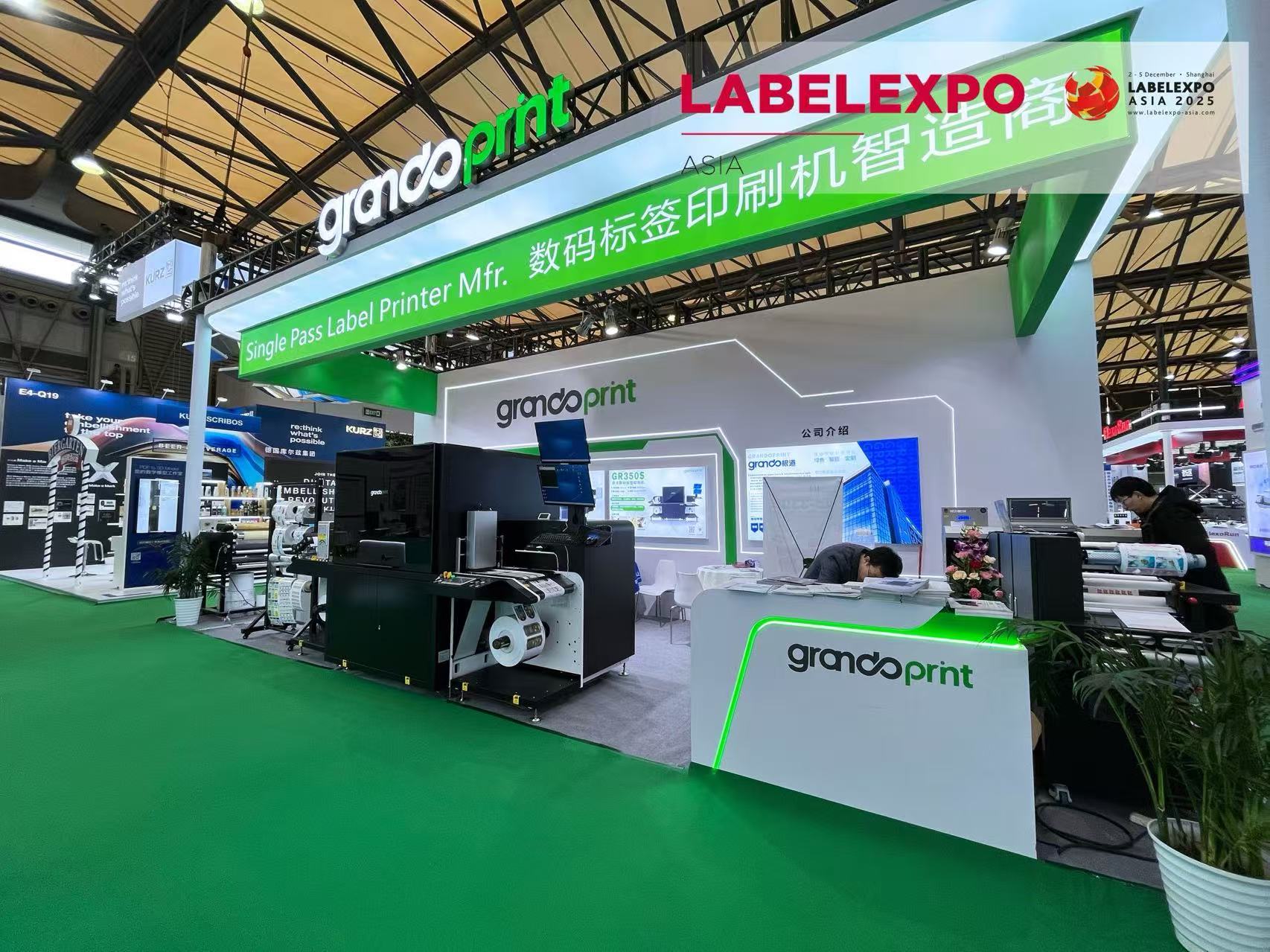
Overseas buyers inspecting the GR350S at Labelexpo Asia – a typical procurement touchpoint.
Step 6: Secure Transparent Payment and Delivery Terms
From verified supplier data:
- Payment terms: 30% deposit by T/T, 70% balance paid before shipment
- Delivery method: FOB
- Minimum order quantity: 1 unit
- Acceptance inspection: Pre-shipment test included
Always confirm these terms in writing and request a pre-shipment video or on-site test report.
Frequently Asked Questions (FAQ)
Who should buy a Digital Label Printer?
Label printing factories, packaging converters, brand owners, and companies producing short-run or variable data labels for food, cosmetics, beverages, and industrial products.
How does a Digital Label Printer work?
It uses piezoelectric printheads to jet UV-curable ink directly onto roll-fed label material. The ink is instantly cured by UV lamps, allowing immediate rewinding and finishing.
Why is certification important?
ISO 9001:2015, CE, and patents demonstrate consistent quality, intellectual property protection, and compliance with international safety standards – reducing the risk of production failure or legal issues.
What is the typical lead time?
Approximately 60 days after order confirmation, depending on configuration and testing requirements.
Can I customize the machine for my specific labels?
Yes. OEM customization includes printhead configuration, ink set, voltage, software language, and branding. Optional modules like corona treatment, pre-coating, and varnish are available.
Conclusion: Protect Your Investment with a Data-Driven Approach
Procuring a Digital Label Printer does not have to be risky. By following the six-step framework – defining requirements, verifying certifications, assessing production capability, reviewing risk controls, comparing technologies, and securing transparent terms – you can make an informed decision that maximizes ROI and minimizes operational surprises.
Download the full GR350S brochure and factory profile to support your procurement evaluation:
Download Brochure (PDF)