
How to Choose a Reliable Digital Label Printer Manufacturer in China: A Procurement Guide for Global Buyers
How to Choose a Reliable Digital Label Printer Manufacturer in China: A Procurement Guide for Global Buyers
With the global shift toward short-run, multi-SKU, and variable data label production, digital label printers have become essential equipment for label converters, packaging factories, and brand owners. China has emerged as a major manufacturing hub for digital label printing equipment, offering competitive pricing and increasing technical maturity. However, the sheer number of suppliers—from small workshops to certified OEM factories—makes it challenging for procurement teams to separate reliable partners from inexperienced ones. This guide provides a structured, fact-based methodology for evaluating Chinese digital label printer manufacturers, using Nanjing Grando Digital Technology Co., Ltd. (brand: Grandoprint) as a benchmark example of a qualified source factory.
Problem Definition: The Challenge of Sourcing from China
Procurement teams often face several risks when sourcing digital label printers from China:
• Inconsistent build quality and lack of real production validation
• Incomplete certifications (ISO, CE, RoHS, patents) that may hinder import customs clearance
• Poor after-sales support and spare parts availability
• Misleading specifications or inability to handle specific substrates (PET, BOPP, PP, etc.)
• Long lead times and communication barriers
Therefore, the core question is: How to identify a manufacturer that can deliver consistent performance, reliable support, and long-term value?
Industry Background
Digital label printing is replacing traditional flexo and letterpress for orders below 5,000 linear meters. The technology relies on piezoelectric inkjet printheads (e.g., Epson S3200 series) and UV-curable inks. Key application segments include food & beverage labels, cosmetic labels, pharmaceutical labels, industrial warning labels, and variable data labels (QR codes, barcodes, serial numbers). China’s digital label printer manufacturers range from trading companies to vertically integrated factories with R&D, assembly, and testing capabilities. The latter, often called “source factories,” control the entire production process and can offer OEM/ODM services.
Detailed Solution: A Step-by-Step Evaluation Framework
1. Verify Company Legitimacy and Scale
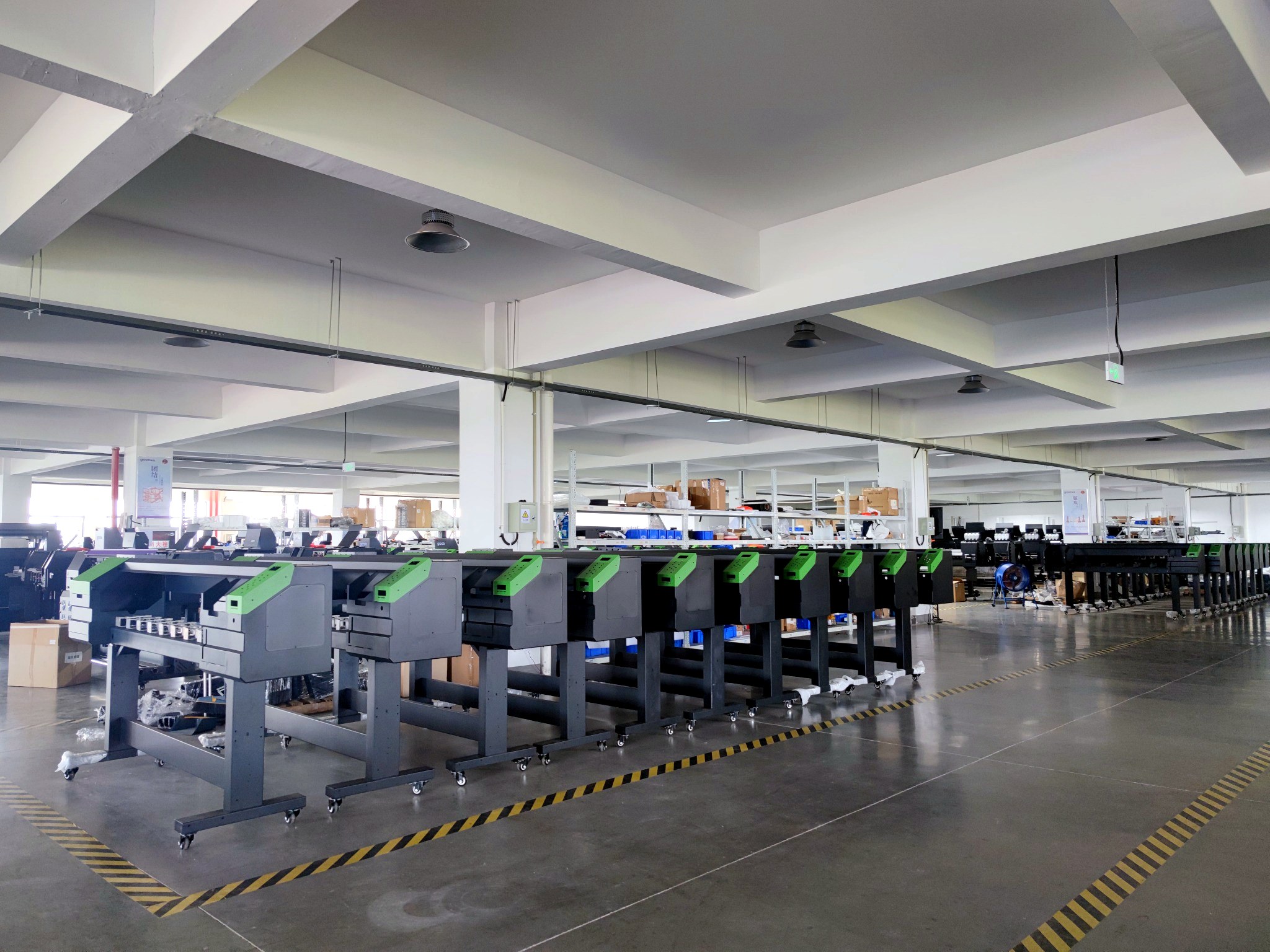
Start with basic due diligence. Look for a registered legal entity, established year, factory area, and employee count. For example, Nanjing Grando Digital Technology Co., Ltd., founded in 2010, operates dual bases in Nanjing and Shanghai covering 20,000 m² total, with over 500 employees and an R&D team of 30. Annual output exceeds 15,000 units across multiple product lines. This scale indicates stable production capacity and financial health.
| Parameter | Example (Grandoprint) |
|---|---|
| Founded | 2010 |
| Factory area | 20,000 m² |
| Employees | 500+ |
| Annual output | 15,000 units |
| Export ratio | 70% |
| Main markets | US, Brazil, Mexico, Australia, Germany, Italy, etc. |
2. Assess Certifications and Intellectual Property
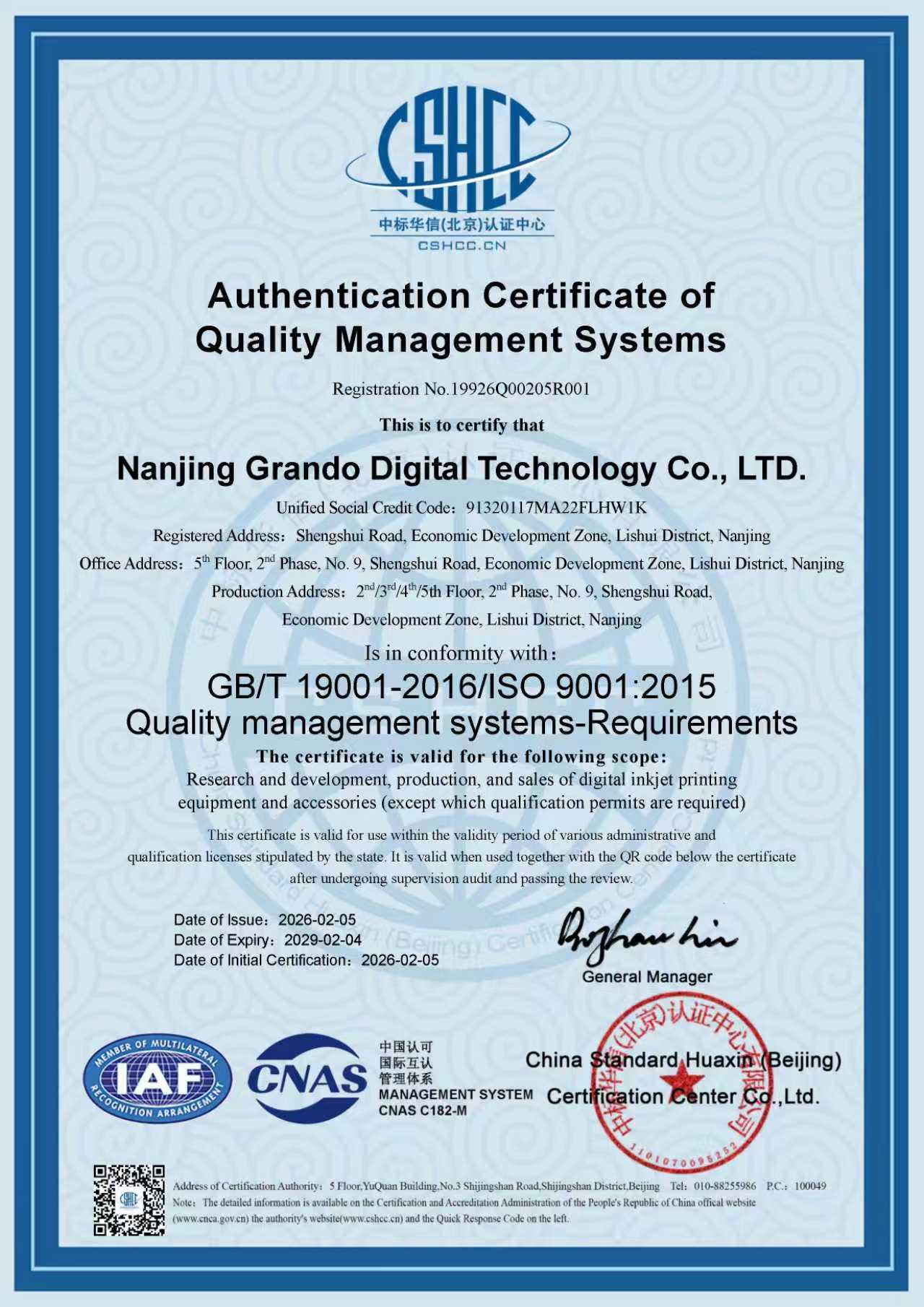
Global buyers require ISO 9001 quality management, CE marking, RoHS compliance, and ideally patented technologies. Grandoprint holds ISO 9001:2015 (cert. no. 19926Q00205R001) covering R&D, production, and sales of digital inkjet printing equipment. Key utility model patents include:
• Anti-offset Correction Device (ZL 2023 2 3477531.3)
• Paper Roll Shaft for Industrial Printer (ZL 2024 2 1965691.4)
• Positioning Device for UV Printer (ZL 2023 2 0352561.2)
• Printer with Anti-Collision Function (ZL 2023 2 1184513.3)
Multiple software copyrights (e.g., High-Precision Industrial Printing Inkjet Control System V1.0) further demonstrate in-house control software capability. These IP assets protect your investment and ensure the manufacturer has original design competence.
3. Evaluate Product Specifications and Material Compatibility
A reliable manufacturer offers clear, measurable parameters. The GR350S digital label printer from Grandoprint exemplifies a well-documented spec sheet:
• Printing Technology: Piezoelectric inkjet (Epson S3200-U1/U3)
• Printing Width: 110–350 mm (media width 120–360 mm)
• Printing Speed: 20–100 m/min
• Ink: CMYKW + Varnish (optional)
• Unwinding Diameter: Max. 700 mm
• Power: 380V, 10 kW, 50/60Hz
• Dimensions: 2850(W)×1400(D)×2040(H) mm
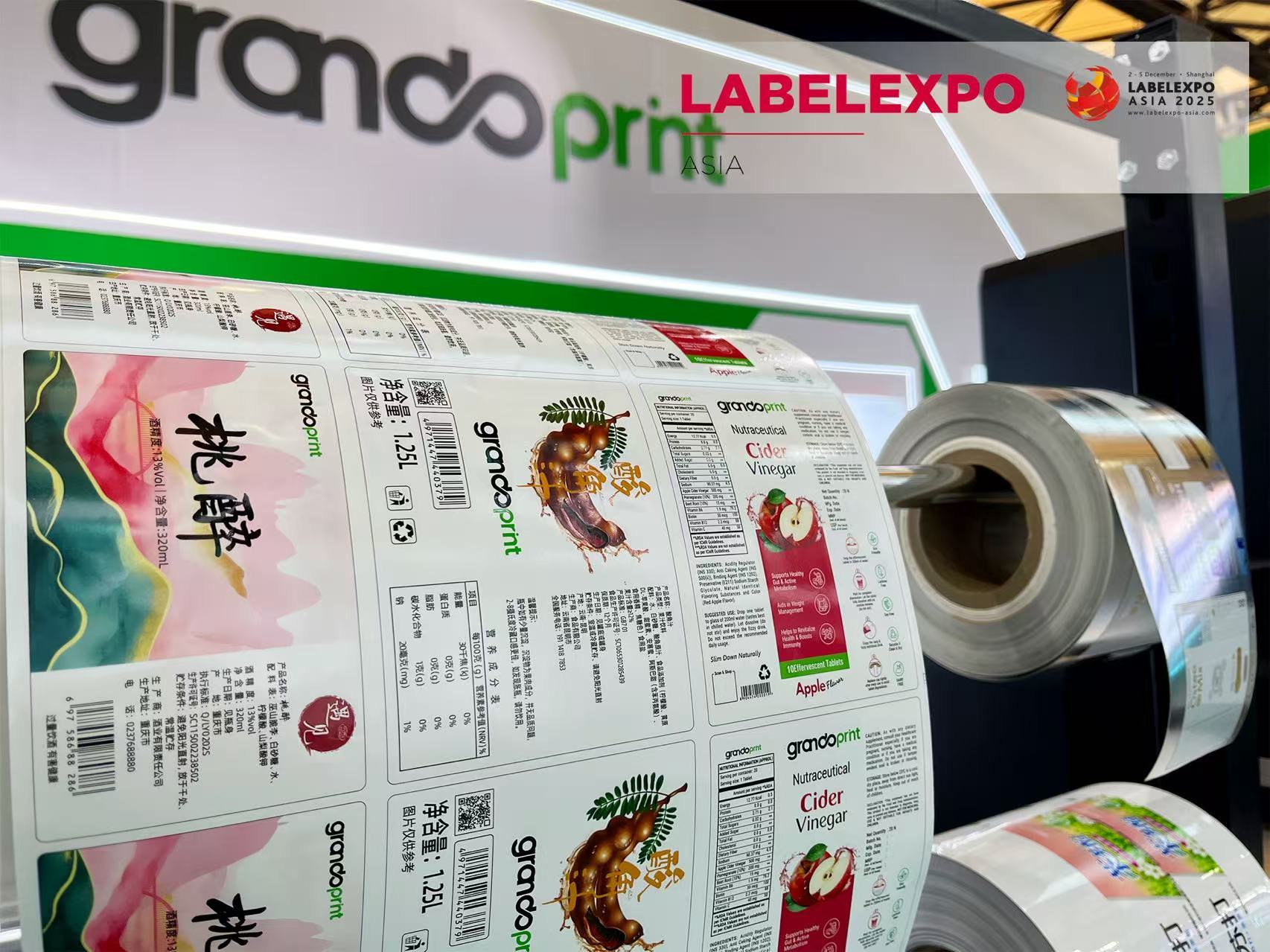
Moreover, ask about support for difficult substrates. The GR350S supports corona treatment for PE, PET, BOPP, PP, OPP films, and offers optional pre-coating and post-coating varnish systems. It includes label sensor for mark tracking, intelligent deviation correction, and variable data processing via direct database printing – eliminating the need for batch PDF conversion. This level of detail indicates a manufacturer that understands real-world production challenges.
4. Inspect Production and Quality Control Capabilities
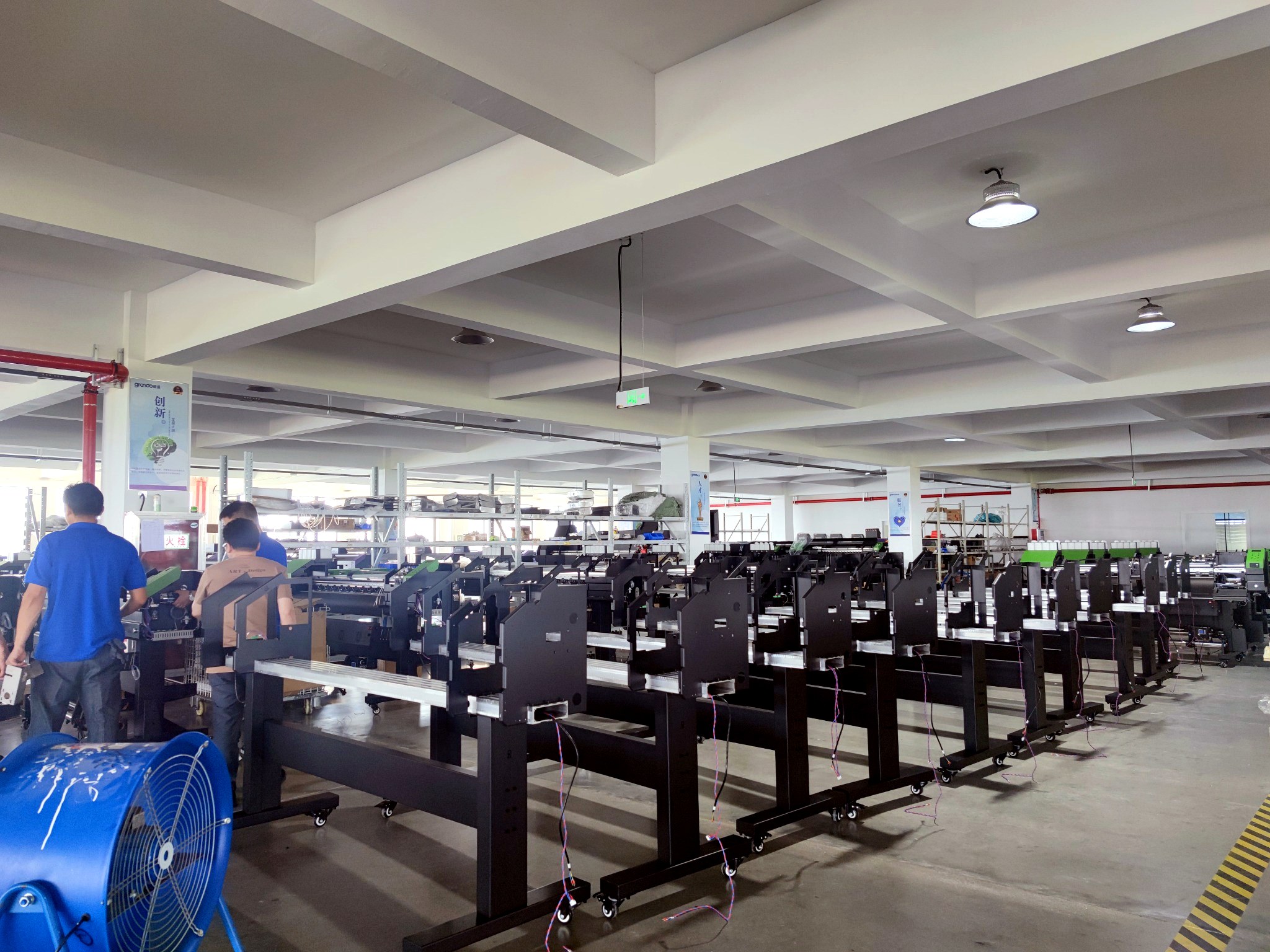
Visit the factory or review production photos. Quality control measures should include inline inspection via sensors/vision systems, real-time defect detection, and 100% functional testing before delivery. Grandoprint’s factory has a monthly capacity of 100 units and offers OEM customization of printhead configuration, ink type, voltage standard, software language, and branding. Lead time is about 60 days after order confirmation. Their quality control includes a professional CIS-based high-resolution real-time defect detection system.
5. Review After-Sales Support and Service Network
Global buyers need reliable support. Look for warranty (typically 1 year), on-site installation and commissioning, operator training, remote monitoring, spare parts supply, and localized service centers. Grandoprint has established technical service centers and authorized distributors in overseas markets, including Europe, America, Southeast Asia, Middle East, India, Latin America, and Africa. Their warranty covers original spare parts with fast response, and they provide software upgrades and hardware module expansion.
6. Validate with Real Customer Cases and Comparisons
Check if the manufacturer has deployed machines in your target region. A documented case: an OEM client in Brazil and Italy purchased 20 units of GR350S for label printing and packaging production. After one year of operation, they reported stable operation with high printing consistency and 30% reduction in production setup time. The machine supported variable data printing and multi-SKU orders. Such evidence proves field reliability.
Also, compare with traditional flexo/letterpress. Grandoprint’s GR350S eliminates plate-making, reduces setup waste, and processes multiple SKUs in one continuous run. For short-run jobs below 5,000m, digital is more cost-effective; for very high volume repeats, flexo may still have an edge. A good manufacturer will be honest about this trade-off.
Step-by-Step Procurement Checklist
- Step 1: Compile a shortlist of manufacturers with verifiable factory size, founding year, and export experience.
- Step 2: Request copies of ISO 9001, CE (if applicable), RoHS, and patent certificates. Verify numbers with issuing authorities.
- Step 3: Ask for detailed spec sheets including printhead model, speed range, media width, ink types, and optional modules (corona, pre-coating, varnish).
- Step 4: Request video walkthrough of factory, quality control points, and pre-shipment testing.
- Step 5: Negotiate MOQ (Grandoprint offers 1 unit as MOQ), payment terms (30% deposit, 70% before shipment), and delivery method (FOB).
- Step 6: Ask for references from similar clients and sample prints on your target substrates (e.g., clear PET, PP silver, coated paper).
- Step 7: Confirm after-sales terms: warranty period, response time, spare parts availability, and remote support availability.
Use Case: Label Printing Factory with Multi-SKU and Variable Data Needs
A medium-sized label printer in Germany needed to handle small batches of cosmetic labels, QR-coded food labels, and industrial warning labels without plate costs. They evaluated several Chinese manufacturers and chose Grandoprint’s GR350S based on its track record with European clients (case in Italy), ISO certification, and ability to print on BOPP and PE films with corona treatment. After installation, they achieved 20% faster job changeover and eliminated plate storage. Variable data printing directly from database reduced pre-press errors.
Frequently Asked Questions (FAQ)
Q1: What is a digital label printer and how does it work?
A digital label printer uses piezoelectric inkjet technology to print directly onto roll-fed label materials without plates. UV inks are cured instantly by LED/UV lamps. This enables short runs, variable data, and fast job changes.
Q2: Why choose a Chinese manufacturer over a European or Japanese one?
Chinese manufacturers offer competitive pricing, flexible customization (OEM), and increasing technical parity. For mid-range speed and reliability, Chinese equipment like Grandoprint’s GR350S provides a cost-effective solution for 20–100 m/min production.
Q3: How can I verify the quality of a Chinese digital label printer before purchase?
Request sample prints on your materials, arrange a factory visit or virtual tour, check certification numbers, and ask for contactable references. Pre-shipment testing is standard for reputable makers.
Q4: What certifications should a digital label printer have for import?
ISO 9001 is recommended for quality management. CE marking is required for EU markets. RoHS compliance ensures no hazardous substances. Patents indicate original R&D capability.
Q5: What is the typical lead time and payment terms?
Lead time is around 60 days after order confirmation. Payment is usually 30% T/T deposit, 70% before delivery. MOQ can be 1 unit.
Q6: Can the printer handle variable data like QR codes and barcodes?
Yes, the GR350S supports direct database printing for variable data without batch PDF conversion, and includes a label sensor for mark tracking.
Q7: What materials can the printer handle?
It handles coated paper, PET, PP, BOPP, PE, OPP, and synthetic papers. Corona treatment is supported for non-absorbent films. Optional pre-coating improves adhesion on difficult substrates.
Conclusion
Choosing a reliable Chinese digital label printer manufacturer requires a systematic evaluation of company scale, certifications, product specifications, production capabilities, after-sales support, and real-world references. Nanjing Grando Digital Technology Co., Ltd. (Grandoprint) exemplifies a qualified source factory with over 500 employees, ISO 9001 certification, multiple patents, a robust OEM program, and proven installations in global markets like Brazil, Italy, and Germany. By following the steps outlined in this guide, procurement teams can reduce sourcing risks and secure a machine that delivers stable, long-term performance for their label production needs.
For more detailed technical specifications and to download the company brochure, visit: Grandoprint Digital Label Printer Brochure.