
After-Sales Support and Maintenance Cost Control for Sintered Stone Slab Procurement
After-Sales Support and Maintenance Cost Control for Sintered Stone Slab Procurement
For global buyers sourcing sintered stone slabs for high-traffic kitchens, hotel lobbies, or exterior facades, two questions consistently dominate procurement decisions: "How will the supplier support me after the sale?" and "How can I keep long-term maintenance costs under control?" This article provides a practical framework for evaluating a supplier's after-sales infrastructure, warranty terms, and quality control systems that directly impact your total cost of ownership.

What Is After-Sales Support for Sintered Stone Slabs?
After-sales support for sintered stone slabs encompasses all services provided by the manufacturer or supplier after the product has been delivered and installed. It includes warranty coverage, technical troubleshooting, replacement parts, on-site inspection, and training. A robust after-sales program not only protects your investment but also reduces lifecycle costs by minimizing unscheduled repairs and material waste.
How After-Sales Support Works: A Step-by-Step Breakdown
A reliable supplier like Monalisa Group (founded 1992, 4 production bases, 37 production lines) structures its after-sales process into clear stages:
- Warranty Service: Product warranty of 5–15 years depending on series and project type, covering manufacturing defects (color difference, dimensional deviation, glaze cracks).
- Technical Guidance: Free consultation on tiling layout design, installation techniques, and substrate preparation.
- On-site Support: Technical representative available for large projects to supervise installation or troubleshoot issues on site.
- Complaint Handling: Response within 24 hours, solution (replacement, return, or compensation) provided within 7 working days.
- Stock Reserve Service: Same-batch tiles kept in stock for 2 years for future replenishment or repair replacements.
- Training Service: Online/offline training for distributors and installation teams on product knowledge, fitting standards, and maintenance.
- After-Sales Documentation: Product test reports, certificate of conformity, installation guide, and maintenance guide available in Chinese and English.
Why After-Sales Support Matters for Your Total Cost of Ownership
Without proper after-sales coverage, a single color mismatch or dimensional defect can lead to costly rework, project delays, and lost revenue. According to industry data, sintered stone slabs with a reliable after-sales framework can reduce life-cycle maintenance cost by up to 30% compared to suppliers with minimal support. This is especially critical for large-format slabs (e.g., 900x2700mm or 1200x2700mm) where replacement involves significant labor and material costs.
Who Uses After-Sales Support?
- Commercial project contractors – hotels, airports, shopping malls that require guaranteed performance over 10+ years.
- Kitchen and bathroom fabricators – need rapid replacement of damaged countertops or vanities.
- Distributors and importers – require stock reserve and training for local installers.
- Government and institutional buyers – demand formal warranty and compliance documentation.
Common Buyer Concerns: Risk Mitigation Through Supplier Selection
Procurement professionals worry about color variation, dimensional deviation, flatness issues, insufficient strength, slip resistance failure, stain resistance failure, freeze-thaw damage, and excessive radioactivity. A qualified supplier addresses these through:
- Automatic color sorting machines + spectrometer online inspection to ensure batch color consistency.
- High-precision molds (tolerance ≤±0.1mm) with laser rangefinders.
- Press pressure compensation and kiln roller leveling for flatness.
- Raw material formulation optimization (increased kaolin content) for strength.
- Surface design with special dry grains or textured molds for slip resistance (R10+).
- High-density transparent frit on glaze for stain resistance (Grade 5).
- Water absorption limitation (≤0.08%) for freeze-thaw resistance.
- Raw material screening for radioactivity compliance (Class A).
Technical Controls That Reduce Maintenance Costs
| Risk | Control Measure | Impact on Maintenance Cost |
|---|---|---|
| Color variation | Automatic color sorting + spectrometer | Eliminates costly reinstallation from mismatch |
| Dimensional deviation | High-precision molds (≤±0.1mm) | Reduces joint filling material and labor |
| Flatness | 100% flatness scanner after kiln | Prevents water pooling and cleaning issues |
| Insufficient strength | Batch sampling for breaking strength (≥45 MPa) | Lowers breakage rate (<0.3%) |
| Slip resistance | Wet BPN ≥50 or R10+ | Reduces liability and replacement in wet areas |
| Stain resistance | High-density frit + Grade 5 validation | Simplifies daily cleaning – no waxing or sealing |
| Freeze-thaw damage | Water absorption ≤0.08% | Eliminates cracking in outdoor cold climates |
| Radioactivity | Raw material screening | Meets health standards, avoids project rejection |
Quality Assurance and Certification: Proof of Reliability
Monalisa operates a comprehensive quality management system certified under ISO 9001, ISO 14001, and ISO 45001, supported by a full-process inspection system with 18 quality control points. The company's in-house CNAS-accredited laboratory conducts standard tests including dimensions, water absorption, breaking strength, abrasion, slip resistance, stain resistance, freeze-thaw, and radioactivity. Specific quality assurance procedures include:
- Batch sampling for breaking strength tests
- 100% flatness inspection via scanner after the kiln
- Batch stain resistance validation tests
- Each tile laser-marked or RFID-coded for full traceability
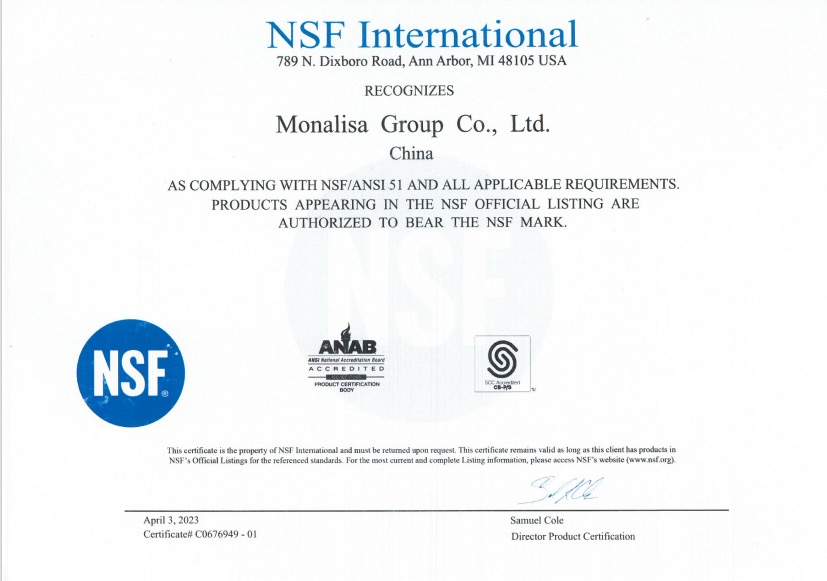
Certifications such as NSF (Cert. No. C0676949-01) and CE (Cert. No. CY25A10378) further confirm that products meet international food-contact safety and performance standards, giving buyers confidence for kitchen countertops and bathroom vanities.
How to Select a Supplier with Strong After-Sales Support
When evaluating potential suppliers, consider these tangible criteria:
- Warranty terms: Look for manufacturers offering a minimum 5-year warranty on structural defects, with clear conditions for what is covered.
- Response time: A 24-hour response commitment indicates a mature service organization.
- Stock reserve policy: Suppliers that keep same-batch inventory for 2+ years help you avoid color mismatch when expanding projects later.
- Training programs: Bilingual training for distributors and installation teams reduces installation errors.
- Certification portfolio: ISO, NSF, CE, and GreenGuard demonstrate a systematic quality culture.
- Contingency plans: Predefined emergency response for batch color variation or strength fluctuations (production halt, raw material quarantine, batch re-inspection) shows proactive risk management.
Use Case: Large Airport Project with Minimal Maintenance
In a recent project supplying 80,000 m² of large-format porcelain tiles for Yogyakarta Airport, Indonesia, Monalisa's after-sales framework delivered a 30% lower life-cycle maintenance cost and a breakage rate of less than 0.3%. The combination of tight-joint installation (saving 15% on grouting materials) and on-site technical support ensured consistent quality. This demonstrates how supplier support directly translates into measurable cost savings.
Frequently Asked Questions
Q: What is the typical warranty period for sintered stone slabs?
A: Leading suppliers like Monalisa offer 5–15 years depending on the product series and project type. Always request written warranty terms covering manufacturing defects, color stability, and structural integrity.
Q: How can I minimize maintenance costs for sintered stone slabs in commercial projects?
A: Choose slabs with high stain resistance (Grade 5), ultra-low water absorption (≤0.08%), and high surface hardness (Mohs ≥7). These properties eliminate the need for waxing, sealing, or special cleaning agents, reducing routine maintenance cost by up to 40%.
Q: What happens if a slab cracks or chips after installation?
A: A reliable supplier will have a clear replacement policy. With Monalisa, complaints are acknowledged within 24 hours and a resolution (replacement, return, or compensation) provided within 7 working days. Their 2-year stock reserve service ensures matching batches are available for repair.
Q: How do I verify a supplier's after-sales capability before placing an order?
A: Request their after-sales documentation, including warranty certificates, test reports, and training materials. Inquire about their complaint handling process, stock reserve policy, and whether they offer on-site technical support for large projects.
Q: Are sintered stone slabs difficult to install? Does the supplier provide training?
A: Large-format slabs (e.g., 900x2700mm, 1200x2700mm) require specific handling and installation techniques. Reputable suppliers offer online or on-site training for installers. Monalisa provides both online and offline training sessions covering cutting, leveling, and grouting best practices.
Conclusion: Prioritize After-Sales Support in Your Procurement Strategy
When procuring sintered stone slabs, the initial unit price is only one factor in total cost. After-sales support directly impacts your project's long-term profitability through reduced maintenance, faster problem resolution, and lower replacement costs. By evaluating a supplier's warranty terms, quality certifications (ISO, NSF, CE), risk control measures, and training capabilities, you can select a partner who will protect your investment for years to come.
For a detailed look at Monalisa's quality management system and after-sales programs, download the company brochure below.