
Sintered Stone Slab Procurement: A Risk Mitigation Guide

Monalisa Group Co., Ltd., Foshan Headquarters – a leading manufacturer of sintered stone slabs.
Sintered Stone Slab Procurement: A Risk Mitigation Guide for Global Buyers
Procuring sintered stone slab for large-scale projects demands more than comparing prices. Buyers face hidden risks: inconsistent color batches, dimensional deviations, weak mechanical performance, and non-compliant certifications that can derail timelines and budgets. This guide provides a structured framework to evaluate suppliers, verify technical claims, and secure reliable sintered stone slabs for kitchen countertops, bathroom vanities, wall cladding, and exterior facades.
What Is a Sintered Stone Slab?
A sintered stone slab is a large-format, high-density ceramic panel produced by pressing natural minerals (clay, quartz sand, feldspar) under ultra-high pressure (up to 48,000 kN) and firing at temperatures exceeding 1200°C. The result is a non-porous, extremely durable material with scratch resistance, heat resistance, stain resistance, and near-zero water absorption (≤0.08%). It is used for kitchen countertops, bathroom vanity tops, wall cladding, flooring, and exterior facade panels.
Why Efficient Procurement Matters
In 2026, the global demand for sintered stone slabs is driven by their superior performance over natural stone and conventional tiles. However, procurement complexity arises from:
- Technical benchmarks – water absorption, breaking strength, Mohs hardness, and slip resistance vary significantly between manufacturers.
- Certification requirements – projects often mandate NSF certified sintered stone slab, CE certified sintered stone panels, or fireproof and eco friendly declarations.
- Supply chain risks – color variation, dimensional tolerances, and lead time failures.
Buyers who neglect these factors face 20–35% higher life-cycle costs due to early replacement and installation rework. Efficient procurement minimizes these risks.
How Sintered Stone Slabs Work – The Technical Foundation
A sintered stone slab is produced through a fully automated process: raw material batching → wet ball milling → spray drying → high-pressure pressing → drying → inkjet decoration → glazing → high-temperature firing → polishing/calibrating → quality inspection. Key characteristics include:
| Property | Typical Value | Benefit |
|---|---|---|
| Water absorption | ≤0.08% | Waterproof sintered stone slabs – prevents staining and freeze-thaw damage |
| Breaking strength | ≥45 MPa | High impact resistance for flooring sintered stone slabs |
| Mohs hardness | ≥7 | Scratch resistant sintered stone – withstands daily abrasion |
| Stain resistance | Grade 5 | Stain resistant sintered stone – easy to clean |
| Freeze-thaw cycles | 150 cycles no cracking | Suitable for exterior facade sintered stone panels in cold climates |
Who Uses Sintered Stone Slabs?
Key verticals include:
- Residential – kitchen countertop sintered stone slab, bathroom vanity sintered stone slab
- Commercial – wall cladding sintered stone slab in hotels, offices
- Public infrastructure – airports, metro stations
- Exterior – exterior facade sintered stone panels for high-rise curtain walls
Problems Solved by Proper Supplier Selection
Buyer concerns include:
- Color variation risk – solution: automatic color sorting + batch stock reserve (e.g., 2-year stock reserve).
- Dimensional deviation – high-precision molds (tolerance ≤±0.1 mm).
- Insufficient strength – optimized raw material formulation + pressing pressure ≥48 MPa.
- Certification non-compliance – verify NSF certified sintered stone slab and CE certified sintered stone panels.
Step-by-Step Procurement Framework
Step 1: Define Technical Specifications
List required properties: water absorption (≤0.08%), Mohs hardness (≥7), stain resistance (Grade 5), slip resistance (R10+ for wet areas). For heat resistant sintered stone slab, confirm thermal shock resistance. For UV resistant sintered stone panels, request UV stability test data.
Step 2: Screen Suppliers by Technical Capability
Look for manufacturers with:
- Annual output >50 million m² – indicates scale and experience.
- Modern production bases – e.g., 37 production lines across four bases.
- Large format sintered stone slabs availability (900×2700 mm, 1200×2700 mm).
Step 3: Verify Certifications
Request copies of:
- NSF certified sintered stone slab – certificate number C0676949-01 (NSF/ANSI 51).
- CE certified sintered stone panels – certificate CY25A10378 per EN 14411:2016.
- ISO 9001, ISO 14001, ISO 45001 management certifications.
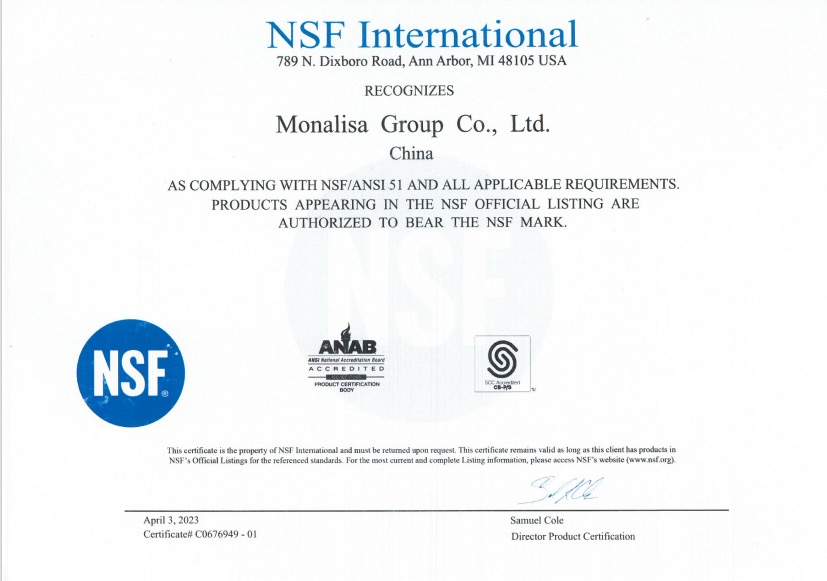
NSF certification (C0676949-01) validates food contact safety for kitchen countertop applications.
Step 4: Request Samples and Conduct Acceptance Inspection
Use the supplier’s acceptance inspection protocol:
- Packaging and labeling check – ensure correct shade, size, quantity.
- Carton opening verification – compare color/pattern against master sample.
- Rapid dimensional and flatness check – measure at least 10 pieces per batch.
Step 5: Evaluate Production Scale and Quality Control
Visit or request video tour of factories. Monalisa Group operates four modern production bases (Xiqiao, Qingyuan, Tengxian, Gao’an) with 37 lines. Their in-house CNAS-accredited lab performs all standard tests. 18 quality control points from raw material to final packaging ensure traceability (tiles laser-marked with batch ID).
Step 6: Negotiate Commercial Terms
Standard terms include:
- Minimum order quantity: 2,000 square meters (common for ultra thin sintered stone slab and large formats).
- Delivery methods: FOB, CIF, EXW.
- Payment methods: Telegraphic Transfer (T/T) and Letter of Credit (L/C).
These terms apply to products 3352 (luxury slab 900×2700×12 mm, glazed-matt), 3220 (homogeneous body tile 1200×2700×12 mm), and 3516 (classic stone 800×800×10 mm). For bulk orders, negotiate batch stock reserve (2-year retention).
Case Study: Large-Scale Government Project in Sri Lanka
Client: National government of Sri Lanka (Urban Development Authority, with Korea International Cooperation Agency).
Application: 80,000 m² of floor and wall coverings in convention halls, banquet spaces, VIP corridors, outdoor connectors, and roof terraces.
Product used: Luxury Slab (model 90-270FDK09003M/09008M) – 900×2700×12 mm, glazed-matt.
Result: Single delivery of 80,000 m² demonstrated mass supply capability. The 900×1800 mm format reduced visible joints by ~50%. Ultra-low water absorption (≤0.08%) ensured weather resistance under monsoon rains. On-site technical support helped local contractors install large-format panels correctly.
Highlight: 30% lower life-cycle maintenance cost vs. conventional stone; 15% savings on grouting materials; breakage rate <0.3%.

Waterproof sintered stone slabs from Monalisa used in the Sri Lanka convention center project.
Real-World Performance vs. Conventional Tiles
| Parameter | Monalisa Sintered Stone Slab | Conventional Ceramic Tile | Improvement |
|---|---|---|---|
| Water absorption | ≤0.08% | 0.5% – 3% | 80–95% reduction |
| Breaking strength | ≥45 MPa | ≥35 MPa | ≥28% higher |
| Wear volume | ≤140 mm³ | ≤540 mm³ | ≥74% less |
| Freeze-thaw cycles | 150 cycles no crack | 50–100 cycles | 50–200% longer life |
| Flatness tolerance | ≤±0.15% | ≤±0.5% | 70% improvement |
Although sintered stone slab unit price is 15–30% higher, total life-cycle cost is 20–35% lower due to extended service life (2–3 times) and reduced maintenance.
How to Choose the Right Aesthetic
Suppliers offer a wide range of visuals:
- Marble look sintered stone slab – Calacatta, Statuario, Carrara.
- Concrete look sintered stone – industrial minimalism.
- Terrazzo sintered stone slab – vibrant patterns.
- Wood look – natural grain effect.
Monalisa’s inkjet printing + adhesive dry grain process achieves 98% realism compared to natural stone.
Frequently Asked Questions
What is the minimum order quantity for sintered stone slabs?
The standard minimum order quantity is 2,000 square meters for products 3352, 3220, and 3516.
What payment methods are accepted?
Telegraphic Transfer (T/T) and Letter of Credit (L/C).
How are products delivered?
FOB, CIF, or EXW terms are available.
How can I verify product quality before shipment?
Acceptance inspection includes packaging/labeling checks, carton opening verification, and rapid dimensional/flatness measurements.
Does the supplier have NSF and CE certifications?
Yes. NSF certificate C0676949-01 (NSF/ANSI 51) and CE certificate CY25A10378 (EN 14411:2016) are held for applicable products.
Can I get a sample before ordering?
Yes, Monalisa can provide samples upon request. Contact Joanna at joanna_wang@fs-monalisatiles.com or +86 18605191548 (WhatsApp).
Conclusion
Efficient procurement of sintered stone slab requires a systematic approach: define technical specs, verify certifications, assess production scale, inspect samples, and negotiate clear commercial terms. By partnering with a manufacturer that demonstrates proven scale (37 production lines, annual output >100 million m²), robust quality control (18 inspection points, CNAS lab), and real-world case references (80,000 m² government project), buyers can minimize risk and achieve optimal life-cycle value. To start your procurement process, download the company brochure for detailed product specifications and certifications.
For personalized consultation, contact: Joanna – joanna_wang@fs-monalisatiles.com | Tel/WhatsApp: +86 18605191548.